Besides the Resolv Hack, This Type of DeFi Vulnerability Has Occurred Four Times Already

marsbitОпубліковано о 2026-03-24Востаннє оновлено о 2026-03-24

Анотація

An attacker exploited a compromised off-chain signing key in the stablecoin protocol Resolv, minting 80 million USR tokens (pegged to USD) from a $100k–$200k USDC deposit within minutes. The stolen keys allowed unlimited minting due to a design flaw—lacking a minting cap—despite multiple audits. The attacker then converted USR to its wrapped version (wstUSR) and dumped it on DEXs, netting ~11,400 ETH (~$24M). This caused USR to depeg, trading at ~$0.25. The depeg triggered a second-phase crisis: lending markets (including Morpho and Fluid/Instadapp) using wstUSR as collateral relied on hardcoded oracles that priced it near $1 instead of its real market value. Arbitrageurs bought cheap wstUSR, used it as overvalued collateral to borrow stablecoins, and amplified losses. Fluid absorbed over $10M in bad debt; Morpho had 15 vaults exposed. This incident repeats a known DeFi pattern: similar oracle failures occurred with Usual Protocol (Jan 2025), Stream Finance (Nov 2025), and Moonwell (late 2025), where mispriced collateral led to massive bad debt. Critics highlight flawed incentives in the "curator" model (e.g., Gauntlet), where third-party vault managers prioritize high yields without adequate risk controls, and protocols outsource risk management without enforcing safeguards. The root cause is systemic: over-reliance on static oracles for volatile assets and insecure off-chain infrastructure.

On a quiet Sunday morning, someone turned $100,000 into $25 million in about 17 minutes.

The target was the yield-bearing stablecoin protocol Resolv. Before Resolv paused its contracts, its dollar-pegged stablecoin, USR, had fallen to a few cents. As of this writing, USR remains severely depegged, trading at around $0.25, down more than 70% this week.

The shockwaves extended far beyond Resolv itself. Fluid/Instadapp absorbed over $10 million in bad debt in a single day, experiencing a net outflow of over $300 million on the same day, a record single-day outflow in its history. 15 Morpho vaults were affected. Euler, Venus, Lista DAO, and Inverse Finance all subsequently suspended USR-related markets.
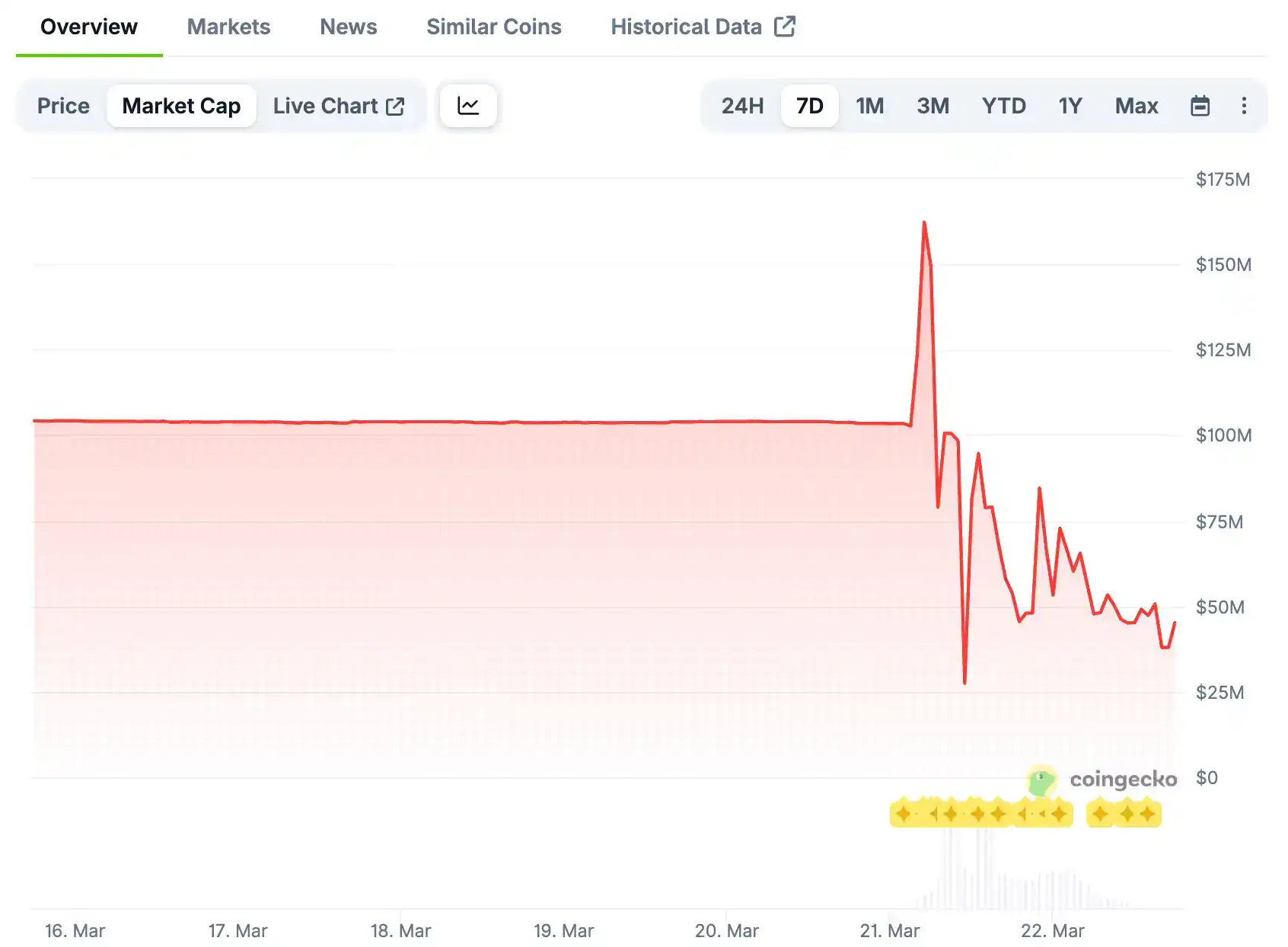
The mechanism that allowed this vulnerability's losses to spread—pricing a depegged stablecoin at $1 in lending markets—is not new. This has happened at least four times in the past 14 months.

How the Vulnerability Worked

USR minting followed a two-step off-chain process: Users deposited USDC via the `requestSwap` function, and a privileged off-chain signing key, `SERVICE_ROLE`, would then finalize the amount of USR to be issued via `completeSwap`.

The contract had a minimum output limit but no maximum limit. The contract executed whatever the key holder signed.

The attacker gained access to this key through Resolv's AWS Key Management Service. They submitted two USDC deposits totaling approximately $100,000 to $200,000, then used the stolen key to authorize the minting of 80 million USR in return. On-chain data shows two transactions of 50 million USR and 30 million USR, both completed within minutes.

"The Resolv USR exploit wasn't a bug—it was a feature operating as designed. That's the problem," said on-chain analyst Vadim (@zacodil).

The SERVICE_ROLE was a regular external owned address (EOA), not a multi-signature wallet. The admin key had multi-sig protection, but the minting key did not.

"Resolv underwent 18 audits," Vadim said, "One of the findings was literally named 'Missing Cap'."

The attacker exited: They first converted the minted USR to wstUSR (a staked wrapped version) to slow the market impact, then swapped it for ETH via Curve, Uniswap, and KyberSwap. The attacker's wallet holds approximately 11,400 ETH (around $24 million). The underlying ETH and BTC collateral pools supporting the entire system remained intact as the stablecoin collapsed.

How the Contagion Spread

The Resolv exploit was effectively two events stacked on top of each other. The first was the minting exploit, the second was the failure of connected lending markets.

When USR and wstUSR crashed, every lending market that accepted them as collateral faced the same problem: their oracles were still pricing wstUSR at close to $1.

Omer Goldberg, founder of risk analysis firm Chaos Labs, documented this mechanism. His key finding: "The oracle was hardcoded, so it never repriced. wstUSR was marked at $1.13, while trading on secondary markets for around $0.63."

Traders bought wstUSR cheaply on the open market, then used it as collateral on Morpho or Fluid at the oracle price of $1.13, borrowing USDC against it and walking away.

At Fluid, the team secured short-term loans to cover 100% of the bad debt and promised to make every user whole. At Morpho, co-founder Paul Frambot stated that about 15 vaults had significant exposure, all in high-risk, long-tail collateral strategies.

Prominent curator Gauntlet stated that "a few high-yield vaults had limited exposure."

But D2 Finance directly countered this, publishing on-chain data showing Gauntlet's flagship "USDC Core Vault" had allocated $4.95 million to the wstUSR/USDC market. Goldberg later stated that Gauntlet vaults constituted 98% of the lender liquidity in that market.

Frambot said in a written response to The Defiant: "We are constantly working on how to present various risks more comprehensively. However, we don't believe the core issue here is a lack of labeling."

Frambot added: "Morpho is oracle-agnostic, meaning it allows curators to choose any oracle they deem most suitable for a specific market. Morpho is open, permissionless infrastructure designed to outsource risk management to curators."

"It's difficult to enforce objectively 'correct' guardrails in all scenarios," Frambot said, "Imposing constraints at the protocol level also risks hindering legitimate strategies."

While the underlying protocol leaves risk management to curators, some in the industry believe the curators are not fulfilling their duty.

"I believe the curator industry is flawed by design because there is no real curation happening," Marc Zeller said on X.

At the time of publication, Resolv, Gauntlet, and Fluid had not responded to The Defiant's requests for comment.

A Recurring Failure Pattern

This is not a new type of attack. In January 2025, Usual Protocol's USD0++ was hardcoded at $1 by curator MEV Capital in a Morpho vault.

Usual then abruptly adjusted its redemption floor price to $0.87 without warning, locking lenders into the MEV Capital vault, whose utilization rate soared to 100%.

In November 2025, Stream Finance's xUSD collapsed after curators had routed USDC deposits into leverage loops backed by the synthetic stablecoin. When its oracle refused to update, an estimated $285 million to $700 million in assets were at risk on Morpho, Euler, and Silo.

Moonwell suffered two consecutive oracle failures in October and November 2025, resulting in over $5 million in bad debt combined.

What This Means for the Curator Model

Morpho's architecture outsources all risk decisions to third-party "curators," who build vaults, select collateral, set loan-to-value ratios, and choose oracles. The theory is that professional firms have deeper expertise, and competition leads to better risk management, with the protocol enforcing the rules.

But curators earn fees based on the yield generated, creating an incentive to accept higher-risk, higher-yielding collateral (like yield-bearing stablecoins). The problem is that when these stablecoins depeg, the losses are borne by the depositors, not the curators.

In the Resolv incident, some curators' automated bots continued pumping funds into the affected vaults for hours after the exploit, deepening the losses.

The reason for using hardcoded oracles for yield-bearing stablecoins is to prevent unnecessary liquidations triggered by short-term volatility. But this protection only works if the stablecoin remains stable.

On-chain analytics firm Chainalysis stated in a post-mortem that real-time on-chain detection capabilities are needed.

"The on-chain smart contracts were functioning perfectly. The issue clearly lay with the broader system design and off-chain infrastructure," the analytics firm said.


Трендові криптовалюти

Пов'язані питання

QWhat was the core mechanism that allowed the Resolv exploit to cause widespread contagion across multiple DeFi lending markets?

AThe core mechanism was that the oracles in the lending markets continued to price the depegged stablecoin, wstUSR, at or near its intended $1 peg value, even after it had collapsed in value on the open market. This allowed attackers to buy the cheap stablecoin and use it as overvalued collateral to borrow other assets.

QHow did the attacker initially obtain the ability to mint a massive amount of USR tokens?

AThe attacker gained access to the `SERVICE_ROLE` signing key, which was an external private key (not a multi-sig) used to authorize the `completeSwap` function. This access was obtained through a compromise of Resolv's AWS Key Management Service.

QAccording to the article, this type of vulnerability has occurred at least four times in the past 14 months. Name one other protocols mentioned that suffered from a similar oracle pricing failure.

AThe article mentions that a similar failure occurred with Usual Protocol's USD0++ in January 2025 and with Stream Finance's xUSD in November 2025.

QWhat is the fundamental criticism of the 'curator model' used by protocols like Morpho, as highlighted by the Resolv incident?

AThe fundamental criticism is that the incentives for curators are misaligned. Curators earn fees based on the yield their vaults generate, which incentivizes them to accept higher-risk, higher-yielding collateral (like yield-bearing stablecoins). However, when those assets depeg and cause losses, the losses are borne by the depositors/lenders, not the curators.

QWhat did the post-incident analysis from Chainalysis identify as the root of the problem, rather than a smart contract bug?

AChainalysis stated that the problem was not a smart contract bug, as the contracts were 'functioning exactly as designed.' They identified the root of the problem as 'broader system design and off-chain infrastructure.'

Пов'язані матеріали

Must-Watch Events Next Week|CLARITY Act Could Face Senate Vote; SpaceX, Circle to Report Earnings (8.3-8.9)

**Summary: Key Events and Developments to Watch (August 3-9)** The upcoming week is marked by significant financial disclosures, key legislative deadlines, and notable product updates. **Major Financial Events:** Several companies are scheduled to release their Q2 2026 earnings. American Bitcoin (ABTC) will report on August 3, followed by SpaceX and Hut 8 Mining Corp. on August 4, and Circle on August 5. Notably, a significant portion of SpaceX shares (up to 12% of total shares) will be unlocked on August 6 following their earnings release. **Key Legislative Deadline:** The U.S. Senate faces an August 7 deadline to secure 60 votes for the CLARITY Act, a bipartisan bill aiming to establish a federal regulatory framework for cryptocurrencies. The Senate may hold a full vote on the bill during the week. **Economic Data:** The U.S. July Non-Farm Payrolls report will be released on August 7, providing crucial labor market data. **Technology & Product Updates:** * **Shutdowns:** DeFi portfolio tracker Zapper and wallet app Ctrl Wallet will cease operations on August 3. * **Upgrades:** LayerZero will deprecate its v1 relayers on August 3. XRP Ledger's new version 3.3.0, featuring five new functions, is expected next week. * **AI:** Elon Musk announced that the advanced Grok 4.6 AI model is set for release around August 7. * **Bitcoin:** The BIP-110 forced signaling for a potential Bitcoin network change is scheduled to begin around August 8. **Other Notable Events:** Chinese robotics firm Unitree Tech has set its preliminary price inquiry for its IPO for August 5. South Korean exchange Upbit will delist AQT and AERGO tokens on August 3.

marsbit1 год тому

Must-Watch Events Next Week|CLARITY Act Could Face Senate Vote; SpaceX, Circle to Report Earnings (8.3-8.9)

marsbit1 год тому

Stocks Are Plummeting More Sharply Than Cryptocurrencies. Where Has the Money Gone?

Stock Markets Plunge Deeper Than Cryptocurrencies: Where Did the Money Go? In late July, Seoul's Kospi index triggered circuit breakers for two consecutive days, plummeting over 40% from its June high. The collapse was led by heavyweight stocks like SK Hynix, whose record profits still disappointed investors, and devastating leveraged ETFs, with one major product losing over 83% of its value. This signaled a global, forced deleveraging targeting the most crowded trades. Interestingly, while stocks exhibited extreme volatility akin to crypto markets, Bitcoin rose nearly 15% in July after a prior steep drop. Analysis shows the money fleeing equities did not flow into Bitcoin. Instead, Bitcoin had already absorbed its sell-off in May-June, when U.S. spot Bitcoin ETFs saw historic outflows. The true safe-haven beneficiary was gold, whose price rose over 20% year-on-year, highlighting a decoupling between Bitcoin and gold as "digital gold." The sell-off was a targeted unwinding of leveraged positions in tech and semiconductors, accelerated by broker-dealer risk management and shifts in the AI narrative, including new competition from Chinese memory chipmakers. The retreat path was clear: from high-valuation tech stocks to cash and U.S. Treasuries, then to gold. For Bitcoin to attract sustained institutional inflows, conditions like eased global liquidity pressure, a "soft-landing" Fed rate cut, and U.S. regulatory clarity via legislation like the stalled CLARITY Act are needed. Currently, Bitcoin is not a safe haven but an already-cleared asset. Its low correlation with tech stocks, however, makes it a potential diversification play for institutional portfolios once the storm passes. The money isn't here yet, but the positioning is underway.

marsbit1 год тому

Stocks Are Plummeting More Sharply Than Cryptocurrencies. Where Has the Money Gone?

marsbit1 год тому

In Conversation with Ray Dalio: We Are Currently in an AI Bubble, with 1% of My Portfolio in Bitcoin

Ray Dalio, founder of Bridgewater Associates, warns in an interview that the current AI boom shows classic bubble characteristics, which could lead to significant economic downturns as seen in past cycles like 1929 or 2000. He explains that speculative enthusiasm, fueled by debt and overvaluation, often precedes a crash when rising rates or taxation force asset sales, causing widespread losses and recession. Dalio also outlines his "Big Cycle" theory, describing an approximate 80-year pattern where widening wealth gaps, massive government deficits, and shifting geopolitical power (like China's rise) create internal conflict and global instability. He emphasizes that we are in a late-cycle, transitional phase where traditional powers like the US and UK face decline. For personal wealth protection, Dalio advises diversification beyond cash into assets like stocks, bonds, real estate, and particularly gold, which he prefers over Bitcoin. While he holds about 1% of his portfolio in Bitcoin as a non-printable hard asset, he views gold as more secure from technological or governmental threats. Regarding AI's impact, Dalio believes it will disproportionately benefit capital owners, worsening inequality by replacing both physical and cognitive labor. He suggests that human intuition and emotional intelligence, combined with AI, will be key for future workers. On taxation, Dalio argues that wealth taxes are impractical and risk triggering asset sell-offs, reducing productive investment. He points to the UK as a cautionary example of debt, low productivity, and political strife. Geopolitically, Dalio foresees a more regionalized world, with the US showing weakness in prolonged conflicts like with Iran, akin to past imperial declines. The ideal outcome, he suggests, is coexisting powerful blocs (e.g., Americas, China-Asia Pacific) without major war.

marsbit5 год тому

In Conversation with Ray Dalio: We Are Currently in an AI Bubble, with 1% of My Portfolio in Bitcoin

marsbit5 год тому

Торгівля

Спот

Популярні статті

Як купити RESOLV

Ласкаво просимо до HTX.com! Ми зробили покупку Resolv (RESOLV) простою та зручною. Дотримуйтесь нашої покрокової інструкції, щоб розпочати свою криптовалютну подорож.Крок 1: Створіть обліковий запис на HTXВикористовуйте свою електронну пошту або номер телефону, щоб зареєструвати обліковий запис на HTX безплатно. Пройдіть безпроблемну реєстрацію й отримайте доступ до всіх функцій.ЗареєструватисьКрок 2: Перейдіть до розділу Купити крипту і виберіть спосіб оплатиКредитна/дебетова картка: використовуйте вашу картку Visa або Mastercard, щоб миттєво купити Resolv (RESOLV).Баланс: використовуйте кошти з балансу вашого рахунку HTX для безперешкодної торгівлі.Треті особи: ми додали популярні способи оплати, такі як Google Pay та Apple Pay, щоб підвищити зручність.P2P: Торгуйте безпосередньо з іншими користувачами на HTX.Позабіржова торгівля (OTC): ми пропонуємо індивідуальні послуги та конкурентні обмінні курси для трейдерів.Крок 3: Зберігайте свої Resolv (RESOLV)Після придбання Resolv (RESOLV) збережіть його у своєму обліковому записі на HTX. Крім того, ви можете відправити його в інше місце за допомогою блокчейн-переказу або використовувати його для торгівлі іншими криптовалютами.Крок 4: Торгівля Resolv (RESOLV)Легко торгуйте Resolv (RESOLV) на спотовому ринку HTX. Просто увійдіть до свого облікового запису, виберіть торгову пару, укладайте угоди та спостерігайте за ними в режимі реального часу. Ми пропонуємо зручний досвід як для початківців, так і для досвідчених трейдерів.

319 переглядів усьогоОпубліковано 2025.06.11Оновлено 2026.06.02

Як купити RESOLV

Обговорення

Ласкаво просимо до спільноти HTX. Тут ви можете бути в курсі останніх подій розвитку платформи та отримати доступ до професійної ринкової інформації. Нижче представлені думки користувачів щодо ціни RESOLV (RESOLV).

活动图片












