40% Fee Rebate + 7-Level Miner System! WEEX 'Futures Mining' Phase II Officially Launches on December 26

marsbitОпубліковано о 2025-12-26Востаннє оновлено о 2025-12-26

Анотація

WEEX Exchange has launched the second phase of its "Futures Mining" activity on December 26 (UTC+8), set to run until January 15, 2026. The upgraded campaign offers users up to 40% transaction fee rebates paid in the platform token WXT. Key enhancements include an expanded 7-tier miner hierarchy (from Bronze to King Miner), with multiple ways to upgrade—such as sharing the event, inviting friends, or accumulating rebates. Participation requires no extra cost; users simply sign up and trade as usual to earn real-time WXT rewards. Additionally, users can enable "Auto Earn" to earn up to 100% annualized interest on idle assets across spot, futures, and funding accounts. Since its introduction in July 2024, WXT has surged over 358%, outperforming 90% of exchange tokens tracked by CMC. The rebate system, combined with WXT’s appreciation potential, effectively reduces net trading costs and enhances overall returns. The event aims to lower barriers for both new and experienced traders while sharing platform growth benefits.

On December 26, globally leading cryptocurrency exchange WEEX announced that the newly upgraded Phase II of the 'Futures Mining' activity officially commenced at 00:00:00 (UTC+8) on December 26 and will conclude at 23:59:59 (UTC+8) on January 15, 2026. Users can register to participate via the activity link (https://www.weex.com/zh-CN/events/futures-trading/trade-to-earn).

As a user benefit activity, 'Futures Mining' aims to share the platform's growth dividends with users. During the activity period, users will receive real-time fee rebates in the form of the platform token WXT for each futures trade executed. Since its launch, the activity has received enthusiastic support from users, with the trading volume on the platform repeatedly reaching new highs. According to data displayed on the WEEX official website, as of 18:00 (UTC+8) on December 24, the trading volume of just the top 100 users on the 'Futures Mining' leaderboard had exceeded 2.18 billion USDT, with mining rewards exceeding 11.25 million WXT.
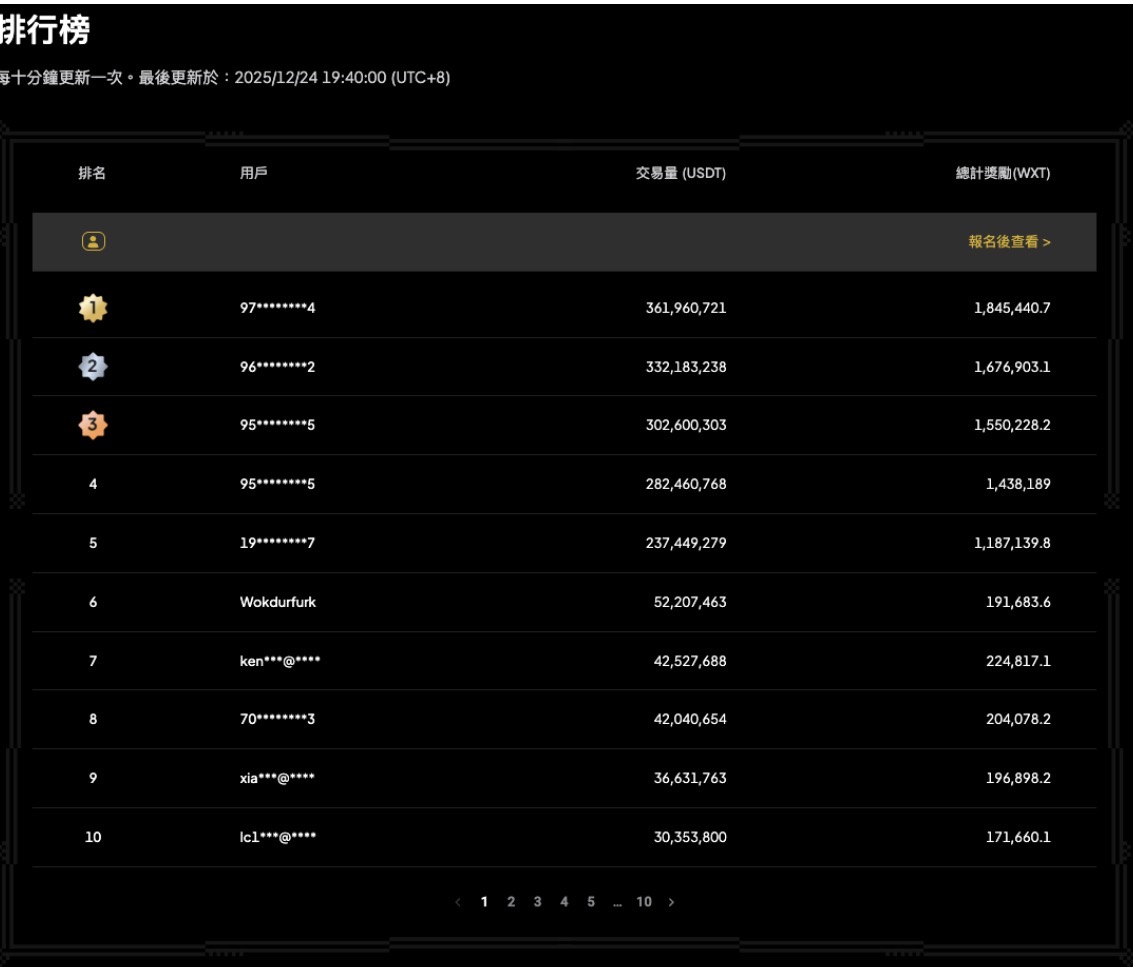
Building on the great success of the first phase, the second phase of 'Futures Mining' has undergone comprehensive upgrades in rebate ratios, the miner level system, participation methods, and more. Not only are the rewards more substantial and the玩法 more diverse, but the participation threshold has been further lowered. It is expected to continue the participation热潮 of the first phase.

Up to 40% Rebate, Easier Miner Level Promotion

The second phase of 'Futures Mining' expands the miner levels from the original 6 levels to 7 levels,依次为: Brass Miner → Silver Miner → Gold Miner → Platinum Miner → Diamond Miner → Glory Miner → King Miner.

Different levels correspond to different transaction fee rebate ratios, with the highest level, 'King Miner,' offering a rebate ratio as high as 40%. The greater the cumulative futures trading volume of a user, the higher the miner level and the higher the transaction fee rebate ratio they can enjoy.

In addition to promoting miner levels through trading volume, the second phase of 'Futures Mining' also adds multiple new level promotion paths. Users can upgrade by meeting any one of the following conditions:

1 Share the 'Futures Mining' activity and join the WEEX official community;

2 Invite 3 friends to register for 'Futures Mining';

3 Accumulate fee rebate rewards obtained through 'Futures Mining' exceeding 1,000 WXT.

Furthermore, users who register for 'Futures Mining' on the WEEX新手活动 (https://www.weex.com/zh-CN/events/welcome-event) page can not only enjoy up to a 40% transaction fee rebate but also receive additional 'Futures Mining' task rewards.

The upgraded 'Futures Mining' not only offers more diverse玩法 but also features broader miner level promotion channels, a lower threshold, and more generous rewards.

Zero-Cost Participation, Multiple Ways to Increase Earnings

The core value of 'Futures Mining' lies in transforming users' daily trading into profitable behavior. By offering up to a 40% transaction fee rebate, it significantly reduces the net cost of trading, thereby effectively increasing users' net profit (trading profit + fee rebate). Especially for heavy futures traders, as trading volume increases, miner levels and rebate ratios rise, leading to lower net trading costs and higher net profits.

Unlike some DeFi mining activities that require complex operations like locking, staking, or providing liquidity with high thresholds, and unlike traditional reward programs that rely on fixed tasks or fixed prize pools, 'Futures Mining' requires no additional operations or costs. Users simply need to click to register and then trade normally at their own pace as usual to receive real-time fee rebates distributed in WXT.

Additionally, users can enable the 'Auto Earn' function. While receiving 'Futures Mining' fee rebate rewards, they can also enjoy daily理财收益 of up to 100% APR. Auto Earn is a活期理财 tool launched by WEEX that generates continuous interest on idle funds without affecting user trading or占用资金流动性. Balances in users' spot, futures, and fund accounts are all included in the interest calculation range. With one click to enable, interest is calculated automatically and收益 are automatically credited daily.

WXT Outperforms 90% of Platform Tokens, Mining Output 'Great Value for Money'

WEEX Token (WXT) is the platform token issued by WEEX exchange. Since its listing in July 2024, it has achieved a maximum increase of over 358%. Considering holder benefits such as WE-Launch new token airdrops, the comprehensive annualized yield of WXT exceeds 660%.

According to CMC data, as of December 24, WXT's price increase in 2025 was 57.88%, ranking 5th among the 53 CEX platform tokens with comparable data tracked by CMC. This performance not only surpasses 90% of platform tokens like BNB but also demonstrates strong resilience in a market environment where BTC fell by 6.75% during the same period.
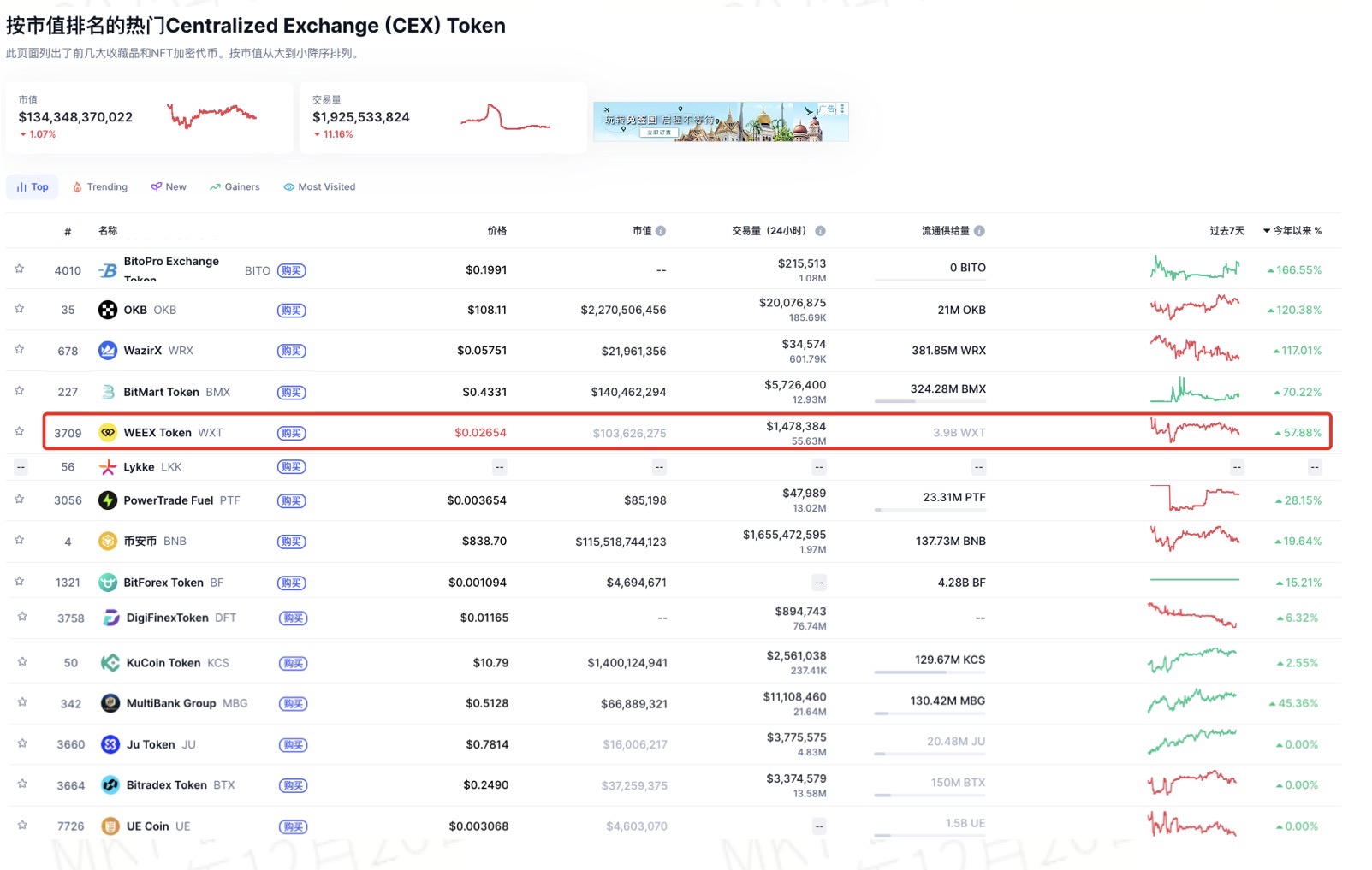
The essence of WEEX 'Futures Mining' is to reduce user trading costs. However, compared to direct fee reductions, the WXT rebated through mining has appreciation potential, thereby offering greater potential profits.假设 user A has a miner level of 'King Miner' with a 40% rebate ratio. If the WXT price doubles over a certain future period, it would be equivalent to this user's trading cost being 0.

In summary, the second phase of 'Futures Mining,' through higher rewards and more flexible miner promotion methods, not only lowers the user participation threshold but also amplifies the actual profit margin. Coupled with WXT's excellent market performance and增值潜力, it provides users with a全新的 futures trading experience. For traders looking to reduce trading costs and increase asset returns, the upgraded 'Futures Mining' is undoubtedly an highly attractive option. Both futures beginners and seasoned players can find a suitable way to participate and easily enjoy the dual乐趣 of trading and mining.


Пов'язані питання

QWhat is the main purpose of WEEX's 'Contract Mining' Phase II event?

AThe main purpose is to share platform growth dividends with users by offering real-time fee rebates in the form of WXT tokens for each contract trade, thereby reducing users' net transaction costs and increasing their potential earnings.

QWhat is the highest miner level and corresponding fee rebate percentage in the upgraded 'Contract Mining' event?

AThe highest miner level is 'King Miner', which offers a fee rebate percentage of up to 40%.

QBesides trading volume, what are the additional ways for users to upgrade their miner level in Phase II?

AUsers can upgrade by: 1) Sharing the 'Contract Mining' event and joining WEEX's official community, 2) Inviting 3 friends to register for 'Contract Mining', or 3) Accumulating over 1,000 WXT in fee rebate rewards from the event.

QHow does WEEX's 'Auto Earn' feature complement the 'Contract Mining' rewards?

AThe 'Auto Earn' feature allows users to earn up to 100% annualized interest on idle funds across spot, futures, and fund accounts, without affecting trading or liquidity, while simultaneously receiving fee rebates from 'Contract Mining'.

QHow has WXT performed compared to other exchange platform tokens in 2025 according to CMC data?

AAs of December 24, WXT's price increased by 57.88% in 2025, ranking 5th among 53 comparable CEX platform tokens on CMC, outperforming 90% of platform tokens including BNB, and showing strong resilience despite BTC's 6.75% decline.

Пов'язані матеріали

Analyzing the Impact of AI on Economic Growth and Productivity

**Title: Analyzing AI's Impact on Economic Growth and Productivity** This article examines three contrasting views on AI's influence on economic growth and productivity. **The Optimistic View** posits that AI, especially through automating R&D ("recursive self-improvement"), could dramatically accelerate growth, even triggering a technological "singularity" with explosive, potentially infinite, economic expansion. **The Moderate/Mainstream View** acknowledges AI's productivity benefits but emphasizes significant real-world constraints that could limit its impact. These include: limited cost savings per task, structural ceilings on which jobs and industries are "exposed" to AI, adoption bottlenecks (e.g., compute, energy, regulatory hurdles), and the "weak link" effect where non-automatable tasks cap overall gains. Consequently, the realized AI dividend may be far lower than optimistic projections, with estimates typically ranging from 0.1% to 1.3% annual productivity growth. **The Pessimistic View** stems from two strands. The first aligns with the moderate view but applies extremely conservative assumptions about task exposure and efficiency gains, yielding minimal projected impact. The second introduces a demand-side critique: if AI primarily replaces rather than augments labor, it could depress labor's share of income, weaken consumer demand, and create a "demand trap" that ultimately stifles growth, unless offset by redistribution policies. **The authors' assessment** is nuanced: * **Short-term (1-2 years):** AI will support growth primarily through investment spending, not significant productivity gains. * **Medium-term (3-5 years):** Three potential paths emerge based on AI demand and bottleneck severity: 1. **"Optimistic Path":** High demand, few bottlenecks. Rapid productivity gains but risk of major job displacement and social conflict without redistribution. 2. **"Moderate Path" (most likely):** High demand but significant, surmountable bottlenecks. Leads to moderate productivity gains, financial market volatility (K-shaped returns), and sectoral job losses. 3. **"Pessimistic Path":** Low demand or severe bottlenecks. Minimal productivity and growth impact, triggering financial market corrections but allowing a smoother societal transition with less labor disruption. * **Long-term:** AI holds potential for a major productivity revolution and prosperity. The conclusion stresses that no path is smooth. Technologically "optimistic" outcomes could be socially detrimental, while "pessimistic" technological diffusion might be more socially stable. Policymakers must monitor developments and prepare balanced responses to manage economic, financial, and social sustainability.

marsbit4 хв тому

Analyzing the Impact of AI on Economic Growth and Productivity

marsbit4 хв тому

The New Cold War is a Tech Stock War

The New Cold War is a Tech Stock War The article argues that the contemporary geopolitical and economic rivalry between the US and China represents a "New Cold War," but one fundamentally fought through technology and financial markets, not physical barriers or conventional trade. Historically, US dominance was secured through financial systems. The Soviet Union, reliant on the rigid "Transferable Ruble," was ultimately undermined by its dependency on the US dollar for oil trade. Later, Japan's semiconductor challenge was countered not just by tariffs (e.g., Plaza Accord, 301 investigations) but by binding it to US Treasury bonds. China presents a more complex, "embedded" challenger. While it holds vast dollar reserves and US debt like Japan, its industrial base is stronger and more diversified than the Soviet Union's. Surviving the initial 2018 trade war phase, the conflict has evolved into a "tech-financial war." The core battlefield is now the stock market. US tech stocks (AI, semiconductors) are treated as sovereign assets, buoyed by bipartisan national will. China is pushing to strengthen its own financial markets to convert industrial strength into financial power and fund its tech ambitions. Companies like ChangXin (semiconductors), Moonshot AI, and DJI compete not just for market share but as financial proxies for their respective systems. The new paradigm is moving from globally efficient monopolies (Apple, Google) towards companies that achieve monopolistic profits within their respective geopolitical spheres. This competition over "pricing power" and financial valuation in segmented markets defines the current era, making the stock market the primary arena for this tech-centric struggle.

marsbit13 хв тому

The New Cold War is a Tech Stock War

marsbit13 хв тому

RWA Weekly: Ten European Financial Institutions Establish Tokenized Asset Cooperative; Ondo Launches New Execution Network Ondo Network

RWA Weekly: European Banks Form Tokenized Asset Cooperative; Ondo Launches New Execution Network Ondo Network Covering July 24-31, 2026, the RWA sector saw a steady on-chain total value locked (TVL) of $36.8 billion, with holder count hitting a record high. However, stablecoin transfer volumes fell sharply (~30%), indicating low on-chain settlement demand. Key regulatory moves include South Korea advancing stablecoin legislation and a push to scrap crypto taxes, Kenya lowering capital requirements for stablecoin issuers, and Zimbabwe approving seven projects for its crypto sandbox. In project developments, BIS-led Project Agorá successfully tested cross-border payments with tokenized funds across six currencies. Ten major European financial institutions formed the RL1 blockchain cooperative to build tokenized asset infrastructure. Other notable updates: Aviva launched a tokenized dollar liquidity fund on XRPL, POSCO International tokenized commercial invoices on Injective, and a Brazilian farmer used tokenized cattle as collateral for a loan. Additional progress includes BNY Mellon migrating its core transfer agent operations to blockchain, Securitize gaining SEC investment advisor registration, and Tether’s compliant stablecoin USA₮ launching on Celo. Ondo Finance introduced Ondo Network, a new execution layer focused on speed and privacy, moving away from its initial chain plans. An analysis highlights that despite the growing scale of on-chain RWAs (~$32B), approximately 90% remain underutilized in DeFi, pointing to a critical challenge in unlocking liquidity and fostering real-world application beyond mere issuance.

marsbit14 хв тому

RWA Weekly: Ten European Financial Institutions Establish Tokenized Asset Cooperative; Ondo Launches New Execution Network Ondo Network

marsbit14 хв тому

South Korean Stock Market Sees Sharp Rebound After Forceful De-leveraging, SK Hynix Rises 30%

On July 31, South Korean stocks staged a historic rebound. The benchmark KOSPI index surged 18.27%, with chipmaker SK Hynix hitting a 30% gain limit. This followed a brutal, near-40% decline in the KOSPI over the previous month, driven largely by a deleveraging spiral involving leveraged ETFs. Analysts attributed the sharp sell-off to structural liquidity issues rather than deteriorating corporate fundamentals. The rally was triggered by a confluence of positive catalysts. Firstly, strong earnings from U.S. cloud giants Microsoft and Amazon alleviated fears of an "AI bubble burst," boosting global tech sentiment. Secondly, SK Group Chairman Chey Tae-won made a rare personal purchase of SK Hynix shares, seen as a strong vote of confidence. Thirdly, the South Korean government announced a 20 trillion won ($139 billion) AI investment fund. In response to the market turmoil, South Korean regulators are tightening controls on leveraged ETFs, admitting oversight shortcomings. Measures include raising minimum cash保证金 requirements for散户 investors and suspending new product launches. While the rebound signals eased liquidity pressure, analysts note deep structural issues remain. The market's future stability is seen as dependent on global tech capital expenditure trends and memory chip price cycles, with some viewing the surge as a technical correction rather than a definitive trend reversal.

marsbit34 хв тому

South Korean Stock Market Sees Sharp Rebound After Forceful De-leveraging, SK Hynix Rises 30%

marsbit34 хв тому

Торгівля

Спот
活动图片