Bitcoin mining revenue jumps 68.6% from the lowest-earning day of 2022

CointelegraphОпубліковано о 2022-08-13Востаннє оновлено о 2022-08-13

Анотація

Since July 2022, the Bitcoin ecosystem recovered across numerous determinants, including miners’ revenue in dollars, network difficulty and hash rate.
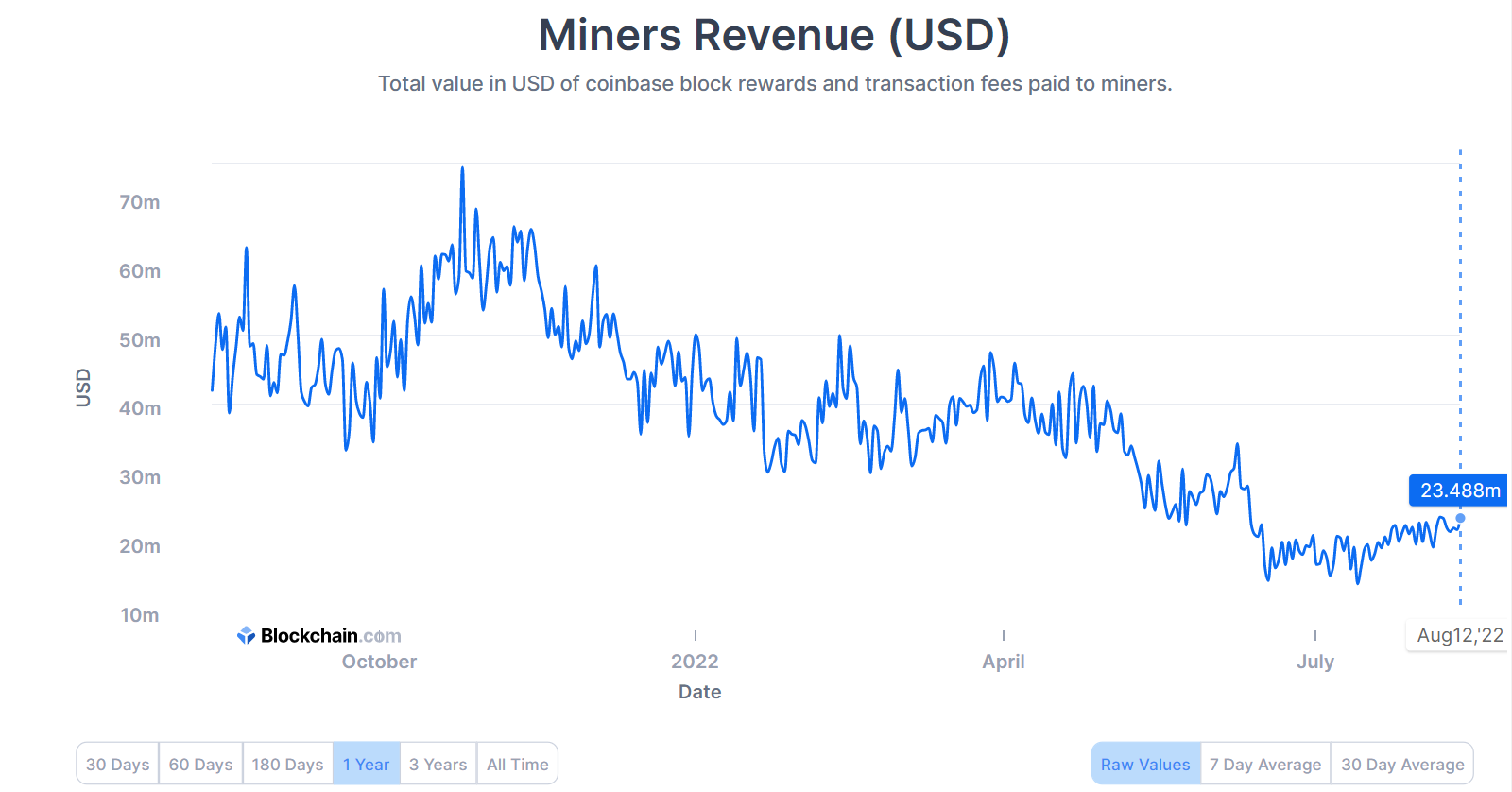
The Bitcoin (BTC) mining industry endured immense financial stress throughout the year 2022 as a prolonged bear market directly impacted their earnings when translated to the U.S. dollar. However, miners resilient to the year’s lowest mining revenue day, June 13, witnessed a 68.63% increase in mining revenue within a month.

Over the year, revenue from Bitcoin mining dropped due to a multitude of factors centered around investor sentiment — driven by tensions arising from market crashes, ecosystem collapses and loss-making investments. Cutting through the noise, the Bitcoin ecosystem recovered across numerous determinants, including miners’ revenue in dollars, network difficulty and hash rate.

Total miners revenue over time. Source: blockchain.com

Data from blockchain.com confirms that BTC mining revenue jumped nearly 69% in one month — from $13.928 million on July 13 to $23.488 million on Aug. 12. The significant increase in mining revenue reassures Bitcoin mining as a viable business despite high operational costs. In addition, lower mining equipment (GPU) prices have allowed BTC miners to expand their existing infrastructure as they pursue mining the last 2 million BTC.

Alongside mining revenue, Bitcoin’s hash rate grew over 10% over the last month, adding to the network’s resilience against double-spending attacks. However, as a result, network difficulty — a measure of how difficult it is to mine a new BTC block — increased for the first time since June.

Mirroring the positive outcomes across the Bitcoin network, crypto mining companies reported increased stock prices over the last month.

Crypto mining companies, including Hut8 Mining Corp., Marathon Digital Holdings and Core Scientific, revealed skyrocketing stock prices, each performing at least 95% better than June 2022.

All three companies, however, posted widened losses, driven by impairment losses on their crypto holdings.


Пов'язані матеріали

No Sales Team, $20 Million in Revenue: How Did AI Employee Viktor Win Over 30,000 Companies?

The AI employee Viktor, developed by a team with DeepMind background, has achieved $20 million in annual revenue without a traditional sales team, serving over 30,000 companies. Its core innovation lies in positioning itself as a "Tier 3 AI Coworker" capable of "end-to-end execution and delivery of results," moving beyond the "draft and wait for human completion" model of typical AI assistants. Users can simply mention Viktor in Slack or Microsoft Teams using natural language commands, and it autonomously performs tasks like pulling sales data from a CRM, generating reports, or even cross-tool operations like creating board meeting PPTs by aggregating data from six different sources. Key to its growth is a pure Product-Led Growth (PLG) model, eliminating complex implementation cycles and per-seat licensing. Instead, it charges based on task credits or consumption, lowering the trial barrier with a $100 free credit offer and no credit card required. This enabled viral, bottom-up adoption within organizations. Viktor's interaction paradigm removes the barrier of prompt engineering, allowing non-technical employees to delegate complex workflows seamlessly. It also features proactive, automated task execution (e.g., overnight bookkeeping, scheduled reports) based on triggers, effectively embedding AI as an automated "process layer" within business operations. However, its expansion into Microsoft Teams—a platform with 320 million users—highlights challenges. Large enterprises require stringent IT compliance, security reviews (e.g., SOC 2), and governance, potentially hindering the frictionless, user-driven adoption that succeeded in Slack. Additionally, the "black box" nature of its autonomous decision-making raises concerns about operational risks, data integrity, and the need for robust audit logs and permission controls. Balancing efficiency gains with security and trust remains a critical hurdle for Viktor and similar AI agents aiming to become core enterprise infrastructure.

marsbit1 год тому

No Sales Team, $20 Million in Revenue: How Did AI Employee Viktor Win Over 30,000 Companies?

marsbit1 год тому

Торгівля

Спот
Ф'ючерси
活动图片