[Key interpretation] BTC is brewing a short-term decline, and eth loan lock up volume has shrunk by 64% to US $17.89 billion

Huobi ResearchОпубліковано о 2022-08-04Востаннє оновлено о 2022-08-08

Анотація

The short-term weakness of BTC and Ethereum further prompted the adjustment of expectations.

1. BTC currency holding cost down

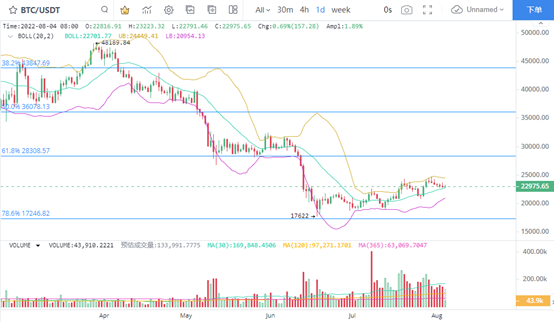
In the daily K-line chart, the trading volume of BTC is relatively stable, and the volume and price performance in the past month is relatively active, during which a large number of BTCs have changed hands. Based on this, BTC is already at a very concentrated price. Although there are still many hold ups at the high price, the number of hold ups continues to decrease with the adjustment. At present, the daily trading volume of BTC is not strong enough, and the continuous decline of prices may further indicate the decline expectation. Therefore, around the price range below $25000, low absorption is more likely to reduce the risk of holding currency.
2. Stable currency prompts capital flight

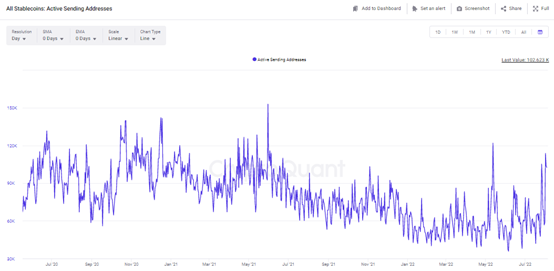
The number of active addresses of stable coins has increased significantly. Among them, the number of active addresses sending stable coins increased rapidly, reaching a high of 103000 on August 3. Recently, the peak value of the stable currency rose, and the peak performance continued on July 12 and August 1, with the corresponding values reaching 122000 and 114000 respectively. This shows that the overall investors are not confident in the current transaction, and sending a stable currency may be a signal of capital flight.
3. The proportion of stable currency sending addresses increased

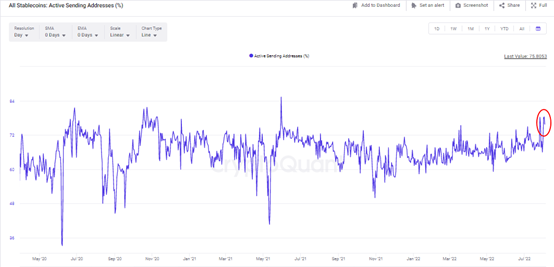
The proportion of sending addresses of stable currency has effectively rebounded, and its short-term peak has reached around 79%, indicating that the number of sending addresses still has a large share. The proportion of actively sending stable coins decreases, while the proportion of receiving stable coins is very low. This shows that the number of addresses receiving stable currency remains at a low level, and few investors actively buy stable currency, which may limit market performance.
4. Eth trading volume remained low

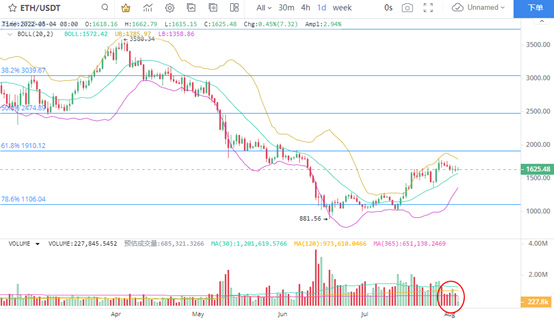
The trading volume performance of eth is obviously lower, and the shrinking trend of trading volume in the short-term six trading days is very significant. In terms of price, ETH began to callback after reaching $1784 in the short term, and the volatility was obviously at a low level. The shrinking trading volume and the low intensity of price fluctuations mean that there are more opportunities for eth to decline sideways.

At present, the middle rail of brin line can support eth horizontal consolidation, but there is obviously insufficient space to continue downward. Therefore, ETH only needs a small pullback at present, which may expand the adjustment space after falling below the brin line medium rail. There is a large downward space from around $1600, so we should pay attention to tracking risks in the short term.
5. Eth mortgage loan project TVL low level operation

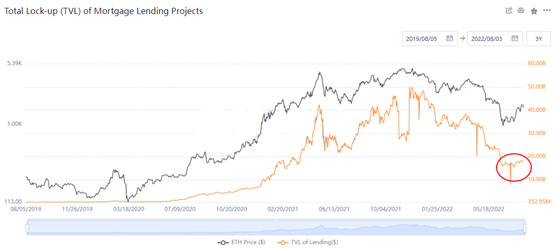
Used to judge the utilization rate of eth chain, the total lock up (TVL) value of mortgage lending projects on eth chain is relatively low, especially the relative historical high has significantly shrunk by 64%, indicating that the current data on the chain has limited support for eth price. On August 3, the total lock up volume of its on chain lending reached US $17.89 billion, a significant decrease from the historical high of nearly US $50billion.

After entering the adjustment state, the ETH chain lock volume data showed signs of continuous stabilization, but the short-term rebound space is not high. This also shows that the rapid rebound of eth short-term price has deviated from the fundamentals, and the pressure of price adjustment may appear in the short term.
Пов'язані матеріали

Dylan Patel: Founder of SemiAnalysis, Praised by Jensen Huang, is a 'Beekeeper' and 'Forum Enthusiast'

Dylan Patel, founder of the independent research firm SemiAnalysis, has an unconventional background. A former beekeeper from rural Georgia, he entered the semiconductor world as a self-taught "forum warrior," discussing chip technology anonymously online from a young age. He launched the SemiAnalysis blog in May 2020, which later transitioned to a paid subscription model. The firm has grown from a one-person operation to a global team of around 60, with a dedicated teardown lab. Its detailed, technically-focused analysis on semiconductor supply chains, AI infrastructure, and products has earned significant industry recognition. Notably, NVIDIA founder Jensen Huang has publicly cited their reports. In a landmark case, a critical 2024 report on AMD's MI300X GPU software stack led to a 90-minute call with AMD CEO Lisa Su, who thanked him for the constructive feedback. SemiAnalysis later acknowledged AMD's improvements. The firm's influence on markets was seen when a report on NVIDIA's Rubin memory configuration was partially shared, affecting memory stock prices. Dylan Patel emphasized the importance of context, contrasting the shared excerpt with the report's actual title. SemiAnalysis, now a multi-faceted consultancy with revenue projected to reach $100 million, is known for its deep technical insights that influence major industry players and investment decisions.

marsbit46 хв тому

Dylan Patel: Founder of SemiAnalysis, Praised by Jensen Huang, is a 'Beekeeper' and 'Forum Enthusiast'

marsbit46 хв тому

Dylan Patel: SemiAnalysis, Praised by Jensen Huang, is Founded by a 'Beekeeper and Forum Warrior'

Dylan Patel, founder of the independent research firm SemiAnalysis, has an unconventional background. Growing up in rural Georgia, he later worked as a beekeeper in Minnesota. His entry into semiconductors began as a self-taught "forum warrior," engaging anonymously in online tech communities from a young age. In May 2020, he started the SemiAnalysis blog on WordPress, later moving it to Substack as a paid subscription service. The firm has since evolved from a one-person operation into a global company with around 60 employees, featuring a dedicated chip teardown lab. Its revenue, reaching $20 million last year, is projected to surpass $100 million this year. SemiAnalysis is highly regarded in the AI and semiconductor industry for its deep technical analysis. NVIDIA founder Jensen Huang has publicly praised its reports. In a notable instance, a critical report on AMD's MI300X GPU software shortcomings prompted a 90-minute call with CEO Lisa Su, who thanked Patel for the "constructive feedback." A later report acknowledged AMD's subsequent improvements. The firm's analyses have significant market impact. For example, a June report discussing potential memory configuration changes in NVIDIA's next-generation servers was cited as a factor in pressure on memory-related stocks. Patel plans to establish a venture capital firm, having already made personal investments in about 20 startups. SemiAnalysis combines roles as a consultancy, model platform, and tech lab, focusing on the practical bottlenecks in AI infrastructure.

Odaily星球日报50 хв тому

Dylan Patel: SemiAnalysis, Praised by Jensen Huang, is Founded by a 'Beekeeper and Forum Warrior'

Odaily星球日报50 хв тому

Ethereum Q1 Report: On-chain Activity Hits Record High, Tokenized Assets Lead the Industry

Ethereum Q1 2026 Report: On-chain activity hits record high, tokenized assets lead the industry. In Q1 2026, Ethereum's network experienced a unique divergence: on-chain activity soared while USD-denominated metrics declined. Monthly active users reached 13.2 million, transactions hit 200.4 million, and TPS averaged 25.78, all setting new highs. However, total value locked (TVL) fell 11.0% to $316.2B, DEX volume dropped 24.0% to $134.5B, and ETH's fully diluted market cap fell 30.3% to $290B. A key driver was the Blob Parameter Fork (BPO#2) in January, which increased data capacity and caused a sharp 47.9% drop in layer-1 transaction fees despite higher usage. Etherean's tokenized asset market cap reached $203.4B, up 42.9% year-over-year. While stablecoins ($178.9B) saw a slight dip, tokenized funds ($19.4B, +73.1% YoY), commodities ($4.7B, +325.9% YoY), and stocks ($365.1M) grew strongly. Ethereum dominates cross-chain comparisons, holding 71% of TVL, 79.2% of active loans, 61.8% of stablecoins, and 73% of tokenized funds among top chains. The report highlights a "Jevons Paradox" scenario: network expansion reduces per-transaction costs but unleashes latent demand, driving long-term growth. Ethereum's strategy mirrors Amazon's early focus on scale over profit. Its open, neutral foundation is seen as critical for institutional adoption, as evidenced by growing activity from firms like BlackRock and JPMorgan. The roadmap targets further scalability, aiming for thousands of TPS by 2029 to solidify its role as a global financial settlement layer.

marsbit53 хв тому

Ethereum Q1 Report: On-chain Activity Hits Record High, Tokenized Assets Lead the Industry

marsbit53 хв тому

Торгівля

Спот
Ф'ючерси
活动图片