Jupiter’s 12% surge faces a reality check: On-chain activity hits 2-year low

ambcryptoОпубліковано о 2026-02-15Востаннє оновлено о 2026-02-15

Анотація

Jupiter (JUP) experienced a significant 12% price surge, driven by hundreds of millions in capital over 24 hours. However, on-chain data reveals a stark contrast, with user activity and transaction volume hitting a two-year low, indicating the rally may be speculative rather than organically driven. Despite weak network usage, Total Value Locked (TVL) increased by $166 million, suggesting genuine capital commitment and longer-term positioning. Derivatives market growth was modest, reinforcing that spot buying and capital locking were primary drivers. Short-term price movement is expected to be influenced by liquidity clusters, with potential resistance near $0.18 and support around $0.15. The sustainability remains in question due to the divergence between price and on-chain fundamentals.

Jupiter [JUP] attracted substantial inflows over the past 24 hours, with capital rising by hundreds of millions of dollars. The wave of buying pressure lifted the token by at least 12% within the same period.

Yet, JUP’s expansion has not been matched by stronger on-chain engagement.

Core network metrics show that user participation and transaction activity remain subdued, creating a widening gap between valuation and protocol fundamentals.

Weak usage undermines rally strength

On-chain data suggests that the recent rally may be driven more by positioning than by organic growth.

Artemis, which tracks daily active or transacting users, showed a sharp decline in participation. The metric has fallen to its lowest level since February 2024, marking a two-year low.

This drop in active users coincides with a contraction in total transactions executed on the protocol. Transaction volume has declined to roughly 1.5 million, a level last recorded on the 19th of January.

Although transaction counts have stabilized within a narrow range in recent sessions, overall activity remains materially below previous highs.

When network usage declines while price accelerates, the divergence often signals speculative momentum rather than sustainable demand.

In JUP’s case, the absence of strong on-chain confirmation raises the risk that the rally may lack structural support.

TVL inflows signal committed capital

Despite weak usage metrics, capital commitment to the protocol has increased.

Total value locked, which measures the amount of assets deposited in liquidity pools and other protocol mechanisms, surged by approximately $166 million over the past day.

At press time, TVL stood at $2.163 billion, according to DeFiLlama.

An increase in TVL typically reflects longer-term positioning, as locked assets reduce circulating supply and indicate investor confidence in the protocol’s yield opportunities or utility.

The sharp rise suggests that a meaningful volume of JUP has moved off the open market and into locked positions.

While it remains unclear whether institutional players or retail investors drove the inflow, the magnitude of the increase points to genuine capital allocation rather than purely short-term trading activity.

Derivatives positioning remains modest

Speculative activity in the derivatives market has also expanded. The OI-Weighted Funding Rate remains positive, indicating that long positions dominate JUP’s perpetual futures market.

However, derivatives exposure alone appears insufficient to explain the scale of the rally. Open Interest rose 13% in the past 24 hours but stood at just $50.29 million at press time, according to CoinGlass.

Compared to the $166 million surge in TVL, derivatives positioning remains relatively small. This comparison strengthens the view that spot-driven inflows and capital locking played a larger role in the recent price advance.

What comes next for JUP?

Liquidity cluster analysis outlines two near-term scenarios.

The bullish case suggests limited upside toward the $0.18 level, where a concentration of liquidity could cap gains.

The bearish scenario, by contrast, presents a broader downside path, with price potentially extending toward $0.15.

Liquidity clusters represent areas of unfilled orders that often attract price movement, as markets tend to gravitate toward zones with concentrated liquidity.

In the short term, momentum will determine direction. Sustained buying pressure could push JUP toward the upper liquidity zone before any correction unfolds.

Conversely, fading momentum may expose the asset to a deeper retracement toward lower support levels.


Final Summary

  • Weak network usage contrasts with rising demand for JUP, raising concerns about the durability of the rally.
  • A $166 million increase in total value locked (TVL) confirms that fresh capital is entering the ecosystem.


Пов'язані питання

QWhat was the percentage increase in Jupiter's (JUP) price over the past 24 hours, and what concerning on-chain trend contradicts this price surge?

AJupiter's price surged by 12% over the past 24 hours. This price increase is contradicted by on-chain activity, which has fallen to a two-year low, showing a sharp decline in user participation and transaction volume.

QAccording to the article, what does the divergence between rising price and declining network usage often signal?

AThe divergence between a rising price and declining network usage often signals that the rally is driven by speculative momentum rather than sustainable, organic demand.

QDespite weak on-chain activity, what metric showed a significant capital inflow, and how much did it increase by?

ADespite weak on-chain activity, the Total Value Locked (TVL) metric showed a significant capital inflow, surging by approximately $166 million in the past day to reach $2.163 billion.

QWhat are the two potential near-term price scenarios for JUP outlined by liquidity cluster analysis?

AThe two potential near-term price scenarios are a bullish case where the price could rise to the $0.18 level, and a bearish case where the price could retrace toward the $0.15 level.

QHow does the scale of derivatives market activity (Open Interest) compare to the TVL inflow, and what does this suggest about the rally's drivers?

AThe derivatives market Open Interest of $50.29 million is relatively small compared to the $166 million TVL inflow. This suggests that spot-driven inflows and capital locking played a larger role in the price advance than derivatives speculation.

Пов'язані матеріали

Wintermute Market Weekly: Iran War Ends, Inflation Meets Expectations, BTC Rebounds to Lower 60ks But Don’t Rush to Buy the Dip

**Wintermute Market Weekly: BTC Rebounds to $60K Lows, But Caution Advised** This week saw a broad market rebound, primarily driven by two converging factors: a US CPI inflation reading that met expectations (4.2% YoY) and former President Trump's announcement of a deal to end the Iran conflict. The latter triggered a sharp drop in oil prices, reducing geopolitical risk premiums and easing inflation fears. Consequently, risk assets like equities and cryptocurrencies rallied, with Bitcoin recovering from lows around $60,000 to close the week up 1.9%, while altcoins gained 3.1%. Despite the price bounce, the underlying liquidity picture for crypto remains weak. Key funding channels—stablecoin flows, ETF inflows, and Digital Asset Treasury (DAT) activity—show no signs of structural improvement. ETF outflows recently hit a record streak, and DAT assets have declined significantly. The rally from $60K to $83K earlier is now viewed as a bear-market rally that has failed. The current environment is characterized by low directional conviction and choppy, range-bound trading, likely persisting into summer. The report advises caution against aggressively buying the dip. While the $60K area offers attractive long-term risk/reward, a sustained bull run requires a visible turnaround in capital inflows, which hasn't materialized. The upcoming FOMC meeting and Powell's commentary, alongside the formal Iran deal signing, are noted as near-term catalysts. The core takeaway is to watch fund flows rather than price action and avoid being whipsawed by volatility before clear signs of institutional or retail capital returning emerge.

marsbit11 хв тому

Wintermute Market Weekly: Iran War Ends, Inflation Meets Expectations, BTC Rebounds to Lower 60ks But Don’t Rush to Buy the Dip

marsbit11 хв тому

Cursor, Why Boarded Musk's Starship?

SpaceX announced its acquisition of AI programming startup Cursor's parent company, Anysphere, for $60 billion in an all-stock deal, just days after its record-breaking IPO. The move sent SpaceX's stock soaring, briefly making it the most valuable U.S. company. Cursor, founded in 2022 by MIT graduate Michael Truell and his classmates, is a popular AI coding assistant that allows developers to switch between models from OpenAI, Anthropic, and others. It saw explosive revenue growth, reaching a $4 billion annualized run rate in early 2026. However, its market share was eroded by the launch of competitor Claude Code from its key AI supplier, Anthropic. This dependence prompted Cursor to develop its own AI model, Composer, in early 2026. To scale Composer, Cursor needed immense computing power. In April 2026, it struck a deal with SpaceX, granting the latter an option to acquire it post-IPO. SpaceX exercised this option, offering Cursor access to its Colossus supercomputer, powered by hundreds of thousands of top-tier Nvidia AI chips. For SpaceX, the acquisition is a strategic move to bolster its AI capabilities, particularly for its xAI division, and advance its broader ambition of building orbital, solar-powered data centers. While the deal surprised some employees and investors given Truell's earlier stance on independence, it represents a high-stakes partnership. SpaceX CEO Elon Musk has projected the company could reach $1 trillion in revenue by 2030. For Truell, joining forces with SpaceX is a monumental gamble on an unprecedented scale in the race for AI dominance.

链捕手13 хв тому

Cursor, Why Boarded Musk's Starship?

链捕手13 хв тому

The More It Rises, the More Dangerous? The Systemic Risks Behind SpaceX's Soaring Valuation

Summary: The article raises concerns about the systemic risks posed by SpaceX's skyrocketing valuation, arguing that modern market mechanics, rather than fundamentals, are driving its price discovery. Following SpaceX's market capitalization surpassing $3 trillion in after-hours trading, the author contends that the market is no longer functioning properly. The core issue is not SpaceX's business prospects but the unhealthy market structure surrounding it. With limited float and the imminent launch of options trading, the stage is set for a potential "gamma squeeze"—a feedback loop where market makers hedging call options are forced to buy shares, pushing the price higher and attracting more speculative momentum traders. This mechanism, seen previously with Tesla and meme stocks, can decouple valuation from financial reality. The danger escalates as extreme valuations force passive funds, ETFs, pensions, and major indices to hold the stock. If SpaceX grows large enough—hypothetically reaching $5 or even $10 trillion—its performance would increasingly dictate broader market indices, embedding systemic risk. The author warns that when price appreciation itself becomes the primary bullish thesis, the market transforms from a capital allocation mechanism into a self-reinforcing speculative machine, endangering the retirement savings of ordinary investors tied to passive strategies. The piece questions whether such a system can still perform its fundamental role of price discovery.

marsbit18 хв тому

The More It Rises, the More Dangerous? The Systemic Risks Behind SpaceX's Soaring Valuation

marsbit18 хв тому

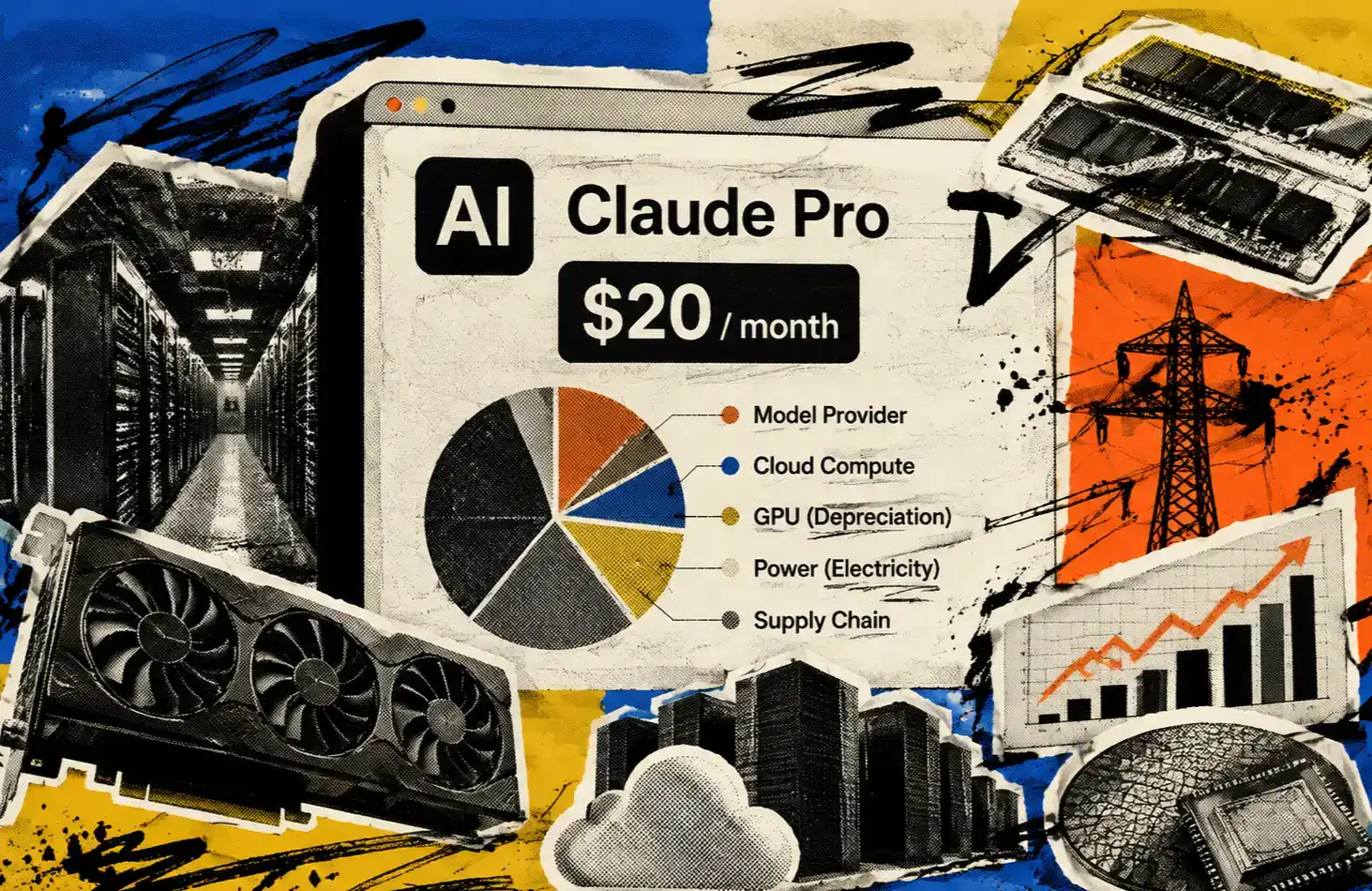
How Much of the Subscription Fee You Pay to Claude Can Optical Module Companies Get?

How much of your $20 Claude Pro subscription actually goes to AI model companies like Anthropic? A viral breakdown image highlights the fundamental valuation challenge for AI applications versus traditional SaaS. Unlike SaaS with high software margins, AI subscriptions face variable "inference costs": every user query consumes GPU time, power, and cloud resources. This creates a tension between fixed subscription fees and usage-driven expenses. While the specific dollar splits are illustrative, the core question is whether AI revenue can achieve SaaS-like margins as usage scales. Currently, infrastructure providers (cloud platforms, GPU makers like Nvidia, HBM suppliers, power/data centers) capture more certain revenue from growing AI usage. Their financials reflect pricing power and faster earnings validation. The bullish case hinges on efficiency improvements: model optimization, caching, smaller models, and custom chips could lower per-token costs over time. The key debate is whether cost declines can outpace increases in user workload complexity and volume. Ultimately, for AI companies to command high SaaS-like valuations, they must demonstrate not just user growth but also improving gross margins after accounting for inference costs. Investors will scrutinize not just subscriber numbers, but usage patterns, enterprise pricing tiers, and real efficiency gains.

marsbit28 хв тому

How Much of the Subscription Fee You Pay to Claude Can Optical Module Companies Get?

marsbit28 хв тому

OpenAI's Hyperliquid Pre-IPO Pricing Venture: Why Did It Last Only Half a Year?

The article discusses the rise and fall of Pre-IPO pricing markets on the Hyperliquid blockchain. Trade.xyz, an anonymous team, successfully built the largest pre-market for SpaceX (SPCX) by launching a contract with a clear anchor: the eventual Nasdaq listing price. This provided inherent price stability and validation. In contrast, Ventuals, a team backed by Paradigm, failed despite holding exclusive contracts for highly sought-after companies like OpenAI and Anthropic. Its key mistake was its pricing mechanism. For companies with no near-term IPO date, Ventuals' oracle relied partly on opaque private market transactions and, critically, partly on its own contract's moving average price. This created a self-referential feedback loop where prices were artificially propped up and detached from genuine supply and demand, leading to illiquid markets. Ventuals shut down after nine months, settling positions at final prices of $1,341.80 for OpenAI and $1,618.90 for Anthropic. Ironically, some employees and late-stage investors of these very companies reportedly used these flawed Ventuals prices for valuation reference, highlighting the acute demand for any price signal in illiquid private markets. The article concludes that while demand for pre-IPO trading is real and growing, with players like Coinbase now entering the space, the fundamental challenge remains: without a public listing to provide a definitive price anchor, these markets struggle to establish truly accurate and liquid pricing. The need for a transparent, self-correcting market is the critical lesson from Ventuals' failure.

marsbit44 хв тому

OpenAI's Hyperliquid Pre-IPO Pricing Venture: Why Did It Last Only Half a Year?

marsbit44 хв тому

Торгівля

Спот
Ф'ючерси

Популярні статті

Як купити CHECK

Ласкаво просимо до HTX.com! Ми зробили покупку Checkmate (CHECK) простою та зручною. Дотримуйтесь нашої покрокової інструкції, щоб розпочати свою криптовалютну подорож.Крок 1: Створіть обліковий запис на HTXВикористовуйте свою електронну пошту або номер телефону, щоб зареєструвати обліковий запис на HTX безплатно. Пройдіть безпроблемну реєстрацію й отримайте доступ до всіх функцій.ЗареєструватисьКрок 2: Перейдіть до розділу Купити крипту і виберіть спосіб оплатиКредитна/дебетова картка: використовуйте вашу картку Visa або Mastercard, щоб миттєво купити Checkmate (CHECK).Баланс: використовуйте кошти з балансу вашого рахунку HTX для безперешкодної торгівлі.Треті особи: ми додали популярні способи оплати, такі як Google Pay та Apple Pay, щоб підвищити зручність.P2P: Торгуйте безпосередньо з іншими користувачами на HTX.Позабіржова торгівля (OTC): ми пропонуємо індивідуальні послуги та конкурентні обмінні курси для трейдерів.Крок 3: Зберігайте свої Checkmate (CHECK)Після придбання Checkmate (CHECK) збережіть його у своєму обліковому записі на HTX. Крім того, ви можете відправити його в інше місце за допомогою блокчейн-переказу або використовувати його для торгівлі іншими криптовалютами.Крок 4: Торгівля Checkmate (CHECK)Легко торгуйте Checkmate (CHECK) на спотовому ринку HTX. Просто увійдіть до свого облікового запису, виберіть торгову пару, укладайте угоди та спостерігайте за ними в режимі реального часу. Ми пропонуємо зручний досвід як для початківців, так і для досвідчених трейдерів.

356 переглядів усьогоОпубліковано 2026.01.19Оновлено 2026.06.02

Як купити CHECK

Обговорення

Ласкаво просимо до спільноти HTX. Тут ви можете бути в курсі останніх подій розвитку платформи та отримати доступ до професійної ринкової інформації. Нижче представлені думки користувачів щодо ціни CHECK (CHECK).

活动图片