[Key interpretation] The trading volume of 600000 BTC giant whales disappeared, and 800 thousand investors in eth recently sent eth

Huobi ResearchОпубліковано о 2022-08-02Востаннє оновлено о 2022-08-04

Анотація

BTC continued to retreat, and the decline may exceed expectations.

1. BTC triple negative callback

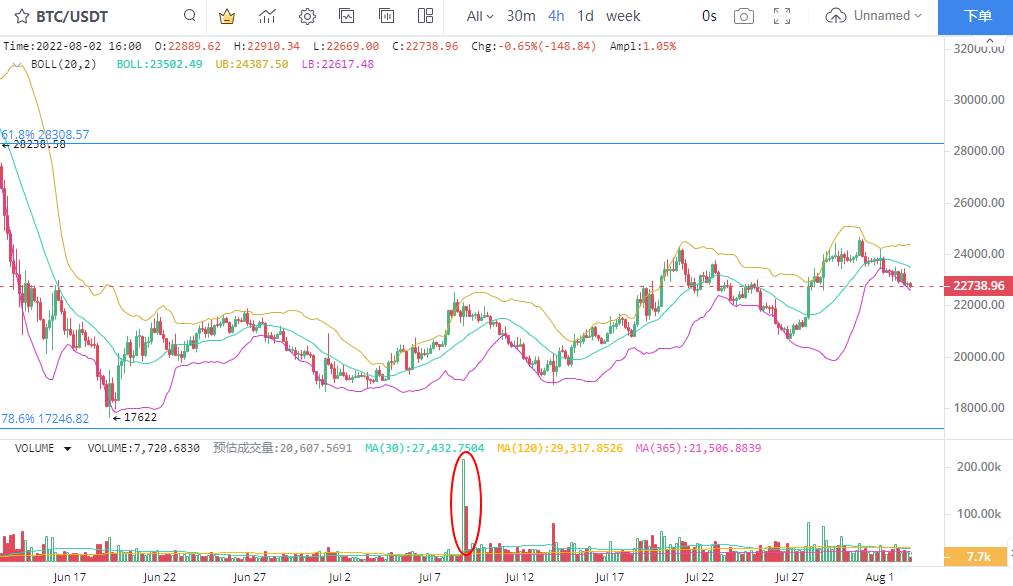
The 4-hour K-line chart shows that the overall trading volume of BTC began to increase after the peak trading volume on July 8. The average trading volume after July 8 is very high, which means that more BTCs have completed turnover in the near future. At the same time, we can see that although the average trading volume is relatively high, the downward trend of trading volume has been confirmed. Since July 29, the price callback space has increased in the process of BTC trading volume shrinking.
2. The proportion of BTC's main selling pressure rose

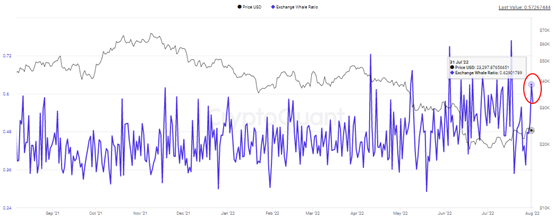
BTC's main selling pressure rebounded significantly. Numerically, the proportion of main selling pressure reached 0.572 on August 1, and the short-term peak occurred on July 31, reaching 0.629. Judging from the strength of selling pressure, the peak value of BTC selling volume has reached a short-term high, but whether the value can maintain a high level needs further verification.

The proportion of BTC's main selling pressure easily reached more than 0.5, and the value was close to 0.6, which means that the selling volume of BTC has been at a high level, with the potential risk of further lowering the price.
3. The transaction of giant whale on BTC chain continues to decrease

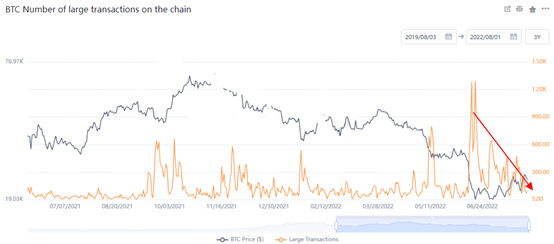
The trading volume of BTC's main chain continues to decline, and its value has fallen from a high of 1295 to around 77, while the average value has fallen back to 200 per day. In terms of transaction volume, the transaction volume of BTC on August 1 was 93, a decrease of 1202 compared with 1295 on June 18. Judging from the transaction volume of 500 BTCs per large transaction, the transaction volume of BTC decreased by 600000 BTCs. This shows that BTC's trading enthusiasm is falling, and the impact of the rebound in trading volume triggered by the decline has been very small. This also shows that BTC may enter the bear market contraction operation state again, and the decline expectation is increased.
4. Eth trading volume remained low

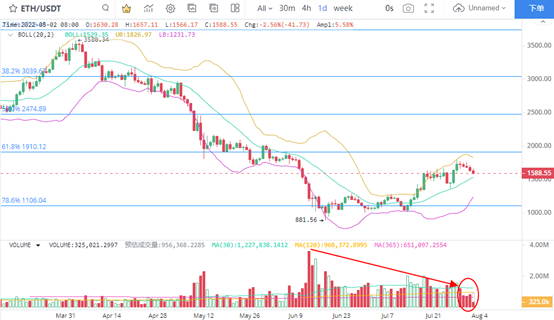
The characteristics of eth trading volume downturn are more clear, especially compared with the previous peak trading volume in June, the recent intraday trading volume is about 12% of the peak level. Therefore, the weak short-term rise of eth is indeed supported by data. According to the characteristics of low trading volume of eth, it is difficult to maintain high prices in the short term. Next, the possibility of eth falling back to the $1000 platform increases.

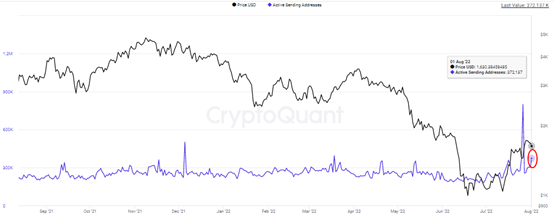
Combined with the recent high number of eth active addresses and the higher activity of sending eth, the judgment of price decline is verified.
5. The number of eth sender addresses rebounded again

In the rebound stage of eth's active address number, the address activity of sending eth performs better, indicating that more eth may be used by investors for selling. The figure shows that the number of active addresses of eth rebounded to a high of 799000 on July 26, which means an increase of 190% compared with the recent average of 275000. On August 1, the number of active addresses sending eth showed signs of rebound, reaching a high of 372000.

At the transaction level, ETH has heavy short-term selling pressure, and the risk of holding currency has increased. We should pay attention to the low absorption opportunities for further correction.

Пов'язані матеріали

Coin & Stock Compass: Global Listed Companies Net Sold $85.45 Million in BTC Last Week, Strategy's Dollar Reserves Scale Up to $3 Billion (July 14)

Global Public Companies Net Sell $85.45 Million in BTC; Strategy's Dollar Reserves Hit $3 Billion (July 14) Last week saw a significant net sell-off of Bitcoin by global public companies, excluding miners, totaling $85.45 million—a 908.42% decrease from the prior week. Major buyers like Strategy (formerly MicroStrategy) and Japan's Metaplanet were notably absent from the market. However, two companies, Brazil's OrangeBTC and asset manager Strive, made purchases, adding 8 and 18 BTC, respectively. The aggregate BTC holdings of tracked public companies now stand at 1,139,635 BTC, valued at approximately $71.38 billion and representing 5.7% of Bitcoin's circulating market cap. In corporate updates, Strategy announced its dollar reserves have grown by $450 million to reach $3 billion, while its BTC holdings remain at 843,775 coins. Hyperscale Data increased its BTC reserves past 1,000 coins. Strategy will report its Q2 2026 financial results on July 30. Mining firm Cleanspark added 454 BTC, bringing its total to 13,924 BTC. Conversely, BitFuFu sold 184 BTC, Bitdeer maintained zero net BTC holdings after selling its weekly production, and Empery Digital sold 1,400 BTC to fund an AI data center project and repay debt. Overall, public companies purchased 110,000 BTC in Q2 2026, 1.8 times the volume of the previous two quarters combined. In other cryptocurrency-related corporate news, Ethereum treasury company Bitmine increased its ETH holdings by 27,801 coins, with total staked ETH exceeding 4.9 million. Solana-focused company DFDV transferred daily operations of its meme coin DONT to an independent team. BNB treasury company BNB Plus was delisted from Nasdaq for failing to meet the $1 minimum bid price and moved to trade on the OTCQB market under the symbol BNBX. The broader equity markets showed mixed signals. Bank of America warned that bullish investor positioning indicated a potential pullback risk for stocks. In contrast, Morgan Stanley predicted the ongoing earnings season could broaden market gains beyond tech giants. Specific regional highlights included continued foreign investor outflows from South Korean stocks, pressure on US equities, and the upcoming IPO of Chinese memory chip maker ChangXin Memory. Most crypto-linked stocks remained in a downtrend.

marsbit2 хв тому

Coin & Stock Compass: Global Listed Companies Net Sold $85.45 Million in BTC Last Week, Strategy's Dollar Reserves Scale Up to $3 Billion (July 14)

marsbit2 хв тому

Why Are Major Crypto Conferences Losing Their Luster?

Why Are Major Crypto Conferences Losing Their Appeal? A growing sense of fatigue surrounds large-scale offline crypto conferences. Participants complain of declining returns and less substantial information, but the root cause is deeper. Initially, these global summits were vital for a decentralized industry without a physical hub, enabling crucial face-to-face connections. However, the value of large main-stage events has been eroded. High-quality developers and investors have migrated to exclusive, invitation-only side events and private dinners. While these offer focused networking, they lose the "serendipitous encounters" of larger gatherings and can create elitist barriers, contradicting crypto's open ethos. This fragmentation triggers a vicious cycle: as key people leave main events, their value diminishes further. Simultaneously, the industry's focus is shifting outward. Leading crypto firms are now engaging with traditional finance and real-world applications like stablecoins, digital banking, and prediction markets. Consequently, crypto-specific topics are increasingly integrated into mainstream financial conferences, making dedicated crypto summits potentially redundant. Looking ahead, the frequency of top-tier crypto conferences will likely decrease significantly. The industry has moved past its inward-looking phase. The migration of quality discourse to private settings and the push for mainstream adoption, while diluting the large conference model, are ultimately signs of the sector's maturation.

Foresight News14 хв тому

Why Are Major Crypto Conferences Losing Their Luster?

Foresight News14 хв тому

Tensions in the Strait of Hormuz Escalate, Bitcoin Plunges to $61,700 Amid Safe-Haven Selling

Bitcoin fell sharply to around $61,700 on Monday, July 13th, as geopolitical tensions in the Strait of Hormuz triggered a broad shift toward risk-off sentiment across global markets. The decline of roughly 4% mirrored weaker performances in major U.S. stock indices. Market analysts attributed the sell-off to a confluence of factors stemming from the heightened U.S.-Iran tensions. These tensions reignited inflation concerns, reduced expectations for near-term Federal Reserve rate cuts, and prompted investors to reduce exposure to risk assets like Bitcoin. Additional pressure came from slowed institutional ETF inflows, Bitcoin's failure to breach a key resistance level, and a wave of liquidations for leveraged long positions. Despite the drop, analysts largely viewed the move as a typical macro-driven correction within a healthy long-term cycle. They emphasized that Bitcoin's underlying growth trajectory remains intact. The sell-off was seen more as a liquidation event targeting over-leveraged longs rather than a structural loss of confidence. Attention now turns to the upcoming U.S. Consumer Price Index (CPI) report. A higher-than-expected inflation reading could further delay Fed rate cuts, making safer assets like bonds more attractive and continuing to pressure volatile assets like Bitcoin. The consensus is that the current volatility reflects short-term macro and geopolitical shocks, not a fundamental breakdown in Bitcoin's long-term proposition.

Foresight News1 год тому

Tensions in the Strait of Hormuz Escalate, Bitcoin Plunges to $61,700 Amid Safe-Haven Selling

Foresight News1 год тому

Торгівля

Спот
活动图片