Pelepasan Token Mingguan: STRK Melepaskan Token Sekitar 4,6% dari Peredaran

marsbitОпубліковано о 2026-02-07Востаннє оновлено о 2026-02-07

Анотація

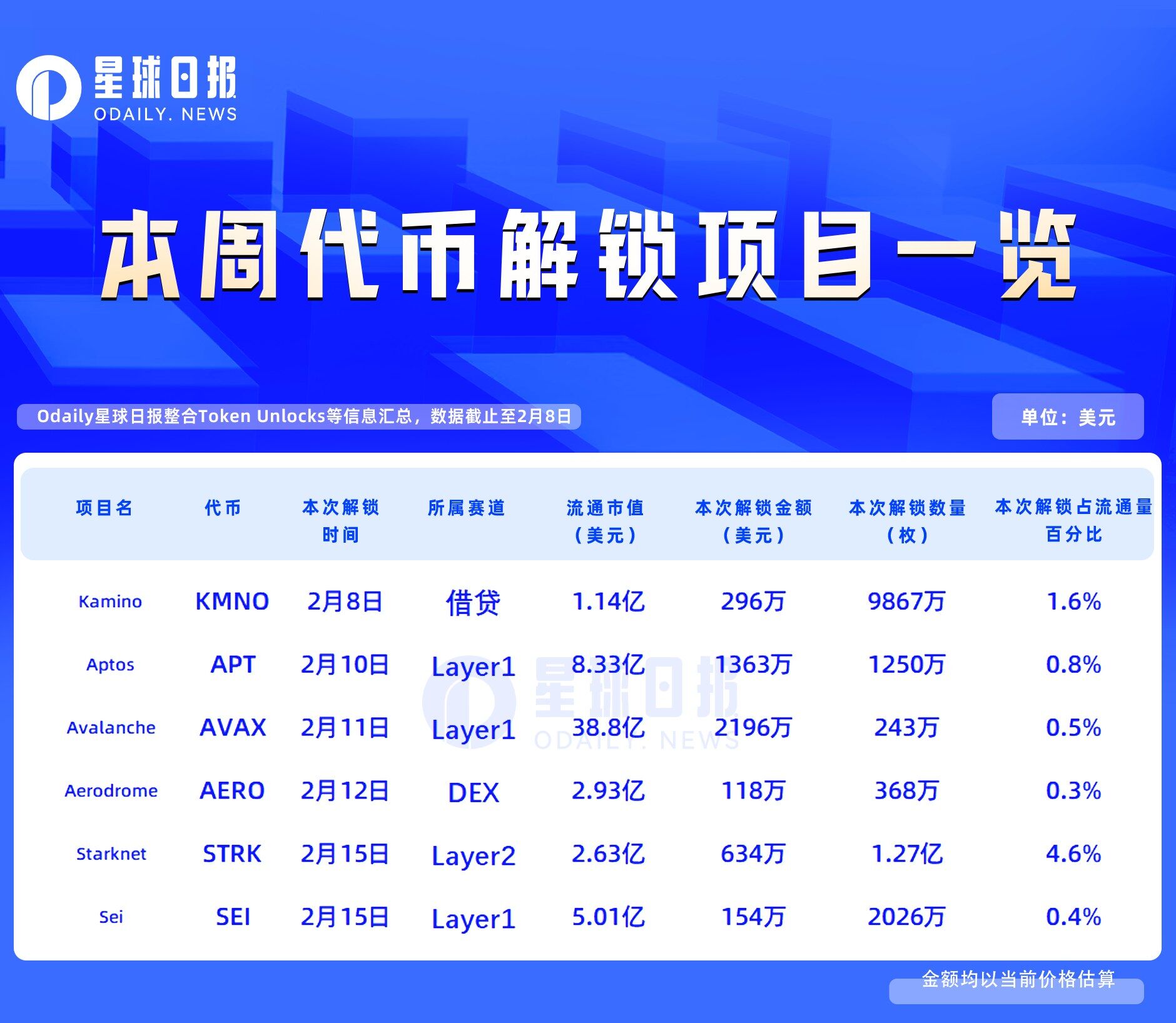
Starknet, sebagai Layer 2 Ethereum yang menggunakan teknologi zk-STARKs, akan membuka kunci 127 juta token STRK senilai sekitar $6,34 juta, setara dengan 4,6% dari pasokan yang beredar. Sementara itu, Kamino, platform likuiditas otomatis di Solana, akan melepas 12,5 juta token KMNO senilai sekitar $13,63 juta. Kedua proyek ini merupakan bagian dari jadwal pelepasan token rutin yang bertujuan meningkatkan skalabilitas dan efisiensi di ekosistem masing-masing.

Starknet

Twitter Proyek:https://twitter.com/Starknet

Situs Web Proyek:https://starknet.io/

Jumlah Pelepasan Kali Ini: 127 juta token

Nilai Pelepasan Kali Ini: Sekitar $6,34 juta

Starknet adalah Layer2 Ethereum, memanfaatkan teknologi zk-STARKs untuk membuat transaksi Ethereum lebih cepat dan biaya lebih rendah. Perusahaan induk StarkNet, StarkWare, didirikan pada tahun 2018, berkantor pusat di Israel, dan produk utama yang dikembangkan di bawahnya adalah Starknet dan StarkEx. Dengan menggunakan STARK, Starknet memverifikasi transaksi dan komputasi tanpa memerlukan semua node jaringan untuk memverifikasi setiap operasi. Ini secara signifikan mengurangi beban komputasi dan meningkatkan throughput jaringan blockchain.

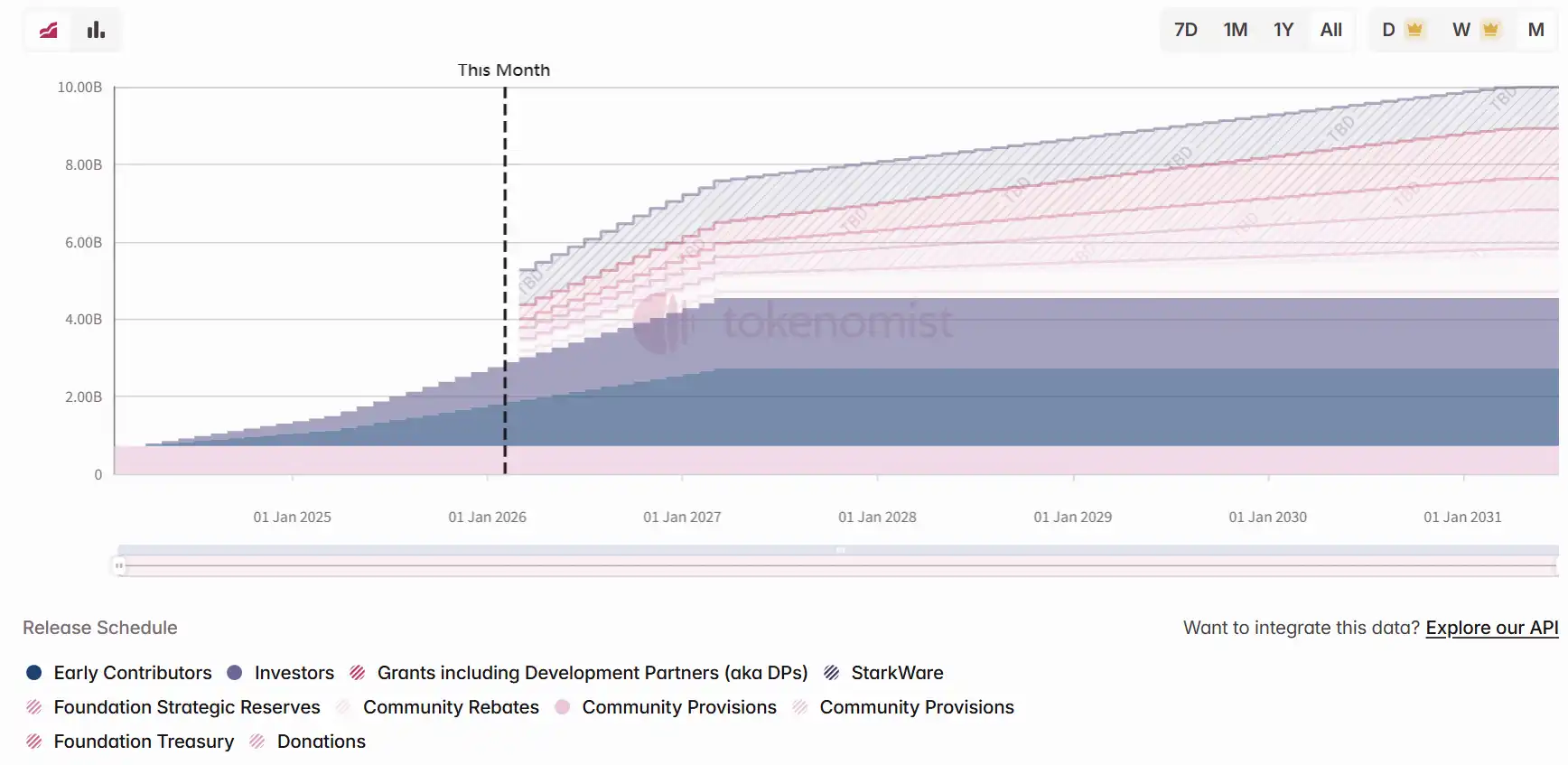
Kurva pelepasan spesifik adalah sebagai berikut:
Kamino

Twitter Proyek:https://x.com/kamino

Situs Web Proyek:https://kamino.finance/

Jumlah Pelepasan Kali Ini: 12,5 juta token

Nilai Pelepasan Kali Ini: Sekitar $13,63 juta

Kamino adalah solusi likuiditas otomatis yang berbasis pada mekanisme market maker likuiditas terkonsentrasi (CLMM). Penyedia Likuiditas (LP) yang mencari efisiensi modal dapat memanfaatkan perpustakaan market maker otomatis Kamino untuk meningkatkan perkiraan imbal hasil dari biaya dan pengembalian. Kamino diinkubasi oleh Hubble Protocol.

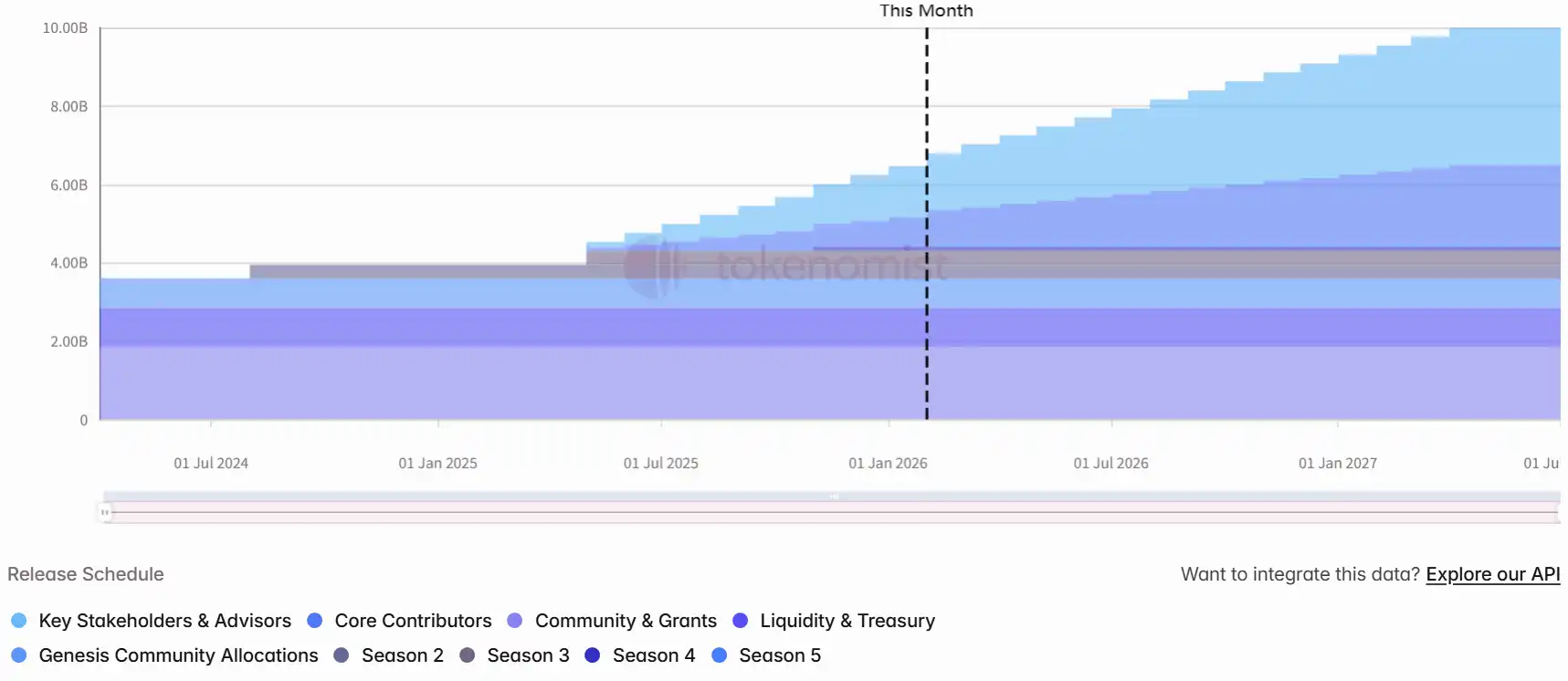
Kurva pelepasan spesifik adalah sebagai berikut:
Пов'язані питання

QApa itu Starknet dan bagaimana cara kerjanya?

AStarknet adalah Layer2 Ethereum yang menggunakan teknologi zk-STARKs untuk membuat transaksi Ethereum lebih cepat dan lebih murah. Dengan menggunakan STARK, Starknet memverifikasi transaksi dan komputasi tanpa memerlukan semua node jaringan untuk memvalidasi setiap operasi, yang secara signifikan mengurangi beban komputasi dan meningkatkan throughput jaringan blockchain.

QBerapa jumlah token STRK yang akan dilepaskan dalam unlock kali ini?

AJumlah token STRK yang akan dilepaskan dalam unlock kali ini adalah 127 juta token.

QApa itu Kamino dan apa yang dilakukannya?

AKamino adalah solusi likuiditas otomatis yang berbasis mekanisme market maker likuiditas terkonsentrasi (CLMM). Platform ini memungkinkan penyedia likuiditas (LP) yang mencari efisiensi modal untuk menggunakan vault market maker otomatis Kamino guna meningkatkan perkiraan imbal hasil dari biaya dan pengembalian.

QBerapa nilai dolar AS dari token KMNO yang akan dilepaskan?

ANilai dolar AS dari token KMNO yang akan dilepaskan adalah sekitar 13,63 juta dolar AS.

QSiapa yang mengembangkan Starknet dan di mana perusahaan induknya berbasis?

AStarknet dikembangkan oleh StarkWare. Perusahaan induknya, StarkWare, didirikan pada tahun 2018 dan berkantor pusat di Israel.

Пов'язані матеріали

The 'Chip' Challenge and Breakthroughs in China's Optical Industry Chain

China's Photonics Industry: Bottlenecks and Breakthroughs In the global AI race, computing chips dominate the narrative, but the underlying bottleneck increasingly defining the scale of AI clusters is light—or more specifically, optical connectivity. Optical modules, which translate electrical signals to light and vice versa, are crucial for connecting thousands of GPUs in AI data centers, preventing data congestion and ensuring efficient model training. High-speed modules (800G, 1.6T) are now standard, with performance hinging on advanced DSP (Digital Signal Processor) chips. This is where a critical dependency lies. Two US giants—Marvell and Broadcom—collectively dominate over 90% of the high-end DSP chip market. Chinese optical module leaders like Zhongji Innolight and Eoptolink rely on these chips to manufacture modules for overseas AI customers, primarily in North America. While this creates a supply chain vulnerability, complete decoupling is difficult. Marvell derives over half its revenue from Greater China, and the US firms depend on Chinese partners for chip packaging and optical components. The risk from laser chips (e.g., from Lumentum), another key component, is considered more manageable due to multiple global suppliers and faster progress in domestic alternatives from companies like YOFC and Accelink. To mitigate risks, China's industry is pursuing a multi-pronged strategy: diversifying supply chains and locking in long-term orders; fostering a domestic market ecosystem to adopt homegrown DSPs from firms like Huawei HiSilicon and CETC; accelerating R&D in high-speed DSPs and advanced packaging; and investing in next-gen technologies like silicon photonics and Co-Packaged Optics (CPO) to reduce reliance on discrete DSPs. The ultimate solution lies not in short-term博弈 but in persistent advancement of domestic high-end chip R&D and manufacturing. While challenges remain in performance, certification, and ecosystem building, China's vast domestic market and manufacturing base provide a crucial buffer, buying time for the industry to achieve greater technological independence.

marsbit4 хв тому

The 'Chip' Challenge and Breakthroughs in China's Optical Industry Chain

marsbit4 хв тому

Behind SpaceX's $2 Trillion Market Cap: Why Does Musk Always Have the Next Move Planned?

On June 12th, SpaceX debuted on the Nasdaq, reaching a valuation that briefly touched $2 trillion. This marked the culmination of a 24-year journey from its founding in 2002, driven by Elon Musk's frustration at the high cost of buying rockets. The company's path was defined by early failures, with its first three Falcon 1 launches ending in explosions before a successful 2008 flight opened the era of commercial spaceflight. Key to its model was a fixed-price NASA contract, incentivizing cost reduction. SpaceX mastered rocket reusability, first achieving a Falcon 9 landing in 2015, which drastically cut launch costs. This enabled its profitable Starlink satellite internet constellation, envisioned years before reusability was proven, to create an internal market for frequent launches. Similarly, the next-generation Starship rocket was in development long before its first flight, with its business case evolving from Mars colonization to supporting the emerging concept of in-orbit data centers for AI—a story now central to its valuation. The company's recent IPO, a reversal of its long-standing "no IPO" stance, is funding this ambitious "space-based compute" vision. While major tech players like Google, Blue Origin, and others are investing heavily, significant technical and cost hurdles remain. Ultimately, SpaceX's history is one of creating its own demand: first with Starlink and now with space-based AI compute, betting that its next rocket will enable its next giant market.

marsbit7 хв тому

Behind SpaceX's $2 Trillion Market Cap: Why Does Musk Always Have the Next Move Planned?

marsbit7 хв тому

When Crypto Meets the World Cup: CoinW and Modrić's Art of "Navigating Cycles"

When Encryption Meets the World Cup: CoinW and Modrić's "Transcending Cycles" Philosophy In the context of the 2026 FIFA World Cup and its massive global audience, the crypto exchange CoinW announced football legend Luka Modrić as its global brand ambassador. This move is framed not merely as a marketing tactic, but as a strategic experiment in user profile migration. It targets mature, financially stable football fans—particularly in Europe, Southeast Asia, and Latin America—who traditionally have low crypto awareness but value trusted, time-tested authority figures like Modrić. The article draws parallels between Modrić's enduring, disciplined career—marked by consistency and success at the highest level over two decades—and CoinW's own development path. Founded in 2017 during a volatile industry period, CoinW focused on building robust infrastructure and risk management. It weathered the 2022 industry crisis without major security incidents, subsequently earning recognition like "Europe's Most Trusted Exchange" and growing to over 20 million registered users. This "long-termism" is translated into user-centric products. CoinW Academy lowers the initial knowledge barrier. Its integrated ecosystem (CoinW, GemW, DeriW, PropW) and the recent launch of a TradFi section—offering perpetual contracts on traditional assets like stocks, gold, and oil—aim to create a unified platform for diverse assets. For the World Cup, CoinW launched the "We Are The Game" campaign, collaborating with Alchemy Pay to offer zero-fee deposits and local payment options, aiming to transform spectators into participants and lower entry barriers. Ultimately, CoinW's sports partnerships and product strategy are presented as a concerted effort to build trust and accessibility for the "silent majority" still outside crypto—shifting the industry narrative toward inclusivity and long-term value.

Foresight News13 хв тому

When Crypto Meets the World Cup: CoinW and Modrić's Art of "Navigating Cycles"

Foresight News13 хв тому

A Panoramic View of the Solana Privacy Ecosystem: The Complete Privacy Stack from Computation to AI

**Solana Privacy Ecosystem: A Comprehensive Overview from Computation to AI** Solana's privacy ecosystem, while nascent, is rapidly evolving to address key challenges across multiple layers. Key figures like Helius CEO Mert acknowledge that Solana has lagged in privacy but highlight its unique potential for scalable, composable privacy protocols, potentially leveraging technologies like ZK compression without persistent rollups. The foundational layer is **Private Compute**, addressed by providers like Arcium and Magic Block. Arcium utilizes Multi-Party Computation (MPC) networks to process encrypted data off-chain with final settlement on Solana, supporting use cases like confidential payments (via its C-SPL token standard) and encrypted data analysis. Magic Block employs Trusted Execution Environments (TEEs) to create private, ephemeral rollups, offering confidentiality, scalability, and composability. Both enable private order books, dark pools, and DeFi rails. Building on this infrastructure are applications for **Private Transfers and Balances**. Umbra, built on Arcium, offers encrypted token accounts with amount, balance, and sender-receiver linkage privacy, plus compliance features. Privacy Cash uses Tornado-style shielded pools for SOL, while Hush provides private staking and trading with integrated swaps via Jupiter. To eliminate **On-Chain Trails** from everyday activities like trading, protocols like encifherio and VanishTrade are emerging. encifherio privately routes swaps through Jupiter by encrypting transaction details within TEEs. VanishTrade routes trades through shielded liquidity pools. Darklake offers a ZK-native "blind slippage" AMM and private perpetuals to hide trading intent and prevent front-running. More advanced applications include **Private Prediction Markets**. Platforms like Melee Markets use Arcium's MPC to encrypt order books, allowing participants to place hidden bets without revealing their market position until settlement. Finally, the ecosystem is expanding into **Private AI**. Loyal leverages both Magic Block and Arcium to create a decentralized protocol where user-AI interactions, queries, and preferences are encrypted on-chain, giving users ownership and control over their data while enabling private transactions and yield generation. In summary, Solana's privacy stack is developing from core compute and transfer privacy towards sophisticated applications in DeFi, prediction markets, and AI, aiming for a future where Fully Homomorphic Encryption (FHE) and Zero-Knowledge (ZK) proofs combine for a complete privacy solution.

marsbit14 хв тому

A Panoramic View of the Solana Privacy Ecosystem: The Complete Privacy Stack from Computation to AI

marsbit14 хв тому

Торгівля

Спот
Ф'ючерси

Популярні статті

Як купити STRK

Ласкаво просимо до HTX.com! Ми зробили покупку Starknet (STRK) простою та зручною. Дотримуйтесь нашої покрокової інструкції, щоб розпочати свою криптовалютну подорож.Крок 1: Створіть обліковий запис на HTXВикористовуйте свою електронну пошту або номер телефону, щоб зареєструвати обліковий запис на HTX безплатно. Пройдіть безпроблемну реєстрацію й отримайте доступ до всіх функцій.ЗареєструватисьКрок 2: Перейдіть до розділу Купити крипту і виберіть спосіб оплатиКредитна/дебетова картка: використовуйте вашу картку Visa або Mastercard, щоб миттєво купити Starknet (STRK).Баланс: використовуйте кошти з балансу вашого рахунку HTX для безперешкодної торгівлі.Треті особи: ми додали популярні способи оплати, такі як Google Pay та Apple Pay, щоб підвищити зручність.P2P: Торгуйте безпосередньо з іншими користувачами на HTX.Позабіржова торгівля (OTC): ми пропонуємо індивідуальні послуги та конкурентні обмінні курси для трейдерів.Крок 3: Зберігайте свої Starknet (STRK)Після придбання Starknet (STRK) збережіть його у своєму обліковому записі на HTX. Крім того, ви можете відправити його в інше місце за допомогою блокчейн-переказу або використовувати його для торгівлі іншими криптовалютами.Крок 4: Торгівля Starknet (STRK)Легко торгуйте Starknet (STRK) на спотовому ринку HTX. Просто увійдіть до свого облікового запису, виберіть торгову пару, укладайте угоди та спостерігайте за ними в режимі реального часу. Ми пропонуємо зручний досвід як для початківців, так і для досвідчених трейдерів.

184 переглядів усьогоОпубліковано 2024.12.10Оновлено 2026.06.02

Як купити STRK

Обговорення

Ласкаво просимо до спільноти HTX. Тут ви можете бути в курсі останніх подій розвитку платформи та отримати доступ до професійної ринкової інформації. Нижче представлені думки користувачів щодо ціни STRK (STRK).

活动图片













