Bitcoin Heads for Bullish Monthly Close

Crypto BriefingОпубліковано о 2022-08-01Востаннє оновлено о 2022-08-01

Анотація

Bitcoin is about to close the July in the green, with multiple technical indicators turning bullish.

Key Takeaways

Bitcoin surged by nearly 18% in July.

As the monthly close approaches, several indicators point to bullish price action for the top crypto.

Bitcoin needs to hold above $20,650 to advance toward $31,340.

-
-

Bitcoin is approaching the monthly candlestick close with strength as it holds above a significant area of support.

Bitcoin to Close July in the Green

Bitcoin is about to close July in the green while one technical indicator looks ready to flash a buy signal.

The leading cryptocurrency surged by nearly 18% in July after enduring a brutal 56% correction in the second quarter. The upward price action seen over the past month coincides with improving market sentiment. Although the U.S. economy has entered a so-called “technical recession” after two consecutive quarters of negative growth, investors are indicating that they believe that the weak macroeconomic conditions have been priced in.

From a technical perspective, Bitcoin is holding around the 50-month moving average. Meanwhile, the Tom DeMark (TD) Sequential indicator looks like it’s about to present a buy signal in the form of a red nine candlestick on the monthly chart. The bullish formation anticipates a one to four monthly candlesticks upswing or the beginning of a new uptrend.

Bitcoin US dollar price chart
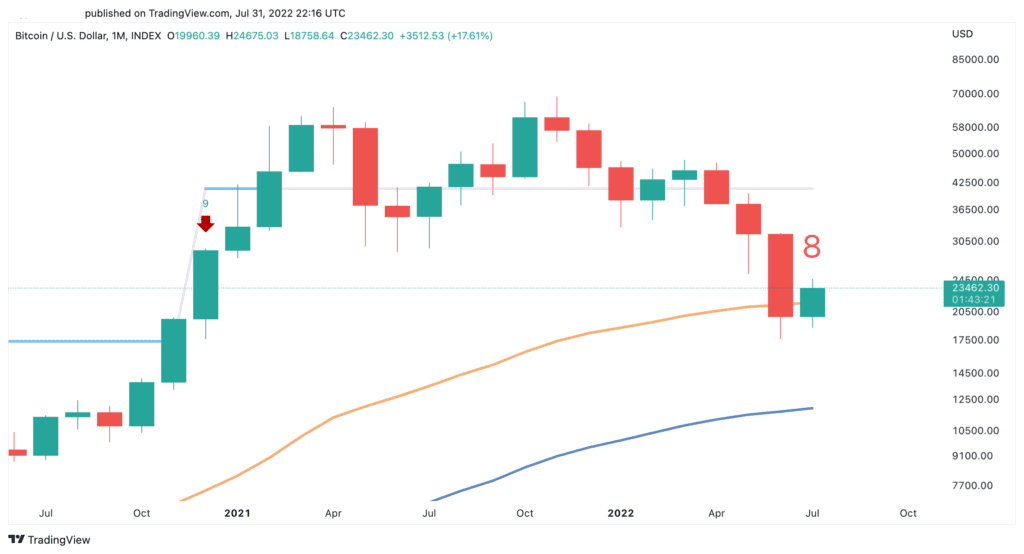
BTC/USD monthly chart (Source: TradingView)

Transaction history shows the importance of the 50-month moving average. Roughly 3.67 million addresses have purchased 2.47 million BTC at an average price of $20,650. If this significant demand wall continues to hold, Bitcoin has a chance of validating the optimistic outlook.

Further buying pressure around the 50-month moving average could push Bitcoin toward $31,340 as IntoTheBlock’s Global In/Out of the Money model shows little to no resistance ahead.

Bitcoin Transaction History
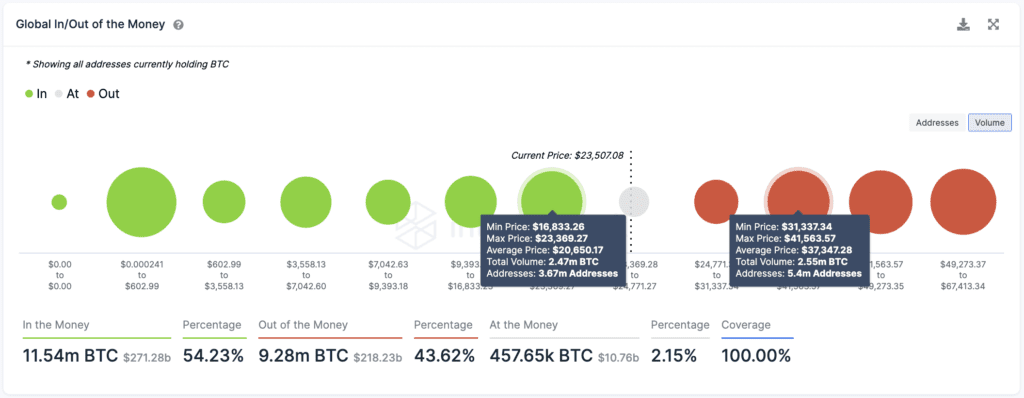
Bitcoin’s GIOM (Source: IntoTheBlock)

It is worth noting that a loss of the $20,650 support level could lead to a major downturn. Dipping below this interest area could cause panic among investors, leading to potential sell-offs as market participants look to avoid further losses. The potential sell-off could push Bitcoin to the next crucial area of support, which sits at around $11,600.


Пов'язані матеріали

NVIDIA CPU Advances, China's RISC-V Responds: Semiconductor Deep Dive - Part Four

NVIDIA is set to launch its new Vera AI data center CPU in China as early as August, with high pricing. While this move offers a new option, it highlights China's continued dependence on foreign-controlled Arm architecture. In response, the Chinese semiconductor industry is increasingly turning to RISC-V as a strategic alternative for achieving high-performance computing autonomy. The article explores the concept of the "impossible triangle" in CPU development—balancing prosperity, control, and autonomy—and posits that RISC-V's open-source, modular nature offers a unique path to achieving all three. While RISC-V is already dominant in embedded systems, the focus is now shifting to data centers and AI workloads. China has become a global hotspot for RISC-V development, driven by AI-driven compute demand, supply chain concerns from export controls, cost benefits of open-source, and strong policy support. Multiple Chinese companies have reportedly crossed the key performance threshold of 15 SPECint per GHz, a benchmark for entering the high-performance CPU club. Progress extends beyond single-core benchmarks. Companies are developing complete computing subsystems, including commercial-grade coherent network-on-chip (NoC) technology and server processors with up to 40 cores that strictly adhere to the RVA23 standard to ensure software compatibility. Real-world applications are emerging in areas like video transcoding and edge AI. However, significant challenges remain. The RISC-V ecosystem faces fragmentation, immature toolchains and verification processes, and gaps in single-core performance and energy efficiency compared to mature x86 and Arm architectures. The formidable software moat, epitomized by NVIDIA's CUDA, is a long-term hurdle. In conclusion, while RISC-V cannot immediately replace offerings like NVIDIA's Vera, it represents a viable long-term path for China to develop a self-sufficient, high-performance CPU ecosystem. The journey is acknowledged to be long and arduous, requiring sustained effort to overcome technical and ecosystem challenges.

marsbit6 год тому

NVIDIA CPU Advances, China's RISC-V Responds: Semiconductor Deep Dive - Part Four

marsbit6 год тому

Торгівля

Спот
Ф'ючерси
活动图片