From Satoshi to Saylor: The Crypto Undercurrent in the Epstein Files

比推Опубліковано о 2026-02-03Востаннє оновлено о 2026-02-03

Анотація

Recent disclosures from the "Epstein Files" reveal significant, previously unknown connections between the late financier Jeffrey Epstein and the cryptocurrency industry. As early as 2011, Epstein was aware of Bitcoin, calling it a "brilliant idea" with "serious flaws." The documents show he was involved in discussions about Bitcoin's nature, invested in the seed round of infrastructure firm Blockstream, and received updates on market developments from figures like a16z's Steven Sinofsky. The files suggest Epstein may have met with "some Bitcoin creators," potentially including Satoshi Nakamoto, raising questions about Bitcoin's origins and the U.S. government's knowledge. He also proposed creating Sharia-compliant digital currencies to Middle Eastern contacts. Additionally, the documents include a harsh critique of MicroStrategy CEO Michael Saylor from 2010, describing him as a socially awkward "weirdo" at one of Epstein's parties. The revelations, which also involve investments in projects like Ripple and Stellar, hint at a deeper, hidden history of crypto's early days, with more information potentially yet to be disclosed.

Author: Cookie, Block Rhythm BlockBeats

Original Title: Claimed to Have Met Satoshi, Called Saylor a Freak: The Crypto Secrets in the Epstein Files


On January 30, the U.S. Department of Justice disclosed a large number of "Epstein Files" for the first time, immediately attracting widespread attention and discussion globally. While we were seeing whether Musk "went to the island," Bill Gates's extramarital affair, or the next Fed chairman nominee Kevin Warsh also appeared on Epstein's party invitation list, these newly disclosed files also dropped a series of bombshells about the cryptocurrency industry.

The history of the cryptocurrency industry may have finally revealed the tip of the iceberg and could be rewritten from now on.

Was Epstein a "Crypto OG"?

As early as 2011, Epstein had already taken notice of Bitcoin. That year, Bitcoin's total annual trading volume had not yet exceeded $100 million, and its price had surged past $30 only to plummet by 90%.

The email below is dated June 12, 2011, right around the peak of Bitcoin's price that year. Epstein stated in the email, "Bitcoin is a brilliant idea, but it has some serious drawbacks."
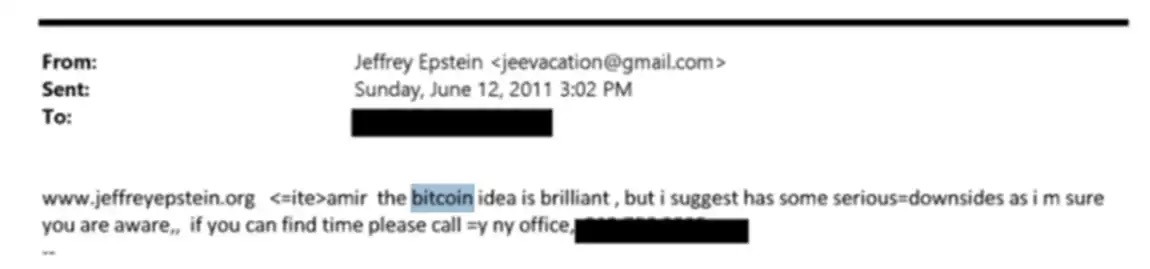
In 2013, the frequency of cryptocurrency mentions in Epstein's correspondence increased.

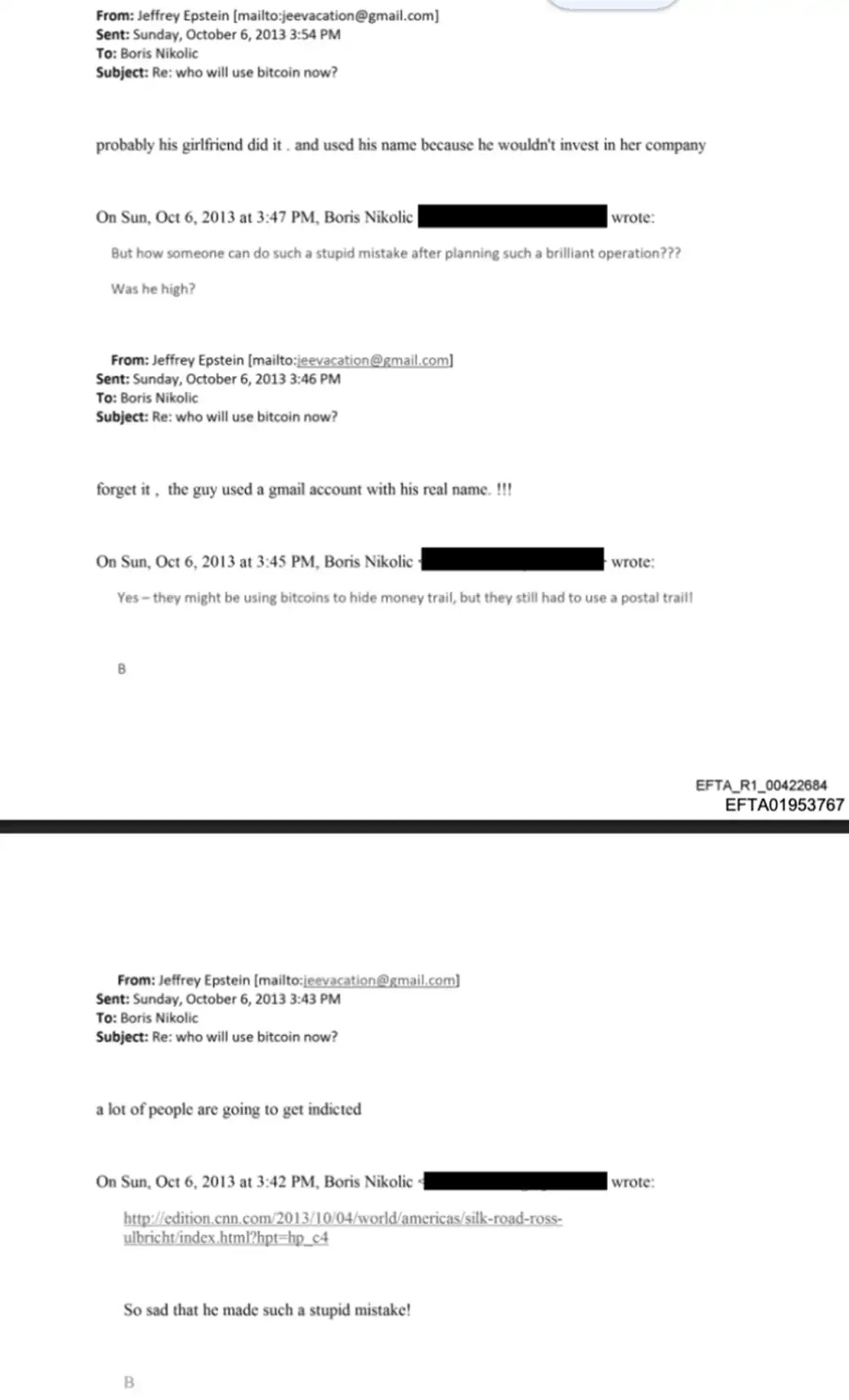
First, in an email exchange with Boris Nikolic (who once served as Bill Gates's chief technology advisor and was named in Epstein's will), the subject was "Who uses Bitcoin now?" They sarcastically discussed Ross Ulbricht, the founder of Silk Road who was arrested that year, saying that Ross's use of a Gmail account with his real name was a stupid mistake.
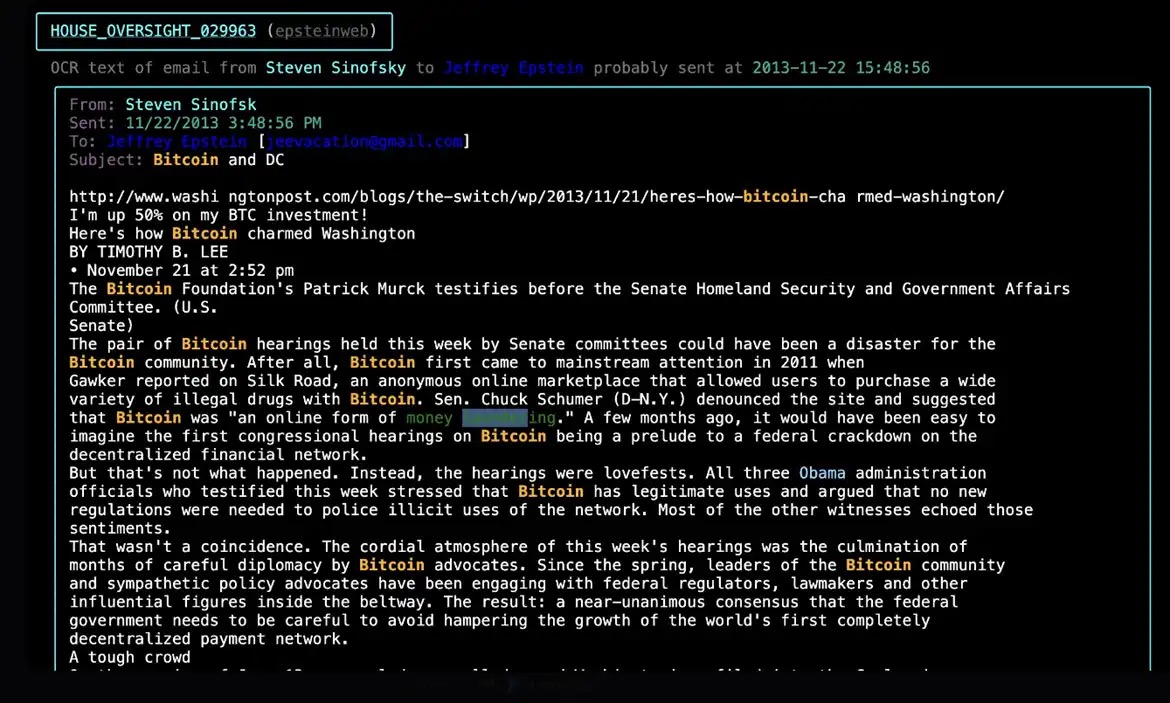
a16z board partner and former president of Microsoft's Windows division, Steven Sinofsky, emailed Epstein to say that his Bitcoin investment had increased by 50% and shared Timothy B. Lee's article "How Bitcoin Captivated Washington."
He also received news that the once-famous Bitcoin website Satoshi Dice had been sold for $11.4 million.
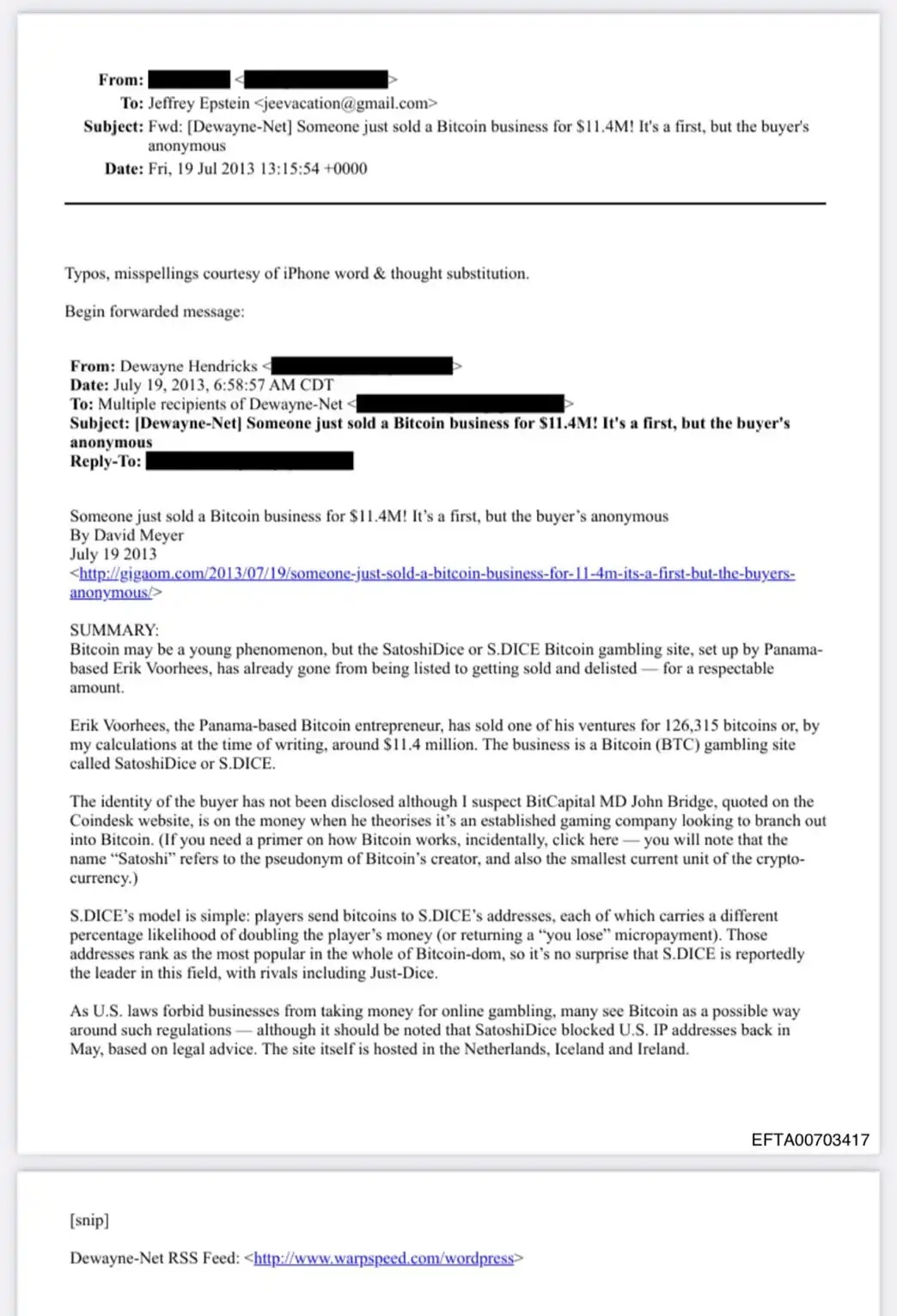
In 2014, Epstein engaged in an in-depth discussion with PayPal co-founder Peter Thiel about the nature of Bitcoin.
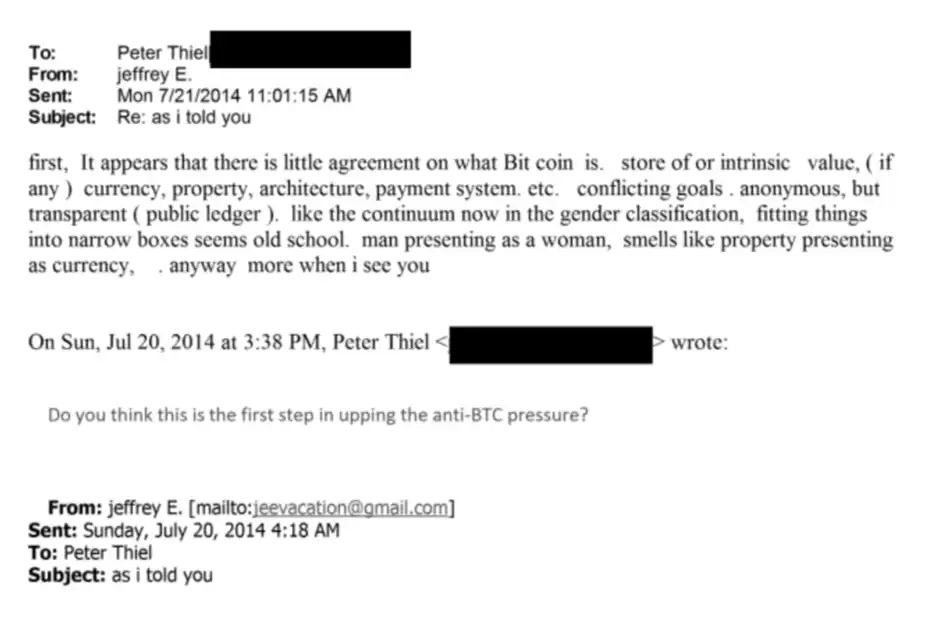
"There is no consensus on what Bitcoin is—a store of value, a currency, or property... It's like a man dressing as a woman, like property masquerading as currency."

This exchange shows that Epstein was very familiar with the ideological debates surrounding Bitcoin's nature in the early stages of the cryptocurrency market. He even compared it to gender identity.

Another email revealed that Epstein participated in the seed round funding of Bitcoin infrastructure company Blockstream. The round totaled $18 million, and Epstein's investment increased from $50,000 to $500,000.
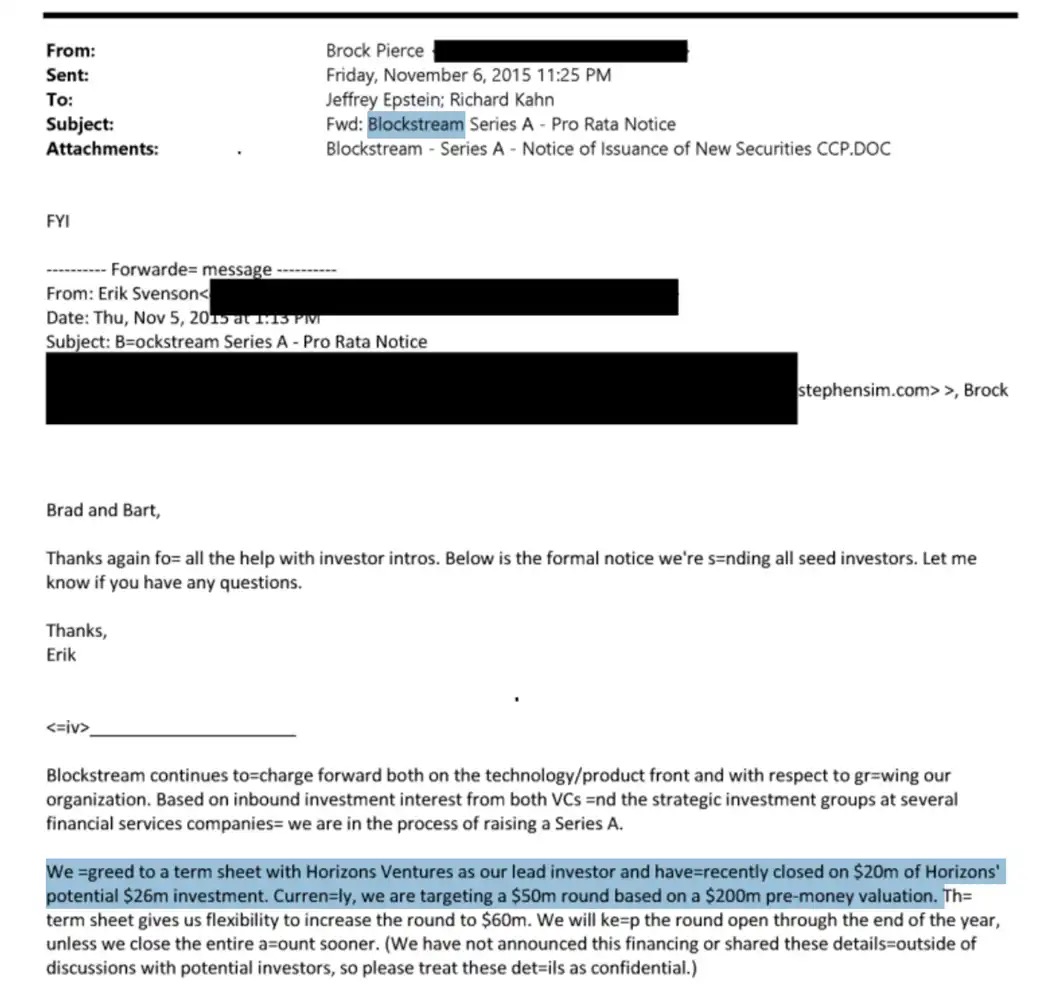
Blockstream CEO Adam Back recently issued a statement denying any direct or indirect financial connection between the company and Epstein or his estate. He explained that Epstein was a limited partner in a fund that once held a minority stake in Blockstream but had since fully divested.

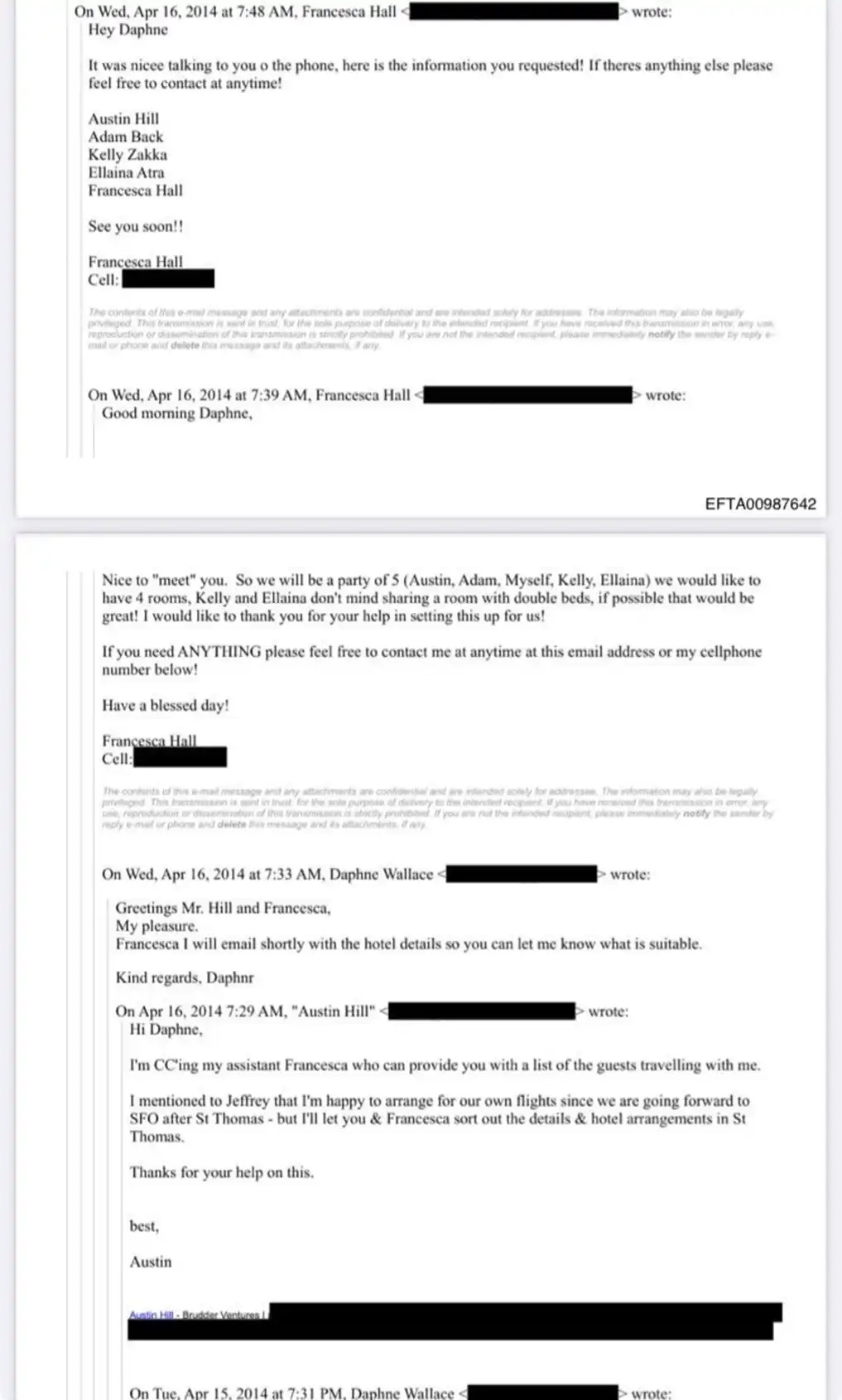
However, the names of Adam Back and Austin Hill (Blockstream co-founder) appeared in travel arrangement emails for St. Thomas Island (about 2 miles from "Epstein Island"):
Additionally, in 2014, Austin Hill emailed Epstein and Joi Ito (former director of the MIT Media Lab; Epstein invested in Blockstream through his fund). He stated that Ripple ($XRP) and Stellar (a new project by Ripple founder Jed McCaleb after leaving Ripple) negatively impacted the ecosystem Blockstream was building and harmed Blockstream because their investors were "backing two horses in the same race."
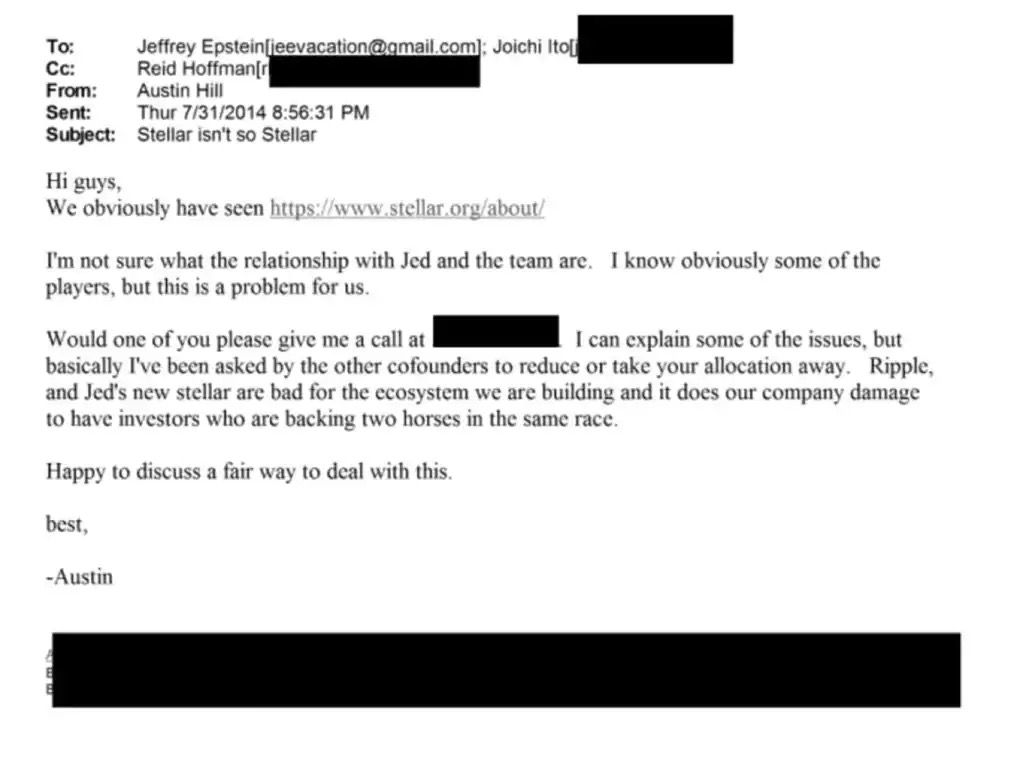
There is some divergence in the English-speaking community regarding the interpretation of this. Based on the context, I personally tend to adopt the interpretation that Epstein may have also invested in Ripple/Stellar at the time, which displeased Blockstream. This led Austin Hill to state in the email, "I was asked by other co-founders to reduce or even cancel your allocation."

Although Ripple and Stellar's growth was not affected, we do not know if more, unknown, excellent cryptocurrency projects have been stifled in their infancy through such behind-the-scenes pressure, from then until now.

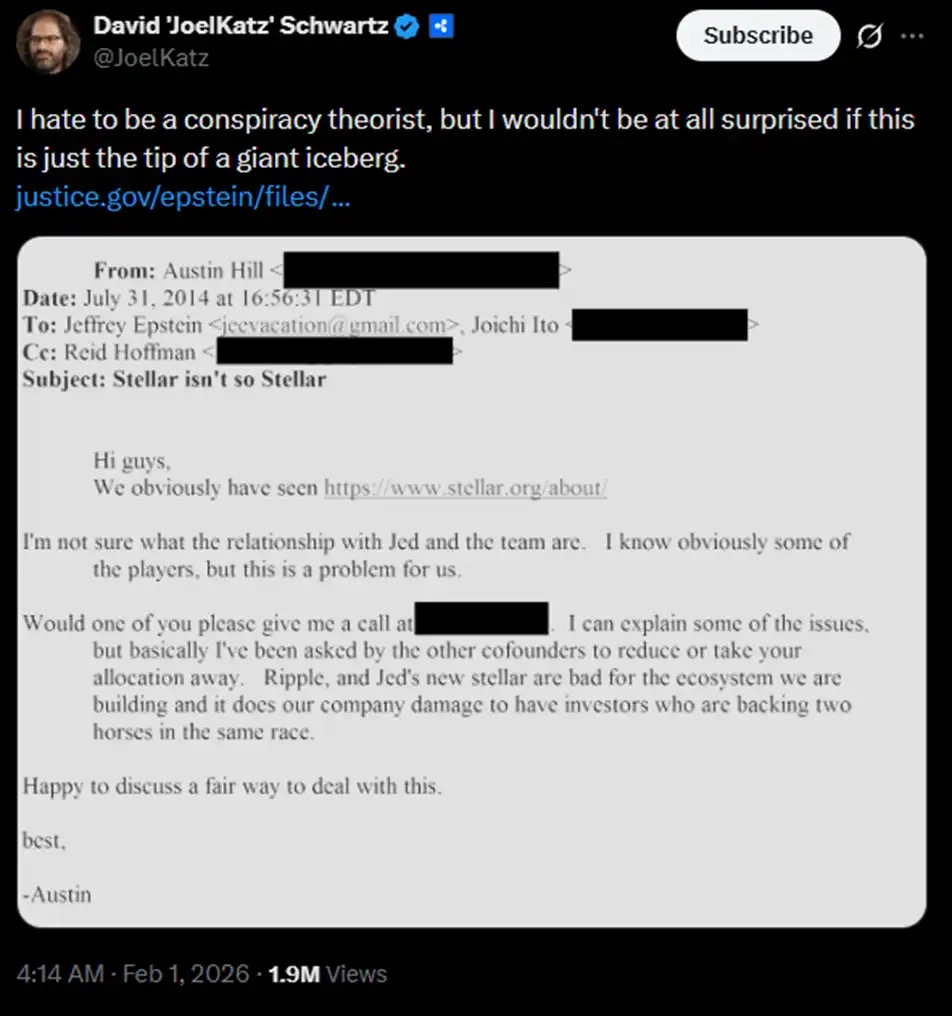
In response, former Ripple CTO David Schwartz tweeted, "I don't want to be a conspiracy theorist, but if this is just the tip of the iceberg, I wouldn't be surprised at all."
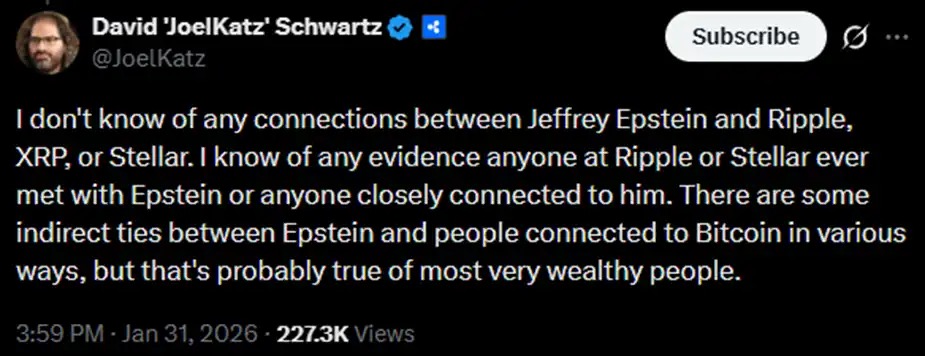
So, does this mean Epstein's evil also existed in the cryptocurrency field? David Schwartz also stated that for most ultra-wealthy individuals, having some connection to Bitcoin is probably very common.
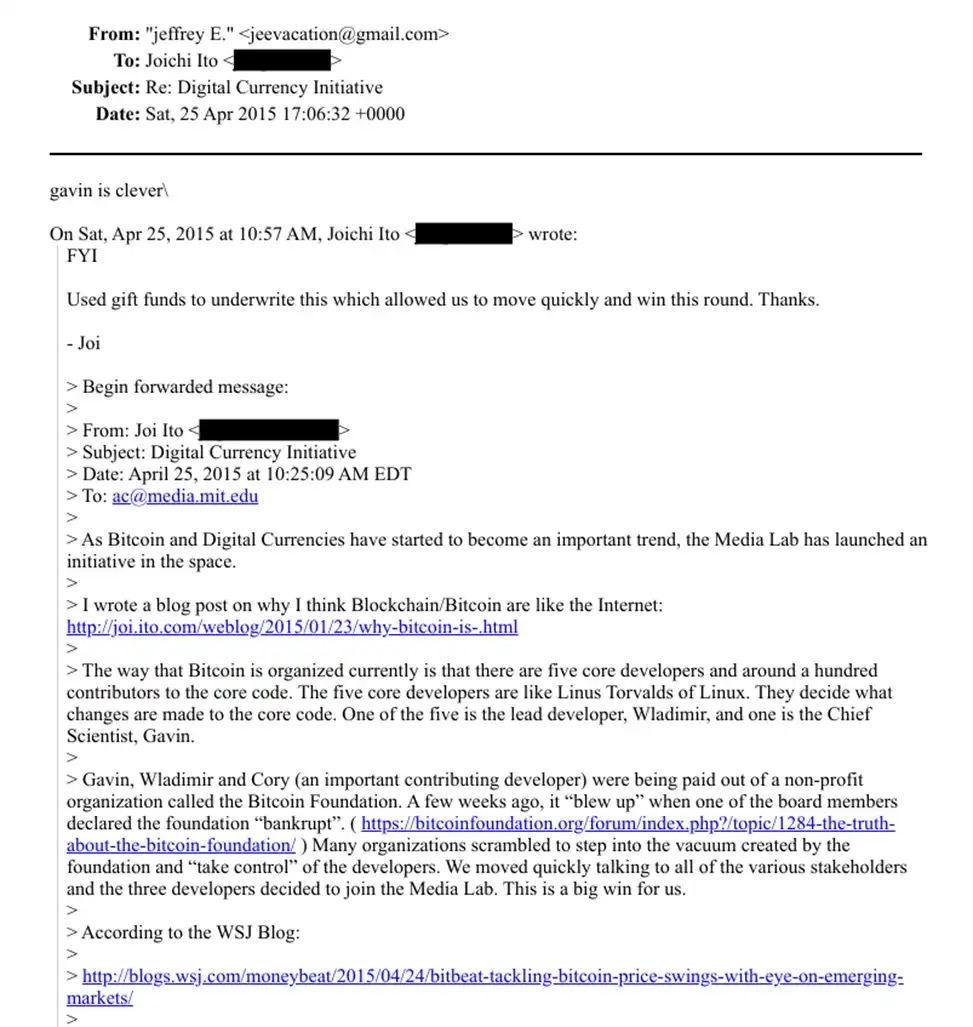
Furthermore, in 2014-2015, the collapse of the Bitcoin Foundation left Bitcoin Core developers without stable salaries. The MIT Media Lab's Digital Currency Initiative (DCI) began paying salaries to several Bitcoin Core developers. As a result, three Bitcoin Core developers—Gavin Andresen, Wladimir van der Laan, and Cory Fields—decided to join the MIT Media Lab.

At that time, the scandal had not yet broken, and the public was unaware of Epstein's anonymous donations to the MIT Media Lab. Joi Ito thanked Epstein via email, not only explaining Bitcoin's development operations to Epstein but also stating that thanks to this money, the lab was "able to move quickly and score a huge victory" because "many organizations wanted to take advantage of the situation to control Bitcoin's developers."

Epstein's reply was a simple compliment about Gavin Andresen: "Gavin is very smart."
Did Epstein Meet Satoshi?

In 2016, Epstein emailed Saudi Royal Court advisor Raafat AlSabbagh and current Abu Dhabi Department of Culture and Tourism advisor Aziza Al Ahmadi with two "radical ideas for creating two new currencies." One was a "Sharia" dollar. Just as all U.S. dollar bills have "In God We Trust," the Middle East could have its own "Sharia" dollar for internal use.
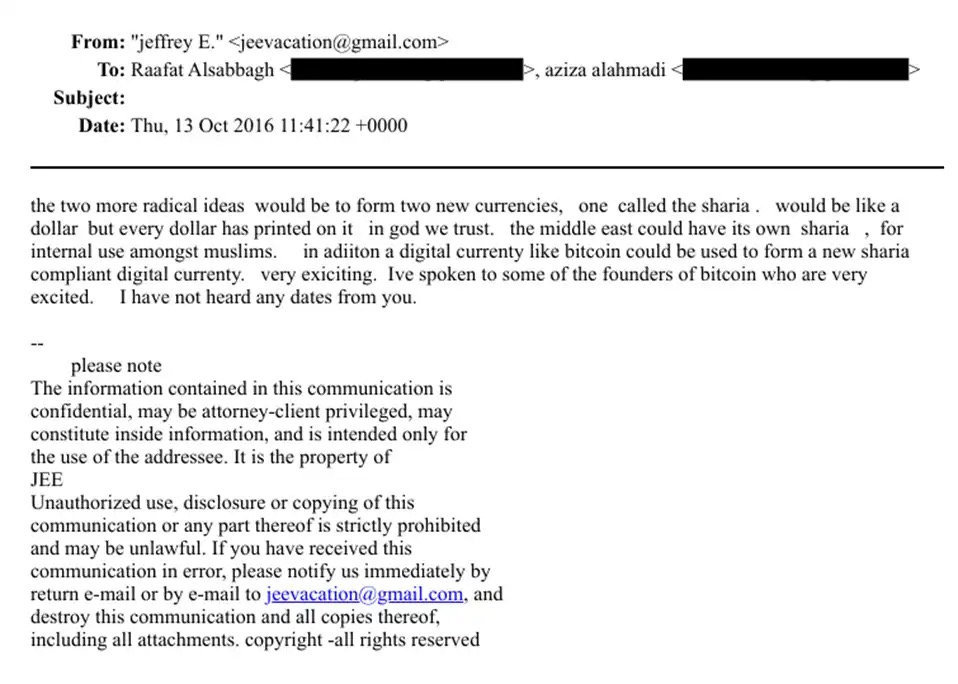
The other idea was to create a digital currency like Bitcoin to make money compliant with Sharia law. Then, after this idea, he casually and lightly dropped this piece of information:

"I have spoken with some of the Bitcoin creators, and they are very excited."

Epstein's purpose at the time might have been more about showing off his connections to enhance his reliable image, so he mentioned it offhand. But this could completely rewrite the history of Bitcoin and even the entire cryptocurrency industry. "Some Bitcoin creators"—does this mean Satoshi Nakamoto was not an individual but a team? If so, many mysteries surrounding Satoshi Nakamoto would have a reasonable explanation.

There are even more thought-provoking questions. Who was this team? What was their motivation for creating Bitcoin? If Epstein really met them, how did he initially find out who they were and establish a relationship with them? If even Epstein knew who created Bitcoin, wouldn't the U.S. government know? What motives does the U.S. government, which has remained silent on this issue, have?

After this latest batch of Epstein files was disclosed, the possibility of "Satoshi Nakamoto's Bitcoin address taking action in 2026" on the prediction market Polymarket rose from about 6% to about 9.3% and is currently holding at 8%.
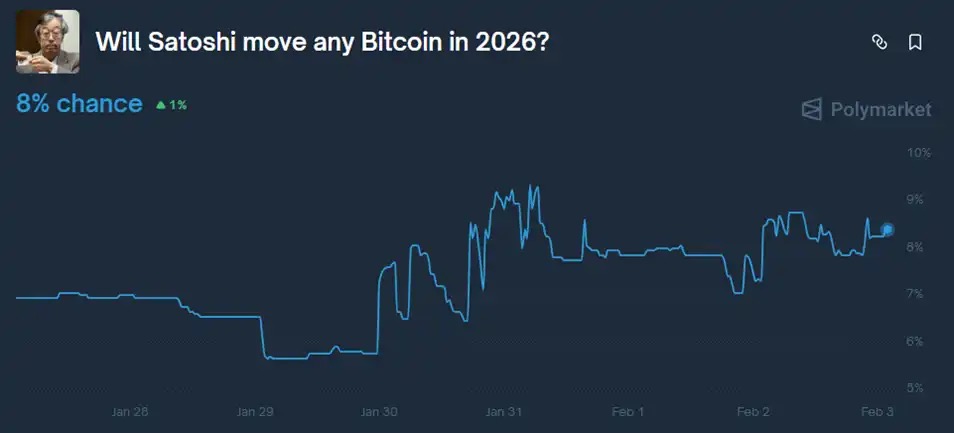
If Epstein did meet Satoshi Nakamoto, it seems Satoshi was not successful in evangelizing Bitcoin to him during their contact. In an email exchange on August 31, 2017, when asked "Is it worth buying a Bitcoin?" Epstein simply said "No." At that time, one Bitcoin was less than $5,000.

Whether Epstein actually met Satoshi Nakamoto is still unknown. However, we do know that he met the now most famous Bitcoin bull—MicroStrategy CEO Michael Saylor.

For years, Saylor's determination to only buy and never sell Bitcoin has been堪称变态 (abnormal/perverse, used here for emphasis on his extreme behavior). But in 2010, he was not yet famous for this identity.

That year, Comrade Saylor spent $25,000 to attend a party organized by Epstein's publicist Peggy Siegal and initially displayed his "autistic" traits at the event. This is how Peggy Siegal described Saylor:
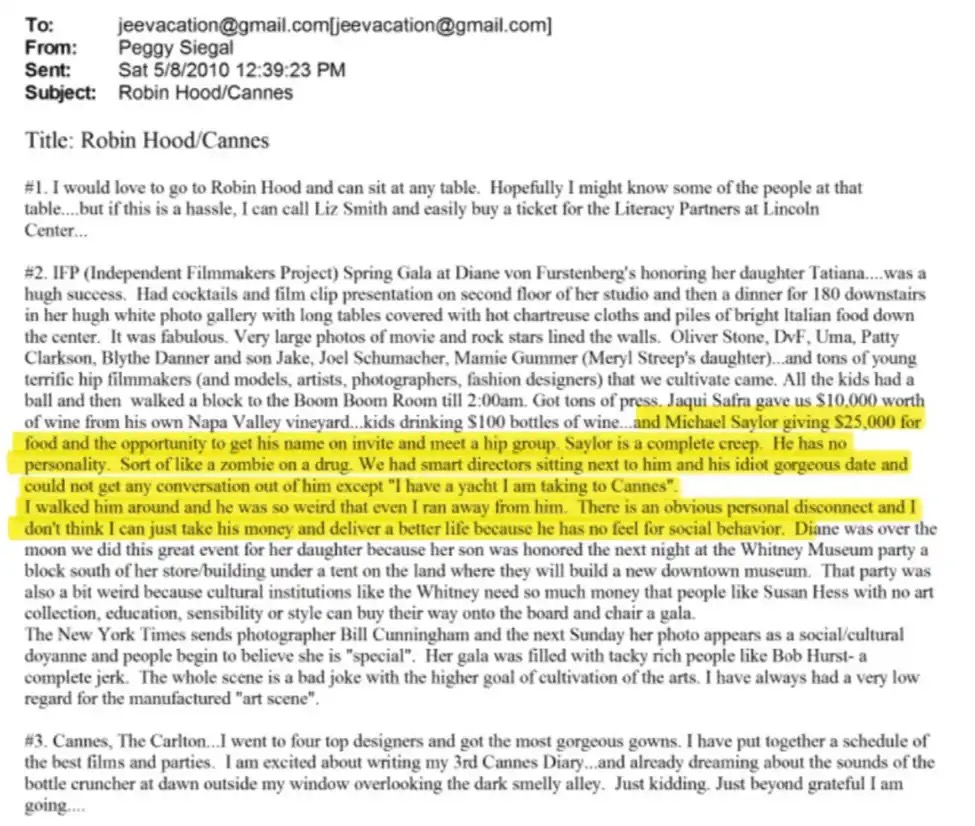
"This guy is a total freak, completely charmless, like a zombie on a drug overdose. We had smart directors at our party, sitting right next to him and his pretty, idiotic chick, and besides 'I have a yacht' and 'I'm going to Cannes,' there was no conversation. I took him around, but he was so weird I just had to run away. He has no personality and no social skills. I don't even know how to get money from him."

Being called变态 (freak/weirdo) by a变态 (freak/weirdo, referring to Epstein's associates) shows just how变态 Saylor) Saylor really is. Perhaps only a creation as great as Bitcoin could accommodate a变态 like Saylor and allow him to build a great career.

Conclusion

About half of the Epstein files have not yet been disclosed. How many more bombshells related to the cryptocurrency industry are hidden in these remaining files?

Will time clear the fog?


Twitter:https://twitter.com/BitpushNewsCN

Bitpush TG Discussion Group:https://t.me/BitPushCommunity

Bitpush TG Subscription: https://t.me/bitpush

Original link:https://www.bitpush.news/articles/7608204

Трендові криптовалюти

Пов'язані питання

QWhat was Jeffrey Epstein's initial opinion on Bitcoin in 2011, and what did he identify as its key issue?

AIn 2011, Jeffrey Epstein described Bitcoin as 'a brilliant idea' but noted that it had 'some serious drawbacks.'

QWhich prominent Bitcoin infrastructure company did Epstein invest in through a fund, and what was the controversy surrounding his involvement?

AEpstein invested in Blockstream's seed round through a fund, initially putting in $50,000 which grew to $500,000. Blockstream's CEO later denied any direct or indirect financial ties, stating Epstein was a limited partner in a fund that held a minority stake and had fully divested.

QWhat startling claim did Epstein make in a 2016 email regarding the creators of Bitcoin?

AIn a 2016 email, Epstein claimed, 'I have been meeting with some of the bitcoin creators and they are very excited,' suggesting he may have had contact with Satoshi Nakamoto or the founding team.

QHow did Epstein's associate, Peggy Siegal, describe MicroStrategy CEO Michael Saylor after meeting him at a party?

APeggy Siegal described Michael Saylor as a 'complete freak' with 'no charm,' comparing him to a 'zombie on too many drugs.' She found him socially awkward and difficult to engage with.

QWhat role did Epstein's donations to the MIT Media Lab play in the Bitcoin ecosystem?

AEpstein's anonymous donations to the MIT Media Lab allowed its Digital Currency Initiative (DCI) to fund the salaries of key Bitcoin Core developers like Gavin Andresen, Wladimir van der Laan, and Cory Fields, which the lab's director saw as a crucial move to prevent other organizations from controlling the developers.

Пов'язані матеріали

Breaking: Google Earth Urgently Pulls Back Nano Banana 2 Image Generation Feature!

Google Earth's newly launched "Create image" feature, powered by the Nano Banana 2 AI image generation model, was abruptly withdrawn shortly after its release due to being "played" by users. The feature allowed users to generate and overlay AI-created visuals directly onto real-world satellite and 3D maps in Google Earth. The tool enabled creative applications like historical recreations (e.g., visualizing ancient Pompeii), generating informational graphics for landmarks, and envisioning architectural projects or futuristic cityscapes on real terrain. It operated under "geospatial grounding," meaning the AI respected the underlying geography, topography, and perspective of the chosen map view. The model also integrated with Gemini to retrieve relevant factual information. However, upon release, users quickly tested its limits. A prominent example involved reimagining Philadelphia's historic Independence Hall as a post-apocalyptic ruin overrun by "happy" zombies, evil clowns, and giant alien mechs. This highlighted both the feature's playful potential and its risks regarding the generation of inappropriate or misleading content on realistic maps, leading to its swift temporary removal. Google stated it would re-release the feature after implementing "enhanced guardrails." Analysts note this move strategically leverages Google's vast proprietary geospatial data, positioning its AI not just for artistic generation but for spatially accurate world visualization—a unique advantage in the competitive AI image generation landscape.

marsbit36 хв тому

Breaking: Google Earth Urgently Pulls Back Nano Banana 2 Image Generation Feature!

marsbit36 хв тому

Altman Admits: Overestimated AI Snatching Jobs! Huang Renxun: The Unemployment Narrative Is Completely Backwards

Sam Altman has revised his earlier predictions about AI rapidly replacing jobs, admitting he overestimated the speed at which AI would eliminate entry-level white-collar roles. Speaking on the "Invest Like the Best" podcast, he stated that people do not truly want an AI CEO, as accountability and human connection remain critical. He found that individuals prefer interacting with people who can be held responsible for decisions. Similarly, NVIDIA's Jensen Huang argued that the narrative of AI destroying jobs is misguided. He distinguishes between tasks and jobs, noting that while AI can automate specific tasks, entire jobs—encompassing communication, judgment, coordination, and accountability—are not eliminated. He cited examples like radiologists and software engineers, where demand for these roles has increased as AI handles repetitive tasks, allowing for business expansion and the creation of more positions. Data from a University of Maryland and LinkUp study supports this, showing that U.S. job postings for new graduates have actually risen, countering the fear of vanishing entry-level roles. However, a significant shift is occurring: the traditional entry-level tasks that help newcomers gain experience are being automated, making initial career access more challenging. The key insight is that as AI takes over standardized tasks, the enduring value of human work shifts toward areas of responsibility, trust-building, and final decision-making—aspects that AI cannot replicate. The real "moat" for professionals lies in these irreplaceable human elements.

marsbit41 хв тому

Altman Admits: Overestimated AI Snatching Jobs! Huang Renxun: The Unemployment Narrative Is Completely Backwards

marsbit41 хв тому

Weekly Editor's Picks (0725-0731)

Weekly Editor's Picks (0725-0731) provides a curated selection of deep analysis, filtering out market noise. Key themes from this week include: **Macro & Policy:** The Federal Reserve's upcoming meeting is marked by high uncertainty, balancing cooling inflation data against persistent price pressures. Meanwhile, the U.S. crypto regulatory Clarity Act faces critical political hurdles, with its 2026 passage probability seen as low. **Investing & Crypto:** Analysis suggests long-term crypto success depends on conviction through volatile cycles, focusing on assets like Bitcoin and core smart contract platforms. A trend noted is the increasing similarity between global equity markets (especially tech) and crypto, driven by narrative and leverage. Several major crypto protocols show strong revenue growth, but this isn't always translating to token price appreciation due to sell pressure and structural factors. **AI & Semiconductors:** Nvidia's rising credit default swap rates signal market concern over AI infrastructure financing risks. The storage sector experienced volatility as markets began pricing in potential 2027 oversupply. Despite a record profitable quarter, SK Hynix's results were deemed "below expectations," reflecting heightened investor demands for future growth visibility. **Markets & DeFi:** TradeXYZ demonstrated remarkable accuracy in pre-market pricing for a major A股 listing. The token ONDO saw gains, linked to its growing role in the on-chain tokenized stock ecosystem. **Ethereum:** Post-Pectra upgrade, a major structural shift is underway as Lido begins migrating millions of ETH to new validator architectures designed for capital efficiency. **Also Highlighted:** Butian's bullish stock market move; OpenAI's Altman promising major advances; Samsung and SK Hynix securing large AI chip deals; Apple reaching a $5T market cap; and ongoing discussions around exchange security following Poolin's bankruptcy case.

marsbit1 год тому

Weekly Editor's Picks (0725-0731)

marsbit1 год тому

Low Investment Isn't Apple's Immunity Pass

While Meta and Google face investor scrutiny over ballooning AI capital expenditures, Apple's minimal AI investment has paradoxically become a strength. Its market cap recently reclaimed the global top spot, surpassing $5 trillion. The irony is deep: Apple's own AI efforts have lagged, with "Apple Intelligence" delayed and core talent lost, forcing reliance on partners like Google Gemini and Alibaba's Qianwen. Its Q3 FY2026 (Q2 CY) earnings initially seemed stellar. Revenue hit $109.4B (up 16% YoY), with iPhone and Mac sales, growing 22% and 29% respectively, driving most of the growth. However, the stock fell over 8% post-earnings. The primary concern was a weaker Q4 revenue growth forecast of 9-11%, below expectations, due to looming supply chain constraints. Apple is feeling the indirect cost of the AI boom. Soaring memory and chip prices, fueled by massive data center investments from Microsoft, Amazon, and others, are forcing Apple to raise Mac and iPad prices significantly. The upcoming iPhone launch is also expected to see substantial price hikes. Despite avoiding heavy AI infrastructure spending—its capital expenditures are actually down 28%—Apple cannot escape the industry-wide supply and cost pressures. While Apple's operating cash flow remains robust, its substantial R&D spending (up 32% YoY) has yet to yield major AI breakthroughs. As Tim Cook prepares to step down as CEO, Apple faces a challenging transition: balancing its premium hardware success against the strategic and cost pressures of the AI era it has so far cautiously navigated.

marsbit2 год тому

Low Investment Isn't Apple's Immunity Pass

marsbit2 год тому

Торгівля

Спот

Популярні статті

Як купити COOKIE

Ласкаво просимо до HTX.com! Ми зробили покупку Cookie DAO (COOKIE) простою та зручною. Дотримуйтесь нашої покрокової інструкції, щоб розпочати свою криптовалютну подорож.Крок 1: Створіть обліковий запис на HTXВикористовуйте свою електронну пошту або номер телефону, щоб зареєструвати обліковий запис на HTX безплатно. Пройдіть безпроблемну реєстрацію й отримайте доступ до всіх функцій.ЗареєструватисьКрок 2: Перейдіть до розділу Купити крипту і виберіть спосіб оплатиКредитна/дебетова картка: використовуйте вашу картку Visa або Mastercard, щоб миттєво купити Cookie DAO (COOKIE).Баланс: використовуйте кошти з балансу вашого рахунку HTX для безперешкодної торгівлі.Треті особи: ми додали популярні способи оплати, такі як Google Pay та Apple Pay, щоб підвищити зручність.P2P: Торгуйте безпосередньо з іншими користувачами на HTX.Позабіржова торгівля (OTC): ми пропонуємо індивідуальні послуги та конкурентні обмінні курси для трейдерів.Крок 3: Зберігайте свої Cookie DAO (COOKIE)Після придбання Cookie DAO (COOKIE) збережіть його у своєму обліковому записі на HTX. Крім того, ви можете відправити його в інше місце за допомогою блокчейн-переказу або використовувати його для торгівлі іншими криптовалютами.Крок 4: Торгівля Cookie DAO (COOKIE)Легко торгуйте Cookie DAO (COOKIE) на спотовому ринку HTX. Просто увійдіть до свого облікового запису, виберіть торгову пару, укладайте угоди та спостерігайте за ними в режимі реального часу. Ми пропонуємо зручний досвід як для початківців, так і для досвідчених трейдерів.

248 переглядів усьогоОпубліковано 2025.07.23Оновлено 2026.06.02

Як купити COOKIE

Обговорення

Ласкаво просимо до спільноти HTX. Тут ви можете бути в курсі останніх подій розвитку платформи та отримати доступ до професійної ринкової інформації. Нижче представлені думки користувачів щодо ціни COOKIE (COOKIE).

活动图片