1inch Team Accused of Dumping, On-Chain Data Reveals Sophisticated Trading Strategies of Large Positions

marsbitОпубліковано о 2026-01-29Востаннє оновлено о 2026-01-29

Анотація

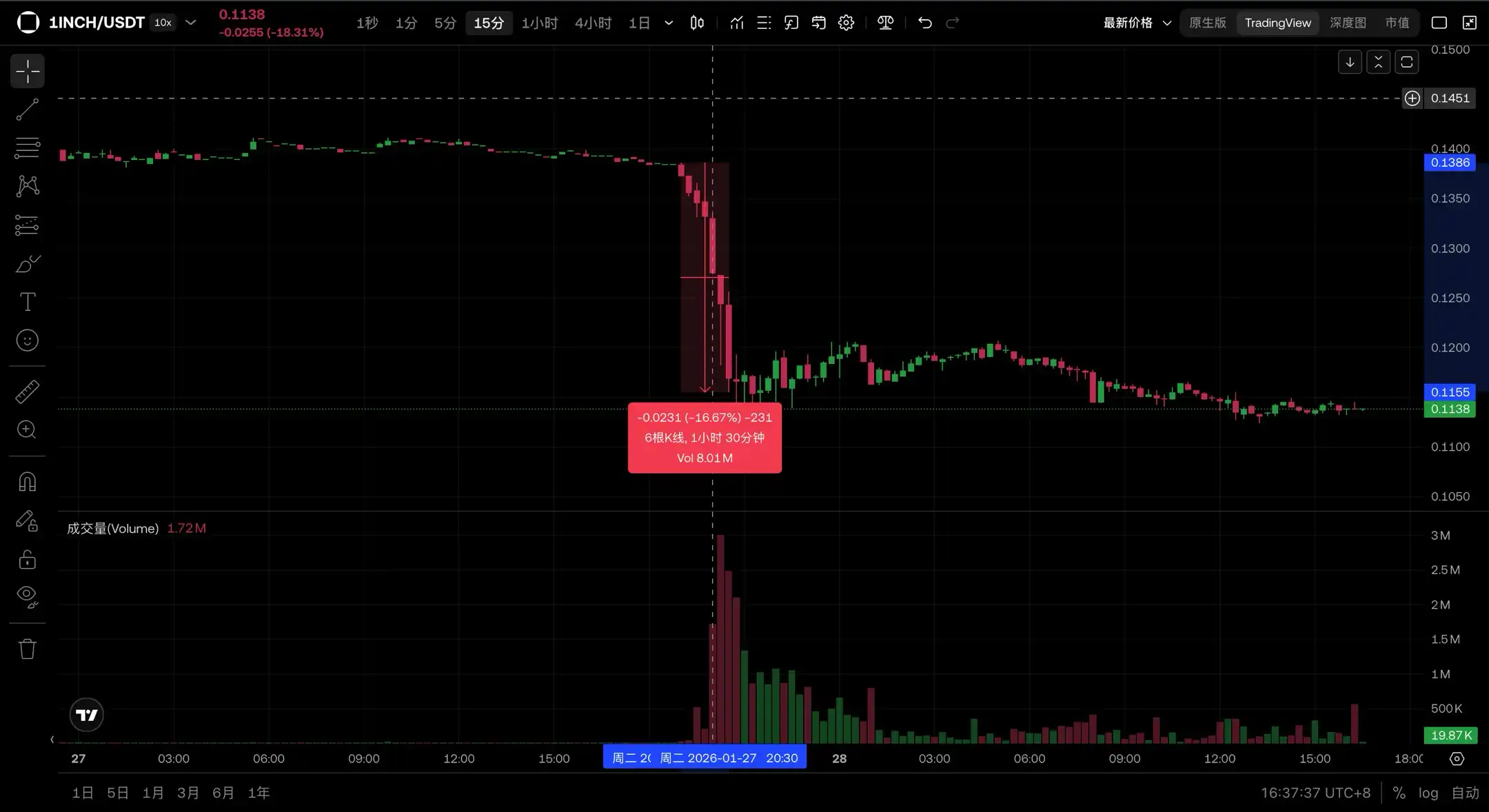
Recent on-chain data from ARKHAM indicated that three wallets labeled as "1inch Team" sold 36.36 million 1INCH tokens, worth $5.04 million, causing the token's price to drop by 16.7% to around $0.1155. The tokens were initially acquired in late 2024 at approximately $0.42 each, meaning the sale resulted in a loss of over $10 million for the seller. This event sparked criticism and raised questions about whether the 1inch team was intentionally dumping tokens. However, the team’s historical trading behavior shows a pattern of strategic accumulation during market lows and gradual profit-taking during highs—not large-scale selling at a loss. For instance, earlier in the year, the team accumulated 1INCH at around $0.20 and sold portions at higher prices, realizing significant profits on 1INCH, ETH, and BTC positions. 1inch officially denied involvement, clarifying that the wallets in question were not controlled by the team or its multisig treasury and that the sell-off was likely executed by a third-party holder. The team emphasized that it does not influence independent token holders' decisions. Despite the clarification, the sell-off exacerbated the token’s already weak market performance. 1INCH has been in a prolonged downtrend since its all-time high of $6, now trading near $0.11. The incident highlights how on-chain labels can be misleading and how low liquidity magnifies the impact of large sales—often harming retail investors the most.

Author | Ethan(@ethanzhang_web3)
Large sales marked as "1inch team" have once again sparked criticism.

Recently, the on-chain data platform ARKHAM showed that three wallets marked as "1inch team" sold a total of 36.36 million 1INCH tokens, worth $5.04 million. According to OKX market data, affected by this, the price of 1INCH briefly fell by 16.7% to $0.1155, currently reported at $0.1164. A question quickly arose in the market: Is the project team really dumping the tokens themselves?

Looking at this sale alone, the outcome was not ideal. On-chain data shows that the above 1INCH tokens were mainly transferred to the relevant addresses in late November 2024. Based on the price at that time, the cost was approximately $0.42, corresponding to a total value of about $15.27 million. Before this sale, the price of 1INCH had already fallen to around $0.14. Combined with the slippage impact due to the large volume of the sale, the actual loss for this batch of positions may exceed $10 million.
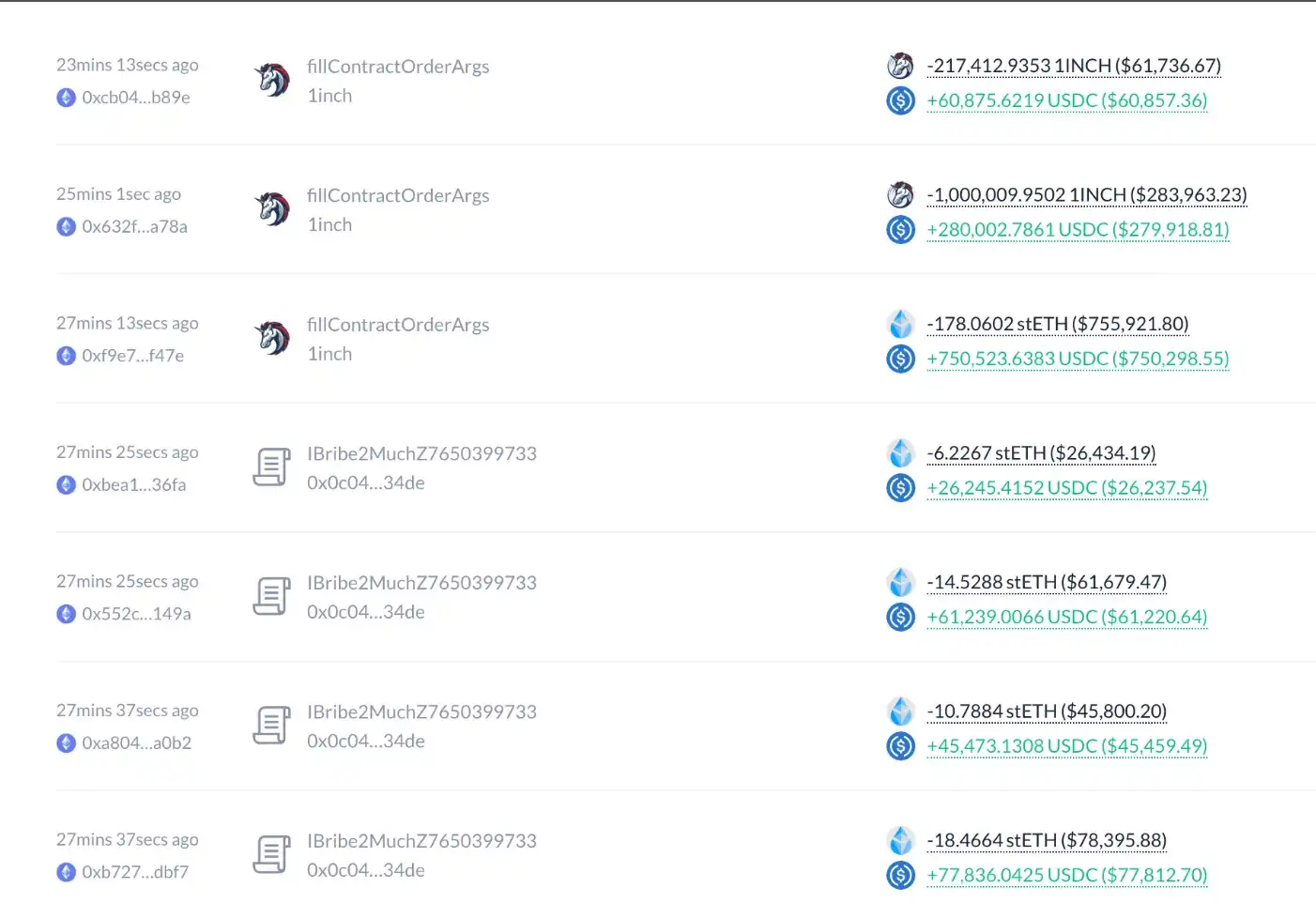
Reference: 1inch Team's Previous Trading Style

Previously, the on-chain operations of the 1inch team investment fund during multiple market fluctuations were regarded by the market as the presence of a "professional trading team."

As early as February to April, the 1inch team investment fund had already begun accumulating 1INCH at low levels. At that time, market sentiment had not yet recovered, and 1INCH had been lingering around $0.2. During this phase, the team invested a total of approximately $6.648 million to buy 33.19 million 1INCH tokens, with an average entry price of about $0.2.

However, this round of buying did not cause significant price fluctuations. What really caught the market's attention was the concentrated buying in early July. From July 6 to 9, the 1inch team investment fund made another move, investing an additional $4.4 million in just a few days to buy 22.99 million 1INCH tokens. As buying continued, the price of 1INCH rose from around $0.18 to $0.206, a short-term increase of about 14%. During this period, the team transferred 3 million USDC to Binance and withdrew 1INCH in batches to their own addresses. The funds were not used all at once, possibly waiting for opportunities, and continued buying.

After July 10, the pace of operations noticeably accelerated. On the afternoon of July 10, the team bought another 4.12 million 1INCH tokens for about $880,000, while also transferring 2 million USDT to Binance to prepare ammunition for subsequent trades. On the evening of July 11, on-chain monitoring showed that the team likely bought another 11.81 million 1INCH tokens at a higher price range, around $0.28. By this point, the address's holdings had increased to 83.97 million 1INCH tokens, with a book value exceeding $23 million. On July 13, the team continued to withdraw 6.334 million 1INCH tokens from Binance.

Looking back to early February, the 1inch team investment fund had cumulatively invested about $13.64 million since the beginning of the year to buy 55.85 million 1INCH tokens, with a comprehensive cost of about $0.244. With the price of 1INCH rising to above $0.39 in mid-July, these positions had already generated paper profits of several million dollars.

It is worth noting that the team was not "only buying and not selling." On the evening of July 13, they began to realize profits on a small scale, selling about 904,000 1INCH tokens at $0.33, exchanging them for $298,000; and in earlier stages, they had already sold some 1INCH tokens in batches at around $0.28.

At the same time, the team also took profits on another important position: ETH, which was bought in February at an average price of $2,577, began to be sold in batches above $4,200, with the ETH position alone realizing profits of millions of dollars.

On August 11, according to on-chain analyst Yu Jin's monitoring, the 1inch team investment fund began to realize some of its earlier positions on-chain. Data showed that they sold 5,000 ETH at an average price of $4,215, exchanging them for 21.07 million USDC; simultaneously, they sold 6.45 million 1INCH tokens at an average price of $0.28, exchanging them for about $1.8 million USDC.

Based on the entry costs, the above ETH was bought by the 1inch team in February this year at an average price of about $2,577; the corresponding 1INCH was mainly accumulated in July, with a comprehensive cost of about $0.253. Based solely on the sold ETH and 1INCH positions, the 1inch team investment fund has realized paper profits of about $8.36 million.
Looking further back, the 1inch team's operational path on BTC is equally clear: "buying against the trend, selling with the trend." During February to March this year, they bought 160.8 WBTC at an average price of about $88,000 during a BTC correction, and completed the sale when BTC approached the $100,000 mark again in May, realizing a total profit of nearly $1 million.

Combining the clues of BTC, ETH, and 1INCH assets, the on-chain operations of the 1inch team investment fund resemble a well-rehearsed capital strategy: completing accumulation during market adjustments, continuously adding positions during the upward trend, and realizing profits in batches when prices enter high ranges.

But This Time, Was It Really Them Operating?

It should be pointed out that comparing this large sale near $0.14 with the past on-chain operations of the 1inch team investment fund reveals: if this sale was indeed directly led by the team, its execution method itself significantly deviates from its past trading logic. Whether in historical operations of BTC, ETH, or 1INCH, the team's more common practice was to realize profits in batches after the price trend was confirmed, rather than selling concentratedly in an obvious low-liquidity range.

For this reason, some market participants began to question: did this selling behavior marked as "1inch team" really come from the team or wallets directly controlled by them.

Subsequently, 1inch official also responded to the related controversy. In a statement, they clearly stated that this selling behavior did not occur in any wallet controlled by the 1inch team, entity, or treasury multi-signature, and the team cannot interfere with the asset allocation and trading decisions of third-party holders.

In other words, the association indicated by on-chain labels does not equate to actual control. Judging from the execution rhythm and price range, this sale is more likely to come from a third-party holder who is no longer under the project's control, rather than a shift in the 1inch team's own trading logic.

In a stage of inherently limited liquidity, a single large sale being quickly equated to "team dumping" is itself an overly compressed interpretation of information. It ignores the natural disconnect between address labels and actual control rights after long-term token circulation.

Returning to 1inch itself. The official statement emphasized that this market fluctuation did not change its core business and long-term direction. Since 2019, 1inch has accumulated a trading volume of nearly $800 billion, and even during market downturns, it can maintain a daily trading scale of hundreds of millions of dollars. The team also stated that it plans to review the token economic model this year to improve overall resilience during periods of low liquidity and downturns. In this context, the discussion around "whether the 1inch team dumped tokens" is more like a misinterpretation amplified by on-chain labels, liquidity environment, and emotional interpretation.

However, even if it is eventually proven to be a misinterpretation, this sale still constituted a secondary impact on the already weakening price of 1INCH. Since the last cycle high of $6, 1INCH has experienced a long-term unilateral decline and is now hovering near $0.11.
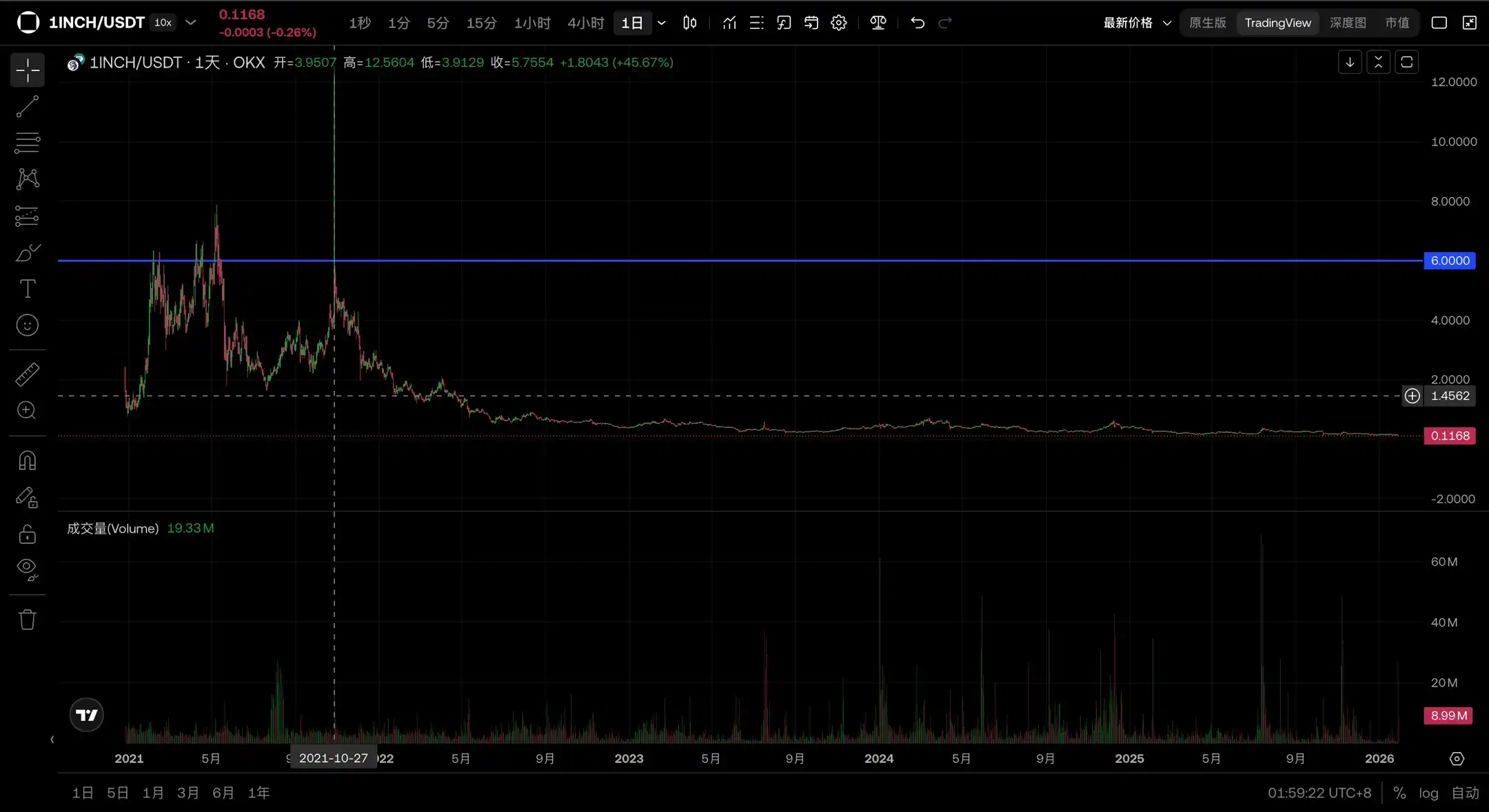
On such a trend, the market clearly no longer has enough buffer space to digest any sudden selling signals. This type of amplified selling event ultimately bears the brunt of emotional impact on the weakest end of risk tolerance—retail investors.


Трендові криптовалюти

Пов'язані питання

QWhat was the recent event that sparked criticism towards the 1inch team, according to the article?

AThree wallets labeled as '1inch team' sold 36.36 million 1INCH tokens, worth $5.04 million, causing the token's price to drop by 16.7%.

QHow does the recent large sell-off at $0.14 contradict the 1inch team's historical trading strategy as described in the article?

AThe team's historical strategy was to accumulate during market adjustments, add positions during rallies, and take profits in batches at higher price ranges. The recent sell-off at a low liquidity price point of $0.14 deviates from this logic of selling after a confirmed uptrend.

QWhat was the official response from 1inch team regarding the sell-off incident?

AThe 1inch team stated that the selling did not occur from any wallet controlled by the 1inch team, entity, or treasury multisig, and that they cannot interfere with the asset allocation and trading decisions of third-party holders.

QWhat key point does the article make about the relationship between on-chain labels and actual control of wallets?

AThe article emphasizes that an on-chain label indicating an association does not equate to actual control. The sell-off was likely from a third-party holder, not the team itself.

QWhat is the long-term price trend for the 1INCH token mentioned in the article?

AThe 1INCH token has been in a long-term downtrend since its previous cycle high of $6 and was trading around $0.11 at the time of the article.

Пов'язані матеріали

Bitcoin Shifts Towards Consolidation, Long-Term Holder Selling Pressure Significantly Eases

Bitcoin's Bottoming Process Shows Signs of Shifting Dynamics Bitcoin's bottom formation is ongoing, but key characteristics are changing. The capitulation selling by long-term holders (LTHs), a primary source of selling pressure this cycle, has begun to cool from its recent peak. Buyers successfully absorbed the selling at the June lows, and price is now recovering to challenge overhead resistance. The market is testing higher resistance levels. Bitcoin reacted more strongly to soft inflation data than major equity indices, signaling sellers may be exhausted and buyers are waiting for a catalyst. Its correlation with stocks is weakening while its inverse relationship with the USD is deepening, suggesting liquidity dynamics are now more influential than risk sentiment. On-chain, price sits between the network's Realized Price (a historical bear market floor) and the Short-Term Holder (STH) cost basis near $69k, a key resistance level where recent buyers break even. LTH profit-taking has largely dried up, and losses now dominate realized on-chain volume—a typical late bear market signal. Crucially, the pace of LTH capitulation has started to decline. Derivatives markets show bearish positions are being unwound, with put/call ratios falling and crash protection costs moderating. However, this derisking hasn't been accompanied by significant spot buying, a missing link for sustained recovery. US spot ETF outflows have slowed but not reversed. In conclusion, foundational elements for a bottom are forming: LTH selling is easing, low-point selling was absorbed, and the market is responding to positive macro cues. The next critical test is whether spot-driven buying can push price through and hold above the STH cost basis near $69k. The follow-through is not yet confirmed.

marsbit5 хв тому

Bitcoin Shifts Towards Consolidation, Long-Term Holder Selling Pressure Significantly Eases

marsbit5 хв тому

Defending Champions or New Kings? World Cup Final Sees All AIs Backing the Same Side

Will the 2026 World Cup final see Argentina successfully defend their title or a new champion crowned? AI models from various platforms have made their prediction. The final in Buenos Aires pits defending champions Argentina against a resilient Spanish side that has reached this stage with a record of exceptional defensive solidity, conceding only one goal in seven matches. Argentina's path was dramatically different, filled with late comebacks and narrow victories, including a semi-final win over England secured by late goals assisted by the 39-year-old Lionel Messi. A poignant subplot adds narrative weight: a nearly 20-year-old photo shows a young Messi bathing an infant Lamine Yamal, who is now a 19-year-old key player for Spain, symbolizing a potential passing of the torch. In the semi-finals, most AI models incorrectly predicted a French victory over Spain, with only Google's Gemini correctly picking Spain's advancement and also accurately forecasting Argentina's win over England. For the final, however, all six surveyed AIs—ChatGPT, Claude, Gemini, Grok, DeepSeek, and Qwen—unanimously predict a Spanish victory. Their reasoning centers on Spain's superior defense, midfield control, and better physical preparedness after a less strenuous knockout stage journey. While consensus favors Spain as champions, five of the six AIs believe the match will be tightly contested, predicting a draw (1-1 or 0-0) within regular time, with Spain's advantage potentially telling in extra time or even a penalty shootout. Only DeepSeek forecasts a clear Spanish victory within 90 minutes. The stage is set for a clash between Argentina's legendary fighting spirit and Spain's machine-like consistency, with artificial intelligence firmly backing the latter to lift the trophy.

Odaily星球日报21 хв тому

Defending Champions or New Kings? World Cup Final Sees All AIs Backing the Same Side

Odaily星球日报21 хв тому

From a Loss of 19.2 Billion to a Profit of 7.1 Billion, ChangXin Technology States 'Downturn Cycle Remains a Concern'

Changxin Technology, China's leading domestic DRAM manufacturer, is nearing its IPO on the STAR Market. After reporting significant net losses of -192.25 billion yuan and -90.51 billion yuan in 2023 and 2024 respectively, the company achieved a net profit of 71.44 billion yuan in 2025. This turnaround is attributed to an AI-driven surge in DRAM demand and tight industry supply, leading to a 33.69% increase in average selling prices alongside reduced unit costs. Despite the improved profitability, with gross margins rising from -1.93% in 2023 to 40.99% in 2025, Chairman Zhu Yiming cautions that the strongly cyclical DRAM industry remains vulnerable. Risks include potential macroeconomic shifts, uncertain AI demand, and new capacity expansions that could trigger another downturn. The company still faces high fixed costs, with depreciation reaching 246.8 billion yuan in 2025. Changxin plans to raise 29.5 billion yuan through its IPO to fund technology upgrades, DRAM advancement, and R&D. While its capacity ranks fourth globally, its 7.67% Q4 2025 market share lags behind leaders Samsung, SK Hynix, and Micron. Analysts note the company must now prove its ability to achieve stable mass production with high yields and low cost-per-bit, especially for advanced products. Its growth currently relies on transitioning from DDR4/LPDDR4X to DDR5/LPDDR5X and increasing domestic substitution. Successfully developing and commercializing high-value AI products like HBM is seen as crucial for future competitiveness and closing the gap with international giants.

marsbit50 хв тому

From a Loss of 19.2 Billion to a Profit of 7.1 Billion, ChangXin Technology States 'Downturn Cycle Remains a Concern'

marsbit50 хв тому

Stop Writing Prompts: Claude’s Official Guide to 4 Types of Loops That Automate Work

The article discusses a shift in AI development from manually crafting prompts to designing "loops"—systems where AI agents autonomously perform tasks until a defined stopping condition is triggered. Inspired by figures like Peter Steinberger and Boris Cherny, this approach, termed "loop engineering," focuses on creating self-running systems rather than one-off interactions. Claude Code's team formally defines a loop as an agent repeatedly executing work until a stop condition is met and categorizes four primary loop types based on their stopping mechanisms: 1. **Turn-based loops:** Human-controlled, step-by-step execution for short, discrete tasks. 2. **Goal loops (/goal):** An evaluator model checks outputs against predefined, quantifiable objectives (e.g., a performance score), forcing retries until the goal is met or a limit is reached. 3. **Time loops (/loop and /schedule):** Time-triggered, like cron jobs, for recurring tasks (e.g., daily summaries) or monitoring external systems. 4. **Proactive loops:** Event or time-triggered, fully automated workflows for ongoing, bounded tasks like bug triage, running until manually stopped. The core shift is from designing prompt content to designing the behavioral system—its triggers, verification mechanisms, and termination rules. Effective verification, where the agent can self-check its output, is highlighted as crucial for loop efficiency. The article warns that uncontrolled loops risk high costs and getting stuck in unproductive cycles. It recommends implementing essential "gates": machine-verifiable completion conditions, hard limits on iterations/cost, and stagnation detection. Best practices include using smaller models where possible, testing on small scales first, and automating deterministic parts with scripts. In summary, AI programming is evolving from prompt engineering to system design, where the skill lies in architecting loops that can autonomously execute, validate, and decisively conclude their work.

marsbit50 хв тому

Stop Writing Prompts: Claude’s Official Guide to 4 Types of Loops That Automate Work

marsbit50 хв тому

Торгівля

Спот

Популярні статті

Як купити 1INCH

Ласкаво просимо до HTX.com! Ми зробили покупку 1inch (1INCH) простою та зручною. Дотримуйтесь нашої покрокової інструкції, щоб розпочати свою криптовалютну подорож.Крок 1: Створіть обліковий запис на HTXВикористовуйте свою електронну пошту або номер телефону, щоб зареєструвати обліковий запис на HTX безплатно. Пройдіть безпроблемну реєстрацію й отримайте доступ до всіх функцій.ЗареєструватисьКрок 2: Перейдіть до розділу Купити крипту і виберіть спосіб оплатиКредитна/дебетова картка: використовуйте вашу картку Visa або Mastercard, щоб миттєво купити 1inch (1INCH).Баланс: використовуйте кошти з балансу вашого рахунку HTX для безперешкодної торгівлі.Треті особи: ми додали популярні способи оплати, такі як Google Pay та Apple Pay, щоб підвищити зручність.P2P: Торгуйте безпосередньо з іншими користувачами на HTX.Позабіржова торгівля (OTC): ми пропонуємо індивідуальні послуги та конкурентні обмінні курси для трейдерів.Крок 3: Зберігайте свої 1inch (1INCH)Після придбання 1inch (1INCH) збережіть його у своєму обліковому записі на HTX. Крім того, ви можете відправити його в інше місце за допомогою блокчейн-переказу або використовувати його для торгівлі іншими криптовалютами.Крок 4: Торгівля 1inch (1INCH)Легко торгуйте 1inch (1INCH) на спотовому ринку HTX. Просто увійдіть до свого облікового запису, виберіть торгову пару, укладайте угоди та спостерігайте за ними в режимі реального часу. Ми пропонуємо зручний досвід як для початківців, так і для досвідчених трейдерів.

138 переглядів усьогоОпубліковано 2024.12.10Оновлено 2026.06.02

Як купити 1INCH

Обговорення

Ласкаво просимо до спільноти HTX. Тут ви можете бути в курсі останніх подій розвитку платформи та отримати доступ до професійної ринкової інформації. Нижче представлені думки користувачів щодо ціни 1INCH (1INCH).

活动图片