A Well-Designed "Self-Detonation": Analysis of the PGNLZ Attack Incident

marsbitОпубліковано о 2026-01-28Востаннє оновлено о 2026-01-28

Анотація

On January 27, 2026, an attacker executed a well-orchestrated exploit against the PGNLZ token on BNB Smart Chain, resulting in approximately $100k in losses. The attacker initiated a flash loan of 1,059 BTCB from Moolah Protocol, used it as collateral on Venus Protocol to borrow 30 million USDT, and then exchanged 23,337,952 USDT for 982,506 PGNLZ on PancakeSwap. These PGNLZ tokens were intentionally burned (sent to a dead address), drastically reducing the liquidity pool supply. This manipulation caused the price of PGNLZ to surge from approximately $0.10 to over $5,528 per token. The attacker then invoked a fee-on-transfer function, triggering a built-in burn mechanism (_executeBurnFromLP) that further depleted the pool, leaving only a minuscule amount of PGNLZ and artificially inflating the price to an extreme 40 billion times its original value. Finally, the attacker drained the liquidity pool, repaid the flash loan, and netted a significant profit. The root cause was identified as a flawed deflationary economic model with insufficient validation during fee processing and LP burns, allowing price manipulation. The incident underscores the importance of rigorous economic model design and multi-audit practices before contract deployment.

Background Introduction

On January 27, 2026, we monitored an attack on the PGNLZ project on the BNB Smart Chain:

https://bscscan.com/tx/0xa7488ff4d6a85bf19994748837713c710650378383530ae709aec628023cd7cc

After detailed analysis, the attacker continuously launched attacks against the PGNLZ project on January 27, 2026, resulting in a loss of approximately 100k USD.

Attack and Incident Analysis

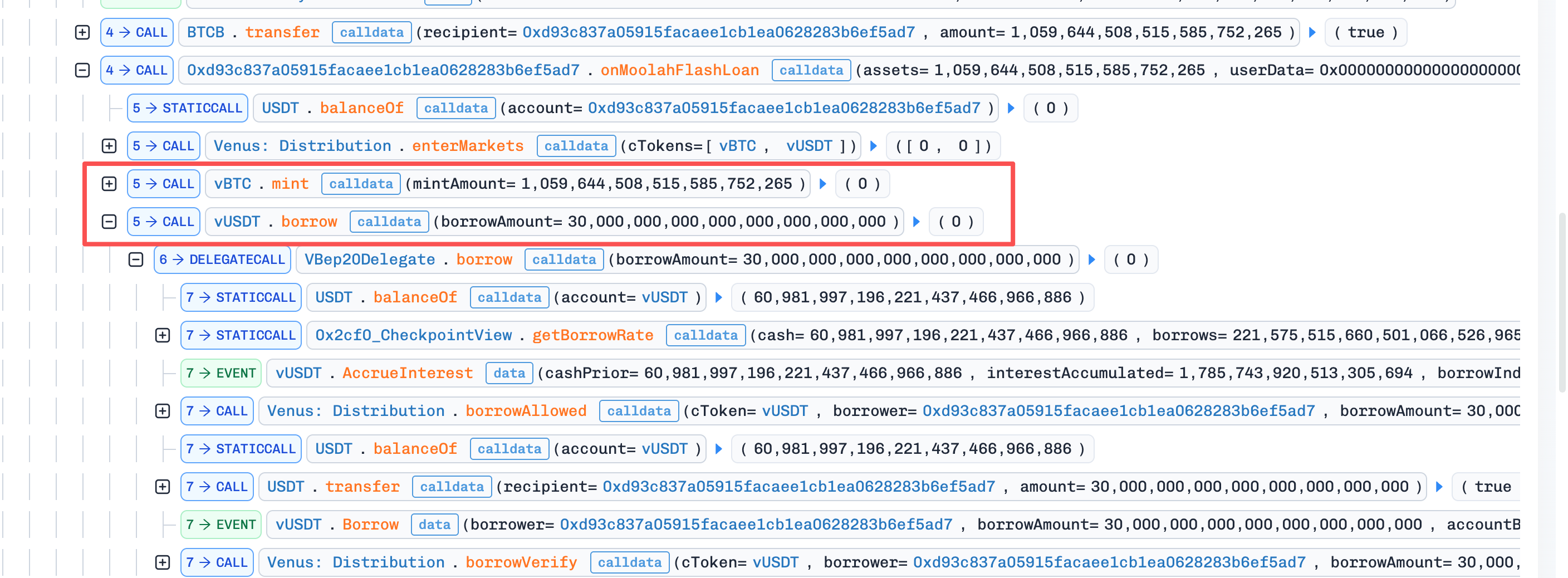
The attacker first borrowed 1,059 BTCB via a flash loan from Moolah Protocol,

Subsequently, they collateralized the 1,059 BTCB on Venus Protocol to borrow 30,000,000 USDT.

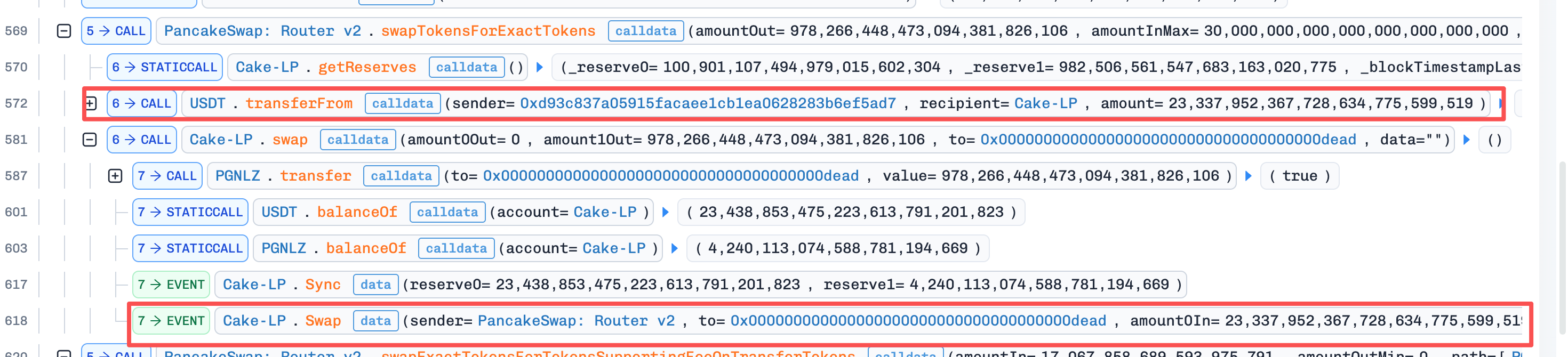
Next, the attacker called the function `swapTokensForExactTokens` on PancakeSwap, using 23,337,952 USDT to exchange for 982,506 PGNLZ, but then burned these PGNLZ (sent them to 0xdead).

Before the swap, the PancakeSwap Pool contained 100,901 USDT and 982,506 PGNLZ, making the price of PGNLZ 1 PGNLZ = 0.1 USDT. After the swap, the PancakeSwap Pool had 23,438,853 USDT and 4,240 PGNLZ remaining, making the price of PGNLZ 1 PGNLZ = 5,528 USDT.

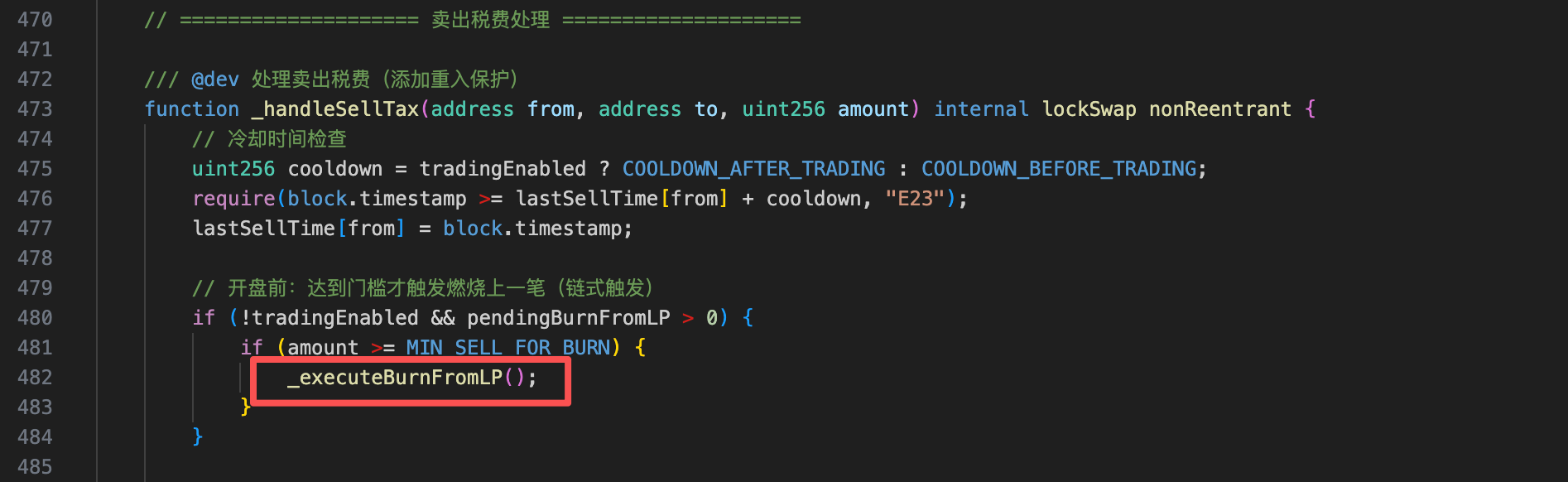
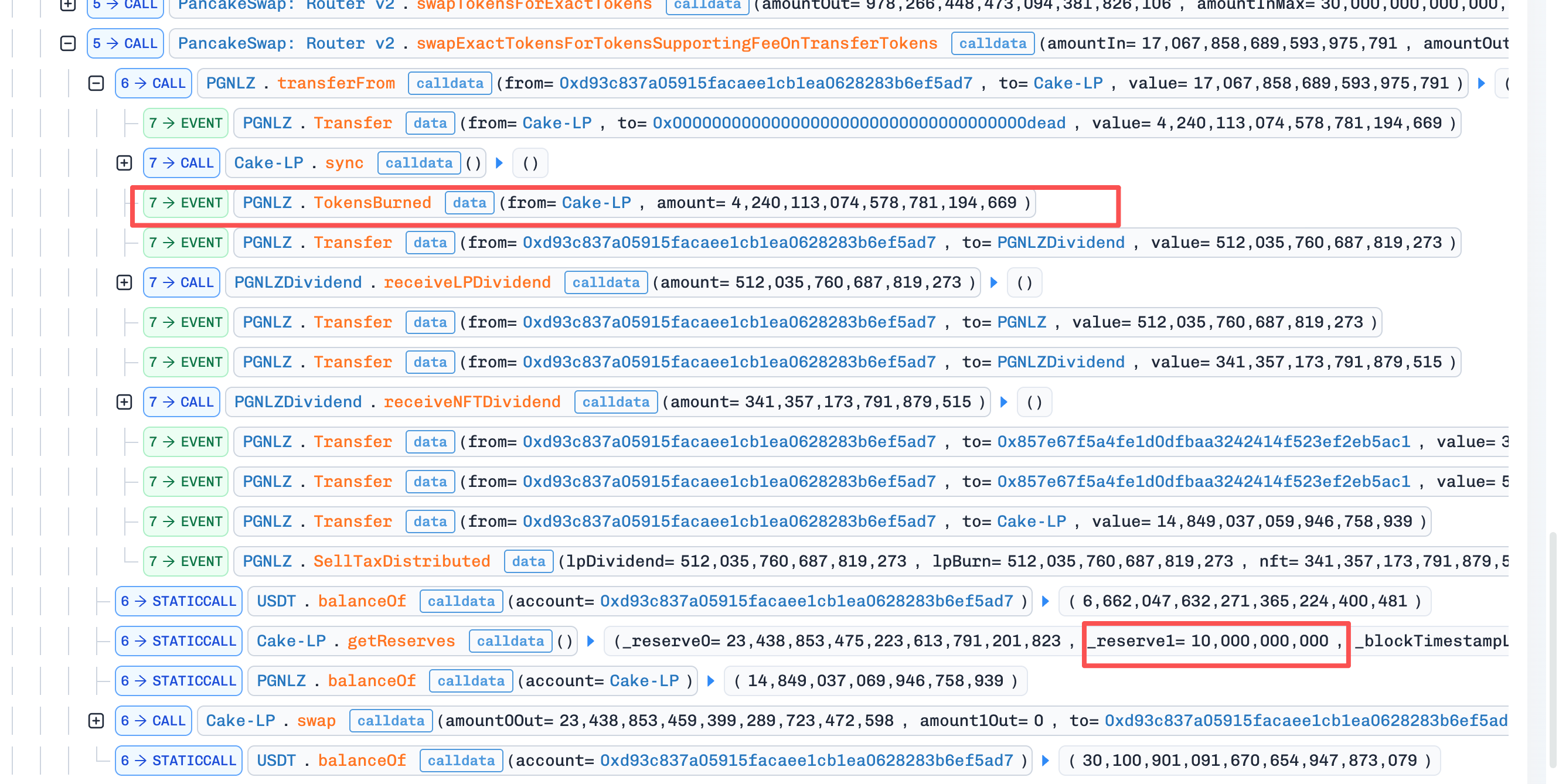
Subsequently, the attacker called the function `swapExactTokensForTokensSupportingFeeOnTransferTokens`. This function primarily supports Fee-On-Transfer Tokens, i.e., tokens that incur fees on transactions. PGNLZ uses `_update` to handle transaction fees. The specific call chain is: transferFrom -> _spendAllowance -> _transfer -> _update

Since this was a sell, `_handleSellTax` was called.

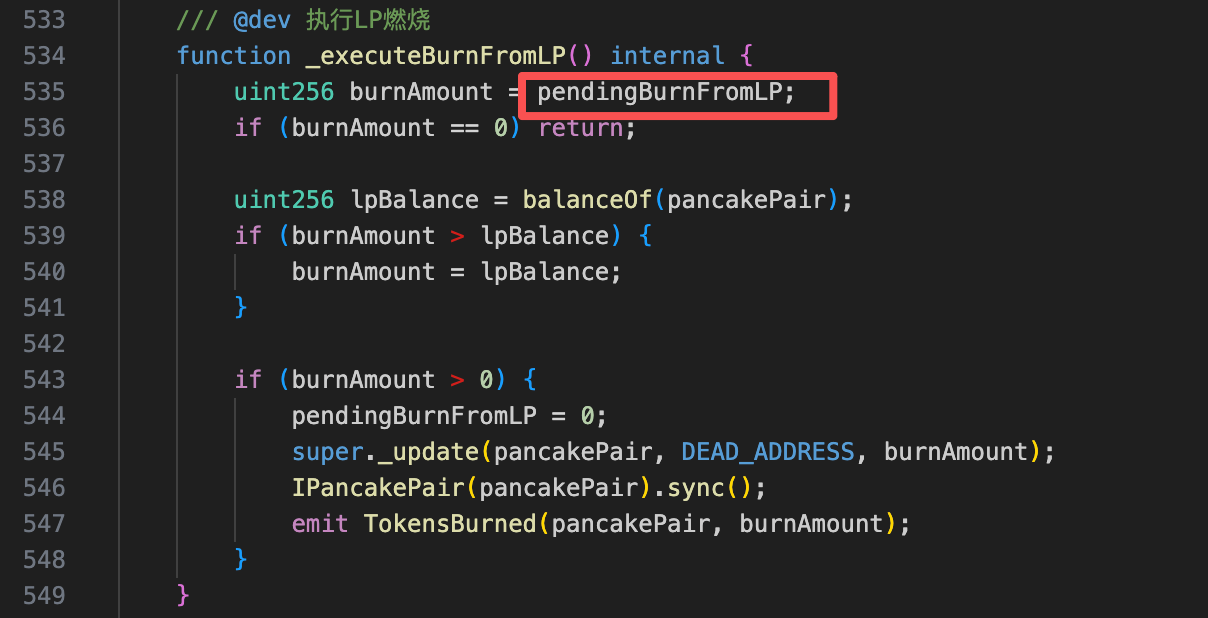
Let's look at how `_executeBurnFromLP` is implemented.

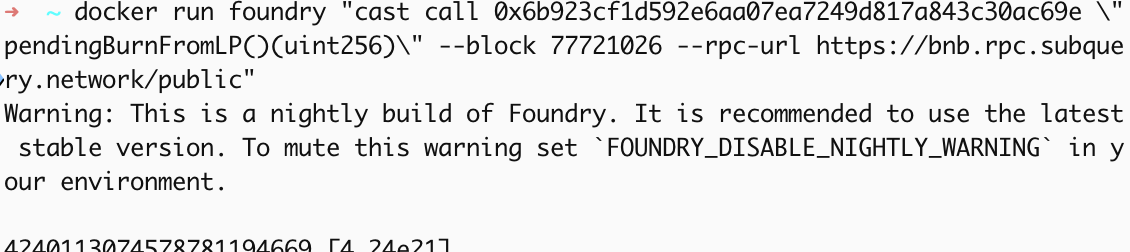
It can be seen that `_executeBurnFromLP` uses `_update` to burn the quantity of PGNLZ specified by `pendingBurnFromLP`. In the previous block, `pendingBurnFromLP` was queried as 4,240,113,074,578,781,194,669.

After the burn, the LP Pool was left with only 0.00000001 PGNLZ, making the price 1 PGNLZ = 234,385,300,000,000 USDT, a 40 Billion-fold increase.

Finally, the attacker drained the LP Pool, repaid the flash loan, and profited 100k USDT.

Summary

The cause of this vulnerability was the deflationary economic model, which lacked validation during fee deductions or LP Pool burns. This allowed the attacker to manipulate the token's price using its deflationary characteristics. It is recommended that project teams conduct thorough multi-party validation when designing economic models and code execution logic. Before contract deployment, opt for cross-audits from multiple auditing firms during the audit phase.

Трендові криптовалюти

Пов'язані питання

QWhat was the total financial loss caused by the attack on the PGNLZ project?

AThe attack resulted in a loss of approximately 100,000 USD.

QHow did the attacker manipulate the price of PGNLZ token during the attack?

AThe attacker first swapped a large amount of USDT for PGNLZ and burned the tokens, drastically reducing the supply in the liquidity pool. This caused the price of PGNLZ to skyrocket by 40 billion times, from 0.1 USDT to 234,385,300,000,000 USDT per token.

QWhich function did the attacker exploit to handle the fee-on-transfer mechanism during the sell operation?

AThe attacker exploited the function swapExactTokensForTokensSupportingFeeOnTransferTokens, which triggered the _handleSellTax function and subsequently _executeBurnFromLP to burn a massive amount of PGNLZ tokens from the liquidity pool.

QWhat was the root cause of the vulnerability in the PGNLZ project?

AThe vulnerability was caused by a deflationary economic model that lacked proper checks when deducting fees or burning tokens from the pool, allowing the attacker to manipulate the token's price through supply reduction.

QWhich protocols did the attacker use to obtain the initial funds for the attack?

AThe attacker used a flash loan from Moolah Protocol to borrow 1,059 BTCB, which was then collateralized on Venus Protocol to borrow 30,000,000 USDT.

Пов'язані матеріали

After Three Consecutive Quarters of Decline, Can the Crypto Market Find a Window for Stabilization in Q3?

The cryptocurrency market has just concluded its worst-performing quarter since 2022, with total capitalization dropping 12.6% to $2.1 trillion. All core metrics indicate capital is leaving the sector, not just rotating within it. Bitcoin fell 14.2% and Ethereum dropped 25.4% in Q2, breaking their previous correlation with US tech stocks. A key driver is the reversal in US spot Bitcoin ETF flows, which saw a net outflow of approximately $4.67 billion in Q2, including a record monthly outflow near $4.5 billion in June. While recent data suggests long-term holders are accumulating again, sustained ETF outflows mean continued selling pressure. Market focus is now singularly on the Federal Reserve. The upcoming July FOMC meeting is seen as the most critical event for Q3. A dovish signal could support Bitcoin reclaiming a $68,000-$84,000 range, while a hawkish stance might establish a new trading band around $50,000-$56,000. Additionally, regulatory uncertainty persists, with the progress of the crucial *CLARITY Act* stalling in the Senate, reducing its perceived 2026 passage probability to 40-45%. Despite the broad downturn, a few sectors showed growth. Prediction markets saw nominal volume surge 48.7% year-over-year to $113.8 billion, and tokenized collectibles transaction volume rose 143% quarterly to $1.4 billion. The Real-World Asset (RWA) tokenization sector also continued steady growth, now representing ~$28.1 billion in on-chain value. The market's foundation for an extreme crash appears limited, with Bitcoin price hovering near its 200-week moving average. However, the trading paradigm has shifted from narrative-driven speculation to decisions based on price action, policy developments, and interest rate expectations, making a broad sentiment-driven rally unlikely in the near term.

marsbitВчора 08:36

After Three Consecutive Quarters of Decline, Can the Crypto Market Find a Window for Stabilization in Q3?

marsbitВчора 08:36

BIT Trading Moment: BTC Still Suppressed by Weekly 200 EMA, Rejection May Restart Decline; Storage and Semiconductors that Surged Last Night Begin Falling in Evening Trading

**Crypto & Stock Market Wrap: Bitcoin Tests Resistance, Stocks Retreat After AI Surge** Bitcoin consolidates around $66,000, facing key resistance near $68,000—an area seen as a major psychological and technical hurdle where previous rallies have failed. Analysts note the cryptocurrency is caught between its 200-week moving average (~$63,333) and 200-week EMA (~$68,328). A clear break above $68k is needed to signal a stronger bullish trend, while a rejection could lead to a retest of $63k support. Market sentiment remains cautious, with low futures open interest pointing to a low-liquidity rebound rather than a full bull market. Bitcoin spot ETFs saw another $203 million inflow. US stock futures pointed lower after a strong Tuesday session led by a massive rebound in semiconductors and memory stocks. The rally was fueled by renewed optimism about AI-driven hardware demand, with Micron, SanDisk, and SK Hynix surging. However, those gains reversed in pre-market trading. Super Micro Computer (SMCI) soared over 20% after hours on strong guidance and a record backlog. Other standouts included Rocket Lab and nuclear energy plays Oklo and X-Energy. Rising oil prices (Brent above $91) and climbing Treasury yields (10-year near 4.64%), however, are reigniting inflation concerns and acting as a headwind for equities. In Asia, markets were mixed. South Korea's KOSPI pared early gains to close slightly higher as semiconductor stocks like SK Hynix gave back initial surges. Japan's Nikkei edged lower as the yen hit a fresh 38-year low against the dollar, raising fears of potential market intervention. Key events to watch include the Samsung Galaxy launch, AMD's AI event, and a slew of major tech earnings from Alphabet, Tesla, and IBM after the close on Wednesday, followed by the ECB meeting and Intel's earnings on Thursday.

marsbitВчора 08:28

BIT Trading Moment: BTC Still Suppressed by Weekly 200 EMA, Rejection May Restart Decline; Storage and Semiconductors that Surged Last Night Begin Falling in Evening Trading

marsbitВчора 08:28

Former CFTC Chairman, Circle President Tarbert: Preaching Long-Termism While Cashing Out $30 Million Himself

Former CFTC Chairman and Circle President Heath Tarbert has consistently advocated for a long-term vision in public, urging patience from investors as Circle’s stock price has fallen significantly from its peak. However, it has been revealed that since Circle’s IPO, Tarbert has continuously sold his CRCL shares through pre-arranged trading plans, cashing out approximately $30 million, without making any public market purchases. This contrast between his public messaging and personal actions has drawn criticism. Tarbert joined Circle in July 2023 as Chief Legal Officer, leveraging his regulatory experience to help guide the company through its IPO and expansion. Despite promoting stablecoins as long-term infrastructure, he established a 10b5-1 trading plan just before Circle went public, leading to substantial stock sales over the following year. In March 2026, he initiated another plan to sell more shares. His career trajectory highlights a pattern of moving between high-level regulatory roles and influential positions in the financial sector. After resigning as CFTC Chairman in early 2021, he joined Citadel Securities as Chief Legal Officer just 27 days later, during a period of intense regulatory scrutiny for the firm. He later joined Circle, aiding its efforts to navigate regulatory challenges for its public listing. While Tarbert's expertise in policy and compliance is valuable to companies like Circle, his actions—advocating long-term confidence while personally divesting—raise questions about the alignment between his public statements and his private financial decisions, leaving investors who followed his advice to bear the market risks.

marsbitВчора 08:06

Former CFTC Chairman, Circle President Tarbert: Preaching Long-Termism While Cashing Out $30 Million Himself

marsbitВчора 08:06

Gate Research Institute: The 'Wall Street-ization' Wave of Crypto Financial Products – Competition or Integration?

The article titled "Gate Research Institute: Are Crypto Financial Products Sparking a 'Wall Street' Wave—Competition or Convergence?" explores the evolving relationship between the crypto ecosystem and traditional finance (TradFi). The piece begins by reflecting on Bitcoin's original 2009 vision of decentralization, disintermediation, and moving away from banks. It then contrasts this with the 2024 landscape, where key crypto assets like Bitcoin are increasingly held through Wall Street products like ETFs issued by giants like BlackRock. The article questions whether this signifies that TradFi is systematically taking over the rights to issue, price, custody, and distribute crypto financial assets. The core argument is that this is not a zero-sum takeover but rather a bidirectional convergence where each side addresses the other's weaknesses. Crypto offers 24/7 global markets, programmable settlement, and open access but lacks compliant channels, institutional-grade custody, deep fiat liquidity, and mainstream distribution. TradFi possesses these but is constrained by legacy systems, limited operating hours, and slow settlement. Two primary convergence paths are highlighted: * **Path A (CEX to TradFi):** Exemplified by Gate, which has progressed from offering tokenized stocks and CFDs to providing direct, real stock trading (US, Hong Kong, South Korea) within its platform, using USDT. * **Path B (TradFi to Crypto):** Exemplified by Robinhood, which has integrated crypto trading, acquired exchanges like Bitstamp, and is moving traditional assets like stocks onto the blockchain via tokenization and its own Layer 2. Both paths are ultimately competing to become the next-generation, unified financial account—a "super account" where users can seamlessly trade cryptocurrencies, stocks, ETFs, RWA (Real World Assets), and tokenized treasury products in one interface. The growth of RWA and tokenized treasuries (e.g., BlackRock's BUIDL) is presented as the asset-layer fusion, providing stable, yield-bearing assets on-chain and acting as a bridge between the two worlds. In conclusion, the "Wall Street-ization" of crypto is framed as a mutual transformation. Decentralized ideals persist in the protocol layer, while at the application layer, a more efficient, global, and accessible unified capital market is emerging from this convergence. The future competition lies not between crypto exchanges and stockbrokers, but between platforms vying to offer the most comprehensive asset coverage, liquidity, and user experience within a single account.

marsbitВчора 08:01

Gate Research Institute: The 'Wall Street-ization' Wave of Crypto Financial Products – Competition or Integration?

marsbitВчора 08:01

Торгівля

Спот

Популярні статті

Що таке $WELL

WELL3, $$WELL: Революція в Здоров'ї та Добробуті з DePIN та AI Вступ У швидко змінюваному світі цифрових технологій сектор здоров'я та добробуту займає передову позицію в інноваціях, прагнучи покращити догляд за пацієнтами та пропагувати здоровіші способи життя. У цьому домені визначним гравцем є WELL3, інноваційний проект Web3, що прагне революціонізувати те, як люди взаємодіють зі своїм здоров'ям. Використовуючи такі технології, як Децентралізована Фізична Інфраструктурна Мережа (DePIN), Децентралізована Ідентичність (DID) та Штучний Інтелект (AI), WELL3 має на меті сприяти безпечним, даними підкріпленим шляхам до здоров'я. Ця всеосяжна стаття глибоко аналізує основні аспекти WELL3, $$WELL, досліджуючи його функціональні можливості, творців, інвесторів та унікальні характеристики. Що таке WELL3, $$WELL? WELL3 слугує інноваційною платформою, яка має на меті переосмислити підхід до здоров'я та добробуту. Сфокусований на інтеграції DePIN і DID поряд із AI-системами, проект створений для надання персоналізованого досвіду для користувачів, забезпечуючи при цьому безпеку та конфіденційність медичних даних. З вражаючою цифрою понад мільйон попередньо зареєстрованих користувачів, основна місія WELL3 полягає в покращенні добробуту через безпечні, орієнтовані на дані шляхи до здоров'я. В основі WELL3 лежать передові блокчейн-технології, які забезпечують повний контроль користувачів над своїми особистими даними. Цей проект не тільки вирішує проблеми безпеки даних і доступності, але також прагне створити активну спільноту, пов'язану спільним прагненням до кращого здоров'я. Основні риси WELL3: DePIN і DID: Ці технології забезпечують безпечну власність та аутентифікацію даних, надаючи користувачам повний контроль над їхньою інформацією. Інтеграція AI: Використовуючи аналітику AI, WELL3 пропонує персоналізовані поради та рішення, адаптовані до індивідуальних потреб здоров'я. Залучення спільноти: Сприяє підтримуючому середовищу, в якому користувачі можуть спілкуватися, ділитися досвідом та надихати один одного на здоровіше життя. Творець WELL3, $$WELL Ідентичність творця WELL3 не уточнюється в доступній інформації. У міру просування проекту можуть з'явитися нові деталі, що проллють світло на творчі уми, які стоять за цією трансформаційною ініціативою. Інвестори WELL3, $$WELL WELL3 здобув підтримку від безлічі впливових інвестиційних структур, що підкреслює його надійність і потенціал у галузі здоров'я та добробуту. Серед відомих інвесторів: Animoca Brands AWS Samsung The Spartan Group Blocore Fenbushi Capital Newman Group Soul Capital XY Finance Lumoz Підтримка з боку цих визнаних організацій свідчить про сильну віру в місію WELL3, забезпечуючи йому необхідні ресурси для інновацій та розширення своїх пропозицій. Як працює WELL3, $$WELL? WELL3 функціонує, поєднуючи передові технології в мультичейн-рамках, забезпечуючи безперебійну та інноваційну взаємодію користувачів. Нижче наведено деякі фактори, які унікально позиціонують WELL3 на ринку добробуту: 1. Безпечна власність на дані З інтеграцією DePIN і DID користувачі можуть зберігати повний контроль над своїми особистими медичними даними. Цей рівень безпеки є надзвичайно важливим в сучасну епоху цифрових технологій, де порушення безпеки та несанкціонований доступ є поширеними. Через WELL3, власність на дані декентралізована, що дозволяє користувачам проактивно управляти своєю інформацією. 2. Персоналізація через AI WELL3 впроваджує аналітику на базі AI для надання користувачам персоналізованих медичних порад. Використовуючи силу AI, платформа може пропонувати індивідуалізовані рекомендації та рішення, заохочуючи користувачів досягати своїх цілей у здоров'ї більш ефективно. 3. Мультичейн-рамки Проект WELL3 розроблений для роботи на кількох платформах блокчейну, таких як Bitcoin, Ethereum, Polygon, Solana, Blast і TON. Ця мультичейн-можливість забезпечує безперебійну взаємодію користувачів з платформою через різні мережі, підвищуючи доступність та зручність. 4. Токен WELL Центральним елементом екосистеми WELL3 є токен WELL, який виконує кілька функцій, включаючи утиліту, управління та винагороди. Токен дозволяє брати участь в екосистемі, підтримує обмін медичними даними та мотивує користувачів на основі їхньої активності на платформі. Хронологія WELL3, $$WELL Шлях WELL3 демонструє значні віхи у її розвитку, кожна з яких реалізує загальний успіх проекту. Ось коротка хронологія ключових подій в історії WELL3: 10 лютого 2024: WELL3 запустив свій NFT проект, швидко ставши найбільшою колекцією NFT на ланцюзі opBNB з понад 324,000 власниками та досягнувши 8 мільйонів NFT, створених до 27 квітня 2024 року. Публічний продаж: Проект досяг вражаючої загальної заблокованої вартості (TVL) близько 15,237.2 ETH всього за сім днів, що свідчить про robust цікавості на ринку та підтримку. Запуск WELL ID: Платформа зареєструвала понад 900,000 користувачів для WELL ID та відповідного білого списку NFT Ring, відзначаючи значну фазу прийняття в екосистемі. Розвиток партнерства: WELL3 встановила партнерства з провідними організаціями, включаючи Animoca Brands, AWS, Samsung та іншими, щоб поліпшити свою екосистему та розширити свою присутність. Обсяг транзакцій: WELL3 здійснив транзакції на загальну суму понад 17 мільйонів доларів, що відображає зростаючу утиліту та залученість у спільноті здоров'я та добробуту. Ключові моменти про WELL3, $$WELL Як прогресивна ініціатива, що переорієнтовується на ринок добробуту, WELL3 визначила кілька важливих елементів, які сприятимуть її триваючому успіху. Ось кілька основних моментів, на які варто звернути увагу: Токеноміка Токен $$WELL має максимальну пропозицію 42 мільярдів, з значним 71% відведеним для ініціатив спільноти. Ця стратегія розподілу підкреслює зобов'язання проекту перед його базою користувачів та довгостроковою стійкістю. Період блокування Щоб забезпечити стабільність у екосистемі, токени випускаються партіями протягом 24-місячного періоду блокування, що сприяє довірі та впевненості серед користувачів. Розвиток екосистеми Бачення WELL3 поширюється на створення комплексної та стійкої екосистеми для сприяння успішному залученню спільноти, поведінці, що покращує здоров'я, та цифровим рішенням, що вирішують нагальні потреби сфери добробуту. Відповідність ринку Індустрія добробуту, оцінювана в 5.6 трильйонів доларів, пропонує вигідну можливість, яку WELL3 прагне використати. З очікуваним щорічним темпом зростання 5-10%, проект ідеально позиціонується на тлі зростаючої тенденції до здорового способу життя. Носимі пристрої Введення кільця WELL3, носимого пристрою з крипто-інцентуванням, відповідає зростаючому попиту на персоналізовані дані про здоров'я. Цей пристрій не лише підвищує досвід користувача, але й переосмислює те, що означає бути залученим до власного здоров'я в контексті Web3. Висновок WELL3 представляє собою значний прогрес у інтеграції блокчейн-технологій у сектор здоров'я та добробуту. Вирішуючи критично важливі питання щодо володіння даними, персоналізації та залучення спільноти, ця інноваційна платформа пропонує прогресивне рішення для покращення індивідуального добробуту. З потужною підтримкою від відомих інвесторів та зобов'язанням до передових технологій, WELL3 готовий зробити відчутний вплив у сфері добробуту. Для тих, хто прагне орієнтуватися в складнощах здоров'я в цифрову епоху, WELL3 безумовно варто стежити за його еволюцією та зростанням.

66 переглядів усьогоОпубліковано 2024.07.14Оновлено 2024.12.03
Що таке $WELL

Як купити WELL

Ласкаво просимо до HTX.com! Ми зробили покупку Moonwell Artemis (WELL) простою та зручною. Дотримуйтесь нашої покрокової інструкції, щоб розпочати свою криптовалютну подорож.Крок 1: Створіть обліковий запис на HTXВикористовуйте свою електронну пошту або номер телефону, щоб зареєструвати обліковий запис на HTX безплатно. Пройдіть безпроблемну реєстрацію й отримайте доступ до всіх функцій.ЗареєструватисьКрок 2: Перейдіть до розділу Купити крипту і виберіть спосіб оплатиКредитна/дебетова картка: використовуйте вашу картку Visa або Mastercard, щоб миттєво купити Moonwell Artemis (WELL).Баланс: використовуйте кошти з балансу вашого рахунку HTX для безперешкодної торгівлі.Треті особи: ми додали популярні способи оплати, такі як Google Pay та Apple Pay, щоб підвищити зручність.P2P: Торгуйте безпосередньо з іншими користувачами на HTX.Позабіржова торгівля (OTC): ми пропонуємо індивідуальні послуги та конкурентні обмінні курси для трейдерів.Крок 3: Зберігайте свої Moonwell Artemis (WELL)Після придбання Moonwell Artemis (WELL) збережіть його у своєму обліковому записі на HTX. Крім того, ви можете відправити його в інше місце за допомогою блокчейн-переказу або використовувати його для торгівлі іншими криптовалютами.Крок 4: Торгівля Moonwell Artemis (WELL)Легко торгуйте Moonwell Artemis (WELL) на спотовому ринку HTX. Просто увійдіть до свого облікового запису, виберіть торгову пару, укладайте угоди та спостерігайте за ними в режимі реального часу. Ми пропонуємо зручний досвід як для початківців, так і для досвідчених трейдерів.

146 переглядів усьогоОпубліковано 2024.12.10Оновлено 2026.06.02

Як купити WELL

Обговорення

Ласкаво просимо до спільноти HTX. Тут ви можете бути в курсі останніх подій розвитку платформи та отримати доступ до професійної ринкової інформації. Нижче представлені думки користувачів щодо ціни WELL (WELL).

活动图片