‘Crypto Doesn’t Care About Fundamentals.’ Is That Sustainable?

BlockworksОпубліковано о 2022-07-28Востаннє оновлено о 2022-07-28

Анотація

A tiny fraction of cryptocurrencies from the last bull market reached all-time highs this cycle. So, what are they really worth? And why?

Cash flows and revenues may be bearish for digital assets, as they place caps on their potential valuations in line with traditional companies with far slower growth trajectories

“The nature of crypto is that it cares about growth potential,” one portfolio manager said

_

_

Most cryptocurrencies die.

It’s well known among those who’ve witnessed more than one cycle. Hundreds, if not thousands, of tokens surge, alongside bitcoin and ether, but rarely — or, often never — reclaim all-time highs.

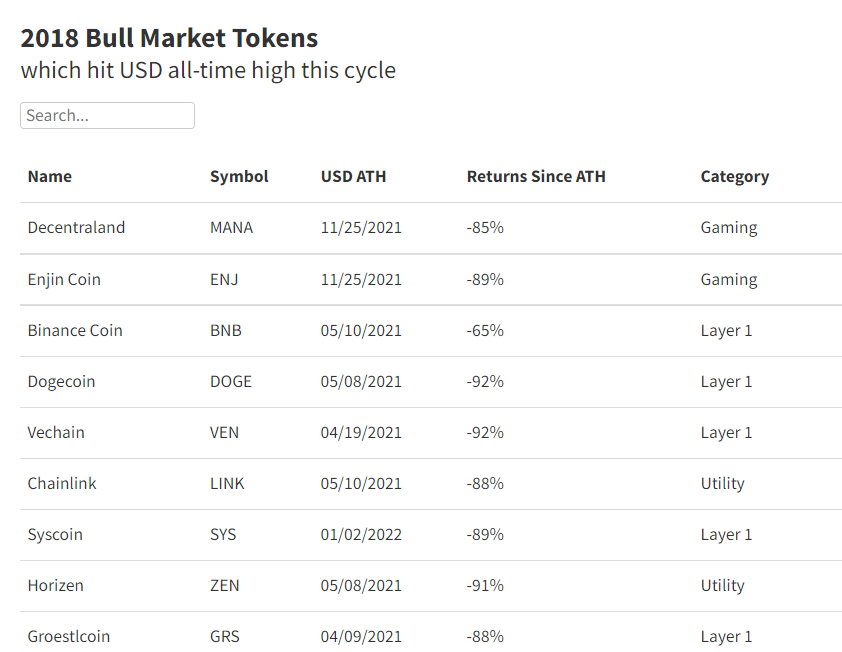
Just 26 of the top 200 digital assets by market capitalization went on to set new highs after the peak of the last bull market in January 2018.

Half were layer-1 tokens, such as litecoin, ether and cardano. Five were governance tokens conferring voting rights powering decentralized finance protocols, such as Gnosis and district0x.

It’s not a rosy picture. But the outlook deteriorates further in denominating how much a cryptocurrency is worth in bitcoin terms, instead of the customary dollar.

Switch to bitcoin pricing, and only six of those cryptocurrencies exceeded their previous peak over the same time period: dogecoin, binance coin, chainlink, decentraland, vechain and enjin coin.

A small selection of winners, representing just 3% of the top 200 digital assets. There’s no clear trend linking them, either.

Dogecoin is literally a “to-the-moon” self-parody, while layer-1 token vechain is powered by the “blockchain for supply chains” meme.

Binance coin boasts some staying power buoyed by enticing burn mechanisms. Chainlink has, arguably, more utility than most, supporting a stretching ecosystem of data feeds and price oracles, which connect various blockchains and smart contracts to execute transactions without third-party validators.

Decentraland and enjin coin’s success, industry participants say, can be explained in part by the metaverse brouhaha and blockchain-powered gaming dapps (decentralized applications) expected to soon grow in popularity.
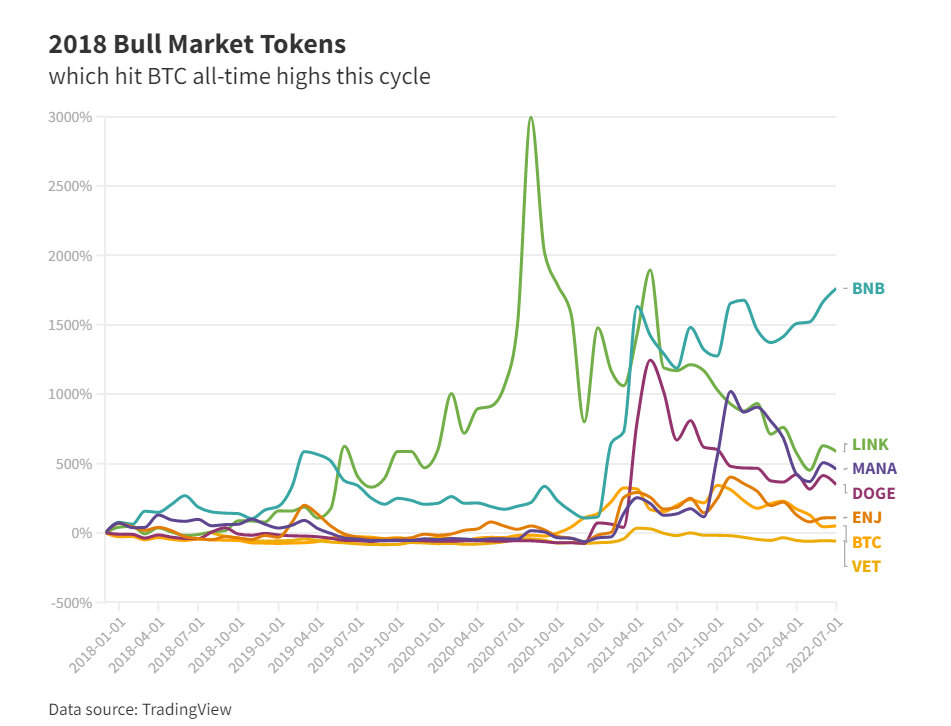
Such spurious connections suggest most digital assets inevitably crescendo in a bull market, but quickly go kaput once the hype fades — destined to never revisit their glittery glories to render top-buying bagholders whole.

So, how does one equitably price digital assets? What is crypto worth, really?

Considering the top 200 coins from the previous bull market are down more than 90%, in dollar terms, from all-time highs, how and why do markets decide how low they go?

Cash flows are bearish for digital assets

Token Terminal is one platform pitching ways to figure it all out. It offers a range of metrics that aim to compare various protocols, echoing traditional company valuation methods in price-to-earning ratios and total revenues.

“Looking backwards, especially comparing the 2018 bull market to what we witnessed in 2021, it’s very difficult to really build any sort of thesis for why certain tokens succeed,” Oskari Tempakka, Token Terminal’s growth lead, told Blockworks.

The platform gauges protocols that generate cash flow alongside blockchain startups that operate entirely on-chain. It wasn’t possible to value protocols based on those factors during the last bull market, Tempakka said, as it was only halfway through 2020 — during DeFi summer — when the first applications built on Ethereum actually started generating positive cash flows to the protocol.

The conclusion: Analyzing the highest-flying cryptocurrencies from the last bull, whether dollar valuation or bitcoin, on a fundamental basis is essentially impossible.

Still, half of the top 200 digital assets which recorded fresh all-time highs throughout the most recent cycle were layer-1 assets.

Layer-1s, the backbone of digital assets, outperformed this time around on the back of healthy name recognition and the efforts of legions of developers, as well as market makers and deep-pocketed traders favoring assets with more liquidity.

There has to be a sizable market capitalization for a $1 billion-plus hedge fund to bother trading an asset — or else move the price needle so much in building a long or short leg that profits become obsolete.

“I’d say the thesis behind layer-1s is that you’re essentially building an infinitely scalable settlement layer for any other applications being built on top,” Tempakka said. “It’s easier to build a more bullish thesis without a valuation cap than it is for a pure application — that’s how we’re looking at layer-1s right now, at least the ones that actually are able to generate cash flow and capture that value.”
Cash flows are actually bearish as they relate to trying to put a price tag on cryptoassets. They’re not bearish in and of themselves as a metric, but industry participants argue that crypto’s rapid growth trajectory demands a different framework.

Applying convention fundamental stock-picking techniques would never work with venture capital-backed startups, they say — so why should it work when it comes to digital assets?

If it’s possible to value a cryptoasset based on conventional fundamentals, then a relatively apples-to-apples comparison to a real-world company ought to be possible, too.

“Crypto doesn’t care about fundamentals, traditional sense of cash flows,” Hassan Bassiri, vice president of portfolio management at digital asset manager Arca, told Blockworks. “The nature of crypto is that it cares about growth potential.”

Added Bassiri: “Say something like Aave or Yearn is trading at a 1,000 price-to-sales ratio but its fintech competitor neobank is trading at 200 — is the cryptocurrency worth a 5x multiple on that?”

Tapping cash flows to value digital assets — just like an Amazon or a Tesla stock — implies they can’t go up forever, a notion akin to kryptonite for crypto die-hards.

Indeed, cash flows provide one method of valuing digital assets, which automatically means they can’t go up forever, a notion akin to kryptonite for cryptocurrency investors.

The result: a volatile, topsy-turvy market that prioritizes social sentiment and glamor over Econ 101.

Markets driven by fundamentals are on the horizon

If looking to the past doesn’t illuminate how traders appraise digital assets, who’s to say which projects out of a sea of many hopefuls have a realistic shot at outlasting the bear market?

One cause for optimism, according to Bassiri: More and more protocols are working to tie real-world use cases to on-chain yield. Case in point: MakerDAO’s recent move to float a $100 million loan denominated in the token DAI to 151-year old Huntingdon Valley Bank, with the potential to increase the credit revolver to a staggering $1 billion over 12 months.

Token Terminal’s Tempakka is vying for the prospects of a future in which the majority of top tokens are driven by measurable fundamentals — and they must generate sustainable cash flows to power that model.

“If you’re a traditional private equity investor, you’re getting to a stage where you can look at the revenue data of crypto protocol and actually build a strong investment thesis around it,” Tempakka said.
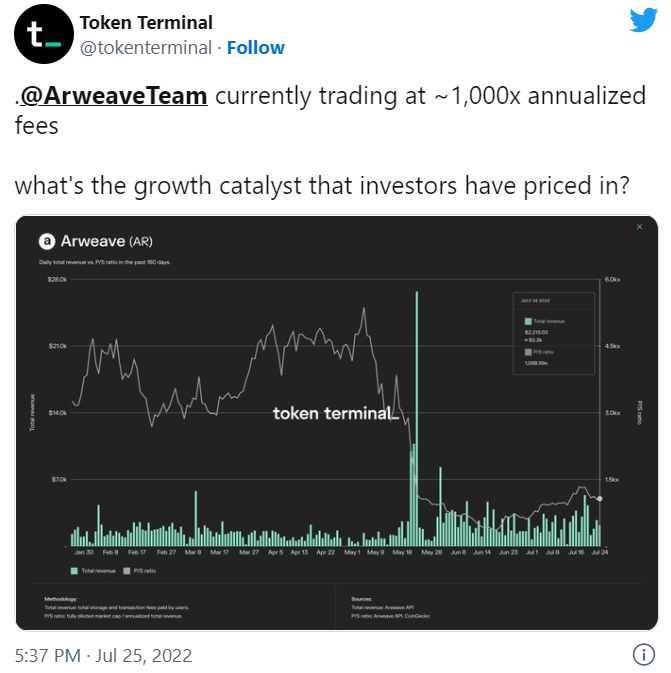
In other words, it’s slowly — then, perhaps, all at once — becoming possible to rationalize crypto plays on something more tangible than hype or belief.

Many an institutional digital assets-focused trader would argue that world is already here. Crypto hedge fund firms build complicated quant models around social sentiment and ebbs and flows in trading volumes.

But those players are often the first to admit those convictions that construct strategies change rapidly in cryptoland. Fundamental metrics are, finally, becoming a powerful standby for sophisticated investors — consider the rise of discretionary strategies — but, for now, they’re just one piece of the overall puzzle.

The remainder is filled in by deep research probing the ins-and-outs of developer teams and their abilities, or lack thereof, to meet the lofty, winding road that lies before them.


Пов'язані матеріали

Matrixdock Featured Again in SBMA’s 《Crucible》: Discussing How Tokenisation Enhances Efficiency in the Precious Metals Market

Matrixdock's research article, titled "Why Tokenisation Matters for the Bullion Industry and How Carrying Costs Fit In," has been featured again in the SBMA's industry publication *Crucible*. Authored by Matrixdock lead Eva Meng, the piece examines how tokenisation enhances the efficiency and utility of the precious metals market. The article argues that tokenisation builds upon the accessibility improvements brought by gold ETFs, not by redefining gold's value but by enabling it to function within digital finance. It extends gold's role beyond a portfolio holding, potentially facilitating instant settlement, digital collateral, and operation in 24/7 markets. A key focus is transparently handling the unavoidable carrying costs (storage, insurance) of physical assets like gold and silver. Matrixdock introduces the Fungible Reserve Standard (FRS) framework, based on an "Economic Purity Principle," which aims to reflect these real-world economic costs clearly within the token mechanism, rather than bundling them opaquely. The platform's practical applications are highlighted, including its gold token XAUm and its silver token XAGm, the first built on the FRS framework. As the tokenised gold market surpassed $6 billion in February 2026, the industry's focus is shifting from initial proofs of reserves to broader concerns of market efficiency and capital utilization. Tokenisation is positioning gold and other precious metals to become active components within the evolving digital financial system.

marsbit9 хв тому

Matrixdock Featured Again in SBMA’s 《Crucible》: Discussing How Tokenisation Enhances Efficiency in the Precious Metals Market

marsbit9 хв тому

New Huo Research: Dense Bottom Fishing in the $60K BTC Range, a 'High Value-for-Money Zone' Sees a Handover Surge

Bitcoin has shown a significant oversold rebound this week, with extreme panic in the crypto market easing. Multiple data points indicate a notable market bottom is forming. On the market front, the net outflow from Bitcoin spot ETFs has continued to shrink, and the negative premium between Coinbase and USDT is steadily correcting. Industry fundamentals suggest the shutdown cost for mainstream miners is concentrated between $30,000 and $50,000, potentially solidifying a阶段性 industry cost floor—a classic signal of market bottoms in previous cycles. Institutional capital is notably positioning against the trend. For instance, Sinohope Group's weekly OTC trading volume surged over 8 times环比, with active platform users doubling, both reaching record highs. This confirms a sharp increase in large capital transaction activity and a spike in off-exchange funding demand. Sinohope Research also observed on-chain data showing that funds from entities with public company attributes and long-term "whale" wallets are actively accumulating Bitcoin around the key $60,000 price level. The research institute has maintained since mid-May that a high-value investment window has reopened, and the market is now undergoing a shift from panic selling to long-term holding. Looking ahead, the core drivers for an upward market move will be liquidity release and macro policy developments. The successful and strong performance of SpaceX's IPO has reignited market optimism, and the massive liquidity frozen during its subscription period is now being unlocked. This substantial capital is expected to seek new value opportunities, potentially flowing into currently undervalued assets like Bitcoin. On the macro and policy front, the tone set in Kevin Warsh's upcoming speech at the FOMC meeting is crucial for near-term monetary policy expectations. Furthermore, the potential passage of the CLARITY Act by late July could significantly boost institutional confidence for capital entry. Considering these bottoming signals alongside favorable liquidity and policy factors, Sinohope Research remains optimistic about the market's subsequent trajectory.

marsbit13 хв тому

New Huo Research: Dense Bottom Fishing in the $60K BTC Range, a 'High Value-for-Money Zone' Sees a Handover Surge

marsbit13 хв тому

Uncovering the 'God of Investment Research' Behind Citrini: Perpetual Substack Chart-Topper, a Single Report Evaporated Trillions from US Stocks

Revealing the "Research God" Behind Citrini: A Non-Finance Founder Shaking Up Markets Citrini, an independent research firm consistently ranked #1 on Substack's finance charts with nearly 250,000 subscribers, has gained significant attention in the current bull market. Its founder, James van Geelen, holds dual degrees in biology and psychology from UCLA, with a background as an emergency medical technician and a healthcare entrepreneur before founding Citrini. The firm is known for its deep, narrative-driven analyses focusing on long-term "super trends" like AI, geopolitics, and macro policy. Citrini made headlines in February with its report "The 2028 Global Intelligence Crisis," a thought experiment on AI's potential societal impact. Despite being labeled a scenario analysis, it triggered a widespread sell-off in software and related stocks, briefly wiping hundreds of billions from the US market. Other notable reports include an on-the-ground analysis of the Strait of Hormuz and accurate calls on the copper foil industry's importance for AI/semiconductors. Geelen champions "second-order thinking," focusing on the indirect consequences of events. His investment style is thematic and often contrarian, seeking opportunities others miss. Citrini operates with a founder-driven, anonymous elite team model, recently adding specialists in macroeconomics and semiconductor analysis. The firm also manages a model portfolio, Citrindex, which has reportedly achieved over 200% cumulative returns.

marsbit17 хв тому

Uncovering the 'God of Investment Research' Behind Citrini: Perpetual Substack Chart-Topper, a Single Report Evaporated Trillions from US Stocks

marsbit17 хв тому

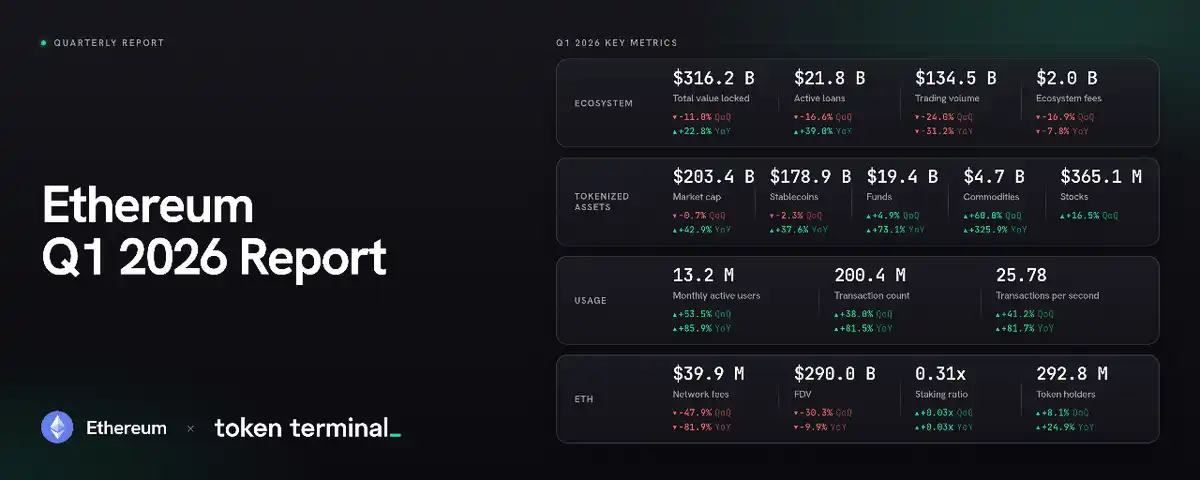
Ethereum Q1 2026 Review: On-chain Activity Hits New Highs, Tokenized Assets Lead the Industry

Ethereum Q1 2026 Review: Chain Activity Hits Record High, Tokenized Assets Lead the Industry In Q1 2026, the Ethereum ecosystem displayed a dual narrative: record-high on-chain activity coincided with declining USD-denominated metrics. User adoption surged, with monthly active addresses reaching 13.2 million (up 53.5% QoQ) and layer-1 transactions hitting 200.4 million (up 38% QoQ). However, the total value locked (TVL) decreased 11% to $316.2B, and protocol revenue fell 16.9% to $2.0B, largely due to a broader crypto market downturn. Tokenized assets emerged as a key strength. Their total market cap reached $203.4B, with significant growth in tokenized funds (+73.1% YoY) and commodities (+325.9% YoY). Ethereum dominated cross-chain comparisons, holding over 61% of stablecoin value and 84% of tokenized commodities value among top chains. A major development was the impact of network scaling. The "Blob" upgrade significantly increased data capacity, causing average transaction fees on layer-1 to plummet 47.9% QoQ despite higher usage. This demonstrates the "Jevons Paradox" in action: cheaper block space stimulates demand. The report highlights Ethereum's established position as the primary settlement layer for institutional tokenization, evidenced by new fund launches from giants like BlackRock and JPMorgan in May. Analysts draw parallels between Ethereum's current stage and the internet in the mid-1990s, suggesting its open, neutral network is poised to become the foundational infrastructure for global finance, outcompeting closed, private alternatives.

Foresight News21 хв тому

Ethereum Q1 2026 Review: On-chain Activity Hits New Highs, Tokenized Assets Lead the Industry

Foresight News21 хв тому

Торгівля

Спот
Ф'ючерси
活动图片