Tesla Dumped 75% of Its Bitcoin Holdings, Should We Worried?

HuobiОпубліковано о 2022-07-21Востаннє оновлено о 2022-07-25

Анотація

Tesla has significantly reduced its position on Bitcoin, but it may not have much negative impact on the market.

Tesla announced a massive reduction in bitcoin holdings on Wednesday night, which seems to show that Musk is giving up his belief in bitcoin? But Tesla’s position on Dogecoin remains unchanged which indicates that this dump may respond to Chinna‘s Covid regulation.

Other analysts argue that a Tesla sale would relieve the potential disruption Musk may cause to the crypto ecosystem and be more conducive to the long-term development of the industry.

1. Tesla dumped 75% of its Bitcoin holdings

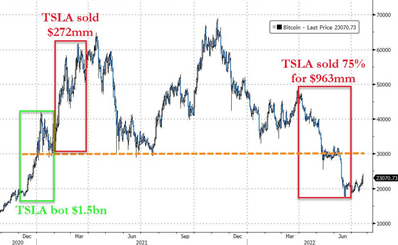
Tesla’s Q2 financial report shows that the company reduced its bitcoin holdings by 75% to about $30,000, which added nearly $1 billion cash to its balance sheet.

On the earnings conference call, Elon Musk stressed that this move is a pre-judgment of the uncertain impact of the external environment and did not represent Tesla's forecast on the price of Bitcoin. He also insisted that Tesla may increase its position on cryptocurrencies in the future.

2. Why did Tesla sell its bitcoin?
Tesla had announced a 10% layoff plan for its regular employees and closed an office in Silicon Valley in last month. This year, due to the closure of Shanghai factory, Tesla’s did tremendous job to keep a health cash flow. Selling bitcoins in a bad market environment is a good move to hedge risks.

Since the beginning of this year, Tesla's short-term solvency has deteriorated, with its quick ratio and current ratio hitting a quiet low position for few years. In addition, due to the shutdown of the Shanghai factory, the demand for working capital has continued to increase, and the company's solvency is being tested.

So far, Tesla has withdrawn about 123.5 million US dollars from Bitcoin, and has not fully refunded for its inverstment (150 million US dollars). This large-scale withdrawal of Bitcoin should be interpreted as a helpless move.

From another perspective, Elon Musk is still in the lawsuit trouble with Twitter. Selling Bitcoin can alleviate the market’s worries about Tesla’s stock price, which will provide more financial support for the upcoming lawsuit.

3. Will Tesla's move sabotage Bitcoin's upward trend?

While the market appears to have pulled back slightly over the past ten hours, Bitcoin quickly stabilize after aborbing this news.

Tesla's dump may not necessarily be a bad thing for the BTC. If we use logic like: "Pendulum Effect", this rebound of BTC may not have seen the peaked.

We may still need to pay attention to the final decision of the market who will decide the market will choose "bounce"or "reversal"?

Appendix. Musk's Web3.0 journey
In 2002, Musk sold PayPal, and this start-up experience gave him a deeper understanding of the monetary system.

In February 2019, Musk tweeted that Bitcoin is well structured. This paved the way for Tesla’s $1.5 billion purchase of Bitcoin in January 2021.

On February 8, 2021, Tesla announced that it would begin accepting Bitcoin as a form of payment to its cars.

But in its Q1 2021 report, Tesla announced it had sale of $272 million in bitcoin.

In May of the same year, Tesla called a halt to Bitcoin as a means of payment, citied his concerns about "the rapid increase in the use of fossil fuels for Bitcoin mining."

In the 2022 Q2 earnings report, Tesla announced the sale of $963 million in Bitcoin to meet the funding needs of the unexpected environment. He also mentioned that Tesla did not sell Dogecoin.


Пов'язані матеріали

Gate Research Institute: ETF Outflows Suppress Risk Appetite, Two-Way System Navigates Weak Market

Gate Institute Research Report: May 2026 Crypto Market Review & Strategy Analysis In May 2026, the crypto market shifted from an early-month rally to a mid-month correction, concluding with low-volatility consolidation. BTC, ETH, and SOL peaked in early May before declining. The primary market dynamic was a divergence between weakening spot ETF inflows and persistently high leverage-driven perpetual trading volume. A dual-direction moving average cluster breakout strategy outperformed, returning +2.11% for an equally-weighted BTC/ETH/SOL portfolio. This contrasted with a -6.09% return for buy-and-hold and -3.65% for a long-only version of the strategy. Profits were primarily generated from short positions on ETH and SOL during the mid-to-late May downtrend, demonstrating the month's suitability for two-way trend trading. Market structure evolved in three phases: an initial surge (May 1-6), a failure and reversal (starting May 7), and low-volatility compression (May 22 onward). While stablecoin supply remained stable, significant outflows from mainstream BTC and ETH ETFs created selling pressure. Concurrently, high correlation with the S&P 500 (~0.6) and stronger performance from AI equities like Nvidia highlighted crypto's position as a high-beta risk asset within a broader risk-budget framework, lacking independent momentum. The successful strategy employed a 4-hour chart system using a cluster of six moving averages (EMA6,12,24 & SMA6,12,24). A breakout signal was triggered after the cluster width compressed below 2.2%. Trades were managed with a 2.5% fixed stop-loss, a 3:1 Risk/Reward (7.5%) take-profit, and an EMA12-based exit rule to control losses from false breakouts. The strategy's low win rate but high payoff from a few large trend moves was effective in May's conditions. The report concludes that for June, a disciplined, bidirectional approach remains superior to subjective directional bets. The framework should adapt signal weighting based on BTC's position relative to key EMAs, ETF flow trends, and the relative strength of the Nasdaq, prioritizing risk management and trend preservation.

marsbit16 хв тому

Gate Research Institute: ETF Outflows Suppress Risk Appetite, Two-Way System Navigates Weak Market

marsbit16 хв тому

Anthropic CEO's Latest Interview: On Technological Explosion, Safety Red Lines, and the Civilization Contract

Interview with Anthropic CEO Dario Amodei covers the intense pressures and ethical dilemmas of leading AI development. He describes the experience as "exponential growth," feeling constant acceleration akin to relativistic time dilation. The discussion delves into his departure from OpenAI, rooted in a fundamental loss of trust and divergent values rather than mere technical disagreements. Amodei emphasizes Anthropic's enterprise-focused business model, arguing it aligns better with safety and responsible deployment than consumer-facing, ad-driven models. He addresses critical issues like AI's impact on employment, advocating for proactive macroeconomic policies and a shift towards "doing more with the same resources" to avoid widespread job displacement. On safety and governance, he details Anthropic's cautious approach, including delaying the release of the powerful "Mythos" model due to its advanced cyber capabilities. He stresses the need for "human-in-the-loop" principles in military applications, setting red lines against autonomous weapons and mass surveillance. Amodei calls for industry collaboration among trustworthy actors to establish standards and advocates for a balanced regulatory framework with checks and balances, such as Anthropic's Long-term Benefit Trust, rather than corporate or government monopoly over the technology. He expresses geopolitical concerns, particularly regarding China, and a belief that AI should bolster liberal democracies. While acknowledging a non-zero risk of civilizational catastrophe from advanced AI, he asserts Anthropic's actions are aimed at significantly reducing that probability. The interview concludes with Amodei arguing that trust must be earned through concrete actions, like sacrificing commercial gain for safety, to distinguish Anthropic in a Silicon Valley landscape he criticizes for eroded public trust.

marsbit19 хв тому

Anthropic CEO's Latest Interview: On Technological Explosion, Safety Red Lines, and the Civilization Contract

marsbit19 хв тому

The Brutal Truth Behind CARDS' $535M FDV: Only $43M in Net Revenue and Halved Profit Margins

The article titled "The Brutal Truth Behind CARDS' $535 Million FDV: Only $43 Million Net Revenue, Profit Margins Halved" provides a critical analysis of Collector Crypt (CC), a platform combining physical collectible cards with NFTs in a gacha-style system. Key findings include: * CC has generated $635 million in total user deposits. However, 90.6% ($576 million) is instantly returned to users via automatic card buybacks, resulting in only $43 million in net platform revenue (6.7% retention). * Activity is highly concentrated among dozens of high-frequency wallets, with an average of only ~420 daily active players. * There is minimal secondary market activity for the cards (under $5 million total), indicating the platform functions more as a gambling casino than a collector's marketplace. eBay sales as a percentage of gacha volume have declined for six consecutive quarters. * Despite a tripling in transaction volume, net profit margins have been halved from 11.2% to 5.8% as activity shifts to higher-priced card packs with lower margins. * Value captured by the CARDS token is minimal: only $140,000 (from burns and recent buybacks), representing just 3.4% of CC's cumulative net revenue. In contrast, wallets linked to operational infrastructure have off-ramped $45.7 million in USDC. * The token's ~$535 million Fully Diluted Valuation (FDV) represents a 7.3x multiple of annualized net revenue. Only 20.5% of the token supply is floating, with 72% allocated to insiders and locked until November 2027. The conclusion is that CC has found product-market fit as a high-speed gambling platform for a niche user base, not as a growing collector economy. The token currently captures a negligible share of the platform's revenue.

Foresight News44 хв тому

The Brutal Truth Behind CARDS' $535M FDV: Only $43M in Net Revenue and Halved Profit Margins

Foresight News44 хв тому

Торгівля

Спот
Ф'ючерси
活动图片