Dos fundadores de la cadena pública china NEO se enfrentan, la opacidad financiera es la causa principal

marsbitОпубліковано о 2026-01-01Востаннє оновлено о 2026-01-01

Анотація

**Resumen: Disputa entre los cofundadores de la antigua cadena pública china NEO por falta de transparencia financiera** Los cofundadores de NEO, Erik Zhang (Zhang Zhengwen) y Da Hongfei, han protagonizado una disputa pública que revela graves problemas de transparencia financiera en la fundación de este proyecto blockchain establecido en 2014. Zhang, quien regresó oficialmente en septiembre después de haber abandonado el proyecto previamente, denunció en noviembre la opacidad en la gestión de los activos de la fundación, controlados unilateralmente por Da Hongfei. Zhang afirmó que buscó acceso a informes financieros detallados pero encontró resistencia, describiendo la situación como una "caja negra". La controversia se intensificó en diciembre cuando Zhang acusó a Da de utilizar recursos de NEO para desarrollar un proyecto independiente llamado EON, lo que motivó su regreso para supervisar la gobernanza. Zhang también criticó que NEO dependía de hackathons para crear una "falsa prosperidad" sin usuarios reales. En respuesta, Da Hongfei contraatacó alegando que Zhang controla la mayoría de los fondos de NEO (incluyendo los tokens NEO y GAS) y domina los derechos de voto de los nodos de consenso. Da prometió publicar informes financieros en el primer trimestre de 2026. Zhang anunció unilateralmente que, a partir del 1 de enero de 2026, Da Hongfei se enfocaría en el desarrollo de NeoX y SpoonOS, alejándose de las operaciones principales de NEO, aunque Da no confirmó este...

Quién iba a pensar que una cadena pública china tan antigua llegaría a este día. Lo que es aún más lamentable es que los principales proyectos de IA chinos, como Manus, Kimi y Minimax, han tenido noticias importantes durante dos días consecutivos, ya sea siendo adquiridos por miles de millones de dólares o recibiendo financiación de cientos de millones, mientras que la antigua cadena pública ha comenzado a enfrentarse.

Por lo visto, los dos cofundadores de la cadena pública NEO, fundada en 2014, Zhang Zhengwen (Erik Zhang) y Da Hongfei, básicamente se han separado por completo y continúan discutiendo en X. Basándonos en sus declaraciones y la información pública disponible en línea, intentaremos entender qué sucedió exactamente entre los dos fundadores de esta antigua cadena pública.

Opacidad financiera

En realidad, Zhang Zhengwen dejó NEO hace algunos años, lo cual confirmó en su propio Twitter, y regresó oficialmente en septiembre de este año. El detonante de esta disputa fue en noviembre. Según mensajes de la comunidad y información pública, Zhang Zhengwen, como núcleo técnico, encontró obstáculos al buscar obtener el informe financiero detallado y el flujo de fondos de la Fundación Neo.
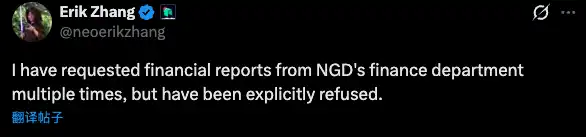
Posteriormente, Zhang Zhengwen acusó a la Fundación Neo de operar de manera opaca durante mucho tiempo, con un estado de activos similar a una "caja negra". Señaló que Da Hongfei ha controlado de manera unilateral los activos de la fundación, excluyendo los tokens NEO/GAS, y carece de un mecanismo completo y auditable de divulgación.

En la discusión mutua de hoy, también descubrimos la razón por la cual Zhang Zhengwen se fue anteriormente. Dijo que Da Hongfei se acercó por separado y le dijo que la eficiencia era baja si ambos estaban a cargo de NEO, por lo que optó por retirarse temporalmente de la gestión para "mejorar la eficiencia". Sin embargo, descubrió que Da Hongfei estaba utilizando los recursos de NEO para desarrollar el proyecto independiente de cadena pública EON. Esto también lo impulsó a regresar e intervenir en la gobernanza de la fundación.

En una comunicación con la comunidad en noviembre, Zhang Zhengwen mencionó que NEO anteriormente dependía de hackathons para crear una "falsa prosperidad", sin usuarios reales, y muchos proyectos de hackathon desaparecían después de recibir premios.

Intensificación de las contradicciones

En diciembre, Zhang Zhengwen emitió una declaración pública exigiendo que Da Hongfei cumpla con las obligaciones de divulgación financiera prometidas desde el 9 de diciembre. Más explosivo aún, Zhang Zhengwen anunció unilateralmente que, según un acuerdo telefónico previo entre ambos, a partir del 1 de enero de 2026, Da Hongfei ya no participará en los asuntos de la red principal de NEO, y en su lugar se centrará en el desarrollo y operación de la cadena lateral NeoX y el nuevo proyecto SpoonOS.

Da Hongfei respondió de inmediato, diciendo que Zhang Zhengwen en realidad controla la gran mayoría de los fondos del ecosistema NEO (incluidos los activos principales tokens NEO y GAS), y domina el derecho a voto de los nodos de consenso. También acusó a Zhang Zhengwen de retrasar durante años por varias razones (como esperar a que se complete la migración a N3) la transferencia de fondos a la dirección multisig (Multisig) de la fundación.

Da Hongfei prometió publicar el informe financiero de finales de 2025 en el primer trimestre de 2026, y compartirá datos preliminares con antelación.


Пов'язані питання

Q¿Cuál es la razón principal del conflicto entre los dos cofundadores de NEO, según el artículo?

ALa razón principal del conflicto es la falta de transparencia financiera en la Fundación NEO, con Erik Zhang acusando a Da Hongfei de controlar unilateralmente los activos de la fundación como una 'caja negra'.

Q¿Qué descubrió Zhang Zhengwen (Erik Zhang) que lo impulsó a regresar a la gestión de la fundación?

ADescubrió que Da Hongfei estaba utilizando recursos de NEO para desarrollar un proyecto de cadena de bloques independiente llamado EON, lo que lo motivó a regresar e intervenir en la gobernanza de la fundación.

Q¿Qué medida anunció unilateralmente Erik Zhang en diciembre respecto al papel de Da Hongfei en NEO?

AAnunció unilateralmente que, a partir del 1 de enero de 2026, Da Hongfei ya no participaría en los asuntos de la red principal de NEO y se centraría en el desarrollo de la cadena lateral NeoX y el nuevo proyecto SpoonOS.

Q¿Cómo respondió Da Hongfei a las acusaciones de Erik Zhang sobre el control de activos?

ADa Hongfei respondió que Erik Zhang en realidad controla la mayor parte de los fondos del ecosistema NEO, incluidos los activos principales NEO y GAS, y domina el poder de voto de los nodos de consenso.

Q¿Qué compromiso de transparencia financiera hizo Da Hongfei durante el conflicto?

ADa Hongfei se comprometió a publicar el informe financiero de finales de 2025 en el primer trimestre de 2026 y a compartir datos preliminares con anticipación.

Пов'язані матеріали

Behind HYPE's Repeated Record Highs, the 'Minions' in the Ecosystem Can't Keep Up

While HYPE, the native token of the Hyperliquid ecosystem, surges to new all-time highs above $76 and attracts significant institutional ETF inflows, a starkly different reality unfolds within its HyperEVM application layer. Multiple core DeFi protocols across lending, NFTs, stablecoins, and DEXs have announced shutdowns between May and June. The article argues HYPE functions more like an "application stock" than a traditional ecosystem token. Its value is anchored to the trading fees from Hyperliquid's core perpetual contracts platform (HyperCore), which boasts a diversified revenue stream from crypto, commodities, and indices. Approximately 97% of protocol fees fund buybacks and burns of HYPE. This means HYPE's price is largely decoupled from the health of projects built on HyperEVM. The closures of significant projects like lending protocol HypurrFi (peak TVL >$300M) and NFT marketplace Drip.Trade highlight a structural tension. Hyperliquid's minimalist philosophy offers infrastructure without official grants, liquidity support, or marketing coordination for HyperEVM projects. This forces protocols into a fiercely competitive environment from day one. Furthermore, the success of HyperCore creates a liquidity vacuum, and mechanisms like HIP-3 (allowing direct perpetual market deployment) divert user attention and capital away from application-layer projects. The stronger the core perpetual trading business becomes, the more difficult it is for peripheral "DeFi lego" projects to survive and capture value, despite the flagship token's rising price.

Foresight News32 хв тому

Behind HYPE's Repeated Record Highs, the 'Minions' in the Ecosystem Can't Keep Up

Foresight News32 хв тому

Conversation with Arthur Hayes: AI Has Drained Market Liquidity, BTC Will Be Below 100k by Year-End

In this June 2026 podcast interview, BitMEX co-founder Arthur Hayes explains his decision to sell his major crypto holdings (HYPE, NEAR, Worldcoin, Zcash). His rationale is based on a macro view linking oil prices, the Iran conflict, US politics, and an impending AI bubble burst. Hayes argues that high oil prices, driven by the ongoing war, will pressure domestic US inflation. To salvage the Republican Party's chances in the midterm elections, he believes Donald Trump may pivot to a populist, anti-AI stance—advocating for taxes and regulation—which would deflate the AI investment narrative. He sees the AI sector, particularly massive capital expenditure on data centers, as having absorbed nearly all excess market liquidity (around $1.5 trillion in debt issuance since 2025), starving other assets like Bitcoin. He highlights the upcoming SpaceX IPO at a ~$1.8 trillion valuation and 100x price-to-sales ratio as a potential tipping point. If these hyped IPOs underperform, it could shatter market confidence in AI. In such a scenario, all risk assets, including crypto, would fall together as correlations converge to 1 during a broad correction. Hayes has moved his portfolio into Treasuries and energy stocks (like ExxonMobil), predicting Bitcoin will be below $100k by year-end. He sees a potential crypto bull market only after the AI frenzy cools, liquidity stops flowing exclusively into AI, and possibly after a significant market downturn prompts new monetary stimulus.

marsbit43 хв тому

Conversation with Arthur Hayes: AI Has Drained Market Liquidity, BTC Will Be Below 100k by Year-End

marsbit43 хв тому

Fed's Internal Doves Flock to Hawkish Stance, Warsh's Debut "Between a Rock and a Hard Place"

U.S. Federal Reserve officials who previously advocated for rate cuts, including Governor Christopher Waller, have recently shifted their stance, with many now not ruling out the possibility of future rate hikes. This sets a challenging stage for new Fed Chair Kevin Warsh's first policy meeting. Appointed by President Trump based on his dovish views, Warsh now faces a committee where the debate has pivoted from "when to cut" to "whether to hike," driven by persistent inflation above 3%, a strong labor market, and supply-side pressures from AI infrastructure demands and geopolitical tensions. Key figures illustrate the shift. Governor Waller, once concerned about employment, now says data has pushed him toward considering rate increases. Even moderate voices like Governor Lisa Cook, while expecting inflation to ease, have indicated readiness to hike if it fails to do so. Long-time hawks such as regional Fed presidents Beth Hammack, Lorie Logan, and Neel Kashkari have grown more vocal, arguing that the real policy rate is effectively falling and that action may soon be needed. The upcoming Fed meeting is expected to keep rates steady but will likely remove the "easing bias" from its statement, signaling a neutral stance between cuts and hikes. The quarterly "dot plot" is anticipated to show most officials projecting no cuts this year, with some potentially indicating hikes. Chair Warsh, a critic of the Fed's reliance on forward guidance like the dot plot, must navigate communicating this pivot using tools he has questioned, all while steering policy in a direction counter to the preferences of the president who appointed him. The consensus suggests the Fed's next move could well be a rate increase.

marsbit1 год тому

Fed's Internal Doves Flock to Hawkish Stance, Warsh's Debut "Between a Rock and a Hard Place"

marsbit1 год тому

The Trillion-Yuan Market Cap 'Yi Zhong Tian': Who is the True Value King?

The article analyzes the three leading Chinese optical module companies, collectively nicknamed "Yi Zhong Tian": Xinyisheng, Zhongji Innolight, and TFC Optical Communication. It evaluates their "cost-performance" not by current stock price, but through three lenses: PEG ratio (growth vs. valuation), earnings quality, and premium/discount for certainty. Xinyisheng shows the most attractive PEG ratio and high profitability, but its valuation reflects discounts for risks like high customer concentration and reliance on overseas markets. Zhongji Innolight, the most expensive, commands a premium for its market leadership, dominant share in key products like 800G/1.6T modules, and higher earnings certainty, though it faces geopolitical risks. TFC Optical, as an upstream component supplier ("water seller"), has the highest gross margin and bets on the long-term CPO/NPO architecture trend, but trades at a high valuation with more stable, less explosive growth. The core argument is that while these companies dominate module assembly, the true profit pool and technological moat lie upstream in laser and switch chips, currently controlled by U.S. firms like Lumentum and Coherent. The long-term "cost-performance" for these Chinese leaders hinges on whether the domestic industry, exemplified by companies like Yuanjie Technology, can successfully move up the value chain into high-power laser chips. Otherwise, their high growth may remain confined to the lower-margin assembly segment.

marsbit1 год тому

The Trillion-Yuan Market Cap 'Yi Zhong Tian': Who is the True Value King?

marsbit1 год тому

Торгівля

Спот
Ф'ючерси

Популярні статті

Як купити CORE

Ласкаво просимо до HTX.com! Ми зробили покупку CORE (CORE) простою та зручною. Дотримуйтесь нашої покрокової інструкції, щоб розпочати свою криптовалютну подорож.Крок 1: Створіть обліковий запис на HTXВикористовуйте свою електронну пошту або номер телефону, щоб зареєструвати обліковий запис на HTX безплатно. Пройдіть безпроблемну реєстрацію й отримайте доступ до всіх функцій.ЗареєструватисьКрок 2: Перейдіть до розділу Купити крипту і виберіть спосіб оплатиКредитна/дебетова картка: використовуйте вашу картку Visa або Mastercard, щоб миттєво купити CORE (CORE).Баланс: використовуйте кошти з балансу вашого рахунку HTX для безперешкодної торгівлі.Треті особи: ми додали популярні способи оплати, такі як Google Pay та Apple Pay, щоб підвищити зручність.P2P: Торгуйте безпосередньо з іншими користувачами на HTX.Позабіржова торгівля (OTC): ми пропонуємо індивідуальні послуги та конкурентні обмінні курси для трейдерів.Крок 3: Зберігайте свої CORE (CORE)Після придбання CORE (CORE) збережіть його у своєму обліковому записі на HTX. Крім того, ви можете відправити його в інше місце за допомогою блокчейн-переказу або використовувати його для торгівлі іншими криптовалютами.Крок 4: Торгівля CORE (CORE)Легко торгуйте CORE (CORE) на спотовому ринку HTX. Просто увійдіть до свого облікового запису, виберіть торгову пару, укладайте угоди та спостерігайте за ними в режимі реального часу. Ми пропонуємо зручний досвід як для початківців, так і для досвідчених трейдерів.

254 переглядів усьогоОпубліковано 2024.12.13Оновлено 2026.06.02

Як купити CORE

Обговорення

Ласкаво просимо до спільноти HTX. Тут ви можете бути в курсі останніх подій розвитку платформи та отримати доступ до професійної ринкової інформації. Нижче представлені думки користувачів щодо ціни CORE (CORE).

活动图片