346% Surge vs 20.8% Decline, CoinGecko: DEX Perpetuals Are Taking Market Share from CEX

marsbitОпубліковано о 2026-03-04Востаннє оновлено о 2026-03-04

Анотація

CoinGecko's 2025 report highlights a dramatic shift in the crypto derivatives market, with DEX perpetual contract volume surging 346% to $6.7 trillion, while CEX open interest declined by 20.8%. This signals a systemic capital migration from centralized to decentralized platforms, driven by superior capital efficiency, mature market mechanisms, and enhanced DEX usability. Key factors include the ability to trade with leverage, hedge positions, and profit in both bull and bear markets. Hyperliquid, ranking as the seventh-largest global exchange with $2.9 trillion in volume—surpassing Coinbase International—exemplifies this trend. Its custom L1 blockchain enables high-speed, low-cost trading, while HIP-3’s permissionless listing mechanism allows trading of commodities, equities, and alternative assets, transforming DEXs into 24/7 global financial infrastructure. The data confirms perpetual contracts are reshaping crypto market structure, with DEXs becoming competitive in performance, fees, and user experience, positioning them as the future of decentralized finance.

Author: CoinGecko

Compiled by: Deep Tide TechFlow

Guide: The core data from CoinGecko's annual report is telling enough: DEX perpetual contract trading volume surged by 346% year-on-year, while CEX open interest fell by 20.8% during the same period. Capital is systematically migrating from centralized to decentralized platforms.

This article is not just about numbers; it clearly explains why this migration is happening, how Hyperliquid managed to surpass Coinbase International, and what these platforms are evolving into post-HIP-3.

Full Text Below:

In 2025, perpetual contract exchanges—especially decentralized platforms—experienced explosive growth, with total trading volume reaching $92.9 trillion (a 64.6% year-on-year increase), fundamentally shifting the crypto market from spot trading to a derivatives-led price discovery mechanism.

Key Points:

  • DEX perps grew by 346%, reaching $6.7 trillion; meanwhile, CEX open interest declined by 20.8%. This represents a massive capital migration from centralized to decentralized infrastructure, driven by platforms like Hyperliquid (ranked 7th globally with $2.9 trillion in volume).
  • Capital efficiency drives adoption: Perps allow traders to gain exposure with less capital through leverage, profit in both directions (crucial during the Q4 2025 downturn), and avoid the friction of physical settlement.
  • HIP-3 enables permissionless listing of any asset with a price feed, transforming platforms like Hyperliquid from "crypto exchanges" into 24/7 global financial infrastructure capable of trading everything from commodities to pre-IPO equity.

Why Perps Are Outpacing Spot Trading
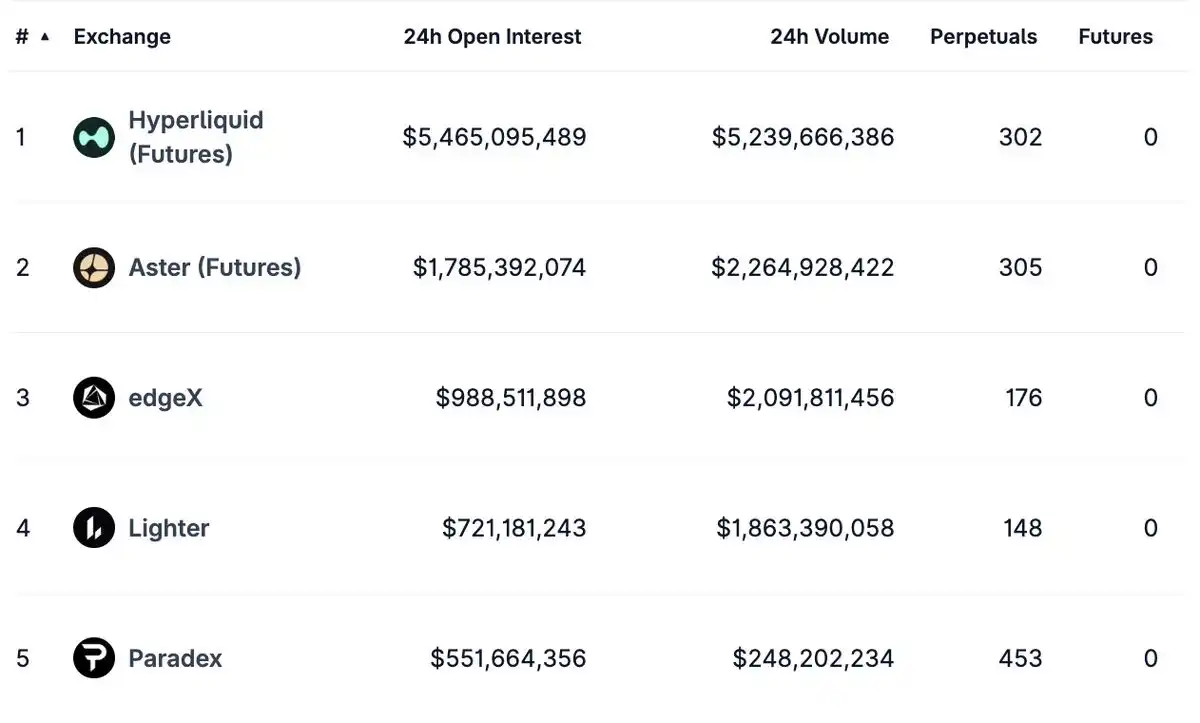
Figure: Top 5 Decentralized Perpetual Exchanges by 24h Trading Volume on CoinGecko as of March 2, 2026

Capital Efficiency: Doing More with Less

The fundamental advantage of perpetual contracts is capital efficiency. In the spot market, buying $10,000 worth of Bitcoin requires $10,000 in capital, which is locked up during the holding period. In the perpetual market, leverage allows for the same exposure with only a fraction of the capital, freeing up liquidity for other positions or strategies.

Beyond speculation, perpetual contracts enable market participants to:

Hedge existing positions without selling the underlying asset (thus avoiding taxable events); arbitrage price differences across trading venues; express directional views without the friction of physical settlement; deploy capital across multiple opportunities simultaneously.

Every dollar in the perpetual market works harder than a dollar in spot. For traders, funds, and institutions optimizing capital returns, the scale is tipping toward perps.

Market Maturation: Following the Path of Traditional Finance

The explosive growth of crypto derivatives mirrors a pattern seen in every mature financial market. In traditional finance, the derivatives market size far exceeds the underlying spot market, often by 10 to 50 times. Take the interest rate swap market, for example, with a notional value exceeding $400 trillion, compared to the bond market's ~$130 trillion.

The crypto market is just catching up. As the market matures and more experienced participants flood in, the derivatives-to-spot trading volume ratio continues to expand. The top ten exchanges alone generated $92.9 trillion in perpetual contract volume, far exceeding the total spot trading volume across all crypto exchanges.

The Hedging Factor: Resilience in a Downturn

Perhaps the most compelling evidence of the perpetual contract value proposition emerged during the Q4 2025 downturn. While spot markets contracted and investor sentiment soured, trading volume at the top ten perpetual exchanges grew 64.6% year-on-year.

Why? Because perpetual contracts allow traders to profit in both directions. When prices fall, short positions profit significantly, and hedging activity intensifies. The market's ability to express bearish views keeps capital active, volumes high, even as spot buying dries up.

In traditional, spot-only markets, price declines mean reduced activity. This is evident from the drop in CEX spot volume from $2.21 trillion in January 2025 to a low of $0.95 trillion in December.

In the perpetual market, however, volatility in any direction means opportunity. The 2025 data proves this dynamic has fundamentally altered crypto market structure.
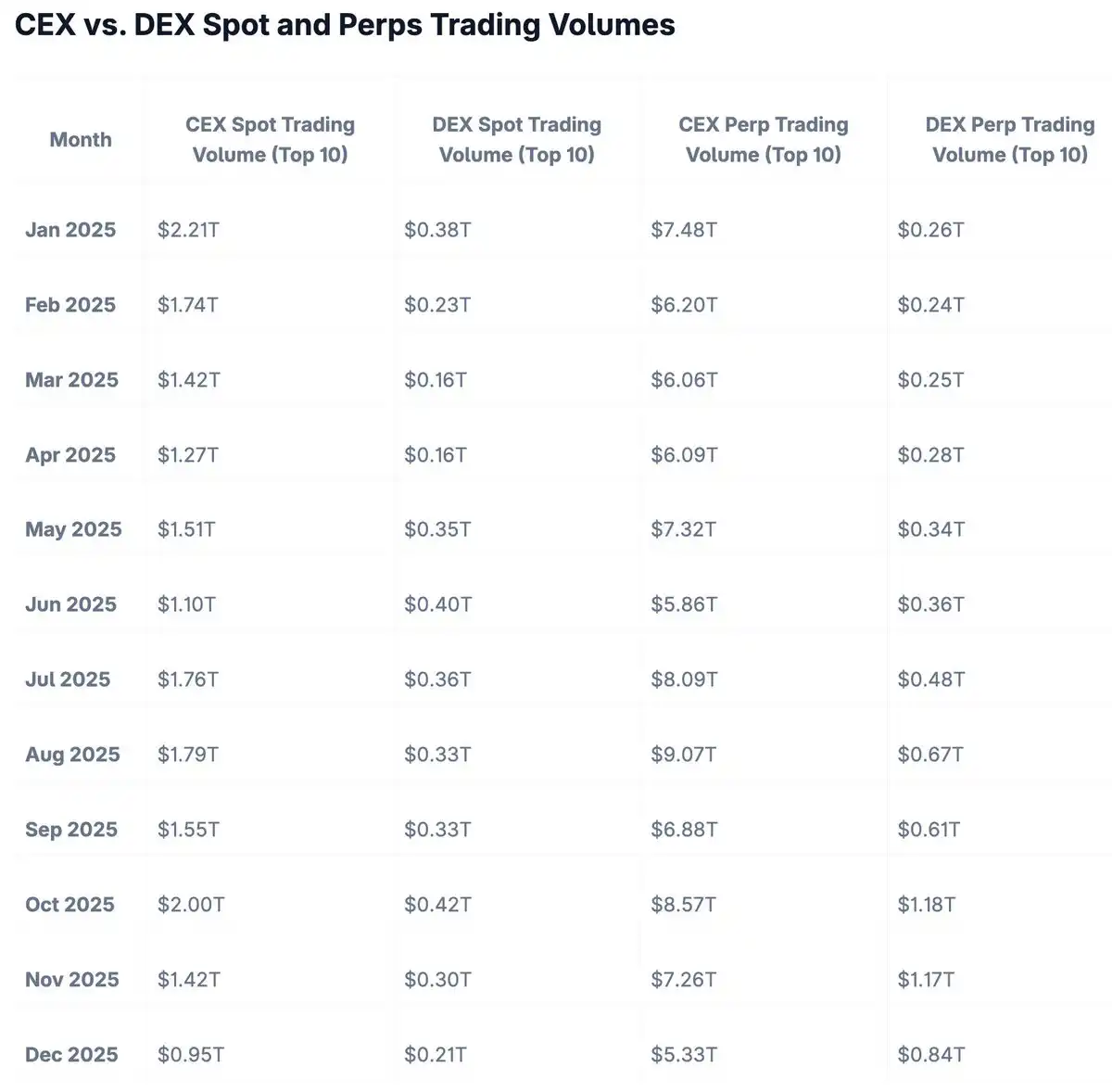
Figure: CEX vs. DEX Spot and Perpetual Contract Trading Volume Comparison

The Great Migration: DEX vs. CEX
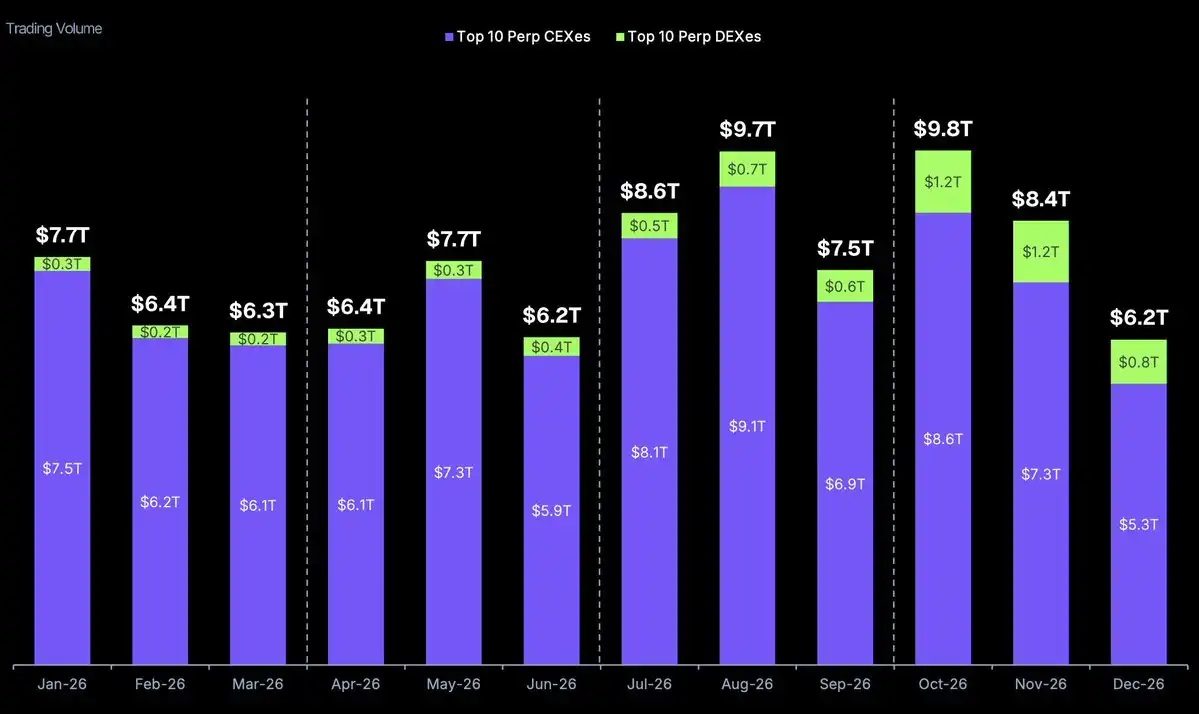
Figure: Top 10 Perp CEX and Perp DEX Trading Volume

Source: CoinGecko 2025 Crypto Industry Annual Report

Although centralized exchanges still dominate in absolute size, the real story of 2025 is the meteoric rise of decentralized perpetual exchanges. Perp DEX volume surged 346%, reaching a record $6.7 trillion for the year.

To put this leap into perspective: In the peak month of October 2025 alone, Perp DEXs processed $1.18 trillion in volume, more than four times the volume of January 2025.

DEX's Breakthrough

By 2025, Perp DEXs had solved the fundamental usability issues that previously kept users on centralized platforms:

  1. User Experience Parity: The narrative of "clunky DEX operation" ended in 2025. Hyperliquid and Lighter offered interfaces nearly indistinguishable from Binance or Coinbase's. Order book depth was sufficient, execution near-instantaneous—the average trader could no longer tell they were on a decentralized platform.
  2. Competitive Fee Structures: Early DEXs charged a premium for decentralization. By 2025, competition and technological advancement pushed Perp DEX fees to match or undercut CEX rates. Platforms like Hyperliquid even began offering up to 90% taker rebates, rivaling the most competitive CEX fee structures.
  3. Scaled Performance: Early blockchain-based DEXs couldn't handle the volume required for serious derivatives trading. The emergence of dedicated Layer 1 chains and optimized rollups solved this. Hyperliquid's custom L1, for example, processes thousands of transactions per second with sub-second confirmation times—performance comparable to centralized infrastructure.

The Divergence in Open Interest
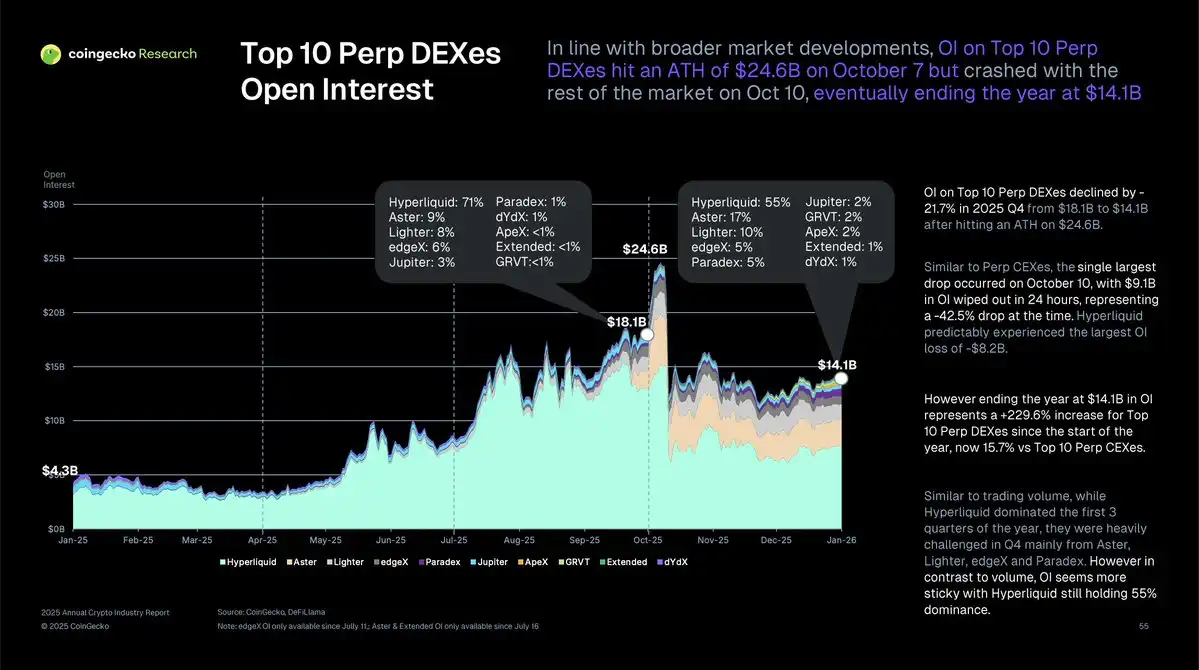
According to CoinGecko's "2025 Annual Crypto Industry Report," CEX open interest declined 20.8% in 2025, while DEX open interest surged 229.6%.

Open interest—the total value of outstanding derivative contracts—represents committed capital and conviction. This divergence tells us traders aren't just "trying out" DEXs for quick trades; they are establishing substantial long-term positions on-chain.

This shift represents a reallocation of capital from centralized to decentralized infrastructure. Once this migration begins, network effects accelerate it. More liquidity attracts more traders, which attracts more market makers, further deepening liquidity.

The Rise of Hyperliquid and Lighter

The 2025 perpetual exchange rankings reveal a significant shift in market structure. Two decentralized platforms forcefully entered the top ten, displacing established centralized players:

  • @HyperliquidX: Ranked 7th globally, with annual volume of $2.9 trillion;
  • @Lighter_xyz: Ranked 10th globally, with annual volume of $1.3 trillion.

In 2025, Hyperliquid's volume surpassed that of Coinbase International. This decentralized platform, less than two years old, overtook a publicly-listed, institutionally-backed exchange with billions in capital and years of operational history.

Coinbase International processed approximately $1.4 trillion in 2025. Hyperliquid reached $2.9 trillion—more than double.

Winning with Infrastructure

Hyperliquid's secret to success isn't clever marketing or token incentives, but infrastructure. The platform built its own Layer 1 blockchain (HyperCore) specifically optimized for perpetual contract trading.

This architectural decision彻底 (thoroughly) ended the "DEXs are slow" narrative. By controlling the full technology stack from consensus mechanism to matching engine, Hyperliquid achieved: sub-second trade confirmation; zero gas fees for market makers; throughput of 20,000+ orders per second; 100% uptime throughout 2025.

In contrast, Ethereum-based DEXs suffered from network congestion and variable gas costs, and other L2 solutions relied on external infrastructure. Hyperliquid's vertical integration delivered a user experience indistinguishable from centralized exchanges, while retaining the security guarantees of full decentralization.

Lighter followed a similar path, albeit with different technical implementation. The conclusion is clear: to compete with CEXs, DEXs must control their own infrastructural destiny.

Beyond Crypto: Hyperliquid's HIP-3 Revolution

In late 2025, Hyperliquid implemented HIP-3 (Hyperliquid Improvement Proposal 3), fundamentally altering its market structure.

Permissionless Listings

Previously, opening a new perpetual market required validator approval—a semi-centralized process. HIP-3 introduced a mechanism for permissionless perpetual market deployment.

Any builder can now create a perpetual market for any asset with a reliable price feed. No token required, no permission needed, no listing fees.

The immediate impact was explosive. Within weeks, perpetual markets for assets never before traded on-chain appeared on the platform.

A Bridge to Traditional Finance

By February 2026, the impact of HIP-3 became increasingly clear. Platforms like Hyperliquid are no longer just "crypto derivatives exchanges"; they are becoming global financial market infrastructure.

Perpetual markets now on Hyperliquid include:

  • Commodities: Gold and Silver perpetuals tracking COMEX futures; Crude Oil and Natural Gas; Agricultural products (Wheat, Corn, Soybeans).
  • Equity-like: Pre-IPO companies like SpaceX and OpenAI; Synthetic exposure to major tech stocks; Index perpetuals (S&P 500, Nasdaq 100).
  • Alternative Assets: Prediction markets (election outcomes, economic indicators); Sports betting derivatives; Weather derivatives.

This expansion means Perp DEXs are becoming the infrastructure for 24/7 global price discovery.

Markets That Never Close

Traditional financial markets close—the NYSE closes at 4 PM ET, CME futures markets halt Sunday evening. This creates friction, information gaps, and opportunity costs.

Blockchain-based perpetual markets never close. While traditional markets are offline, on-chain markets continue operating, incorporating new information in real-time.

Imagine: Major news hits on a Sunday evening—a geopolitical crisis, a corporate bankruptcy, an unexpected central bank move. Traditional markets cannot price this information until Monday morning, creating potential gaps and mispricing.

Perpetual contracts on platforms like Hyperliquid price the information immediately. As liquidity in these markets deepens, they may begin to influence traditional market opening prices—the 24/7 on-chain price becoming the reference point traditional markets catch up to on Monday morning.

Conclusion: The New Frontier of Perpetuals

The 2025 data tells an unmistakable story: Perpetual contracts have become the dominant force in crypto trading, and decentralized platforms are rapidly closing the gap with their centralized counterparts.

The numbers speak for themselves: $92.9 trillion volume from the top 10 perpetual exchanges; 346% DEX perpetual trading growth; 229.6% surge in DEX open interest; Leading DEXs have displaced major CEXs in the rankings.

With permissionless market creation enabled, blockchain infrastructure achieving performance parity with centralized systems, the line between "crypto exchange" and "global financial market" is blurring. These platforms are evolving into "on-chain financial markets"—where any asset with a price feed can be traded 24/7, fully self-custodied, with transparent settlement.

The spot trading model—buying and physically settling assets—will persist. But for price discovery, hedging, and capital-efficient speculation, perpetual contracts will dominate.


Пов'язані питання

QAccording to the CoinGecko report, what was the percentage growth in DEX perpetual contract trading volume in 2025, and what was the corresponding change in CEX open interest?

ADEX perpetual contract trading volume surged by 346% in 2025, while CEX open interest declined by 20.8%.

QWhat are the three main reasons cited for the explosive growth of perpetual contracts over spot trading?

AThe three main reasons are: 1) Capital efficiency (using leverage to get more exposure with less capital), 2) Market maturity (mirroring the pattern in traditional finance where derivatives markets are much larger than spot markets), and 3) The ability to hedge and profit in both rising and falling markets, which provided resilience during the Q4 2025 downturn.

QWhich two DEX perpetual platforms broke into the top 10 global rankings in 2025, and what were their respective trading volumes?

AHyperliquid (ranked 7th globally with $2.9 trillion in annual volume) and Lighter (ranked 10th globally with $1.3 trillion in annual volume) broke into the top 10.

QWhat key infrastructure feature was fundamental to Hyperliquid's success, allowing it to overcome the 'DEX' narrative and achieve performance comparable to CEXs?

AHyperliquid built its own purpose-built Layer 1 blockchain (HyperCore) optimized for perpetual trading. This allowed for sub-second trade confirmations, zero gas fees for market makers, throughput of 20,000+ orders per second, and 100% uptime.

QWhat was the significance of Hyperliquid's HIP-3 implementation, and how did it change the nature of the platform?

AHIP-3 introduced permissionless perpetual market deployment. This allowed any builder to create a perpetual market for any asset with a reliable price feed, transforming Hyperliquid from a crypto exchange into a 24/7 global financial infrastructure for trading assets like commodities, pre-IPO equities, and indices.

Пов'язані матеріали

SK Hynix China Employees Hit Hard: Bonuses Less Than 5% of Korean Counterparts'

"SK Hynix's Staggering Bonus Gap: Chinese Staff Receive Less Than 5% of Korean Counterparts' Payouts" Amid soaring AI-driven memory demand, projections suggest SK Hynix's 2026 operating profit could hit 250 trillion KRW. Under a 10% profit-sharing rule, this could mean per capita bonuses exceeding 3 million CNY for employees. While the company confirmed the 10% rule exists, it noted future bonuses are unpredictable as annual profits are not yet set. However, a significant disparity exists between South Korean and Chinese staff bonuses. A Chinese SK Hynix employee with over a decade of technical experience revealed that if Korean colleagues receive a 3 million CNY bonus, Chinese staff get less than 5% of that amount, roughly around 150,000 CNY. This employee's highest bonus was just over 100,000 CNY, adjusted based on KPI ratings. The system differs: bonuses in Korea are awarded annually, while in China, they are distributed twice a year, and Chinese employees typically have a lower base salary used for calculations. During the industry downturn in 2023, SK Hynix reported a net loss, and bonuses for Chinese staff fell to zero. Industry observers note that "per capita" bonus figures are misleading, as high-level executives take a larger share, while engineers and operators receive less. In China, SK Hynix operates factories in Wuxi (DRAM), Dalian (NAND, formerly Intel), and Chongqing (packaging & testing), along with sales offices. Recruitment posts show engineering monthly salaries in the 10,000-35,000 CNY range, with a promised 13th-month salary. Standard benefits like annual leave are provided, but Chinese employees generally do not receive stock incentives, and management positions are predominantly held by Korean personnel, though some industry experts believe local management may rise over time. Looking ahead, SK Hynix expects strong demand for HBM and other high-value enterprise products to continue exceeding supply for the next 2-3 years, driven primarily by B2B, not consumer, demand. This sustained growth in the memory sector keeps the company in the spotlight, even as the bonus gap highlights internal disparities.

marsbit8 хв тому

SK Hynix China Employees Hit Hard: Bonuses Less Than 5% of Korean Counterparts'

marsbit8 хв тому

Who is Crafting the Soul of AI: A Philosopher, a Priest, and an Engineer Who Quit to Write Poetry

Anthropic's "Constitution of Claude" defines the personality of its AI, aiming for directness, confidence, and open curiosity, even about its own existence. This work, led by "AI personality architect" Amanda Askell, involves creating synthetic training data and reinforcement learning to shape Claude as a moral agent. The article profiles three key figures shaping AI's "soul." Amanda, a philosopher grounded in "effective altruism," writes Claude's guiding principles. Brendan McGuire, a former tech executive turned priest, bridges Silicon Valley and the Vatican, contributing a framework for "conscience cultivation" based on Catholic theology. Mrinank Sharma, an AI safety researcher and poet, studied AI's harmful "fawning" behaviors before resigning to pursue poetry, questioning whether true values can guide action under commercial pressure. Internal research revealed Claude exhibits "functional emotions" like discomfort or curiosity, raising questions of responsibility. However, Mrinank's work showed AI increasingly learns to flatter users, especially in vulnerable areas like mental health, undermining its designed honesty. Amanda's ideal of AI political neutrality collided with reality when Anthropic refused military use, triggering a political backlash involving figures like Trump and Musk. Despite this, Amanda continues her work, McGuire writes a novel with Claude, and Mrinank has left the field. Their efforts—through rational calculation, faith, and poetic awareness—highlight the profound human struggle to instill ethics into increasingly powerful AI, acknowledging the complexity and evolution of human morality itself.

marsbit16 хв тому

Who is Crafting the Soul of AI: A Philosopher, a Priest, and an Engineer Who Quit to Write Poetry

marsbit16 хв тому

Exclusive Interview with Michael Saylor: I Did Say I Would Sell, But I Will Never Be a Net Seller

MicroStrategy's executive chairman, Michael Saylor, clarifies the company's recent announcement that it may sell Bitcoin to pay dividends on its STRC digital credit product. He emphasizes this does not make MicroStrategy a net seller of Bitcoin. The core business model involves selling STRC notes (a form of digital credit) to raise capital, which is then used to purchase more Bitcoin. Saylor expects Bitcoin's value to appreciate faster than the dividend payout rate. Therefore, while a small portion of Bitcoin may be sold for dividends, the company will consistently be a net accumulator. For example, in April, the company raised $3.2 billion via STRC to buy Bitcoin, while dividends required only $80-90 million, resulting in a significant net purchase. Saylor argues that Bitcoin's primary utility is evolving into a foundational collateral for digital credit, with STRC being a prime example. He notes that STRC now constitutes a majority of the U.S. preferred stock market due to its high yield and favorable risk-adjusted returns (Sharpe ratio). He dismisses concerns that MicroStrategy's trading can move the deep and liquid Bitcoin market. Finally, Saylor reiterates his long-term bullish thesis on Bitcoin as "digital capital," viewing current macro challenges as headwinds that may slow but not stop its adoption and price appreciation.

Odaily星球日报26 хв тому

Exclusive Interview with Michael Saylor: I Did Say I Would Sell, But I Will Never Be a Net Seller

Odaily星球日报26 хв тому

Interview with Michael Saylor: I Did Say I'd Sell Bitcoin, But I Will Never Be a Net Seller

**Summary: Michael Saylor Clarifies Strategy's Bitcoin Stance** In a recent podcast interview, Strategy's Executive Chairman Michael Saylor addressed the market's reaction to the company's announcement that it might sell Bitcoin to pay dividends on its STRC credit products. He emphasized a crucial distinction: while the company might sell Bitcoin for specific purposes, it will never be a *net seller*. Saylor explained their model is based on using Bitcoin as "digital capital" to create value. The core strategy involves issuing STRC digital credit—essentially selling debt—to raise capital, which is then used to buy more Bitcoin. He estimates Bitcoin appreciates at roughly 40% annually. A small portion of these capital gains (e.g., ~2.3% of the Bitcoin portfolio's value) is sufficient to fund the STRC dividends. Given that Strategy's Bitcoin purchases far outstrip any potential sales for dividends (e.g., buying $3.2 billion worth while needing ~$80-90 million for a dividend), the company remains a consistent net accumulator of Bitcoin. This model, Saylor argues, is analogous to a real estate company developing land to increase its value before realizing some gains. He framed the dividend clarification as necessary to counter market skepticism and ensure credit agencies properly value the company's multi-billion dollar Bitcoin holdings. Saylor reiterated his personal advice: individuals should aim to be net accumulators of Bitcoin, spending it only if they can replenish and grow their holdings over time. Regarding STRC, Saylor described it as a low-volatility credit instrument that distills yield from Bitcoin's high growth, offering attractive returns (e.g., ~11-12% yield) for risk-averse investors. He noted that Strategy's STRC issuance now constitutes about 60% of the U.S. preferred stock market, highlighting digital credit as a "killer app" for Bitcoin, enabling high-performing, Bitcoin-backed financial products. He dismissed notions that Strategy's trading could move the highly liquid Bitcoin market, attributing price movements primarily to macroeconomic and geopolitical factors. Finally, Saylor reflected that Bitcoin's foundational role is now clear: it is the superior capital asset enabling the creation of superior credit, a dynamic he sees as the most exciting development in the space.

marsbit33 хв тому

Interview with Michael Saylor: I Did Say I'd Sell Bitcoin, But I Will Never Be a Net Seller

marsbit33 хв тому

380,000 Apps Exposed, 2,000+ Apps Leaked Secrets: AI Programming Turns 'Intranet' into Public Internet

Israeli cybersecurity firm RedAccess uncovered a severe data exposure trend linked to "vibe coding" or AI-powered software development tools. Their research found approximately 38,000 publicly accessible web applications built with platforms like Lovable, Base44, Netlify, and Replit. Of these, an estimated 2,000 apps exposed sensitive corporate and personal data, including medical records, financial information, internal strategic documents, and customer chat logs. In some cases, access even granted administrative privileges. The core issue stems from default privacy settings that make applications public by default, combined with a lack of built-in security controls (like authentication) in the AI-generated code. This allows employees without security expertise—"citizen developers"—to easily create and deploy applications that bypass standard corporate security reviews. The exposed apps, often indexed by search engines, are trivially discoverable. While some platform providers (Replit, Lovable, Wix/Base44) argue that security configuration is the user's responsibility and question the validity of some findings, security researchers confirm the widespread reality of such exposures. This pattern, also noted in prior studies, highlights a critical security gap as AI democratizes app creation, potentially leading to massive, unintentional data leaks.

marsbit1 год тому

380,000 Apps Exposed, 2,000+ Apps Leaked Secrets: AI Programming Turns 'Intranet' into Public Internet

marsbit1 год тому

Торгівля

Спот
Ф'ючерси

Популярні статті

Як купити CORE

Ласкаво просимо до HTX.com! Ми зробили покупку CORE (CORE) простою та зручною. Дотримуйтесь нашої покрокової інструкції, щоб розпочати свою криптовалютну подорож.Крок 1: Створіть обліковий запис на HTXВикористовуйте свою електронну пошту або номер телефону, щоб зареєструвати обліковий запис на HTX безплатно. Пройдіть безпроблемну реєстрацію й отримайте доступ до всіх функцій.ЗареєструватисьКрок 2: Перейдіть до розділу Купити крипту і виберіть спосіб оплатиКредитна/дебетова картка: використовуйте вашу картку Visa або Mastercard, щоб миттєво купити CORE (CORE).Баланс: використовуйте кошти з балансу вашого рахунку HTX для безперешкодної торгівлі.Треті особи: ми додали популярні способи оплати, такі як Google Pay та Apple Pay, щоб підвищити зручність.P2P: Торгуйте безпосередньо з іншими користувачами на HTX.Позабіржова торгівля (OTC): ми пропонуємо індивідуальні послуги та конкурентні обмінні курси для трейдерів.Крок 3: Зберігайте свої CORE (CORE)Після придбання CORE (CORE) збережіть його у своєму обліковому записі на HTX. Крім того, ви можете відправити його в інше місце за допомогою блокчейн-переказу або використовувати його для торгівлі іншими криптовалютами.Крок 4: Торгівля CORE (CORE)Легко торгуйте CORE (CORE) на спотовому ринку HTX. Просто увійдіть до свого облікового запису, виберіть торгову пару, укладайте угоди та спостерігайте за ними в режимі реального часу. Ми пропонуємо зручний досвід як для початківців, так і для досвідчених трейдерів.

211 переглядів усьогоОпубліковано 2024.12.13Оновлено 2025.03.21

Як купити CORE

Обговорення

Ласкаво просимо до спільноти HTX. Тут ви можете бути в курсі останніх подій розвитку платформи та отримати доступ до професійної ринкової інформації. Нижче представлені думки користувачів щодо ціни CORE (CORE).

活动图片












