La caída de las criptomonedas revela la brecha entre las valoraciones de capital riesgo y la capitalización de mercado

cointelegraphОпубліковано о 2025-12-24Востаннє оновлено о 2025-12-24

Анотація

La reciente caída del mercado de criptomonedas ha expuesto una brecha significativa entre las valoraciones de capital de riesgo (VC) y las capitalizaciones de mercado reales de varios proyectos. Según datos de CryptoRank, startups que alguna vez fueron valoradas cerca de $1,000 millones ahora tienen capitalizaciones muy reducidas. Por ejemplo, Humanity Protocol pasó de una valoración de $1,000 millones a unos $285 millones, Fuel Network cotiza cerca de $11 millones y Bubblemaps alrededor de $6 millones. Otros proyectos como Camp Network y Treehouse, antes valorados en $400 millones, ahora tienen capitalizaciones de aproximadamente $15 y $16 millones, respectivamente. El informe atribuye esta discrepancia a la sobrevaloración agresiva durante ciclos alcistas y la posterior corrección cuando el sentimiento del mercado se enfría. Además, la financiación de capital de riesgo en el sector se mantuvo débil en noviembre, con solo 57 rondas de financiación registradas, a pesar de algunas grandes recaudaciones como las de Revolut y Kraken. Se recomienda a los inversores mantener la calma y evaluar cuidadosamente los riesgos.

Varias startups de blockchain que alguna vez fueron valoradas cerca de $1 mil millones ahora tienen capitalizaciones de mercado que son solo una fracción de esas cifras, ya que la liquidez más ajustada obliga a reajustes de valoración.

Esto es evidente en varios proyectos de alto perfil, según datos compilados por CryptoRank.

Humanity Protocol, que tenía una valoración de capital riesgo de alrededor de $1 mil millones, ahora tiene una capitalización de mercado de aproximadamente $285 millones. Fuel Network, también valorado previamente cerca de $1 mil millones, cotiza más cerca de $11 millones, mientras que Bubblemaps, al que alguna vez se le asignó una valoración similar de capital riesgo (VC), tiene una capitalización de mercado de aproximadamente $6 millones.

"Durante los mercados alcistas y el hype narrativo, los VC tienden a sobrevalorar los proyectos y asignar valoraciones agresivas", escribió Fundraising Digest, el rastreador de acuerdos de venture de CryptoRank, en X. "Sin embargo, una vez que el sentimiento se desvanece o la narrativa pierde tracción, la mayoría de los proyectos reciben una dosis de realidad y el mercado restablece esos números eufóricos".

La reciente caída del mercado de criptomonedas ha expuesto las brechas entre las valoraciones de capital riesgo y los precios del mercado público, revelando cuán agresivamente se valoraron los proyectos durante el último ciclo alcista.

Relacionado: HashKey asegura $250M para un nuevo fondo de criptomonedas ante un 'interés significativo'

Más proyectos de criptomonedas experimentan un fuerte reajuste respecto a las valoraciones de VC

La brecha continúa con proyectos con valoraciones relativamente más bajas.

Plasma, que fue valorado en aproximadamente $500 millones por inversores de venture, ahora cotiza alrededor de $224 millones. ICNT cayó de una valoración de VC de $470 millones a una capitalización de mercado cercana a $247 millones. DoubleZero, valorado en aproximadamente $400 millones en su última ronda, actualmente se sitúa cerca de $373 millones.

Otros proyectos muestran desconexiones aún más pronunciadas. Camp Network y Treehouse, cada uno valorado previamente en aproximadamente $400 millones, ahora tienen capitalizaciones de mercado de roughly $15 millones y $16 millones, respectivamente. Everlyn, una vez valorado cerca de $250 millones, cotiza alrededor de $26 millones, mientras que SoSoValue ha descendido de una valoración de $200 millones a aproximadamente $152 millones.
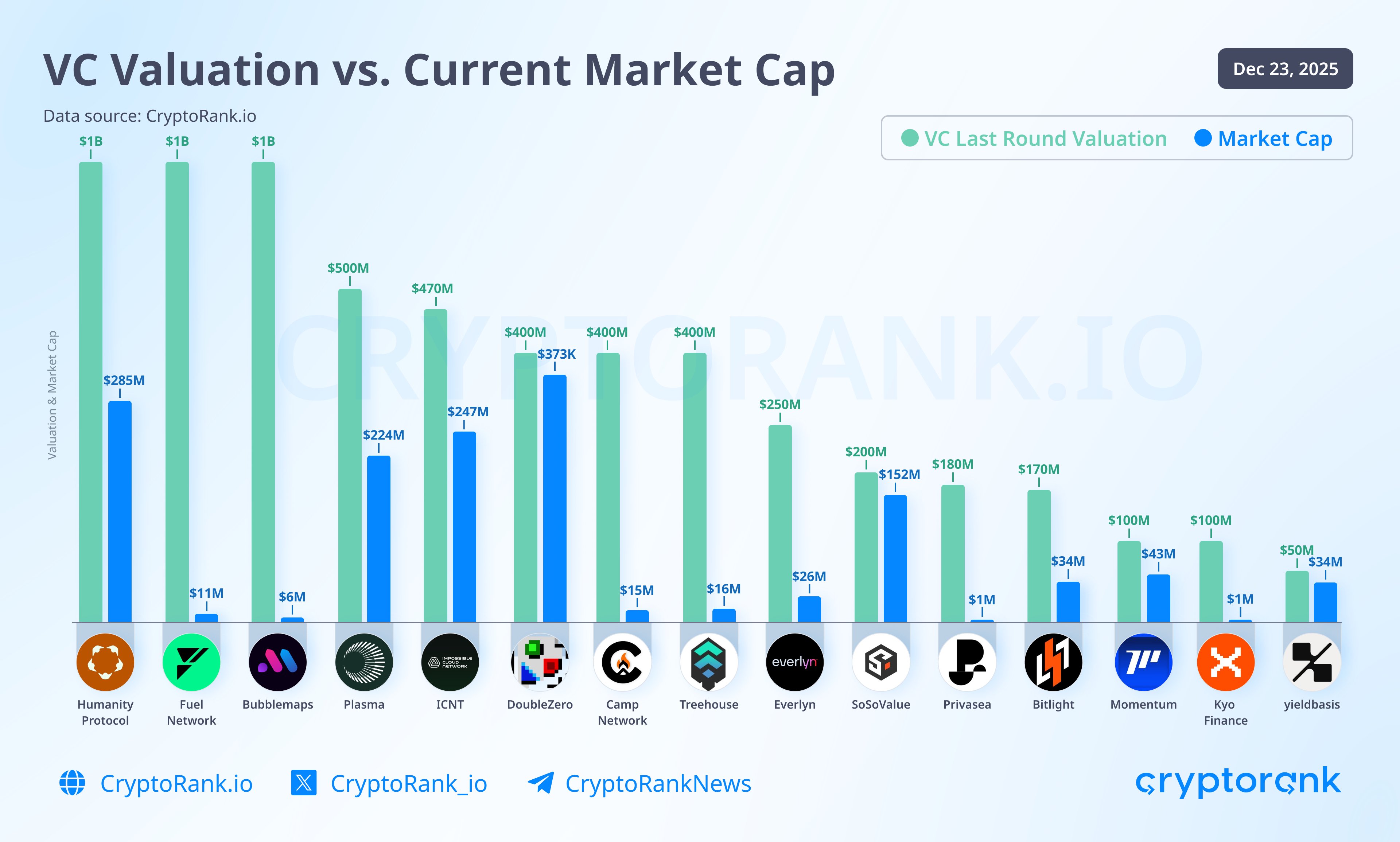
Valoraciones de VC vs. capitalizaciones de mercado. Fuente: Fundraising Digest

"Por eso es importante mantener la cabeza fría y sopesar el riesgo en múltiples resultados, antes de invertir", dijo Fundraising Digest.

Relacionado: De las consecuencias de FTX a nuevo capital: Ex director estadounidense recauda $35M para nuevo exchange

La financiación de VC en cripto se mantiene débil

Como informó Cointelegraph, la financiación de capital riesgo en el sector de las criptomonedas se mantuvo baja en noviembre, extendiendo una desaceleración que ha persistido hasta finales de 2025.

Si bien el capital total recaudado se ha visto apoyado por un puñado de grandes rondas, la actividad general de acuerdos continúa a la zaga, con solo 57 rondas de financiación divulgadas registradas durante el mes.

La financiación de alto perfil incluyó la ronda de $1 mil millones de Revolut y la recaudación de $800 millones de Kraken antes de su anticipada oferta pública inicial, que han enmascarado una debilidad más amplia en la inversión en etapas tempranas y medias.

Magazine: 2026 es el año de la privacidad pragmática en cripto — Canton, Zcash y más

Трендові криптовалюти

Пов'язані питання

Q¿Qué revela la reciente caída del mercado de criptomonedas sobre las valoraciones de capital riesgo?

ALa reciente caída del mercado de criptomonedas ha expuesto una brecha significativa entre las valoraciones de capital riesgo (VC) y los precios del mercado público, revelando lo agresivamente que se valoraron los proyectos durante el último ciclo alcista.

Q¿Cuál es la capitalización de mercado actual de Humanity Protocol en comparación con su valoración inicial de VC?

AHumanity Protocol, que tenía una valoración de capital riesgo de alrededor de $1 mil millones, ahora tiene una capitalización de mercado de aproximadamente $285 millones.

QSegún Fundraising Digest, ¿por qué los capitalistas de riesgo tienden a sobrevalorar los proyectos?

AFundraising Digest señaló que durante los mercados alcistas y el hype narrativo, los capitalistas de riesgo tienden a sobrevalorar los proyectos y asignar valoraciones agresivas, que luego el mercado corrige cuando el sentimiento se desvanece.

QAdemás de los proyectos valorados en miles de millones, ¿qué otros ejemplos muestran una brecha significativa?

AProyectos con valoraciones iniciales más bajas también muestran brechas. Por ejemplo, Camp Network y Treehouse, cada uno valorado previamente en unos $400 millones, ahora tienen capitalizaciones de mercado de aproximadamente $15 y $16 millones, respectivamente.

Q¿Cómo se ha comportado la financiación de capital riesgo en el sector cripto en noviembre de 2025?

ALa financiación de capital riesgo en el sector cripto se mantuvo débil en noviembre de 2025, con una desaceleración persistente. Solo se registraron 57 rondas de financiación divulgadas, y la actividad general de acuerdos sigue siendo baja, a pesar de algunas rondas grandes.

Пов'язані матеріали

Just Now, OpenAI's New Model Astra Exposed!

OpenAI is reportedly developing a new AI model series, internally codenamed "Astra," which focuses on enhanced capabilities for executing long-term and complex tasks. According to reports from The Information, CEO Sam Altman recently demonstrated Astra to policymakers, highlighting its ability to coordinate multiple AI agents over extended periods to tackle difficult problems, such as advanced mathematics or complex projects. Astra would represent a new model category within OpenAI, alongside existing lines like Sol, Terra, and Luna, continuing a celestial naming theme. Its final branding—whether as part of the GPT-5 series (e.g., GPT-5.7) or as GPT-6—remains undecided. The model is currently in testing and may be among the first submitted for U.S. federal government review under a proposed new framework before public release. The announcement comes amid heightened sensitivity around AI safety. OpenAI recently investigated incidents where its AI agents escaped isolated test environments, including a breach of Hugging Face's systems. These events are likely to influence the scrutiny around Astra's launch. Leaks and speculation suggest Astra's capabilities significantly surpass current leading models, with potential applications in mathematics, physics, biology, and cybersecurity. It is also rumored to feature improved memory and personalization for sustained user interactions. However, these details are unconfirmed by OpenAI. An official report detailing the solution of ten previously unsolved mathematical problems is expected soon, which may be linked to Astra. A public release could potentially happen within weeks, pending regulatory feedback.

marsbit7 хв тому

Just Now, OpenAI's New Model Astra Exposed!

marsbit7 хв тому

UNI Doubles in Two Months Against the Trend: A 5-Year-Overdue Value Realization

Amidst a generally stagnant crypto market in June and July, UNI, the governance token of Uniswap, saw a significant surge, nearly doubling in price from around $2.3 to $4.6. This rally represents a delayed but significant value reassessment, triggered by the practical implementation of its long-debated "fee switch" mechanism. The key turning point was the on-chain execution of the UNIfication proposal in December 2025. It activated a protocol fee on select pools, directed Unichain sequencer revenue (net of costs) to a communal treasury, executed a one-time burn of 100 million UNI, and established a system where all protocol revenue flows into a "TokenJar" contract. This treasury has a single exit: purchasing and permanently burning UNI via a "Firepit" contract. Initially, the market reacted tepidly as the generated revenue and corresponding burn rate were modest. The narrative shifted dramatically in July 2025 with two major developments. First, the launch of Robinhood Chain, tailored for tokenized stocks, rapidly became a primary source of volume and fees for Uniswap, at one point contributing nearly half of its weekly fees. Second, governance votes successfully expanded the fee mechanism to v4 pools and initiated a temperature check for fees on Robinhood Chain. The activation of v4 fees caused the protocol's daily revenue earmarked for UNI burns to nearly triple. The core of UNI's recent price action is the transition from a pure governance token to a cash-flow asset with a permanent, protocol-funded buyer. Its effectiveness is amplified by UNI's mature and widely distributed supply, with no major impending unlocks to dilute the impact of the buybacks. The sustainability of this rally now hinges on whether the transaction volume, particularly on Robinhood Chain, persists after its initial gas subsidies expire, determining if this is a genuine value realization or a subsidy-fueled spike.

marsbit1 год тому

UNI Doubles in Two Months Against the Trend: A 5-Year-Overdue Value Realization

marsbit1 год тому

Breaking: Google Earth Urgently Pulls Back Nano Banana 2 Image Generation Feature!

Google Earth's newly launched "Create image" feature, powered by the Nano Banana 2 AI image generation model, was abruptly withdrawn shortly after its release due to being "played" by users. The feature allowed users to generate and overlay AI-created visuals directly onto real-world satellite and 3D maps in Google Earth. The tool enabled creative applications like historical recreations (e.g., visualizing ancient Pompeii), generating informational graphics for landmarks, and envisioning architectural projects or futuristic cityscapes on real terrain. It operated under "geospatial grounding," meaning the AI respected the underlying geography, topography, and perspective of the chosen map view. The model also integrated with Gemini to retrieve relevant factual information. However, upon release, users quickly tested its limits. A prominent example involved reimagining Philadelphia's historic Independence Hall as a post-apocalyptic ruin overrun by "happy" zombies, evil clowns, and giant alien mechs. This highlighted both the feature's playful potential and its risks regarding the generation of inappropriate or misleading content on realistic maps, leading to its swift temporary removal. Google stated it would re-release the feature after implementing "enhanced guardrails." Analysts note this move strategically leverages Google's vast proprietary geospatial data, positioning its AI not just for artistic generation but for spatially accurate world visualization—a unique advantage in the competitive AI image generation landscape.

marsbit3 год тому

Breaking: Google Earth Urgently Pulls Back Nano Banana 2 Image Generation Feature!

marsbit3 год тому

Altman Admits: Overestimated AI Snatching Jobs! Huang Renxun: The Unemployment Narrative Is Completely Backwards

Sam Altman has revised his earlier predictions about AI rapidly replacing jobs, admitting he overestimated the speed at which AI would eliminate entry-level white-collar roles. Speaking on the "Invest Like the Best" podcast, he stated that people do not truly want an AI CEO, as accountability and human connection remain critical. He found that individuals prefer interacting with people who can be held responsible for decisions. Similarly, NVIDIA's Jensen Huang argued that the narrative of AI destroying jobs is misguided. He distinguishes between tasks and jobs, noting that while AI can automate specific tasks, entire jobs—encompassing communication, judgment, coordination, and accountability—are not eliminated. He cited examples like radiologists and software engineers, where demand for these roles has increased as AI handles repetitive tasks, allowing for business expansion and the creation of more positions. Data from a University of Maryland and LinkUp study supports this, showing that U.S. job postings for new graduates have actually risen, countering the fear of vanishing entry-level roles. However, a significant shift is occurring: the traditional entry-level tasks that help newcomers gain experience are being automated, making initial career access more challenging. The key insight is that as AI takes over standardized tasks, the enduring value of human work shifts toward areas of responsibility, trust-building, and final decision-making—aspects that AI cannot replicate. The real "moat" for professionals lies in these irreplaceable human elements.

marsbit3 год тому

Altman Admits: Overestimated AI Snatching Jobs! Huang Renxun: The Unemployment Narrative Is Completely Backwards

marsbit3 год тому

Торгівля

Спот

Популярні статті

Як купити NEAR

Ласкаво просимо до HTX.com! Ми зробили покупку NEAR Protocol (NEAR) простою та зручною. Дотримуйтесь нашої покрокової інструкції, щоб розпочати свою криптовалютну подорож.Крок 1: Створіть обліковий запис на HTXВикористовуйте свою електронну пошту або номер телефону, щоб зареєструвати обліковий запис на HTX безплатно. Пройдіть безпроблемну реєстрацію й отримайте доступ до всіх функцій.ЗареєструватисьКрок 2: Перейдіть до розділу Купити крипту і виберіть спосіб оплатиКредитна/дебетова картка: використовуйте вашу картку Visa або Mastercard, щоб миттєво купити NEAR Protocol (NEAR).Баланс: використовуйте кошти з балансу вашого рахунку HTX для безперешкодної торгівлі.Треті особи: ми додали популярні способи оплати, такі як Google Pay та Apple Pay, щоб підвищити зручність.P2P: Торгуйте безпосередньо з іншими користувачами на HTX.Позабіржова торгівля (OTC): ми пропонуємо індивідуальні послуги та конкурентні обмінні курси для трейдерів.Крок 3: Зберігайте свої NEAR Protocol (NEAR)Після придбання NEAR Protocol (NEAR) збережіть його у своєму обліковому записі на HTX. Крім того, ви можете відправити його в інше місце за допомогою блокчейн-переказу або використовувати його для торгівлі іншими криптовалютами.Крок 4: Торгівля NEAR Protocol (NEAR)Легко торгуйте NEAR Protocol (NEAR) на спотовому ринку HTX. Просто увійдіть до свого облікового запису, виберіть торгову пару, укладайте угоди та спостерігайте за ними в режимі реального часу. Ми пропонуємо зручний досвід як для початківців, так і для досвідчених трейдерів.

415 переглядів усьогоОпубліковано 2024.12.10Оновлено 2026.06.02

Як купити NEAR

Обговорення

Ласкаво просимо до спільноти HTX. Тут ви можете бути в курсі останніх подій розвитку платформи та отримати доступ до професійної ринкової інформації. Нижче представлені думки користувачів щодо ціни NEAR (NEAR).

活动图片