Over 80% of New Tokens Peak at TGE, The Root Cause and Cure for Web3's False Prosperity Lies Here

Odaily星球日报Опубліковано о 2025-12-23Востаннє оновлено о 2025-12-23

Анотація

More than 80% of new tokens in 2025 have seen their Fully Diluted Valuation (FDV) fall below their initial TGE valuation, with a median decline of 71%. Only 15% of tokens performed better post-TGE. This trend indicates that for most projects, the token generation event (TGE) represents their peak valuation. Statistical analysis of 113 token launches reveals that common success metrics—such as high fundraising amounts, large social media followings, and listings on major exchanges—have little to no statistical correlation with token performance. Projects raising more capital (e.g., over $10 million) did not perform better than those raising less (e.g., $300k–$500k). In fact, lower-funded projects often delivered higher returns per dollar raised. Social community size proved irrelevant; most "communities" are speculative and disappear when token prices fall. Token pricing also matters: tokens priced between $0.01–$0.05 at launch had the highest survival rate, while those priced outside this range generally failed. AI-related tokens outperformed others in both peak and current returns, while Gaming and DeFi sectors struggled significantly. Launch platforms (IDOs/IEOs) did not ensure success—most tokens on these platforms fell 70–93% post-launch. The root issue is a market that prioritizes hype over substance, narrative over data, and promises over products. To survive in 2026, projects should focus on lean fundraising, realistic token pricing, product-market fit, and tangibl...

Original Author:Solus Group, Crypto Researcher

Compiled by: CryptoLeo(@LeoAndCrypto)

Editor's Note: Recently, analyst Ash stated in a popular post that among over 100 new tokens TGE'd in 2025, 84.7% had an FDV lower than at TGE. The median FDV of these tokens fell by 71% (median market cap fell by 67%). Only 15% of tokens saw an increase in FDV compared to their TGE FDV. Overall, for new tokens issued in 2025, most tokens fall into the category of "price peaking at TGE".

Extending from this data, I found a more interesting article (from Solus Group), which also starts from the project token TGE, analyzing the correlation between the post-TGE performance of 113 tokens in 2025 and their funding situation, community activity, and exchange listings. The research found that high funding, active communities, and exchange listings—common screening criteria for project quality—have little impact on token performance. We often used these conditions to filter for good projects, but in 2025, this project evaluation model has "failed". One set of data is particularly thought-provoking:

- Projects trading below their IDO price had an average revenue of $1.36 million.

- Projects trading above their IDO issuance price had an average revenue of $790,000.

But these projects all received venture capital support, indicating to some extent that the market values hype over actual performance, stories over data, promises over the product itself. Web3 can no longer pretend "everything is fine," nor call bot traffic "growth." Of course, this article draws some conclusions based on statistics and is not a standard suitable for all projects. Good projects and large funding rounds still represent the direction of the crypto industry's development. Odaily Planet Daily compiles it as follows:

$2 million in funding, top-tier VC participation, 500,000 community followers, listed on a major exchange, a spectacular first day, jubilation on Discord, and a celebratory atmosphere all over social media.

In a previous article, we revealed the reality of the 0.96x ROI: by 2025, the average token effectively died on day one, we proved the system is broken. Now, we've analyzed 113 token launch cases since 2025, proving it with hard data—data most founders dare not face.

The findings are shocking: large funding doesn't help, huge communities don't matter, every variable you optimize is statistically insignificant.

But something more twisted lies beneath the surface, still haunting many founders:

Currently, a project's revenue status is a bearish signal; tokens of profitable projects trade lower than those of unprofitable ones. This dynamic is a matter of life and death. If we continue to punish the profitable and reward the speculators, the entire industry cannot survive.

Odaily Planet Daily Note: Solus Group previously disclosed relevant data showing the average ROI for new project tokens TGE'd in 2025, calculated from the day after issuance, was 0.96, meaning their product launch was effectively losing money from day one.

The Founder's Data Trap: The Funding Paradox, High Funding ≠ Token Advantage
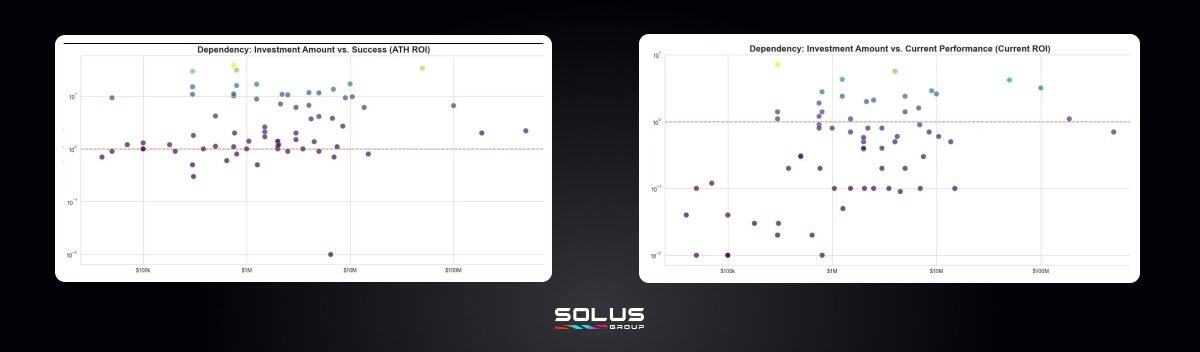
Correlation between funding and token performance: 0.04, statistically considered zero.

Tokens from projects that raised $10 million perform identically to those that raised $1 million. The chart above proves it—the distribution of token performance across the ROI range is random, regardless of funding amount. The best performers: Myshell, B2 Network, Bubblemaps, Mind Network, Particle Network, Creator.Bid (10x to 30x valuation at ATH) raised $300k to $3 million. Meanwhile, projects like Boundless and Analog that raised over $10 million have valuation multiples of around 1x.

Current token performance is even worse; most tokens have an ROI below 1x, regardless of funding size. For example, tokens that raised $5M to $100M have ROIs of 0.1x to 0.7x (e.g., Fleek, Pipe Network, Sahara AI), the same as tokens with little funding.

The truth is: Large funding accelerates token death spiral.

Projects with the least funding ($300k to $5M) have a higher ROI per dollar raised. They execute faster, pivot cheaper, and aren't drowned by quarterly VC token unlock schedules that destroy project gains.

If you chase $10M to "compete," you are preparing to fail.

The Community Myth: A Large Project Community is Also a "Paper Tiger"

500,000 social media followers vs. 50,000 followers, the statistical result is exactly the same.
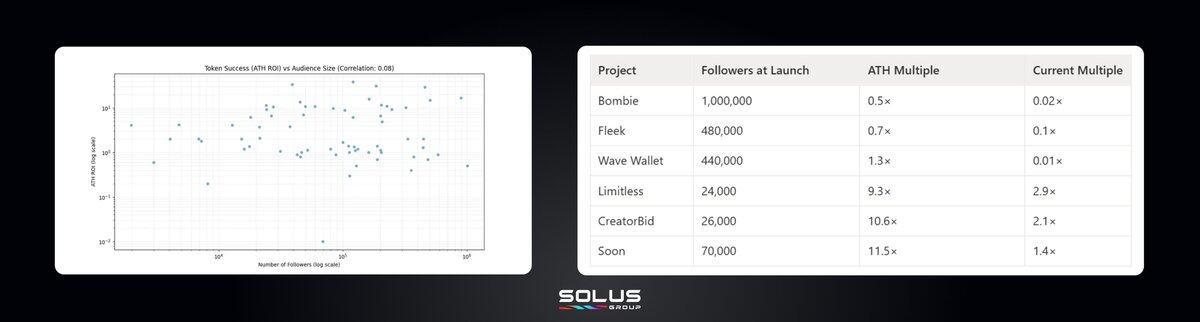
Correlation coefficients: 0.08 (Token ATH) and -0.06 (Token Current)

The data shows audience size has no predictive value for token performance. Projects with huge followings have mixed results—some surge, some crash. The same goes for projects with small audiences. No trend, no pattern, no correlation.

Your Discord group is not a community; it's a speculative audience waiting to leave.
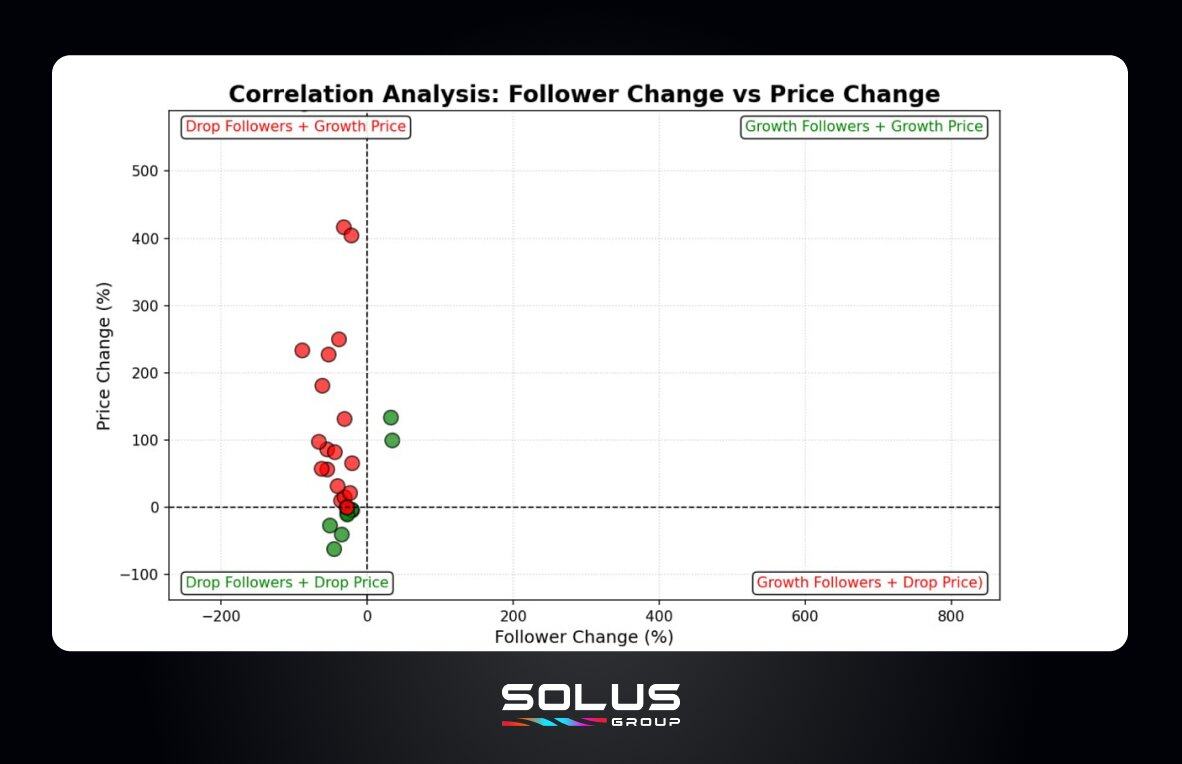
Reality: Price dictates community growth, not the other way around.

When price plummets, followers vanish. The chart proves this—the bottom-left quadrant (decreasing followers + falling price) is very dense. When price soars, followers sometimes grow, but it's not consistent.

This means:

Your "active community" never really cared about the product—they cared about the token price action. They disappear if the token underperforms. Community growth is a lagging indicator, not a leading one.

This isn't just theory; it's the stated view of @belizardd (Researcher & Trader/KOL):

Most people are here purely for speculation, not the product itself. We see very few protocols performing well post-TGE, mainly those with low initial FDV, not high fundraising, and generous airdrops. Honestly, I won't blindly ape into anything right now. The risk/reward isn't worth it; I'm just waiting for the market to improve.

Speculators know the game is broken. They are waiting on the sidelines. Meanwhile, founders keep burning 60% of their budget on Discord bots, Twitter giveaways, and KOL promotions—statistically insignificant metrics.

The real question is: "If the token dropped 50% tomorrow, how many would stay?"

Answer: Almost none.

Token Price Trap, Beware of Overpricing/Underpricing
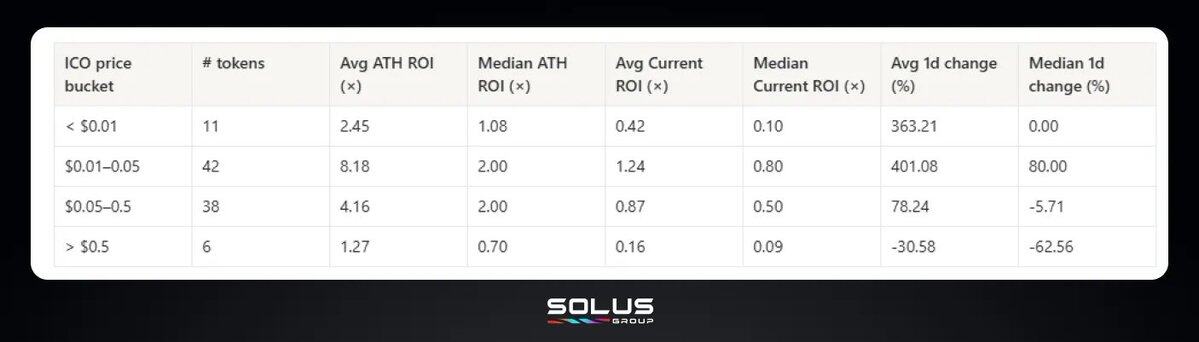
Median ROI by token listing price:

Below $0.01: 0.1x (90% loss)

$0.01 to $0.05: 0.8x (Viable zone)

$0.05 to $0.50: 0.5x (50% loss)

Above $0.50: 0.09x (91% loss)

Let me repeat that:

Pricing below $0.01 doesn't make your token "more accessible"; it makes you a low-priced coin attracting mercenary capital that pumps fast and dumps faster.

Pricing above $0.50 doesn't make your token a "premium token"; it makes it overpriced. Excessively high token prices kill retail markets, and whales won't bite either.

The $0.01 to $0.05 token price range is the only viable pricing zone. This price is high enough to signal legitimacy and low enough to leave room for upside. Within this price range, only 42 out of 97 tokens had a median positive performance.

If your tokenomics peg your valuation at $0.003 or $1.20, stop rebuilding the model; the data says it's already failed.

Industry Status: Stop Building Like It's 2021
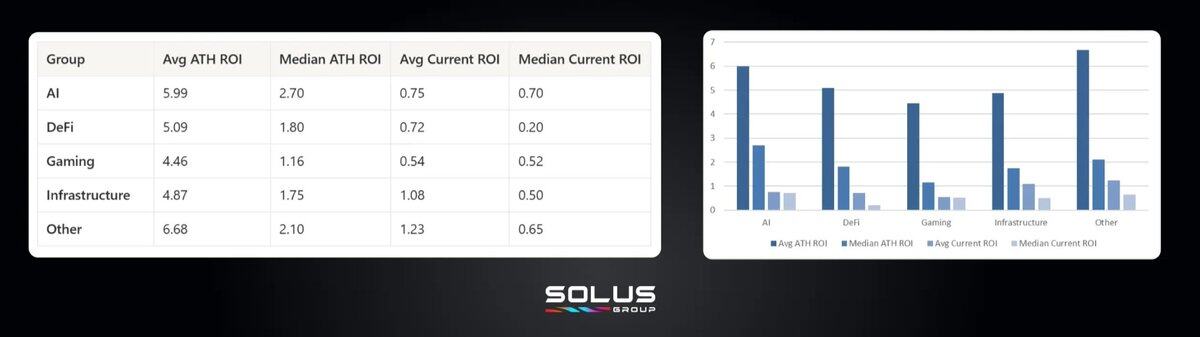
Loser: Gaming

Average ATH ROI: 4.46x (Lowest)

Median Current ROI: 0.52x

GameFi tokens are like lottery tickets; play once, forget forever.

Trap: DeFi

Average ATH ROI: 5.09x (Looks good)

Median Current ROI: 0.2x (Disastrous)

DeFi has early massive pumps followed by deeper crashes than any other sector. The gap between hype and reality is brutally stark.

Winner: AI

Average ATH ROI: 5.99x (Highest peak)

Median Current ROI: 0.70x (Best retention)

AI tokens pump and hold. The trend has staying power, and money follows.

If you're building GameFi, your execution needs to be 10x better than average to achieve an average result. If you're in DeFi, prepare for rapid pumps and violent dumps. If you're in AI, the market will give you a chance, but only if you deliver. Infrastructure is even more demanding: you burn more time and resources compared to standard dApps (like AI agents), yet your median current ROI is slightly lower than the universally frowned-upon GameFi sector.

The data doesn't care which project you find interesting.

IDO/IEO Data Overview: A Good Platform Cannot Save a Project
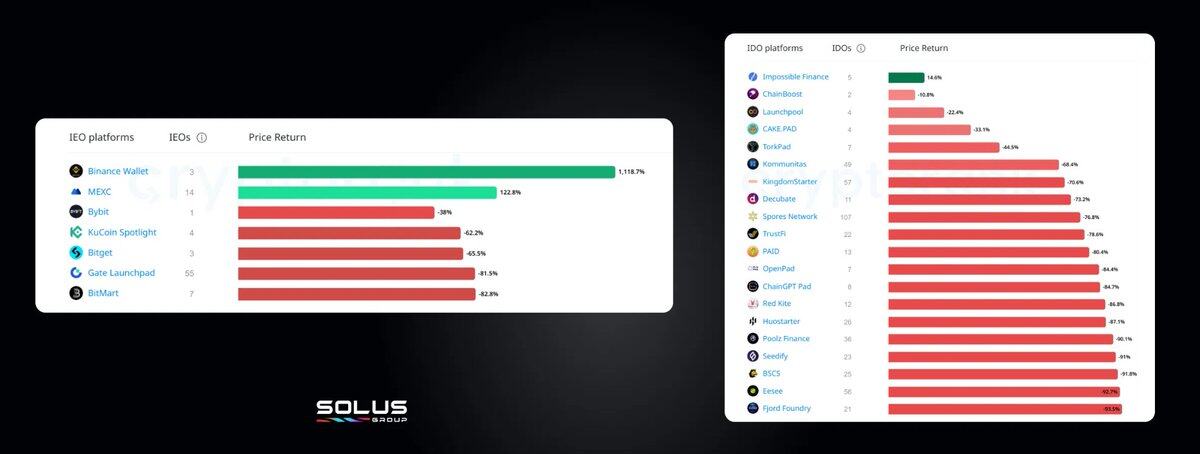
You spend months networking just to get a spot on Binance Launchpad or an allocation from a tier-1 IDO, thinking platform curation means protection. The data shows otherwise.

IDO Platforms: Almost all projects are in the red

Only one project on one of the 5 IDO platforms had a return of +14.6%. That's it. All others ranged from -70% to -93%.

So-called "premium Launchpads" don't protect buyers; they just offer a branded way to lose money.

IEO Platforms: Survivorship Bias at its Finest

Binance wallet shows an 11x return. Looks incredible, but it's only 3 launches, a tiny sample. MEXC shows +122.8% across 14 launches—a larger sample but still an outlier. Everyone else? Underwater. Bybit IEO tokens are down 38%, others are worse.

This proves:

Platform selection is a lottery with better branding. A few outlier wins skew the average, while the vast majority of launches trend downward. The "curation service" you pay for—whether through connections, listing fees, or token allocations—does not reliably protect token ROI.

Platforms cannot save garbage tokens, nor can they help good tokens.

Reflecting on 2025, Looking Ahead to 2026

Project development in 2025 failed at every level.

Layer Zero: Foundation

Problem: "Speculation-based tokenomics." Indiscriminate token dumping into illiquid markets without organic revenue models to absorb the shock.

First Layer: Funding

Problem: "Fake it in the PDF, fix it later."

Second Layer: Marketing

Problem: The KOL model, paid shills, rented users who vanish the moment payments stop.

Third Layer: Liquidity

Problem: Assuming liquidity follows hype; it doesn't. Institutional money waits for proof.

Fourth Layer: User Retention

Problem: Zero-retention infrastructure. The "project community" is 10,000 Telegram users who will abandon you within 90 days.

2026 shouldn't be about playing the old game. There's a deeper problem behind all this. Infrastructure does matter, but even with perfect infrastructure, timing is everything. As Ivan Paskar (Growth Lead at Altius Labs) said:

Tokens don't fix broken things—they amplify reality. Right timing = momentum multiplies. Wrong timing = years of work vanish instantly. Most teams don't fail on token design; they fail by misjudging their stage and the macro environment. Timing isn't a detail; it's everything.

What Should Projects Do in 2026

Survival isn't about following the old playbook; it's about building a new one.

1. Raise Wisely

Target $300k to $5M. The highest ROI per dollar is here. More money = more problems.

2. Price for Survival

Launch between $0.01 and $0.05. Everything else struggles. If your tokenomics don't fit this range, they are broken.

3. Product First, Token Second

If you can't explain why your token exists in one sentence, it doesn't. Revenue precedes speculation.

4. Ignore Vanity Metrics

Follower count is noise. Active wallets, retention, and revenue per user are signal.

5. Sector Realism

Know your sector's failure rate before writing code. GameFi needs 2x the execution just to break even. AI has tailwinds—if you can deliver.

6. Consolidate or Die

The era of M&A is coming. If you can't scale alone, find an acquirer. Acquisition isn't failure; it's strategy.

These six principles matter. But the truth is: The standard playbook is dead. There is no one-size-fits-all model anymore.


Трендові криптовалюти

Пов'язані питання

QAccording to the article, what percentage of new tokens launched in 2025 had an FDV lower than their TGE FDV?

A84.7% of new tokens launched in 2025 had an FDV lower than their TGE FDV.

QWhat did the data reveal about the correlation between high fundraising amounts and token performance?

AThe data showed a correlation of 0.04 between fundraising amount and token performance, which is statistically zero. This means high fundraising amounts did not lead to better token performance.

QWhich token price range was identified as the only viable 'survival zone' for a TGE?

AThe token price range of $0.01 to $0.05 was identified as the only viable 'survival zone' for a TGE.

QWhich sector's tokens had the highest average ATH ROI and the best retention rate according to the study?

AThe AI sector's tokens had the highest average ATH ROI (5.99x) and the best current median ROI (0.70x), indicating the highest retention rate.

QWhat is one of the key recommendations for projects in 2026 regarding their community metrics?

AOne key recommendation is to ignore vanity metrics like follower count and instead focus on key metrics such as wallet activity, user retention rate, and revenue per user.

Пов'язані матеріали

After Three Consecutive Quarters of Decline, Can the Crypto Market Find a Window for Stabilization in Q3?

The cryptocurrency market has just concluded its worst-performing quarter since 2022, with total capitalization dropping 12.6% to $2.1 trillion. All core metrics indicate capital is leaving the sector, not just rotating within it. Bitcoin fell 14.2% and Ethereum dropped 25.4% in Q2, breaking their previous correlation with US tech stocks. A key driver is the reversal in US spot Bitcoin ETF flows, which saw a net outflow of approximately $4.67 billion in Q2, including a record monthly outflow near $4.5 billion in June. While recent data suggests long-term holders are accumulating again, sustained ETF outflows mean continued selling pressure. Market focus is now singularly on the Federal Reserve. The upcoming July FOMC meeting is seen as the most critical event for Q3. A dovish signal could support Bitcoin reclaiming a $68,000-$84,000 range, while a hawkish stance might establish a new trading band around $50,000-$56,000. Additionally, regulatory uncertainty persists, with the progress of the crucial *CLARITY Act* stalling in the Senate, reducing its perceived 2026 passage probability to 40-45%. Despite the broad downturn, a few sectors showed growth. Prediction markets saw nominal volume surge 48.7% year-over-year to $113.8 billion, and tokenized collectibles transaction volume rose 143% quarterly to $1.4 billion. The Real-World Asset (RWA) tokenization sector also continued steady growth, now representing ~$28.1 billion in on-chain value. The market's foundation for an extreme crash appears limited, with Bitcoin price hovering near its 200-week moving average. However, the trading paradigm has shifted from narrative-driven speculation to decisions based on price action, policy developments, and interest rate expectations, making a broad sentiment-driven rally unlikely in the near term.

marsbit15 год тому

After Three Consecutive Quarters of Decline, Can the Crypto Market Find a Window for Stabilization in Q3?

marsbit15 год тому

BIT Trading Moment: BTC Still Suppressed by Weekly 200 EMA, Rejection May Restart Decline; Storage and Semiconductors that Surged Last Night Begin Falling in Evening Trading

**Crypto & Stock Market Wrap: Bitcoin Tests Resistance, Stocks Retreat After AI Surge** Bitcoin consolidates around $66,000, facing key resistance near $68,000—an area seen as a major psychological and technical hurdle where previous rallies have failed. Analysts note the cryptocurrency is caught between its 200-week moving average (~$63,333) and 200-week EMA (~$68,328). A clear break above $68k is needed to signal a stronger bullish trend, while a rejection could lead to a retest of $63k support. Market sentiment remains cautious, with low futures open interest pointing to a low-liquidity rebound rather than a full bull market. Bitcoin spot ETFs saw another $203 million inflow. US stock futures pointed lower after a strong Tuesday session led by a massive rebound in semiconductors and memory stocks. The rally was fueled by renewed optimism about AI-driven hardware demand, with Micron, SanDisk, and SK Hynix surging. However, those gains reversed in pre-market trading. Super Micro Computer (SMCI) soared over 20% after hours on strong guidance and a record backlog. Other standouts included Rocket Lab and nuclear energy plays Oklo and X-Energy. Rising oil prices (Brent above $91) and climbing Treasury yields (10-year near 4.64%), however, are reigniting inflation concerns and acting as a headwind for equities. In Asia, markets were mixed. South Korea's KOSPI pared early gains to close slightly higher as semiconductor stocks like SK Hynix gave back initial surges. Japan's Nikkei edged lower as the yen hit a fresh 38-year low against the dollar, raising fears of potential market intervention. Key events to watch include the Samsung Galaxy launch, AMD's AI event, and a slew of major tech earnings from Alphabet, Tesla, and IBM after the close on Wednesday, followed by the ECB meeting and Intel's earnings on Thursday.

marsbit15 год тому

BIT Trading Moment: BTC Still Suppressed by Weekly 200 EMA, Rejection May Restart Decline; Storage and Semiconductors that Surged Last Night Begin Falling in Evening Trading

marsbit15 год тому

Former CFTC Chairman, Circle President Tarbert: Preaching Long-Termism While Cashing Out $30 Million Himself

Former CFTC Chairman and Circle President Heath Tarbert has consistently advocated for a long-term vision in public, urging patience from investors as Circle’s stock price has fallen significantly from its peak. However, it has been revealed that since Circle’s IPO, Tarbert has continuously sold his CRCL shares through pre-arranged trading plans, cashing out approximately $30 million, without making any public market purchases. This contrast between his public messaging and personal actions has drawn criticism. Tarbert joined Circle in July 2023 as Chief Legal Officer, leveraging his regulatory experience to help guide the company through its IPO and expansion. Despite promoting stablecoins as long-term infrastructure, he established a 10b5-1 trading plan just before Circle went public, leading to substantial stock sales over the following year. In March 2026, he initiated another plan to sell more shares. His career trajectory highlights a pattern of moving between high-level regulatory roles and influential positions in the financial sector. After resigning as CFTC Chairman in early 2021, he joined Citadel Securities as Chief Legal Officer just 27 days later, during a period of intense regulatory scrutiny for the firm. He later joined Circle, aiding its efforts to navigate regulatory challenges for its public listing. While Tarbert's expertise in policy and compliance is valuable to companies like Circle, his actions—advocating long-term confidence while personally divesting—raise questions about the alignment between his public statements and his private financial decisions, leaving investors who followed his advice to bear the market risks.

marsbit15 год тому

Former CFTC Chairman, Circle President Tarbert: Preaching Long-Termism While Cashing Out $30 Million Himself

marsbit15 год тому

Gate Research Institute: The 'Wall Street-ization' Wave of Crypto Financial Products – Competition or Integration?

The article titled "Gate Research Institute: Are Crypto Financial Products Sparking a 'Wall Street' Wave—Competition or Convergence?" explores the evolving relationship between the crypto ecosystem and traditional finance (TradFi). The piece begins by reflecting on Bitcoin's original 2009 vision of decentralization, disintermediation, and moving away from banks. It then contrasts this with the 2024 landscape, where key crypto assets like Bitcoin are increasingly held through Wall Street products like ETFs issued by giants like BlackRock. The article questions whether this signifies that TradFi is systematically taking over the rights to issue, price, custody, and distribute crypto financial assets. The core argument is that this is not a zero-sum takeover but rather a bidirectional convergence where each side addresses the other's weaknesses. Crypto offers 24/7 global markets, programmable settlement, and open access but lacks compliant channels, institutional-grade custody, deep fiat liquidity, and mainstream distribution. TradFi possesses these but is constrained by legacy systems, limited operating hours, and slow settlement. Two primary convergence paths are highlighted: * **Path A (CEX to TradFi):** Exemplified by Gate, which has progressed from offering tokenized stocks and CFDs to providing direct, real stock trading (US, Hong Kong, South Korea) within its platform, using USDT. * **Path B (TradFi to Crypto):** Exemplified by Robinhood, which has integrated crypto trading, acquired exchanges like Bitstamp, and is moving traditional assets like stocks onto the blockchain via tokenization and its own Layer 2. Both paths are ultimately competing to become the next-generation, unified financial account—a "super account" where users can seamlessly trade cryptocurrencies, stocks, ETFs, RWA (Real World Assets), and tokenized treasury products in one interface. The growth of RWA and tokenized treasuries (e.g., BlackRock's BUIDL) is presented as the asset-layer fusion, providing stable, yield-bearing assets on-chain and acting as a bridge between the two worlds. In conclusion, the "Wall Street-ization" of crypto is framed as a mutual transformation. Decentralized ideals persist in the protocol layer, while at the application layer, a more efficient, global, and accessible unified capital market is emerging from this convergence. The future competition lies not between crypto exchanges and stockbrokers, but between platforms vying to offer the most comprehensive asset coverage, liquidity, and user experience within a single account.

marsbit15 год тому

Gate Research Institute: The 'Wall Street-ization' Wave of Crypto Financial Products – Competition or Integration?

marsbit15 год тому

Торгівля

Спот

Популярні статті

Що таке $S$

Розуміння SPERO: Комплексний огляд Вступ до SPERO Оскільки ландшафт інновацій продовжує еволюціонувати, виникнення технологій web3 та криптовалютних проектів відіграє ключову роль у формуванні цифрового майбутнього. Один з проектів, який привернув увагу в цій динамічній сфері, — це SPERO, позначений як SPERO,$$s$. Ця стаття має на меті зібрати та представити детальну інформацію про SPERO, щоб допомогти ентузіастам та інвесторам зрозуміти його основи, цілі та інновації в рамках web3 та крипто-сектору. Що таке SPERO,$$s$? SPERO,$$s$ — це унікальний проект у криптопросторі, який прагне використати принципи децентралізації та технології блокчейн для створення екосистеми, що сприяє залученню, корисності та фінансовій інклюзії. Проект розроблений для полегшення взаємодії між користувачами новими способами, надаючи їм інноваційні фінансові рішення та послуги. У своїй основі SPERO,$$s$ прагне надати можливості індивідам, забезпечуючи інструменти та платформи, які покращують користувацький досвід у криптовалютному просторі. Це включає в себе можливість більш гнучких методів транзакцій, сприяння ініціативам, що підтримуються спільнотою, та створення шляхів для фінансових можливостей через децентралізовані додатки (dApps). Основна концепція SPERO,$$s$ обертається навколо інклюзивності, прагнучи зменшити розриви в традиційній фінансовій системі, використовуючи переваги технології блокчейн. Хто є творцем SPERO,$$s$? Особистість творця SPERO,$$s$ залишається дещо невідомою, оскільки є обмежені публічно доступні ресурси, що надають детальну інформацію про його засновників. Ця відсутність прозорості може бути наслідком зобов'язання проекту до децентралізації — етики, яку багато проектів web3 поділяють, ставлячи колективні внески вище за індивідуальне визнання. Зосереджуючи обговорення навколо спільноти та її колективних цілей, SPERO,$$s$ втілює суть наділення без виділення конкретних осіб. Таким чином, розуміння етики та місії SPERO є більш важливим, ніж ідентифікація єдиного творця. Хто є інвесторами SPERO,$$s$? SPERO,$$s$ підтримується різноманітними інвесторами, починаючи від венчурних капіталістів до ангельських інвесторів, які прагнуть сприяти інноваціям у крипто-секторі. Зосередження цих інвесторів зазвичай узгоджується з місією SPERO — пріоритет надається проектам, які обіцяють технологічний прогрес у суспільстві, фінансову інклюзію та децентралізоване управління. Ці інвесторські фонди зазвичай зацікавлені в проектах, які не лише пропонують інноваційні продукти, але й позитивно впливають на спільноту блокчейн та її екосистеми. Підтримка з боку цих інвесторів підкріплює SPERO,$$s$ як значного конкурента в швидко змінюваній сфері крипто-проектів. Як працює SPERO,$$s$? SPERO,$$s$ використовує багатогранну структуру, яка відрізняє його від традиційних криптовалютних проектів. Ось деякі ключові особливості, які підкреслюють його унікальність та інноваційність: Децентралізоване управління: SPERO,$$s$ інтегрує моделі децентралізованого управління, надаючи користувачам можливість активно брати участь у процесах прийняття рішень щодо майбутнього проекту. Цей підхід сприяє відчуттю власності та відповідальності серед членів спільноти. Корисність токена: SPERO,$$s$ використовує свій власний криптовалютний токен, розроблений для виконання різних функцій в екосистемі. Ці токени дозволяють здійснювати транзакції, отримувати винагороди та полегшувати послуги, що пропонуються на платформі, підвищуючи загальну залученість та корисність. Шарова архітектура: Технічна архітектура SPERO,$$s$ підтримує модульність та масштабованість, що дозволяє безперешкодно інтегрувати додаткові функції та додатки в міру розвитку проекту. Ця адаптивність є надзвичайно важливою для збереження актуальності в постійно змінюваному крипто-ландшафті. Залучення спільноти: Проект підкреслює ініціативи, що підтримуються спільнотою, використовуючи механізми, які стимулюють співпрацю та зворотний зв'язок. Підтримуючи сильну спільноту, SPERO,$$s$ може краще задовольняти потреби користувачів та адаптуватися до ринкових тенденцій. Фокус на інклюзію: Пропонуючи низькі комісії за транзакції та зручні інтерфейси, SPERO,$$s$ прагне залучити різноманітну базу користувачів, включаючи осіб, які раніше не брали участі в крипто-просторі. Це зобов'язання до інклюзії узгоджується з його загальною місією наділення через доступність. Хронологія SPERO,$$s$ Розуміння історії проекту надає важливі уявлення про його розвиток та етапи. Нижче наведено пропоновану хронологію, що відображає значні події в еволюції SPERO,$$s$: Етап концептуалізації та ідеації: Початкові ідеї, що стали основою SPERO,$$s$, були сформовані, тісно пов'язані з принципами децентралізації та фокусом на спільноті в індустрії блокчейн. Запуск білого паперу проекту: Після концептуального етапу був випущений комплексний білий папір, що детально описує бачення, цілі та технологічну інфраструктуру SPERO,$$s$, щоб залучити інтерес та зворотний зв'язок від спільноти. Створення спільноти та ранні залучення: Активні зусилля були спрямовані на створення спільноти ранніх прихильників та потенційних інвесторів, що полегшило обговорення цілей проекту та отримання підтримки. Подія генерації токенів: SPERO,$$s$ провів подію генерації токенів (TGE) для розподілу своїх рідних токенів серед ранніх прихильників та встановлення початкової ліквідності в екосистемі. Запуск початкового dApp: Перший децентралізований додаток (dApp), пов'язаний з SPERO,$$s$, став доступним, дозволяючи користувачам взаємодіяти з основними функціями платформи. Постійний розвиток та партнерства: Безперервні оновлення та вдосконалення пропозицій проекту, включаючи стратегічні партнерства з іншими учасниками блокчейн-простору, сформували SPERO,$$s$ у конкурентоспроможного та еволюціонуючого гравця на крипто-ринку. Висновок SPERO,$$s$ є свідченням потенціалу web3 та криптовалют для революціонізації фінансових систем та наділення індивідів. Завдяки зобов'язанню до децентралізованого управління, залучення спільноти та інноваційно спроектованих функцій, він прокладає шлях до більш інклюзивного фінансового ландшафту. Як і з будь-якими інвестиціями в швидко змінюваному крипто-просторі, потенційним інвесторам та користувачам рекомендується ретельно досліджувати та обдумано взаємодіяти з поточними подіями в SPERO,$$s$. Проект демонструє інноваційний дух крипто-індустрії, запрошуючи до подальшого дослідження його численних можливостей. Хоча подорож SPERO,$$s$ ще триває, його основні принципи можуть справді вплинути на майбутнє того, як ми взаємодіємо з технологією, фінансами та один з одним у взаємопов'язаних цифрових екосистемах.

137 переглядів усьогоОпубліковано 2024.12.17Оновлено 2024.12.17

Що таке $S$

Що таке AGENT S

Агент S: Майбутнє автономної взаємодії в Web3 Вступ У постійно змінюваному ландшафті Web3 та криптовалюти інновації постійно переосмислюють, як люди взаємодіють з цифровими платформами. Один з таких новаторських проектів, Агент S, обіцяє революціонізувати взаємодію людини з комп'ютером через свою відкриту агентну структуру. Прокладаючи шлях для автономних взаємодій, Агент S прагне спростити складні завдання, пропонуючи трансформаційні застосування в штучному інтелекті (ШІ). Це детальне дослідження заглиблюється в складності проекту, його унікальні особливості та наслідки для сфери криптовалюти. Що таке Агент S? Агент S є революційною відкритою агентною структурою, спеціально розробленою для вирішення трьох основних викликів в автоматизації комп'ютерних завдань: Набуття специфічних знань у галузі: Структура інтелектуально навчається з різних зовнішніх джерел знань та внутрішнього досвіду. Цей подвійний підхід дозволяє їй створити багатий репозиторій специфічних знань у галузі, покращуючи її продуктивність у виконанні завдань. Планування на довгих горизонтах завдань: Агент S використовує планування з підкріпленням досвіду, стратегічний підхід, який полегшує ефективний розподіл та виконання складних завдань. Ця функція значно підвищує її здатність ефективно та результативно управляти кількома підзавданнями. Обробка динамічних, неоднорідних інтерфейсів: Проект представляє Інтерфейс Агент-Комп'ютер (ACI), інноваційне рішення, яке покращує взаємодію між агентами та користувачами. Використовуючи багатомодальні великі мовні моделі (MLLMs), Агент S може безперешкодно орієнтуватися та маніпулювати різноманітними графічними інтерфейсами користувача. Завдяки цим новаторським функціям Агент S надає надійну структуру, яка вирішує складнощі, пов'язані з автоматизацією людської взаємодії з машинами, прокладаючи шлях для численних застосувань у ШІ та за його межами. Хто є творцем Агент S? Хоча концепція Агент S є фундаментально новаторською, конкретна інформація про його творця залишається невідомою. Творець наразі невідомий, що підкреслює або початкову стадію проекту, або стратегічний вибір зберегти засновників у таємниці. Незважаючи на анонімність, акцент залишається на можливостях та потенціалі структури. Хто є інвесторами Агент S? Оскільки Агент S є відносно новим у криптографічній екосистемі, детальна інформація про його інвесторів та фінансових спонсорів не задокументована. Відсутність публічно доступних відомостей про інвестиційні фонди або організації, що підтримують проект, викликає питання щодо його фінансової структури та дорожньої карти розвитку. Розуміння підтримки є критично важливим для оцінки стійкості проекту та потенційного впливу на ринок. Як працює Агент S? В основі Агент S лежить передова технологія, яка дозволяє йому ефективно функціонувати в різних умовах. Його операційна модель побудована навколо кількох ключових функцій: Взаємодія з комп'ютером, подібна до людської: Структура пропонує розширене планування ШІ, прагнучи зробити взаємодії з комп'ютерами більш інтуїтивними. Імітуючи людську поведінку при виконанні завдань, вона обіцяє підвищити досвід користувачів. Наративна пам'ять: Використовується для використання високорівневого досвіду, Агент S використовує наративну пам'ять для відстеження історій завдань, тим самим покращуючи свої процеси прийняття рішень. Епізодична пам'ять: Ця функція надає користувачам покрокові інструкції, дозволяючи структурі пропонувати контекстуальну підтримку в міру виконання завдань. Підтримка OpenACI: Завдяки можливості працювати локально, Агент S дозволяє користувачам зберігати контроль над своїми взаємодіями та робочими процесами, узгоджуючи з децентралізованою етикою Web3. Легка інтеграція з зовнішніми API: Його універсальність і сумісність з різними платформами ШІ забезпечують те, що Агент S може безперешкодно вписатися в існуючі технологічні екосистеми, роблячи його привабливим вибором для розробників та організацій. Ці функціональні можливості колективно сприяють унікальному положенню Агент S у крипто-просторі, оскільки він автоматизує складні, багатоступеневі завдання з мінімальним втручанням людини. У міру розвитку проекту його потенційні застосування в Web3 можуть переосмислити, як відбуваються цифрові взаємодії. Хронологія Агент S Розробка та етапи Агент S можуть бути узагальнені в хронології, яка підкреслює його значні події: 27 вересня 2024 року: Концепція Агент S була представлена в комплексній науковій статті під назвою “Відкрита агентна структура, яка використовує комп'ютери як людина”, що демонструє основи проекту. 10 жовтня 2024 року: Наукова стаття була опублікована на arXiv, пропонуючи детальне дослідження структури та її оцінки продуктивності на основі бенчмарку OSWorld. 12 жовтня 2024 року: Було випущено відеопрезентацію, що надає візуальне уявлення про можливості та особливості Агент S, ще більше залучаючи потенційних користувачів та інвесторів. Ці маркери в хронології не лише ілюструють прогрес Агент S, але й вказують на його прихильність до прозорості та залучення громади. Ключові моменти про Агент S У міру розвитку структури Агент S кілька ключових характеристик виділяються, підкреслюючи її новаторський характер та потенціал: Інноваційна структура: Розроблена для забезпечення інтуїтивного використання комп'ютерів, подібного до людської взаємодії, Агент S пропонує новий підхід до автоматизації завдань. Автономна взаємодія: Здатність автономно взаємодіяти з комп'ютерами через GUI означає стрибок до більш інтелектуальних та ефективних обчислювальних рішень. Автоматизація складних завдань: Завдяки своїй надійній методології він може автоматизувати складні, багатоступеневі завдання, роблячи процеси швидшими та менш схильними до помилок. Безперервне вдосконалення: Механізми навчання дозволяють Агенту S покращуватися на основі минулого досвіду, постійно підвищуючи свою продуктивність та ефективність. Універсальність: Його адаптивність до різних операційних середовищ, таких як OSWorld та WindowsAgentArena, забезпечує його здатність служити широкому спектру застосувань. Оскільки Агент S займає своє місце в ландшафті Web3 та криптовалюти, його потенціал покращити можливості взаємодії та автоматизувати процеси означає значний прогрес у технологіях ШІ. Завдяки своїй інноваційній структурі Агент S є прикладом майбутнього цифрових взаємодій, обіцяючи більш безперешкодний та ефективний досвід для користувачів у різних галузях. Висновок Агент S представляє собою сміливий крок вперед у поєднанні ШІ та Web3, з можливістю переосмислити, як ми взаємодіємо з технологією. Хоча проект все ще на ранніх стадіях, можливості для його застосування є величезними та переконливими. Завдяки своїй комплексній структурі, що вирішує критичні виклики, Агент S прагне вивести автономні взаємодії на передній план цифрового досвіду. У міру того, як ми заглиблюємося в сфери криптовалюти та децентралізації, проекти, подібні до Агент S, безсумнівно, відіграватимуть ключову роль у формуванні майбутнього технологій та співпраці людини з комп'ютером.

757 переглядів усьогоОпубліковано 2025.01.14Оновлено 2025.01.14

Що таке AGENT S

Як купити S

Ласкаво просимо до HTX.com! Ми зробили покупку Sonic (S) простою та зручною. Дотримуйтесь нашої покрокової інструкції, щоб розпочати свою криптовалютну подорож.Крок 1: Створіть обліковий запис на HTXВикористовуйте свою електронну пошту або номер телефону, щоб зареєструвати обліковий запис на HTX безплатно. Пройдіть безпроблемну реєстрацію й отримайте доступ до всіх функцій.ЗареєструватисьКрок 2: Перейдіть до розділу Купити крипту і виберіть спосіб оплатиКредитна/дебетова картка: використовуйте вашу картку Visa або Mastercard, щоб миттєво купити Sonic (S).Баланс: використовуйте кошти з балансу вашого рахунку HTX для безперешкодної торгівлі.Треті особи: ми додали популярні способи оплати, такі як Google Pay та Apple Pay, щоб підвищити зручність.P2P: Торгуйте безпосередньо з іншими користувачами на HTX.Позабіржова торгівля (OTC): ми пропонуємо індивідуальні послуги та конкурентні обмінні курси для трейдерів.Крок 3: Зберігайте свої Sonic (S)Після придбання Sonic (S) збережіть його у своєму обліковому записі на HTX. Крім того, ви можете відправити його в інше місце за допомогою блокчейн-переказу або використовувати його для торгівлі іншими криптовалютами.Крок 4: Торгівля Sonic (S)Легко торгуйте Sonic (S) на спотовому ринку HTX. Просто увійдіть до свого облікового запису, виберіть торгову пару, укладайте угоди та спостерігайте за ними в режимі реального часу. Ми пропонуємо зручний досвід як для початківців, так і для досвідчених трейдерів.

1.7k переглядів усьогоОпубліковано 2025.01.15Оновлено 2026.06.02

Як купити S

Обговорення

Ласкаво просимо до спільноти HTX. Тут ви можете бути в курсі останніх подій розвитку платформи та отримати доступ до професійної ринкової інформації. Нижче представлені думки користувачів щодо ціни S (S).

活动图片













