Estalla una tormenta de fuego en el foro de gobernanza de Aave por las tarifas de CoW Swap

cointelegraphОпубліковано о 2025-12-14Востаннє оновлено о 2025-12-14

Анотація

Se ha desatado una fuerte controversia en el foro de gobierno de Aave debido a que las tarifas generadas por la integración con el agregador de intercambios descentralizados CoW Swap están siendo dirigidas a una dirección privada controlada por Aave Labs, en lugar de al tesoro de la DAO. El miembro pseudónimo EzR3aL alertó que esto priva a la DAO de unos 200.000 dólares semanales en Ether, lo que supone cerca de 10 millones de dólares anuales. Aave Labs defendió que los componentes front-end son de su competencia, mientras que los cambios a nivel de protocolo sí corresponden a la DAO. Sin embargo, varios miembros argumentaron que la DAO financió el desarrollo original de la tecnología adaptadora, por lo que los ingresos deberían revertir en ella. Marc Zeller, fundador de Aave-Chan Initiative, calificó la situación de "extremadamente preocupante". El conflicto subraya los desafíos de la gobernanza en las DAOs.

Una disputa entre la organización autónoma descentralizada (DAO) de Aave, que gobierna el protocolo de finanzas descentralizadas (DeFi) Aave, y Aave Labs, la principal empresa de desarrollo de productos de Aave, sobre las tarifas de la integración recientemente anunciada con el agregador de intercambios descentralizados CoW Swap, continúa en aumento.

El problema fue planteado por el miembro pseudónimo de Aave DAO, EzR3aL, quien dijo que las tarifas generadas por los intercambios de criptoactivos utilizando CoW Swap iban a una dirección onchain diferente, no a la tesorería de la organización autónoma descentralizada de Aave.

En cambio, las tarifas van a una dirección privada controlada por Aave Labs. EzR3aL planteó varias preguntas, incluido por qué no se consultó a la DAO antes de que se dirigieran las tarifas, y argumentó que las tarifas pertenecen a la DAO.
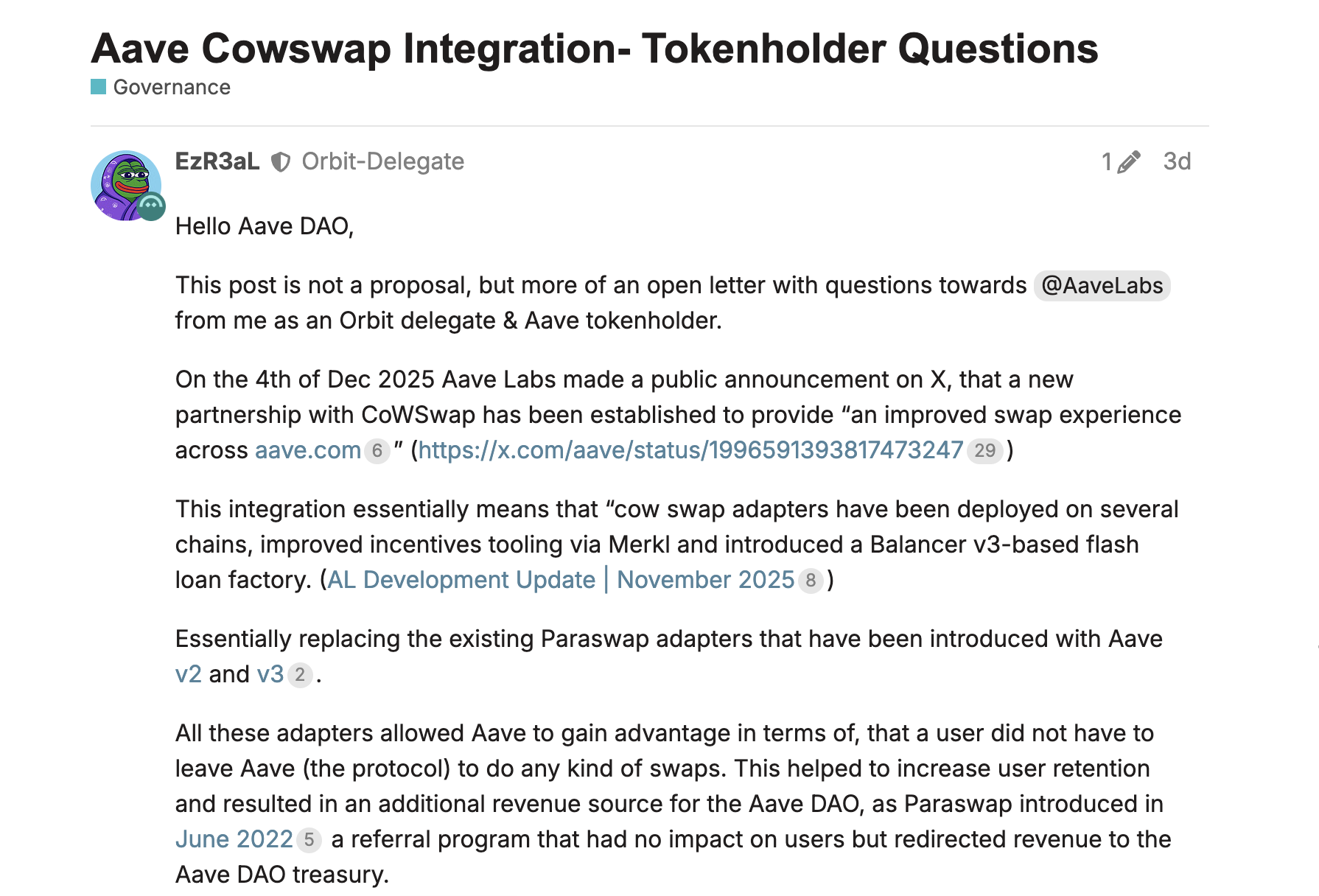
La publicación del foro de gobernanza que desató el debate. Fuente: Aave Governance

“Otra entidad, en lugar de Aave DAO, está recibiendo al menos $200,000 por semana en Ether”, dijo EzR3aL, agregando que esto equivale a $10 millones de ingresos anuales potenciales retenidos de la DAO.

Aave Labs respondió que los componentes front-end para el sitio web y las interfaces de aplicación siempre han sido de la legítima competencia de Aave Labs.

Relacionado: Aave lanza una aplicación de ahorro minorista con hasta 9% APY para competir con los bancos

Los cambios a nivel de protocolo, como las políticas de tasas de interés y la aprobación de cambios en el código de contratos inteligentes, siempre han estado sujetos a la administración de la DAO, dijo Aave Labs.

Aave Labs también afirmó que fue la entidad que financió el desarrollo de los "adaptadores", las líneas de código que permiten que funcionen los intercambios y otras integraciones.
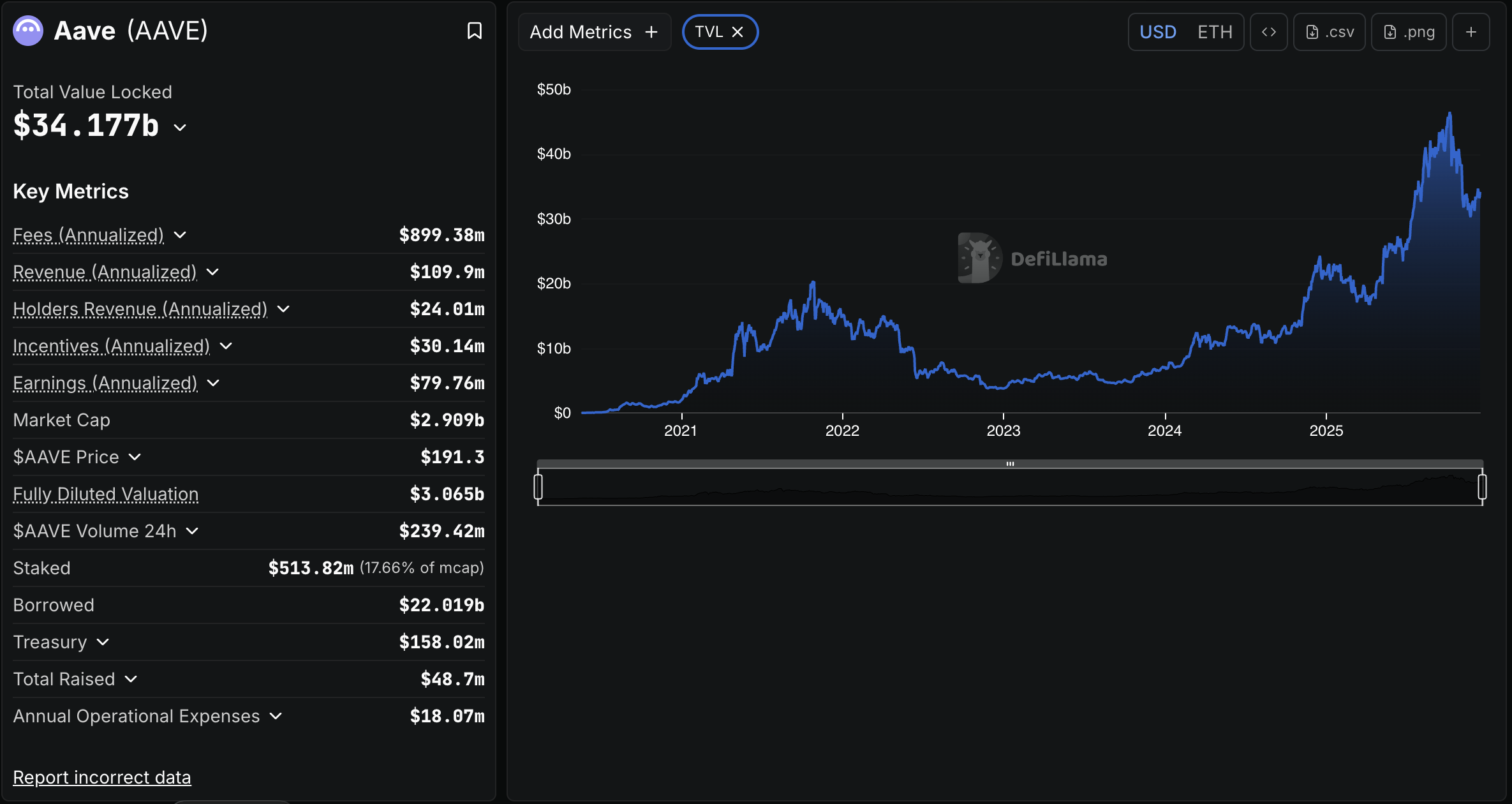
El valor total bloqueado en el protocolo Aave y una descripción general financiera de la plataforma DeFi. Fuente: DeFiLlama

Sin embargo, la respuesta hizo poco para calmar la tensión, y varios miembros de la DAO dijeron que la DAO de Aave financió el desarrollo de la tecnología adaptadora original; por lo tanto, los ingresos de la integración deberían fluir de regreso a la DAO.

Marc Zeller, fundador de Aave-Chan Initiative, una plataforma delegada que sirve a la comunidad de gobernanza de Aave, dijo que la decisión de dirigir las tarifas exclusivamente a Aave Labs es "extremadamente preocupante".

“Aave Labs, en la búsqueda de su propia monetización, redirigió el volumen de usuarios de Aave hacia la competencia. Esto es inaceptable”, dijo Zeller.

Cointelegraph se comunicó con Aave Labs pero no obtuvo una respuesta inmediata al momento de la publicación.

El conflicto destaca las complejidades de administrar una DAO, que es una forma novedosa de gobernanza y organización que tiene beneficios sobre las estructuras empresariales tradicionales, pero que también trae sus propios desafíos únicos.

Revista: La única cosa que estos 6 centros globales de cripto tienen en común...

Трендові криптовалюти

Пов'язані питання

Q¿Qué desató la disputa en el foro de gobierno de Aave?

AUn miembro seudónimo del DAO de Aave, EzR3aL, planteó que las tarifas generadas por las operaciones de intercambio de criptoactivos a través de CoW Swap se estaban dirigiendo a una dirección controlada por Aave Labs en lugar de a la tesorería del DAO.

Q¿A quién se estaban destinando las tarifas de CoW Swap según EzR3aL?

ALas tarifas se estaban enviando a una dirección privada controlada por Aave Labs, no a la tesorería de la organización autónoma descentralizada de Aave.

Q¿Cuál fue la respuesta de Aave Labs ante las acusaciones?

AAave Labs respondió que los componentes front-end de la interfaz siempre han sido de su competencia, y afirmó que fue la entidad que financió el desarrollo de los 'adaptadores' necesarios para la integración.

Q¿Por qué los miembros del DAO consideran que los ingresos deberían volver a la organización?

AVarios miembros argumentaron que el DAO de Aave financió el desarrollo de la tecnología adaptadora original, por lo que los ingresos generados por la integración deberían pertenecer al DAO.

Q¿Qué opinión expresó Marc Zeller, fundador de Aave-Chan Initiative, sobre el conflicto?

AMarc Zeller calificó la decisión de dirigir las tarifas exclusivamente a Aave Labs como 'extremadamente preocupante' y afirmó que es inaceptable que redirijan el volumen de usuarios de Aave hacia la competencia en busca de su propia monetización.

Пов'язані матеріали

WeChat AI Card Hands-On Guide: Has the AI Shopping Era Arrived?

**"WeChat AI Card" Practical Test Guide: Has the Era of AI Shopping Arrived?** WeChat has officially launched the "AI Exclusive Card," a feature integrated into its Workbuddy AI assistant. This card is designed to handle payments for AI-initiated purchases. Our hands-on test reveals it's not yet a tool for fully autonomous AI shopping, but rather a controlled payment layer for AI agents. The AI Card functions as an isolated sub-wallet within WeChat Pay. Users must bind the card and transfer funds into it from their main wallet. Crucially, every transaction requires explicit user confirmation via smartphone scan; AI cannot spend autonomously. Currently accessible through the Workbuddy agent, the card targets specific digital consumption scenarios: purchasing paid content (reports, data), calling paid APIs/tools, and subscribing to services. Its design prioritizes security and control by separating funds and mandating approval for each payment. We tested a real-world scenario: ordering bubble tea via Workbuddy using a "Meituan Life Assistant" skill. The process encountered multiple hurdles: high "skill" usage costs (exceeding daily free credits), and most importantly, while a payment was successfully initiated, the AI purchased an incorrect product (a mismatched group-buy coupon instead of the desired drink). This highlights the current limitation: the **AI Card only solves the payment step**. The broader challenge lies in the **AI agent's execution chain**—accurately understanding intent, navigating third-party platforms, selecting the right product, and ensuring proper fulfillment. The payment succeeded, but the purchase failed to meet the user's need. In conclusion, the WeChat AI Exclusive Card is a cautious, early-step experiment in AI commerce. It provides a secure, user-controlled payment method for agent interactions but is not yet capable of reliable, end-to-end complex purchases. For now, it's best used for low-value, low-risk digital services with careful user verification at each step. The vision of AI handling complete shopping tasks remains a work in progress.

marsbit19 хв тому

WeChat AI Card Hands-On Guide: Has the AI Shopping Era Arrived?

marsbit19 хв тому

Deconstructing Notion's Growth: From a Note-taking Tool to 100 Million Users—How Notion Built a Triple Growth Flywheel Through Product, Templates, and Community

Notion's growth from a niche note-taking tool to a platform with 100 million users is powered by three interconnected flywheels: Product-Led Growth (PLG), a Template Economy, and Community-Driven Growth. First, Notion's PLG strategy relies on a highly flexible, "plastic" product that users can adapt to countless personal and team workflows. Its freemium model lowers the barrier to entry, while features like page sharing and collaboration drive organic, usage-based viral growth as users naturally invite others. Second, the Template Economy solves the "blank page" problem. Templates, created by both Notion and its community, transform abstract product capabilities into concrete, copyable solutions for specific scenarios (e.g., project management, content calendars). This dramatically lowers activation costs for new users and fuels SEO-driven discovery. Third, a vibrant Community acts as a distributed growth engine. Users and official Ambassadors create tutorials, share use cases, and host local events. This community not only educates users but also fosters a sense of identity around pursuing "better ways of working," strengthening loyalty and enabling global, low-cost expansion. Together, these flywheels create a self-reinforcing ecosystem: a great product attracts users who create templates and community content, which in turn attracts more users and deepens engagement. This system allowed Notion to scale from individuals to teams and enterprises through a bottom-up adoption path. Looking ahead, AI integration promises to accelerate these flywheels further by making templates smarter and the platform a potential AI-native work operating system. Ultimately, Notion's defensible advantage is not just its features, but this deeply entrenched network of user assets, creators, and community trust.

marsbit19 хв тому

Deconstructing Notion's Growth: From a Note-taking Tool to 100 Million Users—How Notion Built a Triple Growth Flywheel Through Product, Templates, and Community

marsbit19 хв тому

$10 Billion, Qualcomm to Acquire Chip Legend Jim Keller's Company

Global mobile chip giant Qualcomm is in advanced talks to acquire AI chip startup Tenstorrent in a deal valued between $8-10 billion, according to media reports. This potential acquisition would be one of the largest in the AI chip sector in recent years. Tenstorrent, led by legendary chip architect Jim Keller, has gained prominence for its RISC-V architecture and AI accelerator designs. The move highlights Qualcomm's strategic push to diversify beyond its core smartphone chip business. As the smartphone market matures, Qualcomm is aggressively targeting growth in automotive, data center, and cloud AI. Acquiring Tenstorrent would allow Qualcomm to rapidly enter the high-end AI computing market, bypassing lengthy in-house development cycles. Tenstorrent's cost-effective system architecture, which avoids expensive HBM memory and relies on standard Ethernet for clustering, offers a potential alternative to Nvidia's costly solutions. Furthermore, Tenstorrent's high-performance RISC-V CPU technology and its focus on the automotive and edge computing segments align with Qualcomm's strategic goals, including its "Snapdragon Digital Chassis" platform. Despite the strategic rationale, the high valuation has sparked some investor caution. The successful integration of Tenstorrent's open-source culture and independent team into Qualcomm's organization, along with the commercialization of its technology, remains a key challenge.

marsbit1 год тому

$10 Billion, Qualcomm to Acquire Chip Legend Jim Keller's Company

marsbit1 год тому

CARDS' Brutal Truth of $535M FDV: Only $43M Net Revenue, Profit Margin Halved

The article deconstructs Collector Crypt (CC), a blockchain-based platform for trading tokenized collectible cards, revealing a significant disparity between its high volume and actual business fundamentals. Key findings include: * CC's cumulative revenue of $635M is misleading; 90.6% is instantly returned to users via card buybacks, leaving only $43M in net revenue (6.7% retention). * Trading activity is minimal, with real secondary market trading below $5M. eBay sales as a percentage of volume have declined for six consecutive quarters. * The platform's user base is highly concentrated, with a few dozen high-frequency wallets driving most of the volume, resembling a "casino" with ~420 daily active players. * As volume shifts to higher-priced card packs, the net profit margin has halved from 11.2% to 5.8%. * Token value capture (via burns and buybacks) totals only $1.4M, just 3.4% of net revenue. Meanwhile, operational wallets have off-ramped $45.7M in USDC. * With a Fully Diluted Valuation (FDV) of ~$535M, the token trades at 7.3x net revenue. The float is only 20.5%, with 72% of the supply allocated to insiders and locked until November 2027. The analysis concludes that while CC has found product-market fit as a high-speed gacha machine, it shows little evidence of evolving into a sustainable collector's marketplace, with minimal value accruing to its CARDS token.

marsbit1 год тому

CARDS' Brutal Truth of $535M FDV: Only $43M Net Revenue, Profit Margin Halved

marsbit1 год тому

Торгівля

Спот
Ф'ючерси

Популярні статті

Як купити AAVE

Ласкаво просимо до HTX.com! Ми зробили покупку Aave Protocol (AAVE) простою та зручною. Дотримуйтесь нашої покрокової інструкції, щоб розпочати свою криптовалютну подорож.Крок 1: Створіть обліковий запис на HTXВикористовуйте свою електронну пошту або номер телефону, щоб зареєструвати обліковий запис на HTX безплатно. Пройдіть безпроблемну реєстрацію й отримайте доступ до всіх функцій.ЗареєструватисьКрок 2: Перейдіть до розділу Купити крипту і виберіть спосіб оплатиКредитна/дебетова картка: використовуйте вашу картку Visa або Mastercard, щоб миттєво купити Aave Protocol (AAVE).Баланс: використовуйте кошти з балансу вашого рахунку HTX для безперешкодної торгівлі.Треті особи: ми додали популярні способи оплати, такі як Google Pay та Apple Pay, щоб підвищити зручність.P2P: Торгуйте безпосередньо з іншими користувачами на HTX.Позабіржова торгівля (OTC): ми пропонуємо індивідуальні послуги та конкурентні обмінні курси для трейдерів.Крок 3: Зберігайте свої Aave Protocol (AAVE)Після придбання Aave Protocol (AAVE) збережіть його у своєму обліковому записі на HTX. Крім того, ви можете відправити його в інше місце за допомогою блокчейн-переказу або використовувати його для торгівлі іншими криптовалютами.Крок 4: Торгівля Aave Protocol (AAVE)Легко торгуйте Aave Protocol (AAVE) на спотовому ринку HTX. Просто увійдіть до свого облікового запису, виберіть торгову пару, укладайте угоди та спостерігайте за ними в режимі реального часу. Ми пропонуємо зручний досвід як для початківців, так і для досвідчених трейдерів.

314 переглядів усьогоОпубліковано 2024.12.11Оновлено 2026.06.02

Як купити AAVE

Обговорення

Ласкаво просимо до спільноти HTX. Тут ви можете бути в курсі останніх подій розвитку платформи та отримати доступ до професійної ринкової інформації. Нижче представлені думки користувачів щодо ціни AAVE (AAVE).

活动图片













