Crypto miners in Texas shut down operations as state experiences extreme heat wave

CointelegraphОпубліковано о 2022-07-12Востаннє оновлено о 2022-07-12

Анотація

With many parts of Texas enduring days of temperatures well over 100 degrees Fahrenheit in July.

With many parts of Texas enduring days of temperatures well over 100 degrees Fahrenheit in July, many crypto miners have shuttered operations in anticipation of the state’s energy grid being unable to meet demand.
The Electric Reliability Council of Texas, or ERCOT, on Sunday called on Texas residents and businesses to conserve electricity with “record high electric demand” expected on Monday. According to ERCOT’s forecast, demand for electricity in Texas — due in part from running air conditioners amid extreme heat — could surpass the available supply.
The energy supplier’s prediction model showed demand could reach a record high of 79,615 megawatts (MW). While energy costs in Texas in June were reportedly lessened due to increased production from wind and solar, ERCOT reported on Sunday that wind generation was “generating significantly less than what it historically generated in this time period” — less than 8% of capacity when demand was predicted to be highest.
Many crypto miners in the Lone Star State have announced they have already scaled back or shut down operations in anticipation of demand Texas’ energy grid may not be prepared to handle.  In a Monday announcement on Twitter, crypto miner Core Scientific said it had powered down all its ASIC servers located in the state until further notice "to provide relief to people in Texas."


A Riot Blockchain spokesperson told Cointelegraph its Whinstone facility in Rockdale had curtailed energy use at ERCOT’s request during the summer months, consuming 8,648 MWh less. Argo Blockchain CEO Peter Wall also said that the firm had also reduced operations in the state — likely referring to its Helios facility in Dickens County.
"In times of high-power demand, we believe that people should take priority over crypto mining," Wall told Cointelegraph. "When ERCOT sends out a conservation alert, we take it seriously and curtail our mining operations. We did this again this afternoon, as did many of our peers in the mining space."
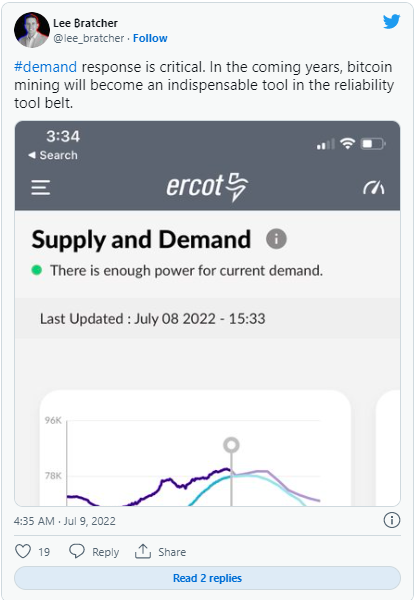

Mining firms operating in Texas during the winter months have faced similar challenges since 2021, when freezing temperatures nearly caused the entire grid to shut down — instead, many parts of the state were without power for days. In February, Riot announced that it had shut down 99% of its operations in advance of a possible repeat winter storm, predicted to demand roughly 50,000 MW of electricity — 62% of what Texans may be attempting to draw from the grid on Monday.
ERCOT’s announcement came as many crypto mining firms continue to set up new operations in Texas, seemingly attracted by less regulatory oversight and lower energy costs. In June, Riot Blockchain said it planned to “ship the balance of its S19 miner fleet” from New York to Texas, and Switzerland-based crypto mining firm White Rock Management announced it will be expanding its operations to the United States — starting with Texas.

Пов'язані матеріали

Why Is the World Nervous About Japan Raising Interest Rates?

In June 2026, the Bank of Japan raised its policy rate to 1%, marking its first hike to this level since 1995. While this rate remains low compared to global peers like the US and Europe, the move signals a profound shift for a nation that has been a global source of ultra-cheap funding for decades. Japan's long-standing near-zero or negative interest rates had facilitated massive "yen carry trades," where international investors borrowed low-cost yen to invest in higher-yielding assets worldwide, such as US tech stocks and emerging market bonds. This made Japan a critical, often overlooked, source of global liquidity. Japan's ultra-loose policy stemmed from structural challenges post-1990s asset bubble: aging demographics, chronic low inflation/deflation, and high public debt. Recent shifts, including sustained wage growth (exceeding 5% in recent years) and inflation consistently above the 2% target, have created a "wage-price spiral" possibility, prompting the policy normalization. The global market's concern lies not in the absolute rate but in the potential unwinding of the yen carry trade. As Japanese borrowing costs rise, the economics of these leveraged global investments change, potentially triggering deleveraging and capital outflows from risk assets. Market anxiety focuses on the end of a thirty-year consensus that Japan would perpetually provide cheap funding. Ultimately, the global impact will depend on the interplay with US monetary policy. While Japan is tightening, the significant interest rate differential with the US remains. The key future dynamic is whether simultaneous Japanese hikes and eventual US rate cuts will narrow this gap, forcing a major recalibration of global capital flows and asset pricing built on an era of abundant, cheap yen liquidity.

marsbit3 год тому

Why Is the World Nervous About Japan Raising Interest Rates?

marsbit3 год тому

Research Report Analysis: MRVL's Optical AI Booming, Why High Valuation Keeps Morgan Stanley's Star Analyst Sidelined?

Report Recap: MRVL Optical AI Boom - Why High Valuation Led Morgan Stanley's Star Analyst to Stay Neutral? Morgan Stanley analyst Joseph Moore maintained an "Equal-weight" (Neutral) rating on Marvell Technology (MRVL) on May 28, raising the price target from $172 to $195, below the trading price. This stance comes despite Marvell reporting a record quarter and significantly raising its full-year outlook (FY27 revenue ~$11.5B, up ~40%). Moore's neutral view is based on valuation. The $195 target implies ~40x CY2027 P/E. He contrasts MRVL with NVDA: both trade near ~$200, but Nvidia's forward EPS is more than double Marvell's. For MRVL's valuation to hold, it needs consistent earnings upgrades, proof of networking market share gains, or certainty on large-scale custom AI chip shipments—none of which are confirmed yet. Growth is driven by two pillars: **1) Optical Interconnect** (the faster runner): Moore raised FY27 growth expectations to >70%, with the optical module product line nearing a $1B annualized run rate. **2) Custom AI Chips** (the climber): Confidence in FY28 is growing, but a major new customer project only ramps in FY28, with no current revenue visibility. Key risks are the underperforming Storage, Enterprise, and legacy Networking segments. Moore acknowledges the real AI opportunity but believes the current price already reflects it. For the stock to work from here, investors need to see the optical business hit its targets, custom chips ramp as planned, and a recovery in the weaker business units.

marsbit4 год тому

Research Report Analysis: MRVL's Optical AI Booming, Why High Valuation Keeps Morgan Stanley's Star Analyst Sidelined?

marsbit4 год тому

Торгівля

Спот
Ф'ючерси
活动图片