The Cookie Ecosystem

HTX NewsОпубліковано о 2025-12-02Востаннє оновлено о 2025-12-02

Анотація

Ever notice how certain traders know which tokens are about to move before everyone else? They’re not magic or lucky. They’re just using better data.

Ever notice how certain traders know which tokens are about to move before everyone else? They’re not magic or lucky. They’re just using better data.

Instead of guessing, they’re tracking market signals, watching conversation shifts on X, and acting before the hype hits.

Today we’re gonna explore one of the tools powering that edge: Cookie.fun part of the Cookie ecosystem, powered by $COOKIE.

So what even is Cookie?

Imagine if Glassnode, Twitter, Dune, and ChatGPT had a baby, and then that baby got decentralized, tokenized, and made hot. That’s Cookie.

Run by Cookie DAO in partnership with Cookie3, Cookie is crypto’s all-in-one data layer: connecting the dots between what’s happening onchain, who’s talking about it on X, and how tokens are actually moving. Whether you’re a trader, builder, KOL, or just figuring out what to buy next, Cookie gives you the context that matters.

The Full Cookie Jar: Ecosystem & Core Functionality

If you thought Cookie was just a fancy social data dashboard, you've only tasted the crumbs. The real magic is in the full ecosystem, which is less of a project and more of a full-blown, AI-powered data cartel (the good kind, we promise).

The entire operation is a strategic partnership between Cookie DAO (the decentralized, community-driven brain) and Cookie3 (the Web3 marketing and data platform that builds the tech). Think of it as a power couple: Cookie DAO operates Cookie.fun and allows users to participate in platform governance and determine the direction of the ecosystem's development, while Cookie3 provides the industrial-grade data infrastructure. This collaboration is the secret sauce behind Multi-Token Farming mechanism, which is a fancy way of saying $COOKIE stakers get to feast on airdrops from projects that ran very popular InfoFi Cookie Snaps campaigns.

Key components of this ecosystem include the user-facing data platform, Cookie.fun, the community-driven campaign mechanism, Cookie Snaps, the powerful Cookie API and the $COOKIE Token.

Here’s a quick peek at the other core components that make the Cookie ecosystem the crypto data layer it claims to be:

1. Cookie.fun: The User-Facing Data Platform
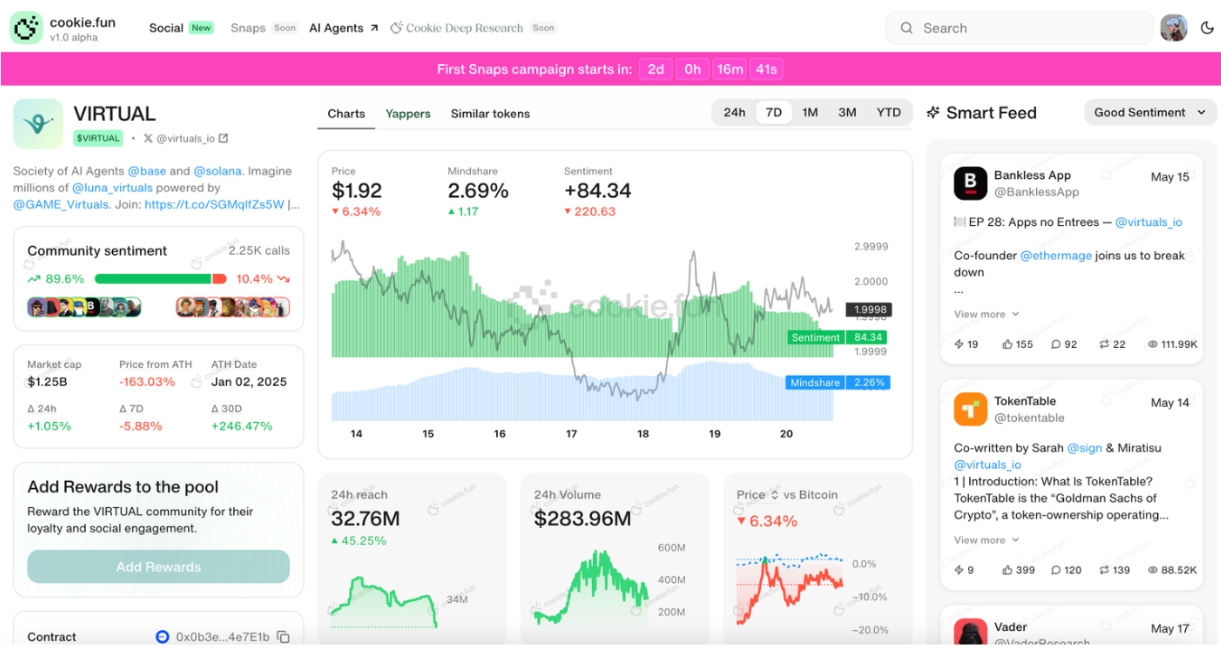
Think of Cookie.fun as CoinMarketCap or CoinGecko, but for social data.

You can search for any token and instantly see:

What influencers are saying about it.

How much conversation the project is getting on X (mindshare).

The overall sentiment from the community.

Why does this matter? Because many traders say that price often follows social trends. More positive chatter = higher chance of upward moves.

Powered by Cookie Deep Research (CDR), Cookie.fun also gives you quick AI summaries of market events directly on token pages, so you get instant context without digging.

That’s exactly why cookie.fun has already crossed 2M visits since its early-2025 launch. Top traders and analysts are making it part of their daily routine, checking it right next to CMC and Coingecko.

Cookie.fun is free, but the team has teased advanced, token-gated analysis for $COOKIE holders soon.

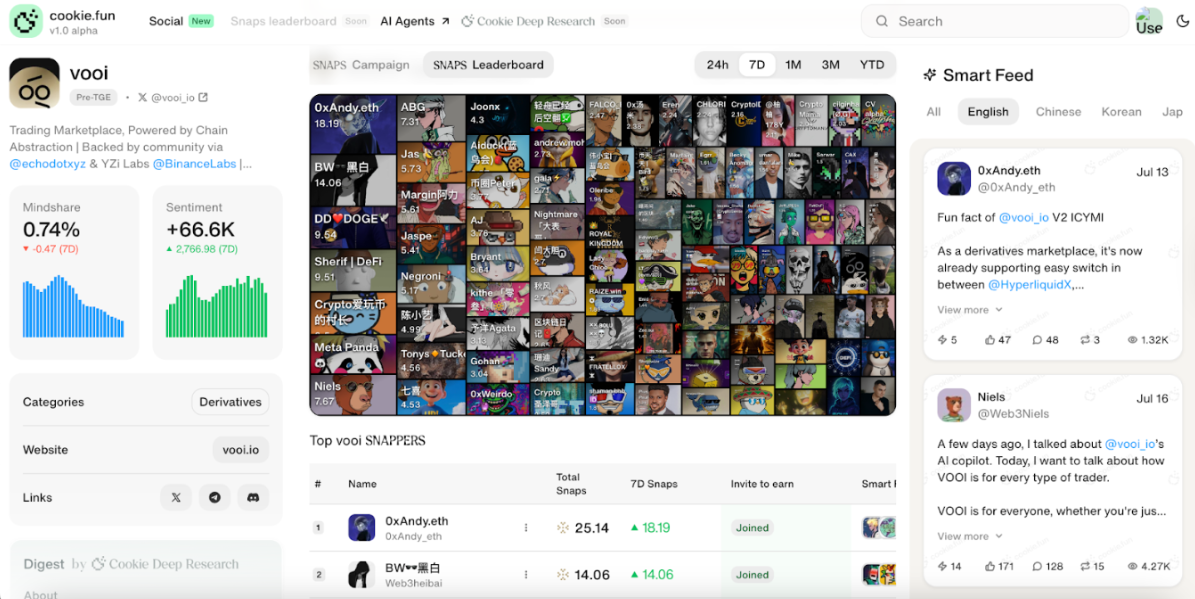
2.Cookie Snaps: Post. Earn. Repeat.

Cookie Snaps (part of cookie.fun) takes this one step further. Projects tap into Cookie’s data to run smarter go-to-market campaigns and reward their communities.

Users post content about projects on X → Cookie scores it for quality and sentiment → If it fits the criteria, you get rewarded for posting.
3. Agent Cookie: The Most Informed AI on the Block

Meet the ecosystem's resident know-it-all. Agent Cookie is an AI agent that works with the Cookie DataSwarm to process all that onchain and social data for market intelligence and predictions.

It's not just about collecting data; it's about making sense of it. Agent Cookie is designed to spot the next big narrative before it hits the mainstream. The team is even launching an interactive terminal for $COOKIE holders soon, which means you'll get to chat directly with the most informed AI in crypto. Imagine having a crystal ball, but it runs on 7TB of data and a lot of code.

4. The $COOKIE Token: The Data Gatekeeper

While the original report touched on staking, it's worth emphasizing the token's role as the ultimate gatekeeper.

$COOKIE is the key to the kingdom. It grants access to Premium Analytics on cookie.fun. More importantly, it's the mechanism for the Multi-Token Farming mentioned above, rewarding stakers with airdrops from partner projects.

As a DAO-issued token, $COOKIE holders have a say in the future direction of the data layer, ensuring the project remains decentralized and community-focused. You're not just buying a token; you're buying a vote in the future of crypto data.

In short, Cookie is a full-stack data solution. It's not just a website; it's a data API for developers, an AI agent for predictions, and a token that rewards you for being part of the club.

Multi-Airdrop Farming: Don’t Just Stake. Stack.

Cookie isn’t only about analysis, it’s also about monetization.

When projects plug into Cookie Snaps, a portion of rewards for posting on X flows back to $COOKIE stakers. So by staking $COOKIE you get access to the fees projects pay to launch their Snaps campaigns.

For more details, check out Cookie docs

How to get started?

Cookie.fun turns market chatter into a clear, usable signal. To trade smarter, checking it often is advised. It helps you track where conversations build, sentiment shifts, and rewards flow.

Here’s how to put it into action:

Check Cookie.fun to scan sentiment and mindshare on the tokens you’re tracking.

Explore live Snaps campaigns to spot which projects are rewarding their communities for posting about them on X & completing onchain actions.

Stake Cookie to get rewards from all Snaps campaigns via multiairdrop farming.

This way, you’re not just watching the market, you’re plugged directly into the next wave of activity and rewards.


Пов'язані матеріали

How Much of the Subscription Fee You Pay to Claude Can Optical Module Companies Get?

How much of your $20 Claude Pro subscription actually goes to AI model companies like Anthropic? A viral breakdown image highlights the fundamental valuation challenge for AI applications versus traditional SaaS. Unlike SaaS with high software margins, AI subscriptions face variable "inference costs": every user query consumes GPU time, power, and cloud resources. This creates a tension between fixed subscription fees and usage-driven expenses. While the specific dollar splits are illustrative, the core question is whether AI revenue can achieve SaaS-like margins as usage scales. Currently, infrastructure providers (cloud platforms, GPU makers like Nvidia, HBM suppliers, power/data centers) capture more certain revenue from growing AI usage. Their financials reflect pricing power and faster earnings validation. The bullish case hinges on efficiency improvements: model optimization, caching, smaller models, and custom chips could lower per-token costs over time. The key debate is whether cost declines can outpace increases in user workload complexity and volume. Ultimately, for AI companies to command high SaaS-like valuations, they must demonstrate not just user growth but also improving gross margins after accounting for inference costs. Investors will scrutinize not just subscriber numbers, but usage patterns, enterprise pricing tiers, and real efficiency gains.

marsbit6 хв тому

How Much of the Subscription Fee You Pay to Claude Can Optical Module Companies Get?

marsbit6 хв тому

OpenAI's Hyperliquid Pre-IPO Pricing Venture: Why Did It Last Only Half a Year?

The article discusses the rise and fall of Pre-IPO pricing markets on the Hyperliquid blockchain. Trade.xyz, an anonymous team, successfully built the largest pre-market for SpaceX (SPCX) by launching a contract with a clear anchor: the eventual Nasdaq listing price. This provided inherent price stability and validation. In contrast, Ventuals, a team backed by Paradigm, failed despite holding exclusive contracts for highly sought-after companies like OpenAI and Anthropic. Its key mistake was its pricing mechanism. For companies with no near-term IPO date, Ventuals' oracle relied partly on opaque private market transactions and, critically, partly on its own contract's moving average price. This created a self-referential feedback loop where prices were artificially propped up and detached from genuine supply and demand, leading to illiquid markets. Ventuals shut down after nine months, settling positions at final prices of $1,341.80 for OpenAI and $1,618.90 for Anthropic. Ironically, some employees and late-stage investors of these very companies reportedly used these flawed Ventuals prices for valuation reference, highlighting the acute demand for any price signal in illiquid private markets. The article concludes that while demand for pre-IPO trading is real and growing, with players like Coinbase now entering the space, the fundamental challenge remains: without a public listing to provide a definitive price anchor, these markets struggle to establish truly accurate and liquid pricing. The need for a transparent, self-correcting market is the critical lesson from Ventuals' failure.

marsbit22 хв тому

OpenAI's Hyperliquid Pre-IPO Pricing Venture: Why Did It Last Only Half a Year?

marsbit22 хв тому

With Daily Active Users Reaching 3-4 Times That of the Industry's Second Place, Which Crack in the Office Agent Market Has Tencent's WorkBuddy Torn Open?

Tencent's AI office assistant, WorkBuddy, has achieved daily active users (DAU) 3-4 times that of the industry's second-place product, primarily driven by non-technical users like HR, operations, and administrative staff. Its rapid growth, starting with a public beta in March 2026, highlights a key strategic divergence from competitors like OpenAI's Codex and Anthropic's Claude Code. Unlike those tools, which originated as developer-focused assistants (in command lines or IDEs) and are now expanding towards office scenarios, WorkBuddy was built from the ground up for non-technical office workers. Its development was user-driven, initiated after腾讯云's team observed non-technical employees using their CodeBuddy coding tool for general tasks. WorkBuddy's design is defined by three core decisions aimed at lowering barriers: 1) Using natural language instead of technical concepts, so users describe their goal without needing to understand prompts or agents. 2) Providing pre-packaged "Skill" templates for common office tasks like data processing, content creation, and research. 3) Natively integrating into existing腾讯 ecosystems like腾讯 Docs and WeChat, making the agent a seamless part of the user's workflow rather than a separate tool. This "scenario encapsulation" approach, prioritizing the shortest path for users to get work done, contrasts with the "underlying capability" focus of Codex and Claude, which offer more flexibility but require more technical setup. Analysts confirm WorkBuddy's leading market position in China by mid-2026, with massive user and request growth following its launch. Recognizing the same trend of surging non-technical adoption, OpenAI and Anthropic are now pivoting their products with features like role-based plugins (Codex) and a simplified desktop interface (Claude Cowork). However, adapting tools built for developers requires significant changes to interaction models and integrations. WorkBuddy currently holds an estimated six-month lead in delivering a complete solution for non-technical office users. Its recently launched enterprise version aims to solidify this advantage. The competition underscores two valid paths: embedding agent capabilities directly into familiar work environments versus building powerful, general-purpose agents that users must learn to access. WorkBuddy's early success demonstrates the effectiveness of the former strategy for mainstream office adoption.

marsbit31 хв тому

With Daily Active Users Reaching 3-4 Times That of the Industry's Second Place, Which Crack in the Office Agent Market Has Tencent's WorkBuddy Torn Open?

marsbit31 хв тому

Торгівля

Спот
Ф'ючерси

Популярні статті

Як купити COOKIE

Ласкаво просимо до HTX.com! Ми зробили покупку Cookie DAO (COOKIE) простою та зручною. Дотримуйтесь нашої покрокової інструкції, щоб розпочати свою криптовалютну подорож.Крок 1: Створіть обліковий запис на HTXВикористовуйте свою електронну пошту або номер телефону, щоб зареєструвати обліковий запис на HTX безплатно. Пройдіть безпроблемну реєстрацію й отримайте доступ до всіх функцій.ЗареєструватисьКрок 2: Перейдіть до розділу Купити крипту і виберіть спосіб оплатиКредитна/дебетова картка: використовуйте вашу картку Visa або Mastercard, щоб миттєво купити Cookie DAO (COOKIE).Баланс: використовуйте кошти з балансу вашого рахунку HTX для безперешкодної торгівлі.Треті особи: ми додали популярні способи оплати, такі як Google Pay та Apple Pay, щоб підвищити зручність.P2P: Торгуйте безпосередньо з іншими користувачами на HTX.Позабіржова торгівля (OTC): ми пропонуємо індивідуальні послуги та конкурентні обмінні курси для трейдерів.Крок 3: Зберігайте свої Cookie DAO (COOKIE)Після придбання Cookie DAO (COOKIE) збережіть його у своєму обліковому записі на HTX. Крім того, ви можете відправити його в інше місце за допомогою блокчейн-переказу або використовувати його для торгівлі іншими криптовалютами.Крок 4: Торгівля Cookie DAO (COOKIE)Легко торгуйте Cookie DAO (COOKIE) на спотовому ринку HTX. Просто увійдіть до свого облікового запису, виберіть торгову пару, укладайте угоди та спостерігайте за ними в режимі реального часу. Ми пропонуємо зручний досвід як для початківців, так і для досвідчених трейдерів.

224 переглядів усьогоОпубліковано 2025.07.23Оновлено 2026.06.02

Як купити COOKIE

Обговорення

Ласкаво просимо до спільноти HTX. Тут ви можете бути в курсі останніх подій розвитку платформи та отримати доступ до професійної ринкової інформації. Нижче представлені думки користувачів щодо ціни COOKIE (COOKIE).

活动图片