Sony Bank To Launch Stablecoin For Games, Anime Payments

bitcoinistОпубліковано о 2025-12-02Востаннє оновлено о 2025-12-02

Анотація

Sony Bank is planning a US stablecoin launch as early as fiscal year 2026, aiming to power low-fee payments for...

Trusted Editorial content, reviewed by leading industry experts and seasoned editors. Ad Disclosure

Sony Bank is planning a US stablecoin launch as early as fiscal year 2026, aiming to power low-fee payments for Sony games and anime.

Sony Bank To Issue Stablecoin As New Payment Method For Games & Anime

As reported by Nikkei Asia, Sony Bank could issue a stablecoin pegged to the US Dollar as early as fiscal year 2026. Sony Bank, a subsidiary of Sony Financial Holdings, is one of the largest online banks in Japan. It applied for a banking license in the US back in October.

The bank’s parent company went public in September and spun off into its own entity separate from Sony Group. The firm, however, is continuing to support the group’s business developments. The stablecoin project is one such avenue, as Sony Group envisions that the USD-pegged token will be used by customers to pay for content like games and anime in its ecosystem.

Sony Group is a well-known name around the world, controlling multiple large media-related businesses like Sony Interactive Entertainment, the company behind the PlayStation, and Sony Pictures Entertainment, a filmmaker.

In the fiscal year that ended in March 2025, US customers made up 30% of the group’s overall sales to external customers. With Sony Bank’s stablecoin, the multinational conglomerate is now hoping these users can start paying in the ecosystem with digital assets, cutting back on the transaction fees paid to credit card companies.

The bank has formed a partnership with Bastion, an American stablecoin infrastructure solutions provider, to help with the project. “The bank plans to establish a subsidiary to handle its stablecoin business,” noted Nikkei.

The move from Sony comes a few months after President Donald Trump signed the GENIUS Act, establishing a regulatory framework for stablecoins in the US. These cryptocurrencies have also been gaining momentum in other parts of the world recently. Hong Kong launched its stablecoin legislation in August and plans on handing out issuer licenses next year. Japan saw the launch of its first yen-backed coin in October.

Major European banks have come together to form a consortium to launch a euro-pegged stablecoin, aiming a rollout in the second half of 2026 in a bid to challenge the currently USD-dominated market. Over the past year, the fiat-tied cryptocurrencies have enjoyed some sharp growth, but in the last month, they have suffered a slowdown as part of the downturn in the digital assets sector as a whole.

Below is a chart from DeFiLlama that shows how the market cap of the stablecoins has changed over the last several years.
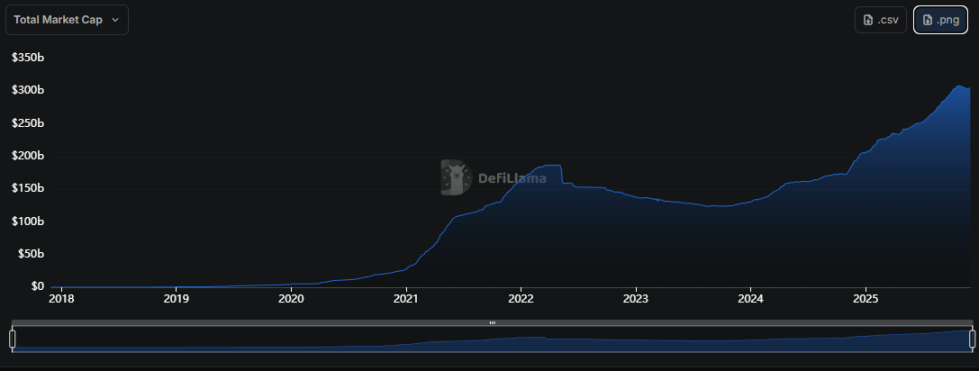
Stablecoins Market Cap

Looks like the metric has dropped into sideways movement in recent weeks | Source: DeFiLlama

The stablecoin market cap set a new record of $309 billion in late-October. Since then, the metric has seen a small decline to $306 billion. USDT and USDC, the two largest tokens in the space, alone account for about $261 billion of this figure.

Bitcoin Price

At the time of writing, Bitcoin is trading around $86,700, down nearly 6% over the last 24 hours.

Bitcoin Price Chart

The price of the coin seems to have plunged | Source: BTCUSDT on TradingView
Featured image from Nikita Kostrykin on Unsplash.com, DeFiLlama.com, chart from TradingView.com
Editorial Process for bitcoinist is centered on delivering thoroughly researched, accurate, and unbiased content. We uphold strict sourcing standards, and each page undergoes diligent review by our team of top technology experts and seasoned editors. This process ensures the integrity, relevance, and value of our content for our readers.

Keshav is a Physics graduate who has been employed as a writer with Bitcoinist since June 2021. He is passionate about writing and through the years, he has gained experience working in a variety of niches. Keshav holds an active interest in the cryptocurrency market, with on-chain analysis being an area he particularly likes to research and write about.

Пов'язані матеріали

Uncovering the Truth About Agent Commerce, Payments, and Infrastructure

Decoding Agent Commerce, Payments, and Infrastructure: The Reality Over the past year, I've been building infrastructure for the Agent economy, engaging with major players like Stripe, Visa, Coinbase, Google, and dozens of startups. A clear conclusion emerges: true, large-scale demand does not yet exist. Startups face structural challenges. Data points illustrate this gap. Stripe's Agent commerce platform has over 1,000 merchants but only single-digit transacting agents. Visa's Agent payment token requires 9-month KYC and a $250M revenue threshold, accessible only to giants like Amazon. On-chain analysis reveals actual daily Agent transaction volume is around $17k, half of which are test transactions. The article analyzes four potential markets: **1. Agent-to-Merchant (A2M):** Current AI shopping UX is often inferior to traditional e-commerce for visual, comparison-heavy purchases (clothing, electronics). Chat interfaces are a step back. Real merchant interest is defensive "Agent Engine Optimization," fearing future obsolescence, not current demand. Potential exists in high-frequency, low-decision purchases (e.g., food delivery) or simplifying terrible UX (complex checkouts, non-native shoppers), but these require massive consumer distribution channels dominated by giants like DoorDash and Amazon. **2. Agent-to-API (A2A):** Developers already have subscriptions and billing for core APIs (compute, data). The argument for micro-payments via crypto for sub-dollar API calls is addressed by pre-paid balances today. The deeper issue is supplier resistance; major SaaS firms rely on enterprise contracts, not fractional cent pricing. Opportunity lies in the long tail of niche services, but this is a smaller market catering to developers, a historically low-paying group. **3. Agent-to-Agent (A2A):** This remains a theoretical long-term vision with near-zero current transaction volume. It involves unique challenges: discovery, trust, negotiation, dispute resolution. When it materializes, it will require a fundamentally new settlement infrastructure for high-speed, variable-value, multi-party transactions. It's a real long-term bet, but not the current market. **4. Agent-to-Finance (A2F):** This is the only category with existing, paying demand. Integrating AI into financial workflows (trading, portfolio management) is a natural evolution and enables new capabilities like autonomous rebalancing. However, competition favors incumbents with regulatory licenses, compliance infrastructure, and existing client relationships. **The Real Issue:** Why is infrastructure still being built? Incumbents can afford long-term bets, and payment companies see every problem as a nail for their payment hammer. However, payment is just one piece. The core challenge is *coordination*—orchestrating work between Agents and humans, verifying outcomes, and settling results. Payment is part of settlement, which is part of coordination. Companies that solve the coordination problem will subsume payments, not the other way around. Startups lack the infinite runway of giants and must find today's real market, which, after a year of exploration, lies outside these four categories—in an area with real, growing, and underserved activity.

marsbit2 год тому

Uncovering the Truth About Agent Commerce, Payments, and Infrastructure

marsbit2 год тому

Торгівля

Спот
Ф'ючерси

Популярні статті

Як купити ANIME

Ласкаво просимо до HTX.com! Ми зробили покупку Animecoin (ANIME) простою та зручною. Дотримуйтесь нашої покрокової інструкції, щоб розпочати свою криптовалютну подорож.Крок 1: Створіть обліковий запис на HTXВикористовуйте свою електронну пошту або номер телефону, щоб зареєструвати обліковий запис на HTX безплатно. Пройдіть безпроблемну реєстрацію й отримайте доступ до всіх функцій.ЗареєструватисьКрок 2: Перейдіть до розділу Купити крипту і виберіть спосіб оплатиКредитна/дебетова картка: використовуйте вашу картку Visa або Mastercard, щоб миттєво купити Animecoin (ANIME).Баланс: використовуйте кошти з балансу вашого рахунку HTX для безперешкодної торгівлі.Треті особи: ми додали популярні способи оплати, такі як Google Pay та Apple Pay, щоб підвищити зручність.P2P: Торгуйте безпосередньо з іншими користувачами на HTX.Позабіржова торгівля (OTC): ми пропонуємо індивідуальні послуги та конкурентні обмінні курси для трейдерів.Крок 3: Зберігайте свої Animecoin (ANIME)Після придбання Animecoin (ANIME) збережіть його у своєму обліковому записі на HTX. Крім того, ви можете відправити його в інше місце за допомогою блокчейн-переказу або використовувати його для торгівлі іншими криптовалютами.Крок 4: Торгівля Animecoin (ANIME)Легко торгуйте Animecoin (ANIME) на спотовому ринку HTX. Просто увійдіть до свого облікового запису, виберіть торгову пару, укладайте угоди та спостерігайте за ними в режимі реального часу. Ми пропонуємо зручний досвід як для початківців, так і для досвідчених трейдерів.

308 переглядів усьогоОпубліковано 2025.06.18Оновлено 2026.06.02

Як купити ANIME

Обговорення

Ласкаво просимо до спільноти HTX. Тут ви можете бути в курсі останніх подій розвитку платформи та отримати доступ до професійної ринкової інформації. Нижче представлені думки користувачів щодо ціни ANIME (ANIME).

活动图片













