BitMEX 创始人 vs Tether CEO:一场关于 USDT 资产质量的推上口水战

marsbitОпубліковано о 2025-11-30Востаннє оновлено о 2025-12-01

12 月 1 日,加密推特上爆发了一场含金量极高的“口水战”。

挑起战争的是 BitMEX 创始人、币圈著名的“毒舌”宏观分析师 Arthur Hayes。而被动应战的,是刚刚交出一份“富可敌国”财报的 Tether CEO Paolo Ardoino

事情的起因很简单:Tether 实在是太赚钱了。

USDT

Paolo Ardoino 刚刚凡尔赛地透露,Tether 仅靠持有的美国国债,每个月就能产生约 5 亿美元 的无风险利润。

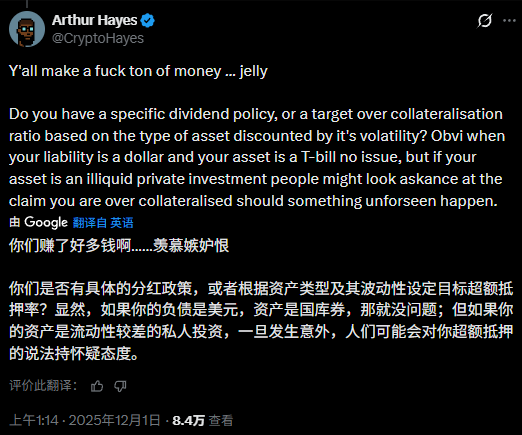
面对这台日进斗金的印钞机,Hayes 在 X 平台上发文,先是酸溜溜地恭维了一句:“你们赚得真 TM 多(Y'all make a fuck ton of money)……嫉妒。”

但紧接着,他话锋一转,抛出了一个极其尖锐的质问:如果发生了意外,你们那些流动性差的“私人投资”,会不会让 Tether 的超额抵押变成一句空话?

这场对话瞬间引爆了社区。一边是这几年对 Tether 资产质量的持续质疑,另一边是 Tether 如今恐怖的资本壁垒。

这不仅仅是两个大佬的互怼,这是两种世界观的碰撞:传统的“流动性原教旨主义” vs 新生的“资本暴力美学”


第一回合:Hayes 的进攻——“你的私房钱安全吗?”

Arthur Hayes 的攻击点非常精准,直击 Tether 资产负债表中最不透明的角落。

他的逻辑是这样的: “如果 Tether 的负债是美元,资产是美国国债(T-bills),那基本上没有太大问题。”

这是常识。Tether 持有 1200 亿-1350 亿美元 的美债,这部分资产的流动性比现金还像现金,没人担心这个。

USDT

但 Hayes 担心的是剩下的部分。他质问道:“如果 Tether 的资产是流动性较差的私人投资(illiquid private investment),一旦发生意外……市场就会对 Tether 的超额抵押持怀疑态度。”

Hayes 指的是 Tether 财报中那些神秘的“担保贷款”(Secured Loans)和“其他投资”(包括比特币、黄金、AI 算力设施等)。

在 Hayes 看来,这就像一个银行家,拿储户的钱去投了房地产或者初创公司。平时没事,但一旦发生大规模挤兑(Run),这些资产卖不掉,或者只能贱卖。那时候,所谓的“超额抵押”就会瞬间缩水,导致资不抵债。

这是一个非常经典的、教科书式的“流动性危机”模型。


第二回合:Paolo 的反击——“你不懂什么是钞能力”

面对 Hayes 的质疑,Tether CEO Paolo Ardoino 没有解释那些“私人投资”到底是什么,而是直接甩出了一张底牌:哪怕那些投资全部归零,我们也赔得起。
USDT

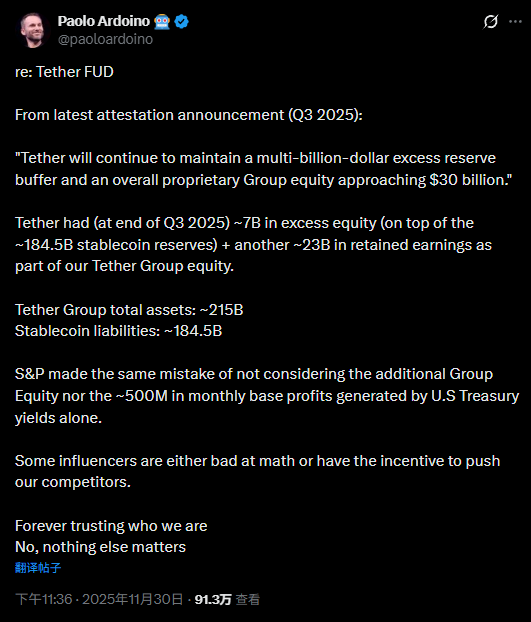
Paolo 在回复中引用了最新的 Q3 2025 鉴证报告,给 Hayes 上了一堂数学课:

  1. 超额储备(Buffer): Tether 账面上已经有 70 亿美元 的超额储备(Excess Equity)。这笔钱是专门用来应对波动的。
  2. 集团权益(Group Equity): 这才是真正的核武器。Paolo 透露,除了那 70 亿,Tether 集团还有 230 亿美元 的“留存收益”(Retained Earnings)。

加在一起,Tether 拥有接近 300 亿美元 的自有资金。

这是什么概念? Tether 目前被诟病的“私人投资”和“担保贷款”加起来大约是 185 亿美元(146 亿贷款 + 39 亿其他投资)。

Paolo 的潜台词是:就算 Hayes 你担心的那些垃圾资产全部一文不值(归零),我剩下的 115 亿美元权益(300 亿 - 185 亿),依然足够覆盖所有用户的兑付需求。

更别提,这台机器每个月还在以 5 亿美元 的速度,用美债利息给自己加厚装甲。

Paolo 甚至在推文中嘲讽道:“有些大 V 要么是数学不好,要么就是想以此推销竞争对手的产品。”


第三回合:Joseph 的补刀——“不仅是大,而且是深”

前花旗银行加密研究负责人 Joseph 随后加入了战局,他的分析让这场口水战升级到了商业模式的层面。
USDT

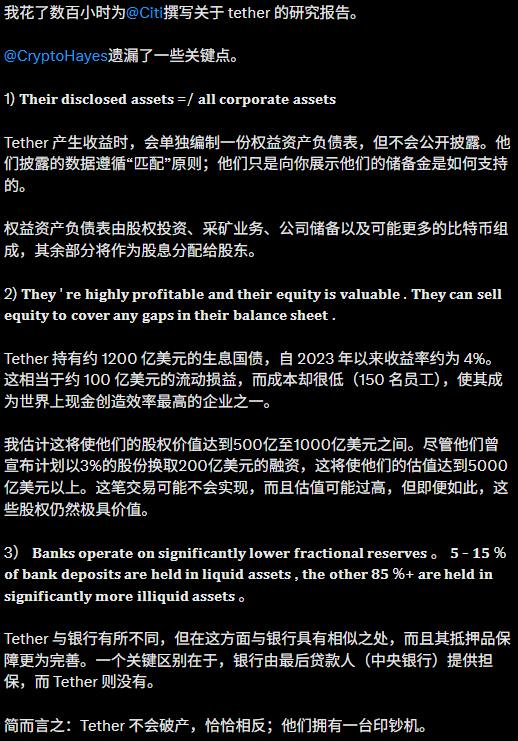
Joseph 指出,Hayes 的分析遗漏了一个关键点:Tether 已经不是一家“银行”,它是一家“投资控股集团”。

  1. 表内 vs 表外: 市场看到的“储备金报告”只是 Tether 的“负债表”。而 Tether 真正的财富——那些股权投资收益、矿业业务、AI 算力——很多都藏在未公开的“集团资产负债表”里。
  2. 效率怪物: Joseph 提到,Tether 仅有 150 名员工,却创造了 100 亿美元 的年净利。这让它成为了全球人效比最高、印钞效率最恐怖的公司。
  3. 降维打击: 传统银行只维持 5-15% 的流动资产,而 Tether 的流动性(美债)占比高达 85% 以上。Hayes 拿着放大镜去找那 15% “非流动资产”的茬,却忽略了 Tether 整体的抗风险能力已经远超传统银行。


小结

这场“口水战”的结果是显而易见的。

Arthur Hayes 的质疑在理论上是正确的——任何非流动性资产在挤兑中都是风险。

但 Paolo Ardoino 用现实击败了理论——当你的资本厚度(Equity Buffer)达到 300 亿美元时,理论上的“流动性风险”就被无限稀释了。

这不仅是 Tether 的胜利,也是加密行业的一个里程碑时刻。我们突然发现,这个曾经被视为“最大雷点”的 USDT,如今已经变成了一个持有 1350 亿美债(相当于全球第 17 大持有国)、年赚 100 亿的金融巨兽。

它已经“大而不倒”(Too Big to Fail),甚至不需要央行的救助,因为它自己就是央行。

Hayes 输了,不是输给了逻辑,而是输给了 Tether 那个深不见底的钱包。

Пов'язані матеріали

Goldman Sachs In-Depth Report: Who Will Be the Long-Term Winners in China's AI Large Model Industry?

Goldman Sachs Report: China's AI Models at an Inflection Point China's open-source/open-weight large language models (LLMs) have reached performance parity with top global proprietary models, according to a Goldman Sachs report. This is driven by architectural innovations and higher parameter efficiency, allowing Chinese models to achieve comparable capabilities at 2%-10% the parameter size and significantly lower cost. The market is evolving into a two-tiered structure: a high-end segment (e.g., GLM5.2, Qwen3.7 Max) with premium pricing and a low-end, price-sensitive segment for global SMEs and individual users. Key points: * **Cost & Performance:** Innovations like Mixture of Experts (MoE) enable high performance with smaller models. Projects like Meituan's LongCat 2.0, trained on domestic hardware, highlight progress in tech self-sufficiency. * **Open-Source Strategy:** Most Chinese players use open-source/open-weight models for flexibility and ecosystem growth. However, Goldman notes this may underreport actual deployment and revenue. A shift toward "open-weight + community license" models with revenue sharing (e.g., MiniMax) could improve monetization. * **Market Shift & Global Expansion:** Enterprise AI adoption is shifting from "token maximization" to "ROI-first." International expansion, especially in non-US markets, is a major growth driver. Chinese models are increasingly available on global platforms like AWS Bedrock and Microsoft Copilot. * **Competitive Landscape:** Using a framework based on pricing power, cost advantage, and financial strength, Goldman identifies **Zhipu AI and DeepSeek** as the strongest in foundational text models, and **ByteDance** as the leader in multimodal/video generation. The report maintains Buy ratings on MiniMax and Kuaishou. * **Market Growth:** China's AI model API and subscription revenue is projected to grow from an estimated ¥35 billion in 2026 to ¥879 billion by 2030.

marsbit15 хв тому

Goldman Sachs In-Depth Report: Who Will Be the Long-Term Winners in China's AI Large Model Industry?

marsbit15 хв тому

Goldman Sachs Deep Dive Report: Who Will Become the Long-Term Winners in China's AI Large Model Industry?

Goldman Sachs Report: Who Will Be the Long-Term Winners in China's AI Large Model Industry? China's AI large model sector is at a historic inflection point. Goldman Sachs argues that the intelligence of Chinese open-source/open-weight models is approaching top global proprietary models. Rapid adoption by domestic enterprises and global SMEs is creating a data flywheel effect that will further drive model iteration. The evolution is summarized as moving from "DeepSeek's cost-efficiency moment last year to GLM's model-intelligence moment this year." Chinese models achieve near-state-of-the-art performance at significantly lower cost, primarily due to architectural innovations like Mixture of Experts (MoE) and higher parameter efficiency. Models like DeepSeek V4 Pro (1.6T params), GLM5.2 (0.7T), and MiniMax M3 (0.4T) are much smaller than global leaders. Recent advancements in coding capability are attributed to better data curation and RLHF. Landmarks like Meituan's LongCat 2.0, trained fully on domestic AI chips, demonstrate progress in hardware stack independence. The market is forming a "two-tiered structure." The high-end tier (e.g., GLM5.2, Alibaba's Qwen3.7 Max) prices around $1 per million tokens, about 10-25% of US top models, with estimated inference gross margins of 10-20%. The low-end tier (priced as low as $0.06-$0.2 per million tokens) targets price-sensitive global SMEs and individuals. MiniMax derives 60-70% of revenue overseas. Goldman forecasts China's AI model API/subscription revenue to grow from an estimated RMB 35bn in 2026 to RMB 879bn by 2030. Most Chinese players adopt open-source/open-weight strategies for deployment flexibility and community feedback, though this limits monetization as deployments on third-party platforms (e.g., Alibaba Cloud) may not generate direct revenue. A shift towards "open-weight + community license" models with revenue-sharing agreements (like MiniMax's approach) could improve unit economics. International expansion, particularly in non-US markets, is the key growth driver. The global enterprise AI paradigm is shifting from "token maximization" to "ROI prioritization." Chinese models are already hosted on major global platforms like AWS Bedrock and are under consideration for integration into Microsoft Copilot. Using a competitive framework based on pricing power, cost advantage, and financial strength, Goldman identifies the strongest players: In foundational text models, Zhipu AI (initiated coverage) and DeepSeek lead. In multimodal/video generation, ByteDance's Seed is the frontrunner, with Kuaishou's Kling and MiniMax's Hailuo also well-positioned. Goldman maintains a Buy rating on MiniMax, citing its attractive valuation.

链捕手19 хв тому

Goldman Sachs Deep Dive Report: Who Will Become the Long-Term Winners in China's AI Large Model Industry?

链捕手19 хв тому

Is Ethereum Truly a "World Computer"?

Title: Is Ethereum Really a "World Computer"? Ethereum, envisioned as a "world computer" by its founder Vitalik Buterin, aims to be a decentralized platform for global applications. However, a recent analysis by Four Pillars raises questions about whether it is more accurately a "Western computer," based on the geographical distribution of its validators. Currently, the United States dominates with 38.19% of all validators, followed by Germany at 13.04%. Combined, these two countries account for over half of the network. In contrast, Asian representation is minimal, with Singapore holding only 3.15%. The concentration is partly due to affordable cloud hosting services like Hetzner and OVH in Europe and North America, as well as the prevalence of residential validators in the U.S., where individuals run nodes via home internet connections. When examining professionally operated validators, the distribution becomes more balanced. The U.S. share drops to 25.81%, while Asian countries like Singapore (7.28%), Hong Kong (6.44%), Japan (6.38%), and South Korea (4.59%) collectively approach the U.S. level. This shift reflects strategic deployments by institutions to meet regulatory requirements and reduce latency for local users. However, regions like South America, the Middle East, and Africa remain underrepresented. Ethereum's peer-to-peer network mechanisms, such as gossipsub, disadvantage areas with low node density, creating a feedback loop where delayed message propagation reduces validator performance and rewards. This imbalance challenges Ethereum's promises of censorship resistance and global accessibility. Despite these issues, opportunities exist for growth in underrepresented regions. As demand for localized staking infrastructure rises, early entrants in areas like the Middle East could establish dominant positions by offering compliant, low-latency solutions. The evolving validator landscape highlights both the structural challenges and the potential for Ethereum to move closer to its "world computer" ideal.

Foresight News2 год тому

Is Ethereum Truly a "World Computer"?

Foresight News2 год тому

Торгівля

Спот
活动图片