Strategy Stock Crashes 60% — But Michael Saylor Refuses To Step Aside

bitcoinistОпубліковано о 2025-11-26Востаннє оновлено о 2025-11-26

Анотація

Strategy’s share price has taken a beating this year, but its Bitcoin hoard remains in the black and still changes...

Trusted Editorial content, reviewed by leading industry experts and seasoned editors. Ad Disclosure

Strategy’s share price has taken a beating this year, but its Bitcoin hoard remains in the black and still changes the long-term picture for investors.

Strategy Bitcoin Holdings Still In Profit

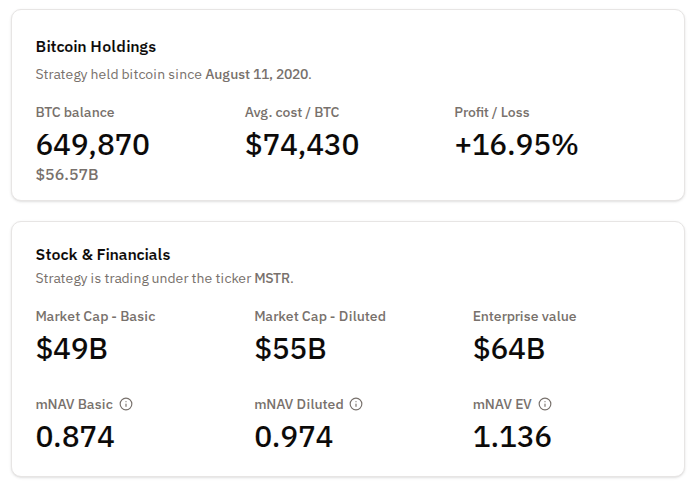
According to BitcoinTreasuries.NET and company disclosures, Strategy bought its Bitcoin at an average cost of $74,430 per coin. With Bitcoin trading around $86,000, that basket is still up roughly 16% on paper.

The firm stepped up its buys on Nov. 17, adding 8,178 BTC for $836 million. Michael Saylor, Strategy chairman, said “I won’t back down.” That move pushed its total to 649,870 BTC, a stash currently worth nearly $56 billion. Short-term swings have hit the stock hard, but the crypto holding itself is not the same as the equity price.

In markets, appearance matters. Shares that once traded near $300 in October slid to about $170 at the time of recent reporting. Over the last year the stock is down close to 60%, and it has fallen by more than 40% year-to-date. Those drops have worried some, yet the balance sheet tied to Bitcoin tells a different numeric story.

Investors Use Strategy As A Hedge

Based on reports and market commentary, the stock’s weakness is partly technical. In a recent interview, BitMine chairman Tom Lee pointed out that Strategy’s options market is very liquid, making the stock an easy tool for large players to hedge Bitcoin exposure.

BTCUSD trading at $87,384 on the 24-hour chart: TradingView

Traders can buy puts or short the equity instead of wrestling with less liquid crypto derivatives. That choice can press the share price independently of whether the company’s Bitcoin position is healthy.

Analysts warned that a deep drop in BTC could force the firm to sell coins and that such a move would put extra pressure on both the stock and Bitcoin itself. He said the risk is there, even if it looks distant today. In plain terms: one day of panic could create a chain reaction. For now, it remains hypothetical rather than immediate.
Source: Bitcoin Treasuries

Stock Returns Outpace Tech Peers

Five-year returns show a stark contrast. Strategy’s shares have climbed more than 500% over that window, compared with Apple’s 130% and Microsoft’s 120%.

Over two years the firm’s stock rose about 226%, while Apple gained 43% and Microsoft gained 25% in the same period. These numbers underline why long-term investors have supported the firm’s strategy despite recent turbulence.

Featured image/photo illustration by Alice Morgan/Getty Images, chart: TradingView

Editorial Process for bitcoinist is centered on delivering thoroughly researched, accurate, and unbiased content. We uphold strict sourcing standards, and each page undergoes diligent review by our team of top technology experts and seasoned editors. This process ensures the integrity, relevance, and value of our content for our readers.

Christian, a journalist and editor with leadership roles in Philippine and Canadian media, is fueled by his love for writing and cryptocurrency. Off-screen, he's a cook and cinephile who's constantly intrigued by the size of the universe.

Пов'язані матеріали

Robert Kiyosaki Shares His Mentor's Predictions About the Emergence of Bitcoin and AI

American entrepreneur and author of "Rich Dad Poor Dad," Robert Kiyosaki, discussed the influence of futurist R. Buckminster Fuller on his worldview, linking Fuller's past technological predictions to the emergence of Bitcoin and the development of artificial intelligence. In an X post, Kiyosaki also reflected on personal purpose, sharing his journey from the music business—where he worked with bands like The Police and Iron Maiden—to creating the "Cashflow" board game and writing his famous book. He described feeling an inner emptiness despite his success, a turning point that came after meeting Fuller, whom he studied with for three summers. Kiyosaki described Fuller as a "friendly genius" who foresaw world-changing developments like Bitcoin and AI. However, the core of his post focused on Fuller's philosophical impact, particularly a quote about belonging to the universe and finding purpose by dedicating one's life to the maximum benefit of others. The entrepreneur remains a vocal advocate for cryptocurrencies. He regularly advises buying Bitcoin during market panics, viewing it and assets like Ethereum, gold, and silver as hedges against traditional financial system failures. Kiyosaki has predicted a major market crash by 2026, seeing it as an opportunity for prepared investors, with long-term price targets including $750,000 for Bitcoin and $95,000 for Ethereum.

cryptonews.ru1 год тому

Robert Kiyosaki Shares His Mentor's Predictions About the Emergence of Bitcoin and AI

cryptonews.ru1 год тому

Etherealize CEO Calls Wall Street's Private Blockchains a 'Race to the Bottom'

Etherealize co-founder and CEO Vivek Raman criticized Wall Street's growing interest in private, permissioned blockchains, calling them a "race to the bottom." In an interview with CoinDesk, Raman argued that consortium networks fragment liquidity and return the industry to the siloed systems that blockchain technology was meant to overcome. He stated that closed networks do not interoperate, undermining two key advantages of the technology: system compatibility and liquidity concentration. Etherealize promotes Ethereum as an open, foundational layer for institutional players. Raman insists that privacy and access restrictions should be built on top of public infrastructure—at the application or L2 level—rather than creating separate, closed networks. He compared Ethereum to HTTP as a base layer, with additional permissioned and private layers akin to HTTPS. Examples of this new wave of "closed" solutions mentioned include Canton Network from Digital Asset, Circle's Arc project, and Stripe's Tempo. Raman termed this trend "consortium chains 2.0," recalling earlier initiatives like the R3 interbank consortium and the Hyperledger corporate ecosystem from 2016 that failed to gain significant traction. He reiterated his firm belief that a global, open, permissionless infrastructure is necessary as a foundational base layer. Raman previously noted in June that traditional financial institutions had begun implementing Ethereum-based solutions into real business processes.

cryptonews.ru1 год тому

Etherealize CEO Calls Wall Street's Private Blockchains a 'Race to the Bottom'

cryptonews.ru1 год тому

Торгівля

Спот
活动图片