Артур Хэйес допустил падение биткоина к $80 000–$85 000 из-за признаков кредитного кризиса

cryptonews.ruОпубліковано о 2025-04-17Востаннє оновлено о 2025-11-18

Биткоин вполне может упасть до $80 000–85 000, а в случае синхронного обвала рынков взлететь до $200 000 или даже до $250 000, если власти США «ускорят свои махинации». Об этом заявил соучредитель BitMEX Артур Хэйес.

В новом эссе эксперт объяснил падение биткоина (BTC) со $125 000 до $90 000 на фоне умеренной слабости индексов S&P 500 и Nasdaq 100 вблизи исторических максимумов формированием кредитного кризиса. Он сослался на снижение индекса долларовой ликвидности с июля на $1 трлн.
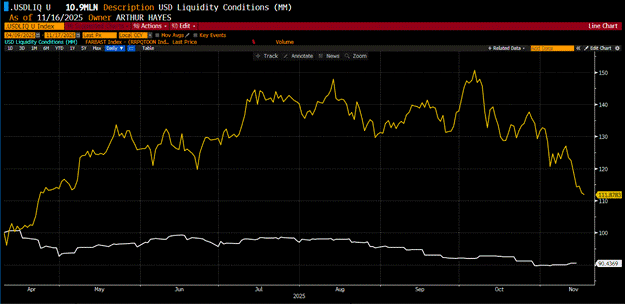
Источник: Артур Хэйес.

По теме: Артур Хэйес назвал дефицит бюджета во Франции драйвером роста биткоина

Когда разворот?

По мнению Хэйеса, коррекции на 10–20% в сочетании с подъемом доходности 10-летних гособлигаций к 5% станут основанием для срочной реализации схемы «печатания денег» Федрезервом, Казначейством или другим государственным агентством США.

Пока к этому в Вашингтоне не готовы. Сигналом изменения позиции могут стать «инсайды» на страницах The Wall Street Journal колумниста Ника Тимираоса, который освещает вопросы монетарной политики.

«Быки правы: со временем денежный сделает brrr. Но сначала активы должны отыграть апрельский рост, чтобы лучше соответствовать фундаментальным индикаторам ликвидности. Биткоин и некоторые шиткоины обновят рекорды только после того, как рынки достаточно „стошнит“, чтобы ускорить темпы печатания денег», — пояснил Хэйес.

Специалист напомнил, что с 1 декабря американский ЦБ прекратит продажу гособлигаций с баланса, а Казначейство США после прекращения шатдауна вскоре достигнет целевого показателя своего счета в Федрезерве в $850 млрд, что нормализует объем ликвидности в системе.

По теме: Артур Хэйес связал экономические меры нового премьера Японии с ростом биткоина до $1 млн

Помощь со стороны Китая

Эксперт также ожидает поддержки со стороны Китая, власти которой «нажмут на курок» после аналогичных действий геополитического оппонента. В настоящий момент препятствием этому выступают опасения укрепления юаня, если Пекин решится на стимулирование в одностороннем порядке.

Сооснователь BitMEX отметил реакцию в КНР на «кражу» правоохранительными органами США первой криптовалюты у гражданина Китая. По мнению Хэйеса, очевидно, что лидер страны Си Цзиньпин считает цифровое золото ценным активом.

«Если и Трамп, и Си Цзиньпин, лидеры двух крупнейших экономик мира, верят в ценность биткоина, почему вы не настроены оптимистично в долгосрочной перспективе?», — заключил специалист.

По теме: шатдаун позади. Что реанимирует рынок криптовалют?
Пов'язані матеріали

GensynAI's Jeff Amico States That Real-World Asset (RWA) Investors May Lose Creditor Rights

Jeff Amico of GensynAI warns that investors in Real-World Asset (RWA) tokenized lending pools may lack creditor rights in case of borrower default. He notes a common structure where users receive a yield-bearing stablecoin from a platform, but the underlying loan and collateral are held by separate legal entities. This setup means investors have no enforceable claims against the borrower, the special purpose vehicles (SPVs), or the collateral itself, relying instead on the platform's promise to return funds. Amico emphasizes that investors must first identify who legally owes them money and what credit enhancement mechanisms exist, rather than focusing solely on nominal yield. Protections like collateral or first-loss capital are meaningless unless the lien is properly perfected and an agent is designated to enforce it on the investor's behalf. Investors without a formal credit agreement are particularly vulnerable. He cites Pareto/FalconX as a better model where depositors are direct contractual creditors, though this comes with higher minimum investments and KYC requirements. This highlights a trade-off: the crypto industry's permissionless ideals often conflict with the legal protections required for secure lending. Amico argues that weak legal structures could limit the RWA sector's growth. Traditional finance offers a clear template with defined creditor rights and perfected liens. Tokenized lending needs infrastructure, like oracles, to verify off-chain loan agreement status and collateral perfection, as smart contracts cannot do this autonomously. Ultimately, transparency is key. Some investors may accept weaker protections for open access, while others may prefer stronger legal rights. The legal structure of a lending pool will be as critical as its advertised yield, especially during a default, determining whether a token holder has enforceable rights or merely a platform promise.

cryptonews.ru2 хв тому

GensynAI's Jeff Amico States That Real-World Asset (RWA) Investors May Lose Creditor Rights

cryptonews.ru2 хв тому

Beyond the 'Kimchi Premium': Institutional Transformation in Korea

South Korea's crypto landscape is moving beyond the volatile "Kimchi Premium" era driven by retail speculation, according to Andrew Park, CEO of Factblock. Park, who organizes Korea Blockchain Week, notes a significant shift in the nature of international inquiries. Global institutions are now focusing on market access, asset custody, tokenization, stablecoins, and regulatory compliance, rather than just token listings and prices. This institutionalization is being built through foundational, "unsexy" back-office work: developing corporate crypto accounts, legal finality for settlements, accounting standards, and custody solutions. Key regulatory steps include the Financial Services Commission's framework for corporate virtual asset accounts and National Assembly amendments to laws governing tokenized securities and real-world assets. Park, with a traditional finance background, bridges the perspectives of Wall Street and Web3. He explains that traditional banks prioritize managing edge-case failures and regulatory reporting, which crypto-native firms sometimes misunderstand. Conversely, traditional financiers often overlook blockchain's systemic utility for 24/7 global settlement and programmable money. Looking ahead, Park sees South Korea's next frontier at the intersection of AI and programmable blockchain infrastructure. He is particularly interested in the infrastructure needed for a "machine-to-machine" economy, where AI agents could autonomously conduct micropayments and transactions using on-chain settlement mechanisms—a concept already being explored in pilot projects by the Bank of Korea. With its advanced digital infrastructure and investments in both Web3 and AI, South Korea is uniquely positioned to develop this future.

cryptonews.ru5 хв тому

Beyond the 'Kimchi Premium': Institutional Transformation in Korea

cryptonews.ru5 хв тому

Торгівля

Спот
活动图片