Майнерам осталось добыть всего 5% биткоинов. Почему это важно сейчас

RBK-cryptoОпубліковано о 2025-11-17Востаннє оновлено о 2025-11-17

Осталось добыть несколько процентов монет биткоина. Сколько криптовалюты находится на открытом рынке

К середине ноября 2025 года майнерами было добыто 95% всех биткоинов, которые когда-либо появятся в обращении. Это около 19,95 млн монет или $1,9 трлн по курсу на момент публикации. Такой процент уже фиксировался летом, но теперь расчеты скорректировали с учетом монет, признанных «застрявшими» (unspendable), например, утерянных или находящихся на технически недоступных кошельках.

Таким образом, майнерам осталось добыть 1,05 млн из изначально предусмотренных в алгоритме 21 млн биткоинов. По данным на 17 ноября, к категории «застрявших» относятся чуть более 230 тыс. монет.

Механизм появления новых биткоинов предсказуем и основан на постепенном снижении эмиссии (халвинге). Заранее известно, когда и сколько монет будет создано, с возможными незначительными отклонениями по времени, но не по объему. Так, 99% всех биткоинов будет добыто к январю 2035 года, а 99,9% — к 2047 году.

Отметку 94% монет биткоин прошел в середине 2024 года, а 90% — в конце 2021 года. Рубеж в 80% монет биткоин преодолел в начале 2018 года, 70% — в конце 2016, 60% — в начале 2014 года, 50% — в конце 2012.
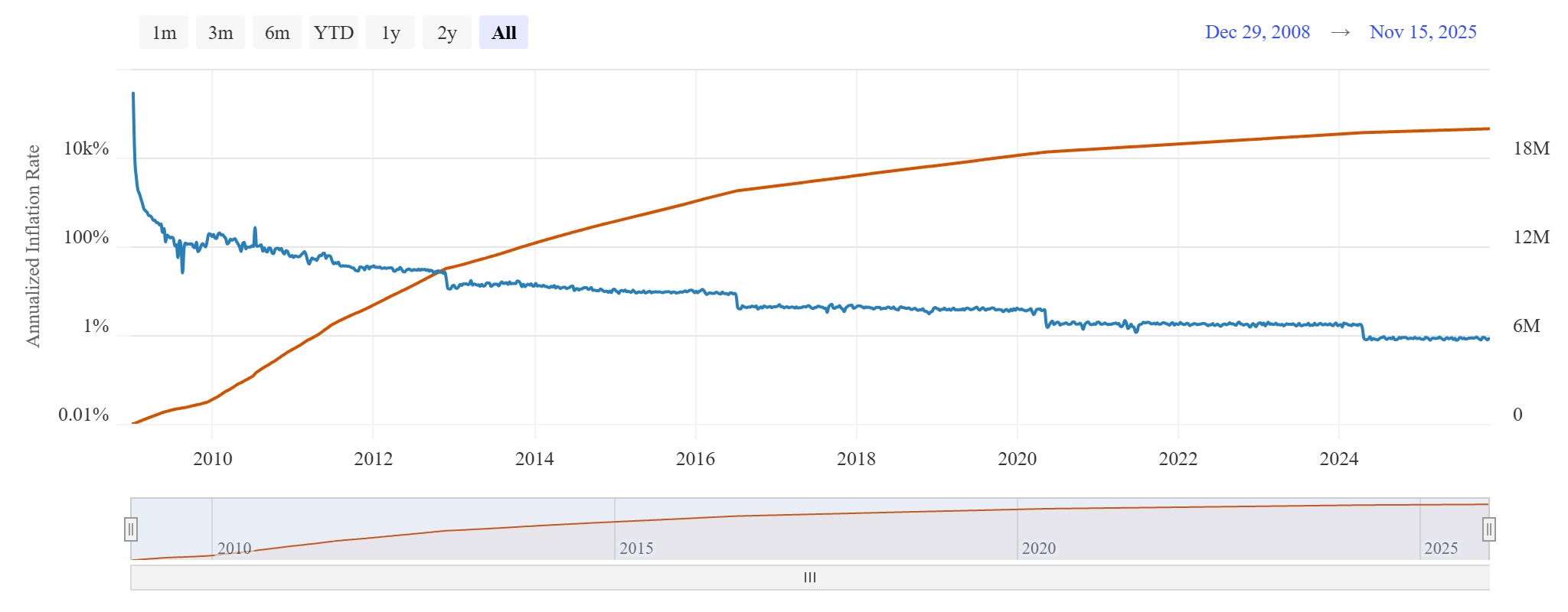
Графики количества созданных монет биткоина (оранжевый) и темпы эмиссии в процентном выражении (синий) на 17 ноября 2025 года с января 2009 года. Источник: Bitcoinvisuals

Несмотря на жестко ограниченную эмиссию биткоина, теоретически существуют механизмы, которые могут увеличить его предложение. К ним относят, например, переименование дробных частей в целые единицы (биткоин делится вплоть до восьмого знака после запятой), а также изменение кодовой базы. Оба подхода непопулярны и вызывают серьезную критику в сообществе и в экспертной среде.

BlackRock допустила изменение конечного числа биткоинов. Как это возможно

Темпы выпуска новых биткоинов продолжают замедляться — это предусмотрено алгоритмом криптовалюты, в котором каждые четыре года происходит так называемый халвинг. Этот механизм вдвое снижает награду в виде новых биткоинов, которую получают майнеры за добавление очередного блока транзакций в блокчейн, тем самым уменьшая скорость появления новых монет в обращении.

Для сравнения: при запуске сети в 2009 году майнеры получали 50 BTC за каждый блок, то есть около 2,6 млн биткоинов в год. После первого халвинга в 2012 году награда сократилась до 25 BTC (примерно 1,3 млн монет в год), в 2016 году — до 12,5 BTC (750 тыс. монет в год), в 2020 году — до 6,25 BTC (325 тыс. монет в год), а в 2024 году — до 3,125 BTC, что соответствует примерно 160 тыс. монет в год.

После следующего халвинга в 2028 году ежегодный прирост предложения составит около 80 тыс. BTC, а еще через четыре года сократится примерно до 40 тыс. монет.

Телеграм-канал «РБК-Крипто» — подпишитесь и будьте в курсе самых главных и актуальных новостей о криптовалюте.

Присоединяйтесь к форуму «РБК-Крипто» в Telegram для обсуждения новостей и тенденций криптомира.

Доходы майнеров, которые получают вознаграждение в биткоинах, со временем снижаются. В долларовом выражении ситуация зависит от курса, но фактически количество получаемой криптовалюты уменьшается. По мере приближения следующего запланированного сокращения эмиссии участники рынка активнее поднимают вопросы устойчивости бизнеса и необходимости адаптации к новым условиям.

В недавнем интервью изданию CoinDesk глава крупнейшей в США майнинговой компании MARA Holdings Фред Тиль заявил, что отрасль в ближайшие годы ждет масштабная трансформация. По его словам, устаревшие и неэффективные бизнес‑модели перестанут быть рентабельными, а выжить смогут лишь компании с доступом к дешевой энергии или те, кто успел диверсифицировать деятельность за пределами майнинга (например, в искусственный интеллект).

Конкуренция усиливается за счет выхода на рынок новых игроков, включая производителей оборудования и компаний с крупным бюджетом вроде Tether. Тиль отметил, что без существенного роста цены биткоина ситуация после халвинга в 2028 году может стать критической.

«Дни сочтены». Глава крупнейшего майнера назвал условия выживания отрасли

Если перевести ориентировочные совокупные доходы майнеров в долларовый эквивалент, то при цене биткоина около $95 тыс. (на середину ноября 2025 года) они составляют примерно $40 млн в сутки. Для сравнения, аналогичные показатели наблюдались в 2021 и 2022 годах, когда курс биткоина находился в диапазоне от $30 тыс. до $60 тыс.

Это указывает на то, что при снижении эмиссии и сохранении текущего числа участников, майнинг может перестать быть экономически целесообразным способом обеспечения работы сети, если курс биткоина не будет расти опережающими темпами.

«Ждем свет в конце туннеля». Что будет с биткоином на неделе

Пошли против рынка. Топ-5 криптовалют с наибольшим ростом за неделю

Биткоин обновил полугодовой минимум. Что будет с курсом дальше

Пов'язані матеріали

Earning Six Figures and Still Struggling to Rent in San Francisco

A couple in San Francisco with a combined tech income over $360,000 struggled for months to find a one-bedroom apartment under $5,000 per month. Their story highlights how the AI wealth boom, driven by upcoming IPOs from companies like OpenAI and Anthropic, is dramatically escalating the city's cost of living. Even six-figure salaries are becoming insufficient for a comfortable lifestyle. The article details the financial reality for tech workers earning around $180,000 annually. After taxes, retirement contributions, and healthcare, take-home pay is roughly $7,000 per month. With average rents exceeding $3,800 and one-bedrooms often costing $4,500-$5,200, discretionary income shrinks to $1,500-$2,500. This contrasts sharply with reported median total compensations of $640,000 at OpenAI and $420,000 at Anthropic. The AI gold rush is identified as the primary driver. The scale of potential wealth from these IPOs, far surpassing previous tech booms, is flooding the housing market. Data shows San Francisco's average rent is now the highest in the U.S., with vacancy rates in desirable neighborhoods plummeting to around 3%. The overall cost of living is 65.6% above the national average. The piece features multiple professionals, including a 25-year-old with a $250,000 salary, facing housing instability, fierce competition for rentals, and a persistent, low-grade financial anxiety despite high earnings. It concludes that the rapid concentration of AI wealth is redefining what constitutes a "high salary" in San Francisco, pushing out mid-tier tech talent and creating a stark divide between those in the AI sector and everyone else.

marsbit59 хв тому

Earning Six Figures and Still Struggling to Rent in San Francisco

marsbit59 хв тому

Rate Hikes to Save STRC, Selling Bitcoin to Preserve Credit: Strategy Picks Its Two Most Expensive Paths

Over the past six weeks, Strategy has faced a significant crisis of confidence, with its core securities MSTR and STRC experiencing sharp price declines. The situation escalated as the company utilized dollar reserves intended for dividends and interest payments to repurchase debt, and then sold a small amount of Bitcoin for the first time since 2022—an action that contradicted its "never sell" narrative and signaled potential liquidity strain. In response, Strategy introduced a Digital Credit capital framework. This formalized a series of measures to manage the pressure down its capital structure: ordinary shareholders have already borne costs through equity dilution from an $11.5 billion ATM offering; new rules enforce a hard dollar reserve covering at least 12 months of expected dividend and interest payments; the STRC dividend rate was increased from 11.5% to 12%; and, most notably, Bitcoin was officially integrated into the capital toolkit, with board authorization to sell up to $1.25 billion worth if needed to support obligations and repurchase programs. The market reacted with a mix of relief and skepticism. While the announcement triggered a sharp single-day rally in both MSTR and STRC, the preferred shares still trade at a significant discount. Supporters view the framework as pragmatic crisis management that provides a price floor and clearer rules. Critics argue that institutionalizing Bitcoin sales undermines the core investment thesis and, with Bitcoin's price below the company's average cost basis, amounts to selling assets at a loss to maintain its financial structure. The broader context shows institutional Bitcoin buying drying up, highlighting that Strategy's challenges and new framework are now a key indicator for overall market risk sentiment. Ultimately, the framework buys time, but STRC's return to par value depends on market belief in the company's ability to cover dividends without further dilution or substantial Bitcoin sales—a task that would be easier if Bitcoin's price recovers.

链捕手1 год тому

Rate Hikes to Save STRC, Selling Bitcoin to Preserve Credit: Strategy Picks Its Two Most Expensive Paths

链捕手1 год тому

Has Bitcoin Bottomed? Unpacking 12 Key Data Indicators

Author: BitalkNews **Title: Has Bitcoin Bottomed? Analyzing 12 Key Data Indicators** The current Bitcoin price is around $59,600, representing a maximum drawdown of approximately 53% from the 2025 high. The market is in a deep correction phase. Multiple indicators suggest valuations are nearing historical lows, but a confirmed bottom requires more time. **Summary of Key Indicators:** 1. **Fear & Greed Index:** At 16, indicating "Extreme Fear," similar to levels seen during the 2022 FTX collapse. 2. **Rainbow Chart:** BTC has fallen into the "Bitcoin is dead" zone, only the second such occurrence historically. 3. **MVRV Ratio:** Currently around 1.13, near the lower historical band, pointing to a bottoming valuation area (approx. $53,200-$53,400). 4. **Realized Price:** The aggregate cost basis is ~$53,400; the current price is only about 12% above it but hasn't broken below yet. 5. **UTXO Profit/Loss Ratio:** Has dropped to its lowest level this cycle, signaling a potential "capitulation" event often seen near cycle bottoms. 6. **Long-Term Holder SOPR:** For holders >155 days, it's at 0.662, now negative, indicating seasoned investors are selling at a loss. 7. & 8. **Miner Health:** ~20% of miners are unprofitable, and actual miner revenue is below theoretical levels, indicating ongoing miner stress. 9. **ETF Flows:** U.S. spot BTC ETFs have seen sustained net outflows, including a 13-day streak with over $1.7B in weekly outflows. 10. **Strategy Risk:** Strategy's stock premium has significantly contracted, pressuring the traditional "borrow-to-buy" model. 11. **Bear Duration & Drawdown:** The correction has lasted >265 days with a ~52.5% drawdown, shorter in depth but lengthy in duration. 12. **Market Expectations (Polymarket):** Betting markets suggest an ~80% probability of BTC falling below $55,000 and a notable chance below $50,000. **Conclusion:** Bitcoin is in a deep correction with potential bottom formation. Valuation metrics are in historically low ranges, and on-chain capitulation signals are accumulating. However, a complete shakeout isn't finished—the realized price hasn't been breached, and ETF demand hasn't reversed. The area below $60,000 holds long-term appeal, but patience is advised. Key signals to watch for include a return to ETF inflows, a recovery in the Long-Term Holder SOPR, and easing miner pressure.

marsbit1 год тому

Has Bitcoin Bottomed? Unpacking 12 Key Data Indicators

marsbit1 год тому

Торгівля

Спот
活动图片