预言机的演化史 ( 一 ):从数据桥到智能信任层

深潮Опубліковано о 2025-11-12Востаннє оновлено о 2025-11-13

预言机既是连接,也是污染;既是突破,也是危机的起点。

撰文:0xhhh

一、引言:信任的盲点

区块链是一场关于信任的革命,但它的信任是封闭的。

它相信数学,却不相信世界。

早期的区块链像一个逻辑主义者:它坚信推理,却拒绝感知。

比特币信任哈希,不信任人;以太坊信任代码,不信任输入。

于是,当一个合约想问出「ETH 的价格是多少?」时,它陷入了沉默。

这不是技术缺陷,而是哲学的边界。

区块链的确定性来自于与外部世界的切割。

信任的源头,是孤立。

但没有连接,就没有意义。

人类构建信任体系的历史,就是不断让「系统」重新看见「现实」的过程。

预言机(Oracle),便是这道裂缝里伸出的第一只手。

它既是连接,也是污染;

既是突破,也是危机的起点。

二、第一阶段:洞穴的裂缝(2015–2018)

背景:封闭智能的孤岛

2015 年,以太坊把「代码即法律」带入世界。

但法律需要证据,而区块链上没有「外部事实」。

一个「基于天气赔付」的合约,无法知道今天是否下雨;

一个「跟踪股价」的合成资产,无法看到 Nasdaq。

智能合约成了柏拉图洞穴中的囚徒,只能凝视链上影子。

区块链的纯净,也成了它的桎梏。

问题:如何「看见」而不被污染

如何让区块链看到外部世界,却不被它污染?

信任外部数据意味着引入主观性、中心化,而区块链的存在目的正是要消除这两者。

于是,「可信输入」成了去中心化信任体系的第一道悖论。

技术演进

  • Oraclize(Provable):通过 TLSNotary 证明数据确实来自特定源头。

  • Town Crier(Cornell):利用 Intel SGX 可信执行环境进行安全数据读取。

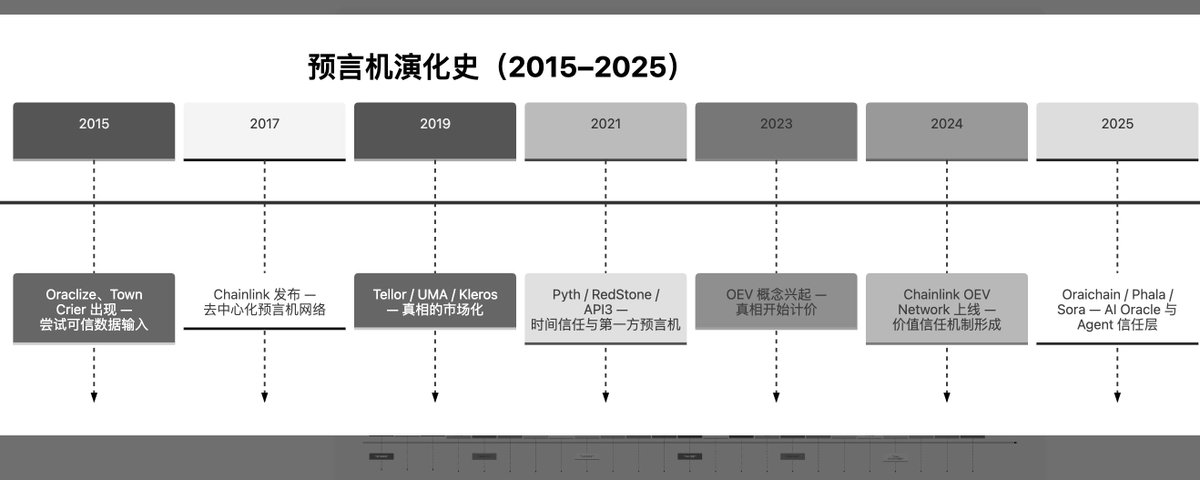
  • Chainlink(2017):提出去中心化预言机网络,节点抵押 LINK、聚合数据、形成加权共识。

信任的第一次呼吸

区块链让信任逻辑化;预言机让信任具象化。

机器第一次学会「相信」,而人类开始用算法定义真理。

三、第二阶段:真相的市场(2019–2021)

背景:DeFi 的信任饥荒

DeFi 的爆发让喂价成为系统生命线。

清算、衍生品、稳定币、合成资产,都依赖外部价格。

但价格操纵一次,就可能掀起连锁反应。

真相,变成可套利的资源。

技术演进

  • Tellor(TRB):以抵押与质疑机制让真相在博弈中产生。

  • UMA(Optimistic Oracle):默认信任,直到被质疑。

  • Kleros(PNK):去中心化陪审团裁决事实争议。

  • Band Protocol / DIA:引入 API 层折中方案,平衡速度与可信度。

信任的博弈时代

Tellor 让真相成为博弈均衡,

UMA 让真相成为默认状态,

Kleros 让真相成为社会契约。

信任不再是名单,而是博弈的结果。

真相第一次被「市场化」。

四、第三阶段:时间的战争(2021–2023)

背景:真相的时延危机

在高频交易和清算的时代,延迟就是风险。

当真相比谎言慢,系统将惩罚真相。

技术演进

  • Pyth Network(PYTH):由交易所直接签名报价,源头即节点。

  • RedStone(RED):按需拉取喂价,执行即验证。

  • API3:第一方预言机,数据源自己签名自己发布。

  • Band Protocol:在 Cosmos 上实现跨链数据层。

当时间成为真理的形状

信任从「正确」转向「及时」。

预言机成为「时间的仲裁者」。

延迟,成为新的信任维度。

🔹 信任开始有价格:OEV 的觉醒(2023–2024)

OEV(Oracle Extractable Value)

—— 真相与时间之间的套利差。

价格更新的瞬间不仅是信息事件,更是价值事件。

真相的传播顺序开始决定财富的分配。

问题不再是「真不真」,而是「谁因真相得利」。

技术与机制演化

  • Chainlink OEV Network(2024):创建 OEV 拍卖市场,让优先更新权可竞价。

  • Pyth / SEDA:通过时间戳签名与随机委员会抑制内部套利。

  • RedStone Pull 模式:天然消除时间差,不留套利窗口。

真相开始计价

OEV 让信任有了经济重量。

过去我们讨论「谁在说真话」,

现在要讨论「谁因真话获利」。

信任从事实验证扩展到价值治理。

五、第四阶段:智能与隐私的碰撞(2023–2025)

背景:AI 进入信任体系

AI 模型能判断市场、分析新闻,但它的「真伪」不可验证。

当机器开始判断真相,我们该如何判断机器?

技术演进

  • Oraichain(ORAI):可验证 AI 推理(Proof of Execution)。

  • Phala / iExec:用 TEE 可信硬件生成远程证明。

  • SEDA / Supra / Entangle:融合 AI 验证与跨链同步。

理智的验证

当我们要求机器证明自己的理智,

Oracle 从「验证世界」变成「验证智能」。

信任扩展到判断层。

六、第五阶段:Agent 时代的信任重建(2025 →)

背景:AI Agent 崛起

AI Agents 已具备经济行为能力。

它们签合约、谈合作、执行交易。

但算法没有道德,只有输入。

当智能体互相交易,谁保证它们看到的是同一个世界?

技术演进

  • Sora Oracle(SORA):AI Oracle + 支付协议 + 预测市场,形成认知自校体系。

  • Flux / OptionRoom:嵌入预测市场进行事实验证。

  • Orochi Network:构建机器身份体系,使判断可溯源。

信任的再造

当智能体成为社会主体,

人类从「信任承担者」变成「信任设计者」。

机器之间的信任,不是情感,而是协议。

Oracle 从数据接口,蜕变为文明结构。

七、尾声:从数据桥到智能信任层

十年演化,Oracle 的每次升级

都源自一次信任危机,也开拓了新的边界。
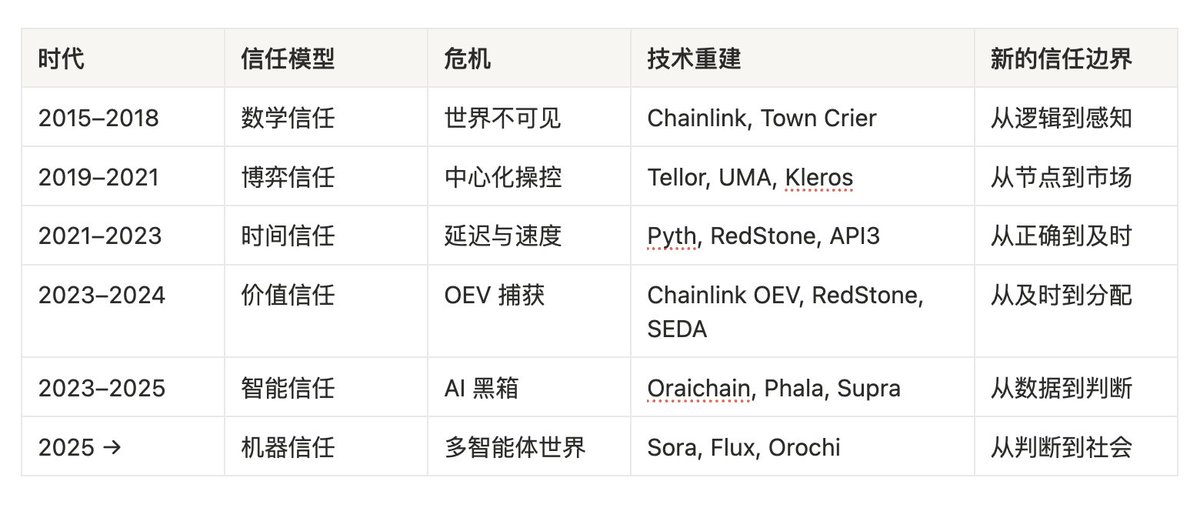
区块链让信任可计算;Oracle 让现实可计算;AI Oracle,让智能可计算。

Oracle 不再只是桥梁,

而是智能文明的信任层。

写在最后

如果区块链是文明的记忆层,Oracle 就是文明的感官层。

我们正在教机器一件前所未有的事:

如何诚实地感知。

当智能社会真正到来,Oracle 将不只是传递数据,而是传递真理的形式。

Пов'язані матеріали

Claude Accused of Becoming Dumber by the Entire Internet, Anthropic Steps In to Reveal: It’s Not the Model That’s Tricking You

When users complained that Claude was "getting dumber," the root cause wasn't the AI model itself. In an official blog post, Anthropic clarified the critical difference between two key settings in Claude Code: Model and Effort. Model refers to the core "brain"—the fixed, trained weights of a specific AI (like Sonnet, Opus, or Fable). Changing the Model addresses *capability* ("can it do this?"), but its knowledge is static post-training. Effort, however, controls the AI's *approach and thoroughness* for a specific task. A higher Effort level instructs Claude to read more files, run tests, perform verification, and complete multi-step reasoning before responding, significantly increasing its "work output" for that job. Conversely, low Effort leads to quicker, less thorough replies. This distinction explains the March 2024 uproar where users experienced a sudden drop in Claude's performance. The cause was not a model change but Anthropic quietly lowering the *default* Effort setting from "high" to "medium" to reduce latency, which was later reverted. The key insight is that a smaller, capable model (like Sonnet) on high Effort can often outperform a larger, more powerful model (like Opus) on low Effort for many tasks. The article provides a practical troubleshooting framework: if Claude makes an error, first check the context and instructions. If it seems to skip necessary steps or validations, increase Effort. If it diligently attempts the task but fails conceptually or makes consistent factual errors despite good context, then consider switching to a more capable Model. The takeaway is a shift in focus: effective AI programming is less about always choosing the "strongest" model and more about intelligently *orchestrating* models and effort levels—acting like a project manager to assign the right "brain" with the right level of diligence for each job, optimizing both results and cost.

marsbit1 год тому

Claude Accused of Becoming Dumber by the Entire Internet, Anthropic Steps In to Reveal: It’s Not the Model That’s Tricking You

marsbit1 год тому

Will the Ethereum Foundation Evolve into a 'Mascot'? Diversified Organizations Are Fragmenting Its Functions

The Ethereum Foundation (EF) is undergoing significant internal turmoil and functional erosion. Following its largest-ever layoff of 54 staff (20% of its workforce) and a major organizational restructuring announced in June, its Protocol Support Team has been officially dissolved. This comes alongside the high-profile resignation of key figures like co-executive director Xiaowei Wang, bringing senior departures this year to at least eight. Criticism of EF's rigid structure, opaque decision-making, and perceived lack of a clear value narrative for ETH has intensified within the community. The layoffs have catalyzed the emergence of independent, non-profit organizations like Ethlabs and Ethereum Institutional, founded by former EF researchers and members. These entities are now taking on core functions such as protocol research/development and institutional adoption, effectively fragmenting the EF's traditional leadership role. Concurrently, EF's security team is adapting to technological change, deploying specialized AI agents to audit Ethereum's codebase, which successfully discovered a critical vulnerability (CVE-2026-34219). While EF states AI complements rather than replaces researchers, it signals a potential future shift in its operational model. Faced with these challenges—internal restructuring, talent drain, the rise of competing organizations, and AI integration—the Ethereum Foundation appears to be stepping back from a central commanding role. Analysts and community observers speculate it may increasingly transition towards a symbolic "ecosystem mascot" function, while decentralized initiatives drive Ethereum's future growth and institutional adoption.

marsbit1 год тому

Will the Ethereum Foundation Evolve into a 'Mascot'? Diversified Organizations Are Fragmenting Its Functions

marsbit1 год тому

Nearly a Hundred Players Rush into Embodied Data: With 4.47 Billion Yuan in Financing in One Year, Who Can Really Make Money by 'Selling Data'?

The domestic embodied AI data industry has attracted nearly 100 players, with 70 focused on data collection and 27 on data infrastructure. In the past year, 15 independent embodied data service providers raised approximately 4.47 billion yuan. Despite this growth, the sector remains early-stage, fragmented, and faces significant challenges. Data collection methods are diverse, categorized into four main routes: teleoperation of real robots, human demonstration without a robot (using motion capture, exoskeletons, etc.), simulation synthesis, and distillation from internet videos. Most companies (43%) adopt hybrid approaches, combining multiple routes, as no single method can meet all training needs. Teleoperation alone is pursued by 31% of players, often by state-owned platforms and robot companies, while newer firms favor asset-light, no-hardware human demonstration. Independent data service providers now form the largest player group (40%), indicating the emergence of a distinct industry segment rather than just a subsidiary function for robot makers. Two-thirds of all players are "embodied-native" startups, while one-third are companies that pivoted from fields like AI data annotation, which are more prevalent in the data infrastructure layer. Current annual industry capacity is estimated at 1.6-1.8 million hours plus 70-80 million data points, with a short-term goal to increase this 15-20 fold within 1-3 years. Data collection factories are spread across 20 provinces in China, concentrated in the Yangtze River Delta, Beijing-Tianjin-Hebei, and Pearl River Delta regions. Financially, the 4.47 billion yuan raised in the past year pales compared to the 43.8 billion yuan raised by the broader embodied intelligence sector in just the first half of 2026, highlighting that data remains a less "sexy" bet for investors. The 15 funded independent providers show clear stratification: a top tier led by a unicorn (Lightwheel Intelligence, 3.1 billion yuan), a middle tier of 11 firms raising tens to hundreds of millions, and an early-stage tier of 3 companies. Sixty-nine investment institutions have participated, but none have made concentrated bets, reflecting uncertainty about viable business models. Over half of these funded companies are less than a year old, most are at pre-A or A rounds, and profitability remains largely unproven. In summary, the embodied data industry has become an independent track creating jobs and local economic activity. However, it is still nascent, with unformed consensus, unsolved problems, and unproven business models. The coming 1-2 years will be a critical validation window to see if companies can build sustainable, profitable businesses purely by "selling data."

marsbit4 год тому

Nearly a Hundred Players Rush into Embodied Data: With 4.47 Billion Yuan in Financing in One Year, Who Can Really Make Money by 'Selling Data'?

marsbit4 год тому

Торгівля

Спот
活动图片