Nasdaq CEO Shows 3 Ways Blockchain Could Change Finance Forever: Best Wallet Token Amps Up

bitcoinistОпубліковано о 2025-11-05Востаннє оновлено о 2025-11-05

Анотація

Quick Facts: ➡️ Nasdaq’s CEO says blockchain can fix settlement and market plumbing. Wallets become the access layer for that...

Trusted Editorial content, reviewed by leading industry experts and seasoned editors. Ad Disclosure

Quick Facts:

  • ➡️ Nasdaq’s CEO says blockchain can fix settlement and market plumbing. Wallets become the access layer for that shift and need strong security and UX.
  • ➡️ Best Wallet uses Fireblocks MPC-CMP, supports multiple chains, and bundles a DEX aggregator, staking, and presale access to turn a wallet into a full crypto hub.
  • ➡️ $BEST presale shows momentum with a live price of $0.025895 and more than $16.8M raised. Tokens are payable via crypto or card with token claims post presale.
  • ➡️ Staking runs during the presale with dynamic rewards from an 8% pool, aiming to reward longer-term holders rather than short-term speculation.

Nasdaq chief Adena Friedman recently outlined three ways blockchain could upgrade global finance. Her message focused on how distributed ledgers can improve post-trade settlement, support tokenized assets, and streamline market infrastructure.

During her conversation with Ripple’s Monica Long, Friedman’s takeaway was simple. Capital markets are moving toward on-chain rails that need secure user access and intuitive wallets to reach scale.

Mobile crypto wallets sit at the top of that stack. They are the gateway to tokenized securities, DeFi liquidity, and on-chain payments. If exchanges and brokers bring issuance and settlement on chain, consumers will need mobile wallets that are both secure and easy to use.

That is why wallet UX and security architecture are fast becoming competitive moats.

Best Wallet Token ($BEST) is positioned for this shift with a mobile-first, non-custodial wallet that integrates Fireblocks MPC-CMP security, a decentralized exchange (DEX) aggregator, and a presale portal for trusted launches. The native $BEST token underpins reduced fees, staking, and governance.

As regulated markets lean into tokenization, the best crypto wallets will be those that combine enterprise-grade security with simple cross-chain action.

And Best Wallet is designed to capture the growing market with tangible holder perks, live staking during presale, and a product roadmap that expands utility beyond storage into swaps, cards, and curated presale access.

Best Wallet Token ($BEST) — Mobile First MPC Wallet With Perks

Best Wallet is a non-custodial, multi-chain wallet built around Fireblocks MPC-CMP technology. MPC removes single points of failure by splitting keys across secure computation, while the app layers biometric login and a mobile-native UX.

The wallet supports cross-chain swaps through an integrated DEX aggregator, which provides access to all major blockchains. Read our Best Wallet review for more on this game-changing crypto app.
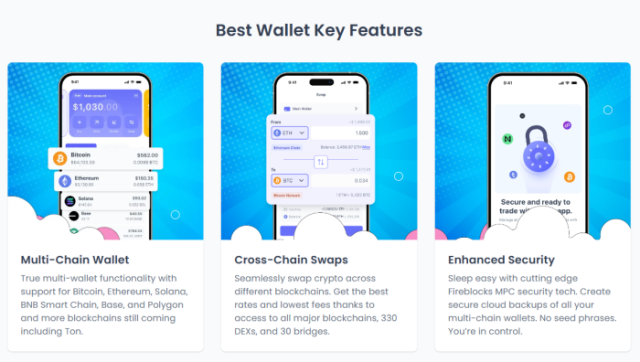
Best Wallet’s key features.

The wallet’s native token, $BEST, is now on presale with a visible raise and price tracker. At the current stage shown on the sale page, $BEST is priced at $0.025895 with more than $16.8M collected. Buyers can use $ETH, $BNB, $USDT, $USDC, or a card, and claiming will be available at the end of the presale window.

🛒 Learn how to buy $BEST here.

Utility is the core pitch rather than hype. Holding $BEST reduces fees inside the Best Wallet ecosystem, grants early access to curated presales via the ‘Upcoming Tokens’ portal, and provides governance decision rights, including what new chains and features to add to the ecosystem.

A staking pool is already available during the sale. Rewards are dynamic and funded from an 8% allocation of the total supply, which aligns incentives with long-term usage rather than short airdrops.

Token design details are straightforward. The total supply is 10B $BEST and the whitepaper outlines allocations for development, marketing, airdrops, staking rewards, exchange liquidity, community rewards, and treasury.

The contract is an ERC-20 on Ethereum and has been audited by Coinsult.

The product suite goes beyond a wallet. Over 330 DEXs and 30 bridges are embedded for same-chain and cross-chain swaps. A Best Card is also in development to enable spending $BTC, $ETH, and other major cryptos, with cashback for $BEST token holders.

The roadmap also includes a browser extension, portfolio tools, an NFT gallery, market analytics, and trading features like limit orders and DCA. The approach is to turn the wallet into a daily driver while keeping custody with the user.

For presale participants, two factors stand out. First is the ‘earn while you wait’ design. That’s because staking during presale lets early users compound exposure rather than sitting idle.

Second is the demand signal. Our $BEST price prediction suggests that the token could reach $0.62 by 2026, marking a 2,290% gain, if demand for secure wallets keeps pace with crypto adoption rates.

A multi-million-dollar raise at this early stage demonstrates traction for a wallet narrative that benefits from traditional finance’s shift toward crypto. That is the same structural change Nasdaq’s leadership is signaling.

Secure $BEST now. The presale ends November 28.

This is informational content only, not financial advice. Do your own research and consider risks. Crypto assets can lose value quickly.

Authored by Bogdan Patru, Bitcoinist: https://bitcoinist.com/best-wallet-token-presale-mpc-security-staking-benefits-best

Editorial Process for bitcoinist is centered on delivering thoroughly researched, accurate, and unbiased content. We uphold strict sourcing standards, and each page undergoes diligent review by our team of top technology experts and seasoned editors. This process ensures the integrity, relevance, and value of our content for our readers.

As a crypto writer, Bogdan’s responsibilities are split between researching and writing articles and entertaining the team with his humor bordering on the politically incorrect, an aspiring Bill Burr, if you will. Thanks to his 12+ years of writing experience in just as many fields, including tech, cybersecurity, modelling, fitness, crypto, and other topics-that-shall-not-be-named, he's become a genuine asset to the team. While his position as a senior writer at PrivacyAffairs thought him valuable lessons about the power of self-management, his entire writing career was and is an exercise in self-improvement. Now, he's ready to sink his teeth into crypto and teach people how to take control of their own money on the blockchain. With fiat as an eternally devaluing currency, Bitcoin and altcoins seem like the best-fitting alternative for Bogdan. Bogdan’s biggest professional accomplishment, aside from securing a position as a main writer for Bitcoinist, was his 5-year run as a writing manager at Blackwood Productions, where he coordinated a team of four writers. During that time, he learned the value of teamwork and that of creating a working environment that breeds efficiency, positivity, and friendship.

Пов'язані матеріали

Farewell to Crash-Style Plunges: An In-Depth Review of the Crypto Lending and Futures Markets in Q2 2026

This report analyzes the Q2 2026 crypto lending and derivatives market, highlighting a continuation of controlled deleveraging. Unlike the 2022 crash, where loan volumes plummeted 55% in a single quarter, the current downturn is characterized by a gradual, stepwise decline across CeFi, DeFi, and crypto-collateralized CDP stablecoins, with Q2 seeing a total reduction of $113.3 billion (-16.78%) to $561.6 billion. DeFi lending saw the sharpest quarterly drop (-27.61%), while CeFi borrowing declined more moderately (-9.62%). For the first time since Q3 2023, CeFi outstanding loans surpassed DeFi. Corporate digital asset treasury (DAT) debt also decreased by $15 billion, largely due to a debt buyback by Strategy Inc. Futures open interest (OI) saw a modest 3.08% quarterly decline to $1032 billion, with notable divergence: Bitcoin OI fell 6.24%, while Ethereum OI dropped 26.31%. Both rebounded in July. A deep dive into Aave V3 revealed high leverage, particularly within "e-mode" loans, which are heavily concentrated on Ethereum staking/restaking tokens, with debt-weighted health factors near liquidation thresholds. The report concludes that the market is undergoing a healthier, managed deleveraging cycle driven by voluntary risk reduction rather than forced liquidations or counterparty failures, suggesting increased resilience against a repeat of the 2022 cascade. Early Q3 2026 data indicates potential stabilization in futures OI and DeFi lending volumes.

marsbit10 хв тому

Farewell to Crash-Style Plunges: An In-Depth Review of the Crypto Lending and Futures Markets in Q2 2026

marsbit10 хв тому

Crypto Funding Halves in Q1, Why Is Stablecoin Payment Still Attracting Money Against the Trend?

Crypto venture capital funding fell roughly 50% quarter-over-quarter in Q1 2026, yet the stablecoin payments sector was a notable exception, continuing to secure significant funding rounds. This shift signals that capital is moving away from speculative "token narratives" toward companies generating real revenue, as stablecoins evolve from a trading tool into payment infrastructure. Despite the overall funding slowdown, companies like Rain, OpenFX, and RedotPay completed major raises, focusing on areas such as card issuance, cross-border payments, and banking connectivity. Investors are attracted to the sector's potential to address long-standing inefficiencies in traditional cross-border payments through 24/7 settlement and clearer revenue models like transaction fees and FX spreads. However, the momentum may be overstated. On-chain stablecoin transaction volume does not equate to real-world payments for goods and services, and funding is concentrated in a few leading firms with reported volumes and customers. Key challenges remain, including compliance, fiat on/off-ramps, local banking relationships, and the risk of core services becoming commoditized. Looking ahead, capital is likely to flow into areas like cross-border B2B payments, bank-to-stablecoin connectivity, stablecoin-linked cards, multi-chain payment orchestration, and payments for AI agents. Ultimately, the investor interest reflects a bet on the necessary infrastructure to integrate stablecoins into the traditional financial system, with future valuations hinging on demonstrable payment volume, real revenue, and profitable market expansion.

marsbit46 хв тому

Crypto Funding Halves in Q1, Why Is Stablecoin Payment Still Attracting Money Against the Trend?

marsbit46 хв тому

South Korean Retail Investors 'Move from Seoul to Wall Street': Buying SK Hynix ADR, Betting on Triple-Leverage ETF

A surge of Korean retail investors is shifting funds from the volatile Seoul market to Wall Street, intensifying their bets on the AI theme through unconventional and high-risk instruments. Data shows Korean investors were net buyers of about $4.5 billion in US stocks in July, nearing a yearly peak. A notable trend is their purchase of approximately $840 million worth of SK Hynix American Depositary Receipts (ADRs), despite a significant 10% premium over the company's domestic shares, leading analysts to label the move as speculative and irrational. Simultaneously, Korean traders are heavily favoring leveraged ETFs. The triple-leveraged semiconductor ETF SOXL was the most-bought US product in July, with leveraged products occupying four of the top ten spots. Experts note that this shift in geography does not represent a diversification of risk; instead, investors are merely expressing the same concentrated bet on AI hardware through different, often riskier, US-listed vehicles. Analysts warn that while this capital inflow is unlikely to systemically impact the vast US institutional market, it risks creating localized distortions and amplifying volatility, particularly in the targeted sectors and instruments. The move follows a sharp correction in the Korean market, where high leverage in semiconductor stocks and related ETFs had previously led to significant losses, prompting this search for alternative avenues to chase the AI narrative.

marsbit1 год тому

South Korean Retail Investors 'Move from Seoul to Wall Street': Buying SK Hynix ADR, Betting on Triple-Leverage ETF

marsbit1 год тому

Bithumb's First Half Report: Net Loss Exceeds $76 Million, Where Did the Profits Go?

**Title: Bithumb H1 2026 Report: Net Loss Exceeds $76M – Where Did the Profits Go?** Despite a headline net loss of approximately 108.7 billion KRW (~$76.44 million) for the first half of 2026, a detailed breakdown reveals Bithumb's core exchange business remained profitable. The significant loss was primarily driven by two major non-operating items: substantial losses on the disposal and valuation of the company's own cryptocurrency holdings (net loss ~$48.21 million) and a sharp increase in litigation provisions (~$25.93 million), largely linked to a regulatory fine. Operating revenue fell 48.7% year-on-year to ~$119 million, almost entirely from transaction fees, as market activity cooled. While the company drastically cut marketing and subsidy expenses by ~70% to protect margins, more rigid costs like payment processing and salaries declined only modestly. This highlights the vulnerability of its highly fee-dependent revenue model in a down market. Total assets decreased by ~$584 million, but this was largely attributable to an ~86% drop in client KRW deposits. The market value of client crypto assets under custody also fell (~32.7%), partly influenced by declining cryptocurrency prices rather than solely client withdrawals. In summary, the report indicates underlying exchange profitability was eroded by significant crypto asset losses and mounting regulatory/legal costs, against a backdrop of declining trading revenue. Future focus should be on revenue recovery, managing crypto-related损益, and the ongoing impact of regulatory challenges.

marsbit2 год тому

Bithumb's First Half Report: Net Loss Exceeds $76 Million, Where Did the Profits Go?

marsbit2 год тому

Торгівля

Спот
活动图片