Что покупают криптокиты после снижения ставок ФРС

cryptonews.ruОпубліковано о 2025-12-29Востаннє оновлено о 2025-12-29

Снижение ставки ФРС США на 25 базисных пунктов не вызвало всплеска на крипторынке. Биткоин и Ethereum остались в минусе, а общая рыночная капитализация снизилась на 1,6%. Это показало, что решение уже было заложено в котировках. Тем не менее после заседания ФРС многие аналитики обсуждают, что именно сейчас скупают крупные инвесторы — и куда текут «умные деньги».

Новые данные указывают на три актива, где активность китов заметно возросла после изменения денежно-кредитной политики. Все они демонстрируют признаки укрепления уверенности игроков накануне ноября.


Cardano (ADA)

Инвесторы, держащие от 1 до 10 млн ADA, с вчерашнего дня начали увеличивать свои позиции: общий объем их холдингов вырос с 5,57 до 5,59 млрд ADA. Это около 20 млн токенов на сумму 12,8 млн долларов по текущей цене $0,64.

Часто именно эта группа «средних китов» начинает покупать первой, когда крупные адреса ещё наблюдают за ситуацией. За последний месяц ADA подешевел примерно на 20%, однако свежая активность указывает на возможный разворот.
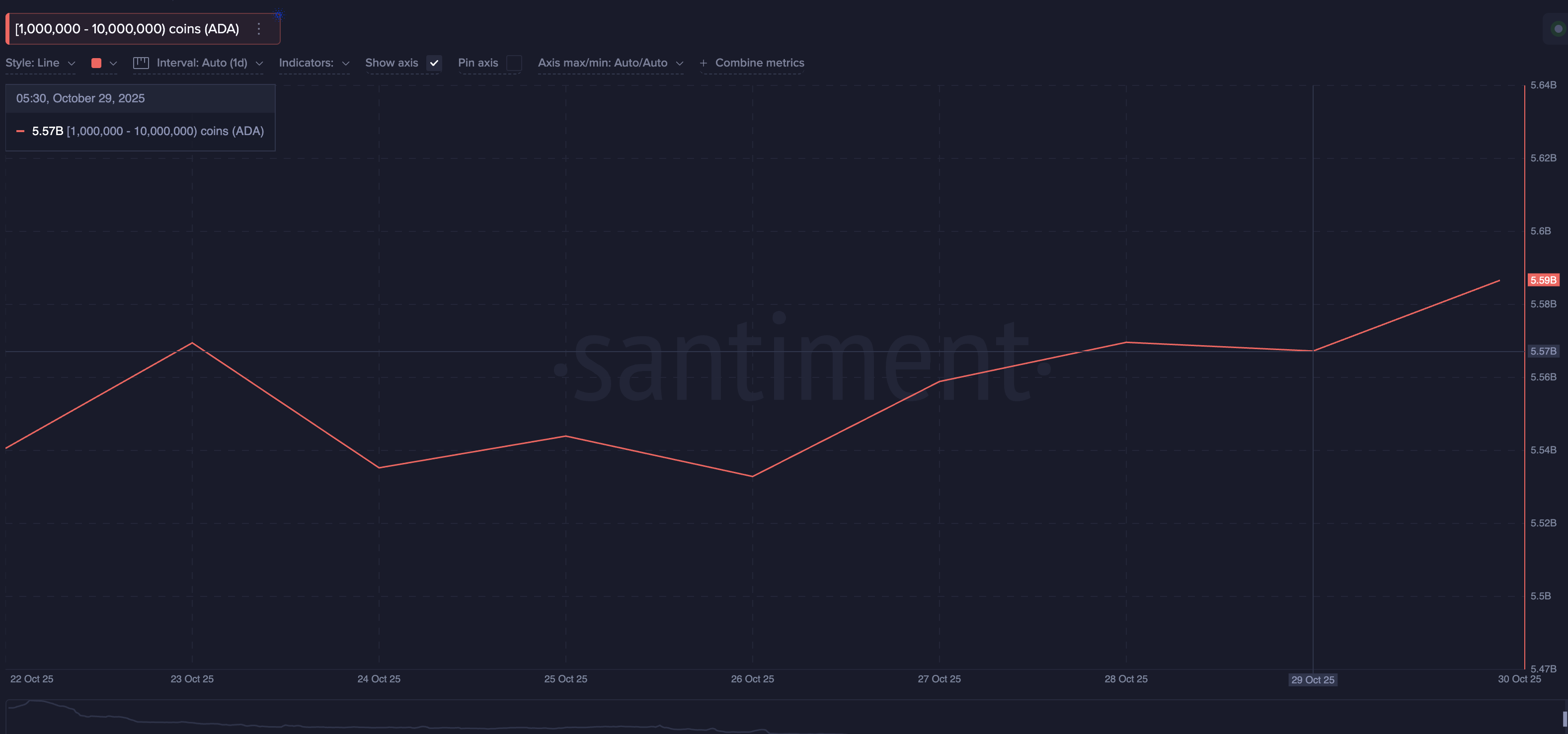
Smaller ADA Whales Accumulating
Мелкие киты ADA накапливают: Santiment

На 12-часовом графике ADA движется в пределах симметричного треугольника. Это означает консолидацию и неопределенность перед потенциальным пробоем. Монета удерживает поддержку $0,64, а выход выше $0,66 может отправить цену к $0,68 — прирост около 6,5%.

Если импульс сохранится, ближайшее сопротивление расположено у $0,73. По данным индикатора Wyckoff Volume Chart, который отслеживает баланс между покупателями и продавцами, давление со стороны продавцов снизилось с 29 октября. Аналогичная ситуация с 22 по 23 октября уже приводила к росту цены почти на 9,4%.
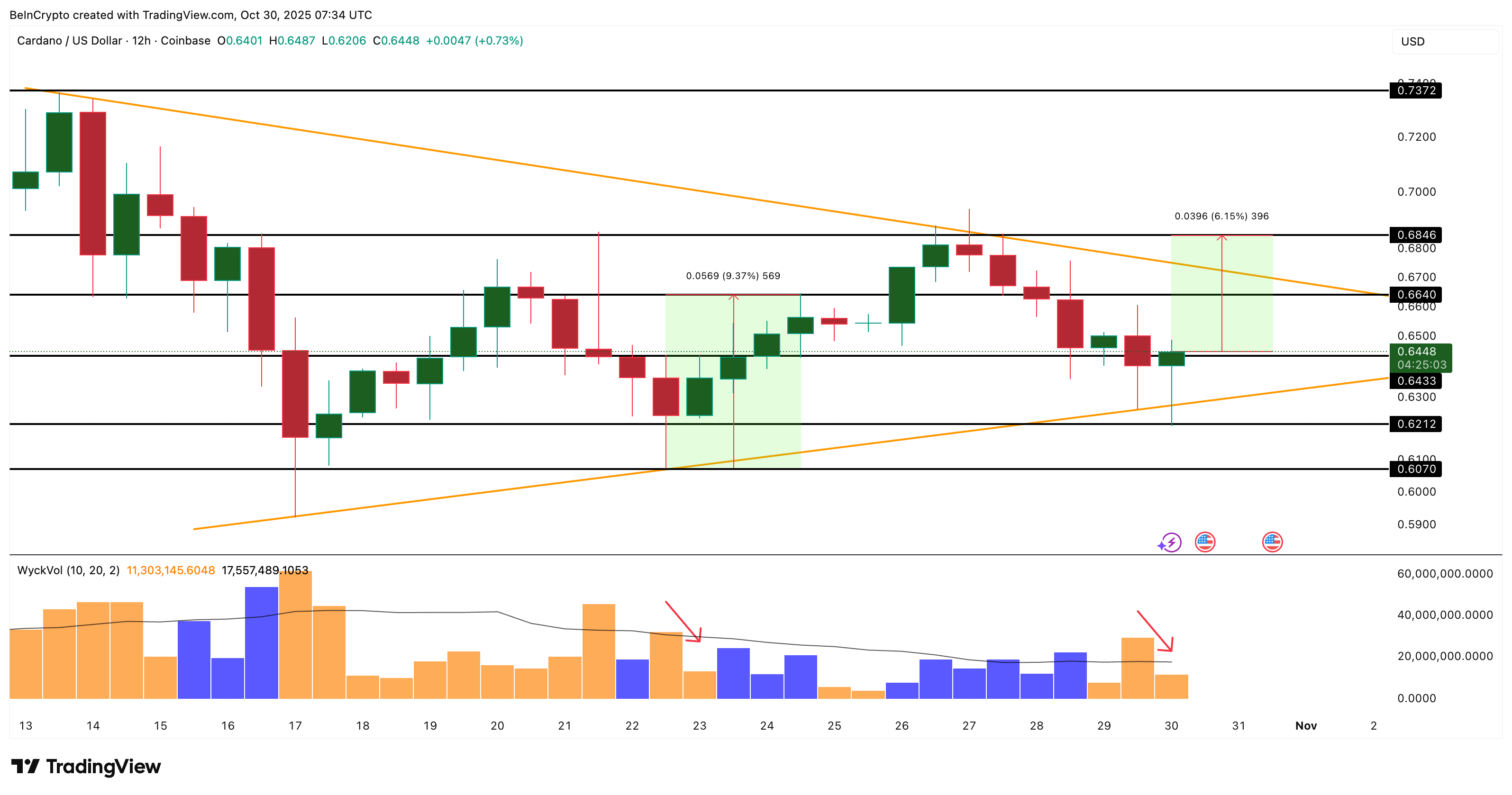
ADA Price Analysis
Анализ цены ADA: TradingView

Киты, возможно, рассчитывают на повторение сценария, и это один из наиболее наглядных примеров покупок криптокитами после ожидаемого снижения ставки ФРС. Однако потеря уровня $0,64 способна увести ADA ниже, к $0,62 и даже $0,60. В этом случае оптимизм китов окажется неоправданным.

Ethena (ENA)

Помимо Cardano, заметная активность наблюдается и среди держателей Ethena. Крупная группа инвесторов с балансом от 100 млн до 1 млрд ENA увеличила свои запасы: объём вырос с 6,79 до 6,9 млрд токенов — прирост на 110 млн ENA (около 46,2 млн долларов).
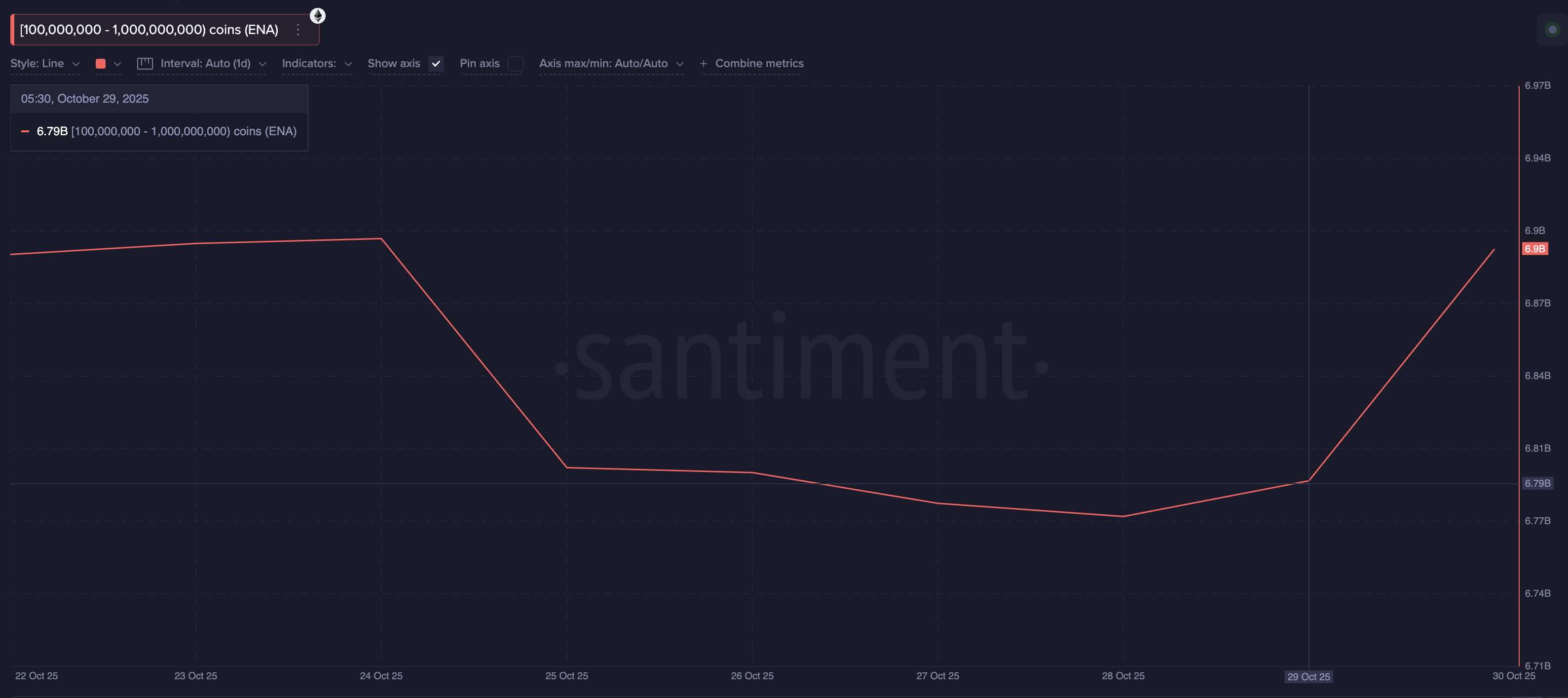
ENA Whales
Киты ENA: Santiment

Такое накопление происходит после падения цены ENA на 21% за месяц, что повторяет динамику ADA. Однако покупки сигнализируют, что киты ждут разворота вверх.

На 12-часовом графике ENA формирует фигуру «расширяющийся нисходящий клин» — обычно это бычий сигнал, предвещающий возможный пробой вверх. 27 октября токен уже пытался выйти из фигуры, но не смог из-за скрытой медвежьей дивергенции — когда цена формирует более низкий максимум, а индекс RSI показывает более высокий. Это означало краткосрочное усиление продавцов.

Сейчас ENA отскочил от поддержки $0,41. Если этот уровень удержится, ближайшие цели находятся на $0,45 и $0,53. Прорыв выше $0,49 — верхней границы клина — подтвердит разворот тренда и откроет дорогу к $0,65.
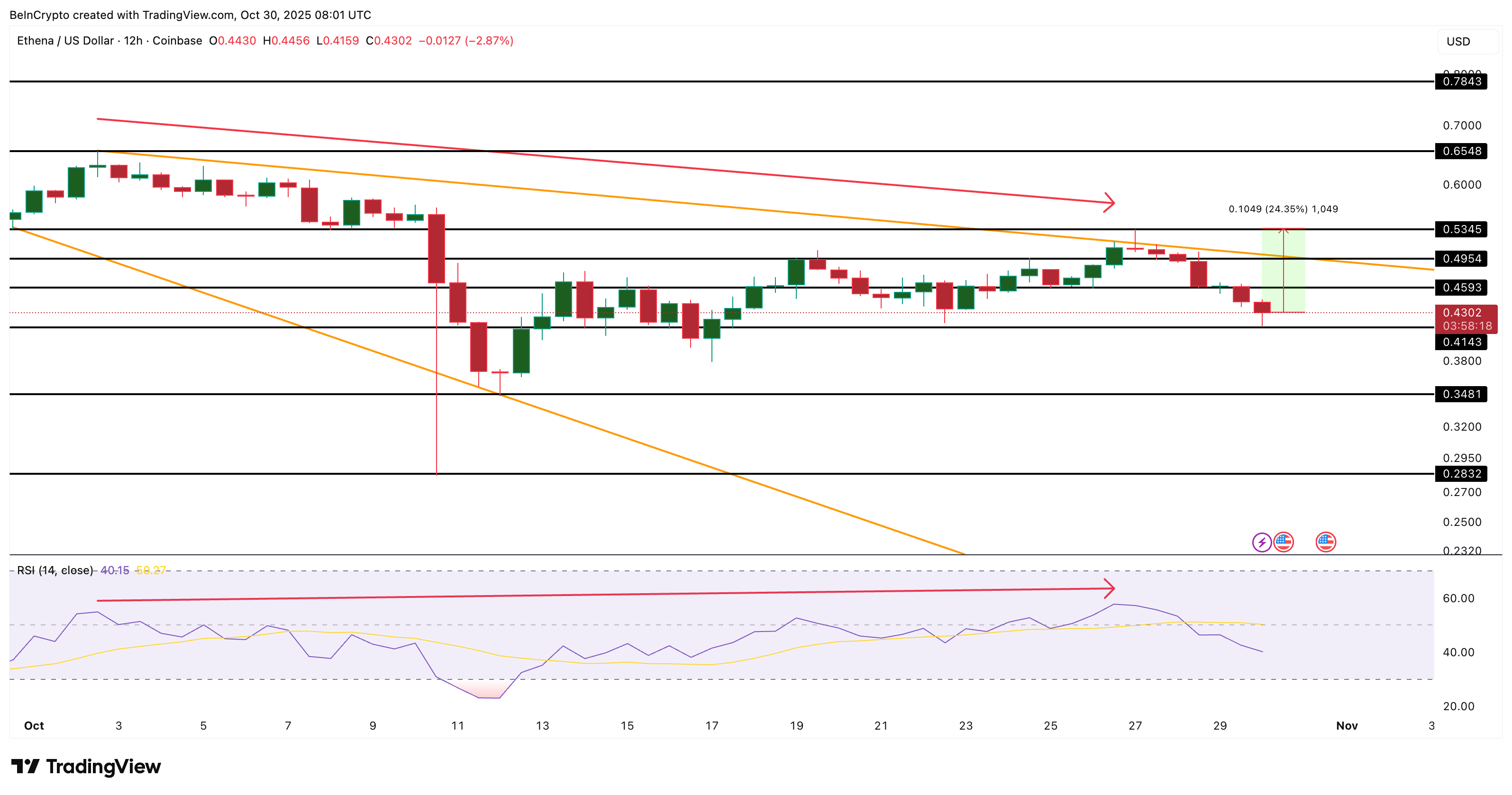
ENA Price Analysis
Анализ цены ENA: TradingView

ТRSI и цена снова движутся синхронно, что устраняет прежнюю дивергенцию. Если тенденция сохранится и $0,41 устоит, прогноз китов может оправдаться — ENA готов к восстановлению с пост-FOMC минимумов. В противном случае, при пробое этого уровня, высока вероятность падения до $0,34 и даже $0,28.

Aster (ASTER)

Третий токен, попавший в фокус внимания инвесторов после снижения ставки ФРС, — Aster, децентрализованная платформа бессрочных контрактов.

За последние 24 часа крупные держатели нарастили позиции на 26,4%, увеличив общий объем до 15,67 млн ASTER. Это плюс 3,27 млн токенов на сумму около 3,33 млн долларов. Такой рост интереса демонстрирует уверенность крупных игроков, делая ASTER одним из явных фаворитов среди покупок китов после решения ФРС.
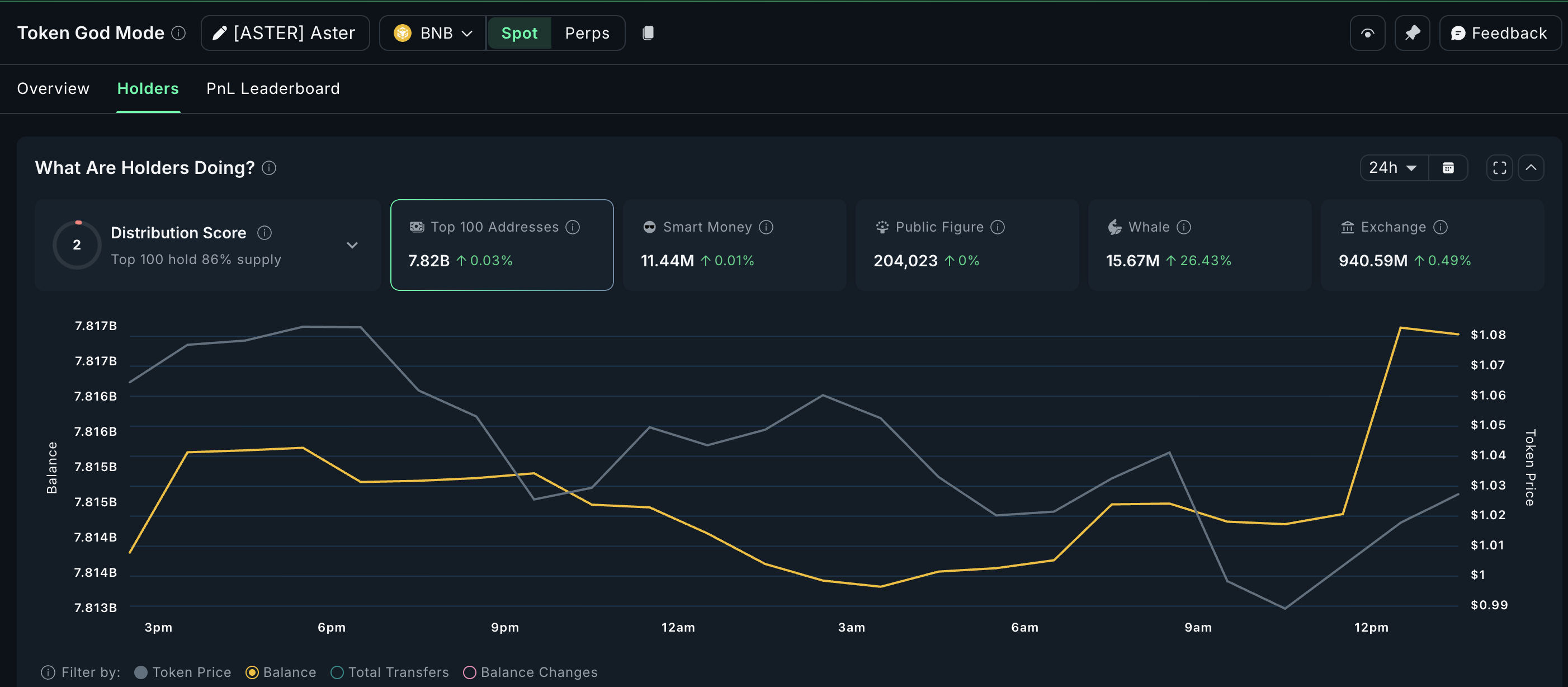
Aster Whales In Action
Киты Aster в действии: Nansen

За прошлый месяц токен потерял 43,2% стоимости, что подтверждает устойчивое снижение. Однако графики показывают, что тренд может близиться к развороту.

На 12-часовом таймфрейме ASTER также движется в нисходящем расширяющемся клине — типичной бычьей фигуре. Поддержка $0,93 остается ключевой зоной. Если цена удержится выше, ближайшие цели — $1,12 и $1,28. Уверенный пробой выше $1,79 подтвердит глобальный разворот тренда.

Между 10 и 29 октября цена формировала более низкие минимумы, в то время как RSI показал более высокие. Это бычья дивергенция, часто указывающая на начало восстановления. В сочетании с растущими покупками китов это усиливает сигнал, что спрос возвращается.
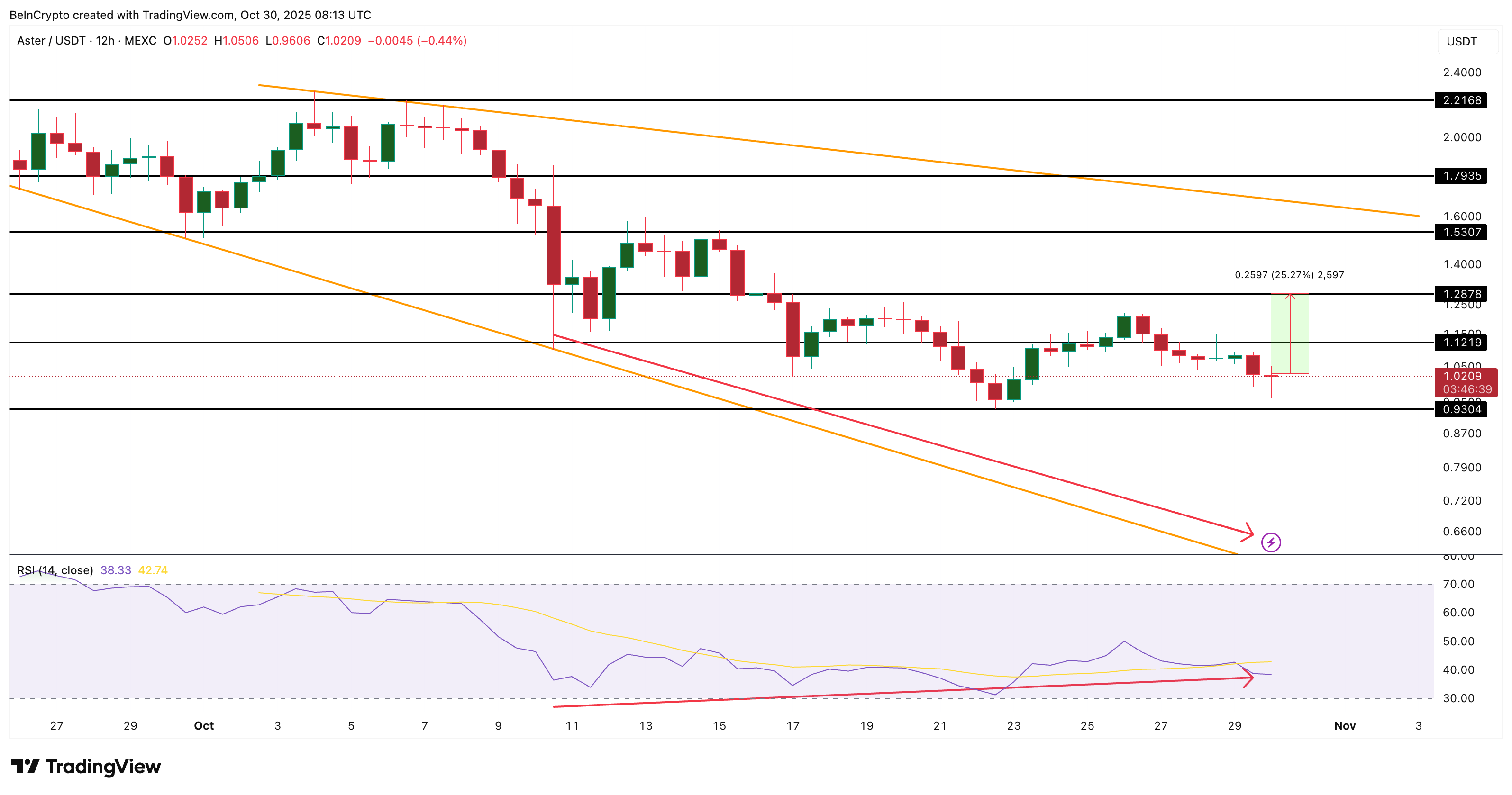
ASTER Price Analysis
Анализ цены ASTER: TradingView

Если текущие уровни останутся в силе, ASTER может начать фазу устойчивого роста. В противном случае потеря поддержки $0,93 приведет к обновлению минимумов и аннулирует краткосрочные бычьи ожидания.

Пов'язані матеріали

NVIDIA CPU Advances, China's RISC-V Responds: Semiconductor Deep Dive - Part Four

NVIDIA is set to launch its new Vera AI data center CPU in China as early as August, with high pricing. While this move offers a new option, it highlights China's continued dependence on foreign-controlled Arm architecture. In response, the Chinese semiconductor industry is increasingly turning to RISC-V as a strategic alternative for achieving high-performance computing autonomy. The article explores the concept of the "impossible triangle" in CPU development—balancing prosperity, control, and autonomy—and posits that RISC-V's open-source, modular nature offers a unique path to achieving all three. While RISC-V is already dominant in embedded systems, the focus is now shifting to data centers and AI workloads. China has become a global hotspot for RISC-V development, driven by AI-driven compute demand, supply chain concerns from export controls, cost benefits of open-source, and strong policy support. Multiple Chinese companies have reportedly crossed the key performance threshold of 15 SPECint per GHz, a benchmark for entering the high-performance CPU club. Progress extends beyond single-core benchmarks. Companies are developing complete computing subsystems, including commercial-grade coherent network-on-chip (NoC) technology and server processors with up to 40 cores that strictly adhere to the RVA23 standard to ensure software compatibility. Real-world applications are emerging in areas like video transcoding and edge AI. However, significant challenges remain. The RISC-V ecosystem faces fragmentation, immature toolchains and verification processes, and gaps in single-core performance and energy efficiency compared to mature x86 and Arm architectures. The formidable software moat, epitomized by NVIDIA's CUDA, is a long-term hurdle. In conclusion, while RISC-V cannot immediately replace offerings like NVIDIA's Vera, it represents a viable long-term path for China to develop a self-sufficient, high-performance CPU ecosystem. The journey is acknowledged to be long and arduous, requiring sustained effort to overcome technical and ecosystem challenges.

marsbit4 год тому

NVIDIA CPU Advances, China's RISC-V Responds: Semiconductor Deep Dive - Part Four

marsbit4 год тому

My Coding Betting Dashboard is Profiting, but Polymarket is Truly Not a Good Place for 'Arbitrage'

The author built a custom monitoring dashboard for Polymarket, a prediction market platform, and tested it with $1,600, achieving over 30% returns. However, the core argument is that Polymarket is not a good venue for traditional arbitrage. The dashboard has two main sections: a "Portfolio Dashboard" for tracking active positions with key metrics like total capital, P&L, and a risk-control module using a tier system (T1, T2, T3), and an "Opportunity Watchlist" for monitoring markets. The article details a critical structural trap in binary markets: a bet with a high perceived probability of success still carries a 100% loss risk if wrong. The author's T1/T2/T3 system is designed to manage this by limiting position sizes based on conviction and time horizon, emphasizing that high confidence should not equal high concentration. A key insight is the danger of "pseudo-diversification"—betting on different markets driven by the same underlying variable. The author concludes that Polymarket offers few true low-risk, arbitrage opportunities. It is instead a high-risk environment where wins can create a false sense of mastery, leading to large losses. The platform is better viewed as a training ground for honing judgment through disciplined, framework-driven betting rather than a reliable income source. The tools help transform intuition into structured, rule-based decisions to mitigate the risk of catastrophic errors.

marsbit7 год тому

My Coding Betting Dashboard is Profiting, but Polymarket is Truly Not a Good Place for 'Arbitrage'

marsbit7 год тому

WeChat AI Card Hands-On Guide: Has the AI Shopping Era Arrived?

**"WeChat AI Card" Practical Test Guide: Has the Era of AI Shopping Arrived?** WeChat has officially launched the "AI Exclusive Card," a feature integrated into its Workbuddy AI assistant. This card is designed to handle payments for AI-initiated purchases. Our hands-on test reveals it's not yet a tool for fully autonomous AI shopping, but rather a controlled payment layer for AI agents. The AI Card functions as an isolated sub-wallet within WeChat Pay. Users must bind the card and transfer funds into it from their main wallet. Crucially, every transaction requires explicit user confirmation via smartphone scan; AI cannot spend autonomously. Currently accessible through the Workbuddy agent, the card targets specific digital consumption scenarios: purchasing paid content (reports, data), calling paid APIs/tools, and subscribing to services. Its design prioritizes security and control by separating funds and mandating approval for each payment. We tested a real-world scenario: ordering bubble tea via Workbuddy using a "Meituan Life Assistant" skill. The process encountered multiple hurdles: high "skill" usage costs (exceeding daily free credits), and most importantly, while a payment was successfully initiated, the AI purchased an incorrect product (a mismatched group-buy coupon instead of the desired drink). This highlights the current limitation: the **AI Card only solves the payment step**. The broader challenge lies in the **AI agent's execution chain**—accurately understanding intent, navigating third-party platforms, selecting the right product, and ensuring proper fulfillment. The payment succeeded, but the purchase failed to meet the user's need. In conclusion, the WeChat AI Exclusive Card is a cautious, early-step experiment in AI commerce. It provides a secure, user-controlled payment method for agent interactions but is not yet capable of reliable, end-to-end complex purchases. For now, it's best used for low-value, low-risk digital services with careful user verification at each step. The vision of AI handling complete shopping tasks remains a work in progress.

marsbit10 год тому

WeChat AI Card Hands-On Guide: Has the AI Shopping Era Arrived?

marsbit10 год тому

Торгівля

Спот
Ф'ючерси
活动图片