Проверка фактами: заявления Трампа о «рекордных рейтингах» и «падающих ценах» не соответствуют данным

cryptonews.ruОпубліковано о 2025-04-29Востаннє оновлено о 2025-10-30

Президент США Трамп на днях заявил журналистам, что имеет «самые высокие рейтинги за все время» и «величайшую экономику в истории», попутно отметив, что цены «падают, а экономика растет». Однако анализ фактических данных показывает существенные расхождения между этими утверждениями и реальным положением дел.

Заявления о «величайшей экономике» частично подтверждаются

Трамп регулярно называет американскую экономику «величайшей в истории», и некоторые показатели это подтверждают. Во втором квартале 2025 года экономика продемонстрировала впечатляющий рост на 3,8% в годовом исчислении, что значительно превысило прогнозы экспертов в 2,3%.

Потребительские расходы выросли на 1,4% во втором квартале по сравнению с 0,5% в предыдущем периоде. Инвестиции в основной капитал бизнеса выросли в среднем на 6,1% в первые два квартала администрации Трампа по сравнению с 0,5% в последние два квартала при Байдене.

Однако сильный рост ВВП частично объясняется техническими факторами. Аналитики отмечают, что резкое сокращение импорта на 30,3% после введения тарифов искусственно завысило показатели роста, поскольку импорт вычитается из расчета ВВП.

Обещания о снижении цен не выполняются

Вопреки заявлениям Трампа о том, что «цены падают», реальность оказалась противоположной. Инфляция в сентябре 2025 года составила 3%, что выше целевого показателя Федеральной резервной системы в 2%.

Анализ Goldman Sachs показывает, что американские потребители поглощают 55% стоимости тарифов к концу 2025 года, что выше текущих 37%. Тарифы составляют дополнительный налоговый платеж в размере около 1 300 долларов на домохозяйство в 2025 году.

Цены на одежду выросли на 0,5%, видео- и аудиопродукцию — на 0,5%, автозапчасти — на 0,6%. Федеральная резервная система отмечает, что «тарифно-индуцированный рост затрат на сырье отмечается во многих округах».

Что касается упомянутых Трампом цен на говядину, то они действительно остаются высокими именно из-за влияния тарифов на корма и другие факторы производства.

Рейтинги одобрения далеки от «рекордных»

Утверждения Трампа о «самых высоких рейтингах за все время» кардинально противоречат данным опросов. Последний опрос Economist/YouGov показывает падение одобрения до 39% при неодобрении 58%, что является новым минимумом второго срока.
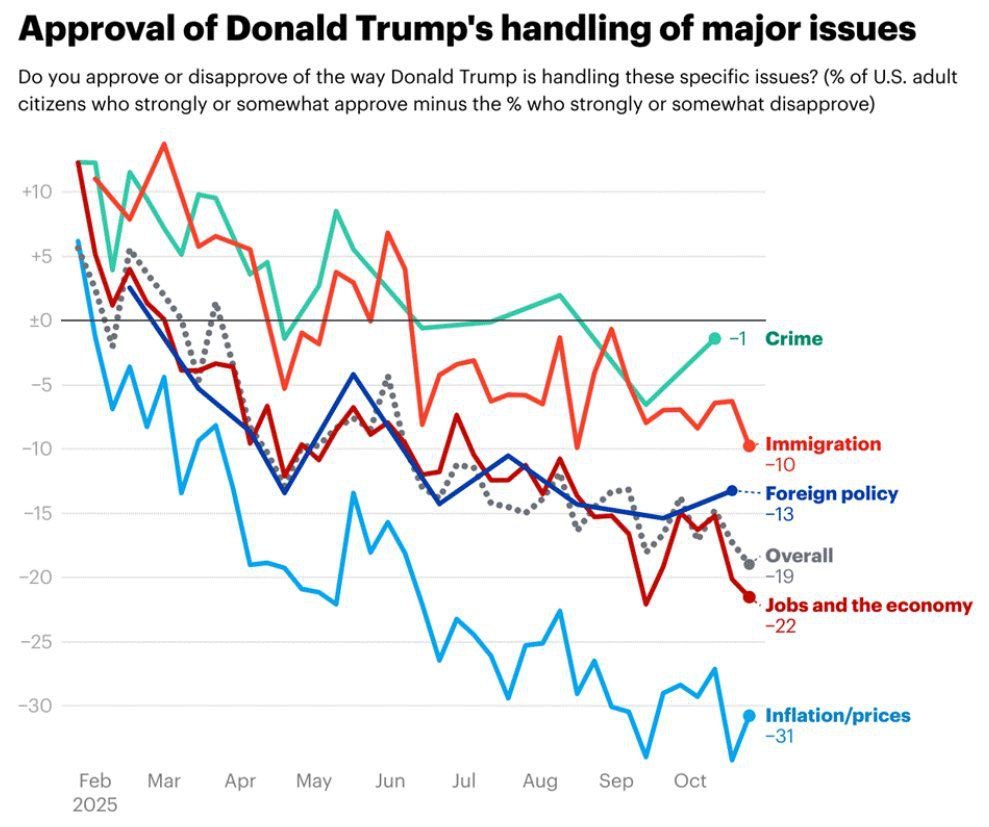
Рейтинги одобрения Трампа по ключевым вопросам демонстрируют отрицательную динамику, особенно по экономике и ценам

Gallup фиксирует более стабильные, но все равно невысокие показатели — 41% одобрения и 54% неодобрения. Особенно критичной является ситуация с экономическими рейтингами: только 42% одобряют экономическую политику при 55% неодобрения.

По вопросам инфляции и стоимости жизни одобрение составляет лишь 34% против 62% неодобрения. Среди независимых избирателей 56% выражают неодобрение.

Смешанные сигналы рынка труда

Заявления Трампа о создании рабочих мест частично подтверждаются данными. Рост рабочих мест ускорился до 150 000 в месяц во втором квартале по сравнению с 111 000 в первом квартале.

Однако с марта создание рабочих мест замедлилось до 53 000 в месяц. Уровень найма держится ниже 4,0% с ноября 2023 года, что сопоставимо с периодом медленного восстановления 2013 года.

Влияние на доверие к институтам

Политика Трампа отражается на общественном доверии к государственным институтам. Одобрение работы Конгресса упало до 15%, при этом республиканцы потеряли 21 процентный пункт поддержки среди своих сторонников.

53% респондентов винят в потенциальных экономических последствиях шатдауна республиканцев и президента против 37% обвиняющих демократов.

Долгосрочные экономические риски

Несмотря на текущий рост, аналитики Morgan Stanley отмечают, что тарифы функционируют как «налог на капитал», заставляя компании поглощать издержки вместо их перекладывания на потребителей.

Исследование Penn Wharton Budget Model показывает, что домохозяйства со средним доходом сталкиваются с потерями в 58 000 долларов в течение жизни из-за тарифной политики.

Анализ показывает существенный разрыв между недавними заявлениями Трампа и объективными данными. Хотя некоторые экономические показатели действительно впечатляют, утверждения о падающих ценах не соответствуют реальности роста инфляции, а рейтинги одобрения находятся на минимальных уровнях второго срока.

Реальность оказывается более сложной, чем политическая риторика: экономический рост сочетается с инфляционным давлением, а краткосрочные достижения могут обернуться долгосрочными издержками для американских семей.

Пов'язані матеріали

Latin America's Payments Landscape Is Not What You Think It Is

This report challenges common misconceptions about Latin America's payment landscape, based on over 500 hours of firsthand research. Key findings include: 1) Crypto card transaction volume primarily comes from high-net-worth individuals receiving USDT salaries, not retail spending. 2) QR code payments (e.g., Brazil's Pix, Argentina's Mercado Pago) are the dominant payment method across most emerging markets, not cards. 3) A major untapped opportunity lies in enabling cross-border interoperability between domestic instant payment systems. 4) Payment competition is shifting from customer acquisition to owning the settlement layer (e.g., acquiring banks). 5) Latin America is not a single market; Brazil, Mexico, Argentina, and smaller "forgotten five" countries (e.g., Guatemala, Honduras) have vastly different dynamics. 6) Stablecoin-to-fiat conversion margins are collapsing toward zero, pushing companies to build value-added services on top. 7) Future payment winners will be multi-country brands, not single-corridor specialists. 8) Marketing must target specific user segments (e.g., digital nomads, unbanked immigrants) with tailored messaging, not a generic "Brazilian" audience. 9) Contrary to perception, Latin American regulators are often ahead of the US in creating frameworks for digital assets and instant payments, with clear licensing deadlines. The core takeaway is that the region's payment rules are being rewritten, moving beyond cards and stablecoin arbitrage towards integrated, cross-border QR-based solutions.

链捕手3 хв тому

Latin America's Payments Landscape Is Not What You Think It Is

链捕手3 хв тому

Vitalik's Algorithmic Stablecoin Vision: Interpreting the Mechanism and Challenges from an Options Perspective

Vitalik Buterin's recent algorithmic stablecoin proposal envisions using an option-like mechanism to create a stablecoin without the liquidation risks inherent in traditional collateralized debt position (CDP) models. The design splits one unit of ETH into two components: a 'stable' leg (P) that maintains value up to a certain strike price, and an 'upside' leg (N) that captures any appreciation above that price. Together, they always sum to one ETH, eliminating the need for debt or liquidation mechanisms. From an options perspective, the stable leg essentially functions as a synthetic, covered call position. However, significant challenges exist. For the stable asset to maintain its peg, it must continuously roll deep in-the-money call options, leading to potential rollover slippage, predictable trading paths vulnerable to front-running, and liquidity issues. Crucially, the system's scalability depends on a constant demand for the upside leg—a form of leveraged ETH long position without funding rates or liquidation risk. It's unclear if such persistent, specific demand will materialize from speculators or market makers who have simpler alternatives like perpetual swaps. The author, drawing from experience with Rysk, argues that DeFi options have struggled as standalone trading products due to complexity and fragmented liquidity. Their potential lies instead as foundational infrastructure underpinning more complex financial primitives like stablecoins, structured yields, or index products—transforming from a direct product into a core pricing and risk distribution engine for the next generation of on-chain finance.

marsbit1 год тому

Vitalik's Algorithmic Stablecoin Vision: Interpreting the Mechanism and Challenges from an Options Perspective

marsbit1 год тому

GPT-5.6 Countdown: Abandon the Illusion of a Single API, Computational Iteration Can't Outpace a Single Page of Compliance

In mid-June, three seemingly independent industry events—the compliance-driven throttling of Fable 5, the open-sourcing of GLM-5.2, and the leaked release timeline for GPT-5.6—are pushing the global AI industry toward a watershed moment. These shifts signal a fundamental restructuring of the industry's underlying logic. First, **"usability" has substantially overtaken "advanced capabilities"** as the primary weight, pushing the global large language model (LLM) supply chain into a "dual-track" phase of controlled closed-source and local open-source coexistence. Second, **the competitive moats of closed-source giants are shifting**. Their technical focus is moving from "language intelligence" toward "spatial intelligence (world models)"—a domain heavily reliant on computing power. Third, faced with常态化 transnational compliance risks, **a "model-agnostic" decoupled design has become a survival necessity for application-layer developers to maintain business continuity.** The article details how Anthropic's Fable 5, despite its advanced engineering feats, was restricted for non-U.S. citizens within 72 hours of launch, highlighting how geopolitical compliance can instantly limit even the most advanced models. In response, the open-source camp, exemplified by Zhipu AI's MIT-licensed GLM-5.2, is gaining market share by offering stable performance improvements and significant cost advantages (up to 70% savings for enterprises), while achieving full adaptation with domestic semiconductor platforms. Meanwhile, closed-source leaders like OpenAI are pivoting. The anticipated GPT-5.6 reportedly shifts focus from language to spatial intelligence and world models, aiming to rebuild a generational gap in areas like 3D understanding, simulation, and industrial design that demand immense compute. The core conclusion is that the LLM supply chain's logic has changed. Enterprises must now evaluate infrastructure based on a composite of technical performance and policy compliance. For developers, complete reliance on a single closed-source API poses unacceptable risk. Implementing a truly model-agnostic architecture—enabling swift switches to compliant, locally deployable open-source alternatives—is no longer just good practice but a fundamental baseline for business continuity.

marsbit4 год тому

GPT-5.6 Countdown: Abandon the Illusion of a Single API, Computational Iteration Can't Outpace a Single Page of Compliance

marsbit4 год тому

Торгівля

Спот
Ф'ючерси
活动图片