Crypto Wins Legal Status In India — High Court Calls It ‘Property’

bitcoinistОпубліковано о 2025-10-27Востаннє оновлено о 2025-10-27

Анотація

Madras High Court has ruled that cryptocurrencies can be treated as property, a decision that could reshape how exchanges handle...

Trusted Editorial content, reviewed by leading industry experts and seasoned editors. Ad Disclosure

Madras High Court has ruled that cryptocurrencies can be treated as property, a decision that could reshape how exchanges handle user assets after hacks.

The court found that certain crypto holdings are identifiable and controllable, and therefore eligible for legal protection similar to other movable property.

Cryptocurrency Treated As Property Under Law

According to the Madras High Court, crypto-assets meet the basic tests of property because they can be owned, transferred and controlled by private keys.

Justice N. Anand Venkatesh said they can be held “in trust,” and that they are neither physical goods nor traditional currency but are property nonetheless.

Based on reports, the decision relied in part on the Income Tax Act’s definition of “virtual digital asset” under Section 2(47A).

WazirX Hack And The Disputed Holdings

Reports have disclosed that WazirX suffered a major security breach on July 18, 2024, when its cold wallet was compromised and about $230 million in Ethereum and ERC-20 tokens were taken.

A WazirX user who held 3,532 XRP — valued at roughly ₹1.98 lakh in January 2024 — asked the court to protect her coins from being swept into any pooled compensation arrangement for the stolen funds. The court agreed that her XRP was separate from the tokens stolen in that hack.

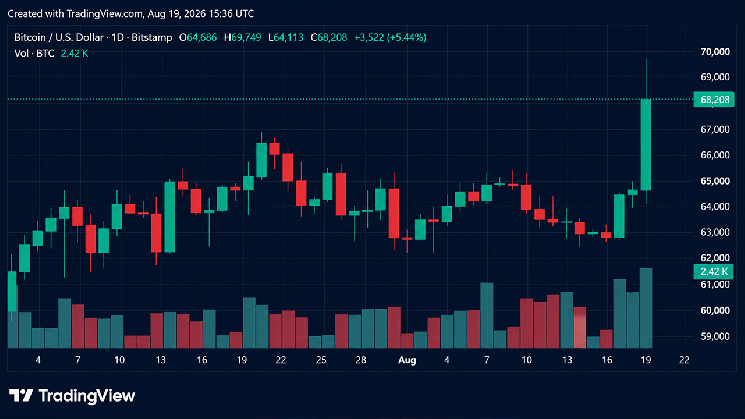
Total crypto market cap currently at $3.84 trillion. Chart: TradingView

Court Rejects Arbitration Barrier

WazirX argued that disputes should go to arbitration in Singapore under its agreements. The court rejected that view for this case because the transactions had clear links to India — funds came from Indian bank accounts and the exchange is registered in India.

Jurisdiction was thus left with the Madras High Court, and ad-interim relief was ordered to stop the user’s XRP from being reallocated as part of the hack losses.

What This Means For Users And Exchanges

The judgment gives a stronger legal basis to individual users to challenge exchanges legally in Indian courts if they feel their funds are misrepresented or exploited.

Exchanges could be required to have a more robust record-keeping regime, clearer segregation of client funds, and direct audit trails.

According to reports, judges pointed to technical characteristics of cryptocurrencies — transferability, identifiability and exclusive control — that support the conclusion that legal ownership can be recognized.

Potential Tax And Legal Implications Ahead

Tax experts are monitoring this closely. Treating crypto as property matches the way some tax rules currently describe virtual assets in tax codes, and may influence the taxation of gains and transfers in the future. This is an important decision of a High Court, which has authority, but can be appealed and reviewed by other courts of higher authority.

The judgment protects the specific XRP holdings in this petition. Further legal fights over other users and different tokens may follow.

Featured image from JSA, chart from TradingView

Editorial Process for bitcoinist is centered on delivering thoroughly researched, accurate, and unbiased content. We uphold strict sourcing standards, and each page undergoes diligent review by our team of top technology experts and seasoned editors. This process ensures the integrity, relevance, and value of our content for our readers.

Christian, a journalist and editor with leadership roles in Philippine and Canadian media, is fueled by his love for writing and cryptocurrency. Off-screen, he's a cook and cinephile who's constantly intrigued by the size of the universe.

Пов'язані матеріали

LATEST NEWS: Long-awaited Fed meeting minutes released! Here's what you absolutely need to read

The Federal Reserve has released the highly anticipated minutes from its Federal Open Market Committee (FOMC) meeting held on July 28-29. The minutes revealed that while most Fed officials supported holding the federal funds rate steady at 3.50-3.75%, a minority advocated for a 25-basis-point increase. A key consensus was that interest rates may need to remain high for longer, and further hikes could be necessary if inflation does not continue to decline. Inflation concerns were central to the discussion. Officials broadly agreed that risks to inflation remain elevated, with some noting that current financial conditions might not be sufficiently restrictive to bring inflation back to the Fed's 2% target. They observed that price increases have been broad-based across many categories of goods and services. The minutes noted that financial conditions had tightened between meetings, partly driven by market expectations of tighter Fed policy. Some officials viewed this market-driven tightening as having already done some of the Fed's work. Staff economic forecasts saw little change in inflation outlook but a slightly downgraded growth forecast. Other points included assessments of financial stability, with some officials flagging a potential sharp correction in AI-related stocks as a risk. The minutes also covered operational topics, such as the effective handling of a payment system glitch and a proposal—though not adopted—to reduce the number of annual policy meetings. The committee affirmed its commitment to maintaining the phrase "will ensure price stability" in its policy statement.

cryptonews.ru13 хв тому

LATEST NEWS: Long-awaited Fed meeting minutes released! Here's what you absolutely need to read

cryptonews.ru13 хв тому

Торгівля

Спот
活动图片