[Key interpretation] 23,378 BTC were newly purchased by listed companies, and 1.87 million ETH recently flowed into the exchange

Huobi ResearchОпубліковано о 2022-07-05Востаннє оновлено о 2022-07-07

Анотація

BTC is brewing for short-term strength and temporarily obtains data support.

1、 BTC brewing double bottom form

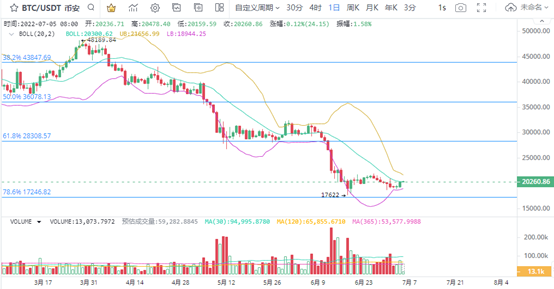
In the daily K-line chart of BTC, BTC ushered in a technical rebound trend when the closing price was not continuously at a new low.

The figure shows that the rebound intensity of BTC is not high, but the closing price has risen significantly from the low level. The amplitude reached 6.72%, and BTC brewed the volume bottom shape in the low price area. This bottom can be compared with the previous rebound on June 18, which is the second rebound performance. Therefore, there is a better expectation of double bottom reversal. Operationally, investors can pay attention to further low absorption and currency holding opportunities.

In terms of indicators, the rebound of BTC continues after the short-term closing of the brin line, which is a typical rebound signal after the increase of fluctuation intensity. Although it has not effectively broken through the middle rail of the brin line, with the expansion of price increase, the possibility of further rise is enhanced.

At present, BTC only needs a small price increase to confirm the typical rebound signal, so the increase is relatively expected.
2. BTC obtains increased holdings from Listed Companies

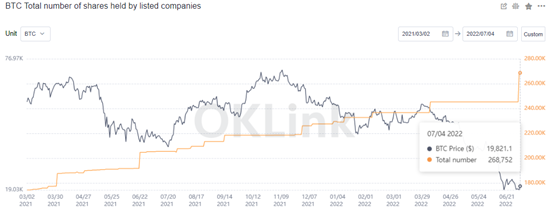
The increase of listed companies' holdings in BTC means that the main force or has recognized the buying opportunities of BTC. The message shows that the bank for International Settlements allows banks to retain 1% of bitcoin reserves, which means that BTC's hedging function may play a greater role.

The number of currency held by listed companies increased rapidly during this period. By July 3, 2022, the number of BTC listed companies increased to 268752 BTCs, an increase of 23378 BTCs compared with 245374 BTCs on July 2. Although the trend of listed companies to increase their holdings of BTC over the past year is very significant, the scale of this increase is undoubtedly the highest. Combined with the cost advantage of BTC, the increased holdings of listed companies are around us $19300, which is also a confirmation signal for the bottom of BTC.

After listed companies increase their holdings of BTC, it is unlikely to be sold. Once BTC's buying opportunity below $20000 is recognized by more investors, the possibility of its reversal will be greatly enhanced.
3. BTC price is close to the cost price of investors

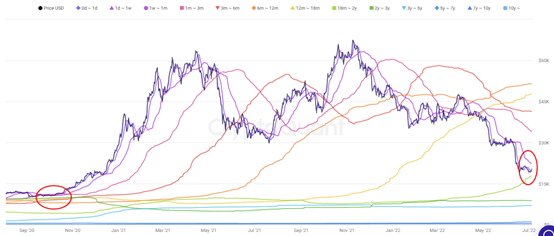
During the low-level and high-volume operation of BTC price, its cost price is rapidly approaching the cost price of investors. The cost price mentioned here includes the main cost price of holding money for 18 to 24 months, as well as the cost price of investors holding money for 1 to 1 week. Recently, in the process of low-level sideways consolidation, the latest 18 to 24 month long-term investor cost price further rebounded to $17788 on July 4. Accordingly, the main cost price of holding money for one week to one month fell back to $22251.

Review the performance of BTC accelerating its rise from the main cost price around us $10000 at the end of 2020.

This time, BTC is close to the short-term and long-term investor cost price, which also indicates a very typical buying opportunity. After different cost prices are close to the current price of BTC, the expectation of further price correction is weak, and the chance of success in bottoming is greatly improved.

From the perspective of holding time, the cost price of investors holding money for 18 to 24 months has risen to $17643, that is to say, this point has been higher than the recent BTC lowest price of $17622. In other words, if BTC is close to US $17643 in the short term, the possibility of further breaking and falling has been significantly reduced. The cost price of investors holding money for 18 to 24 months is the main price for holding money for a long time. Its currency holding cycle starts from the middle of 2020. If the main cost price is lower than this cost price, the cost may be an important buying signal.
4. Eth key position rebound

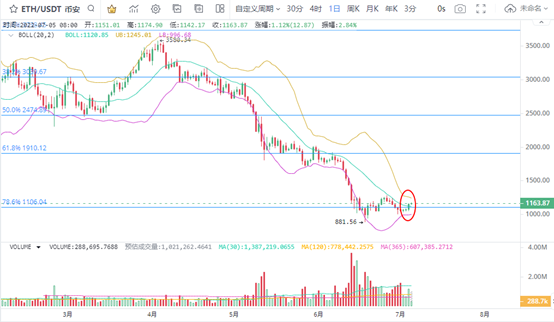
In the daily K-line chart of eth, the price performance is significantly stronger than that of BTC. Eth has broken through the medium gauge of the brin line during the rebound, thus indicating a strong signal of short-term price, creating conditions for further expansion of the increase.

In terms of trading volume, the trading volume of eth rebounded slightly on July 4, about twice that of the previous day. In terms of support, after eth received short-term support of 78.6% of Fibonacci's corresponding US $1106, the price trend was better. It is expected that the linkage between Eth and BTC will be enhanced, especially in the stage of price rise, which further verifies the trading opportunities.
5. Increase in the number of eth exchanges

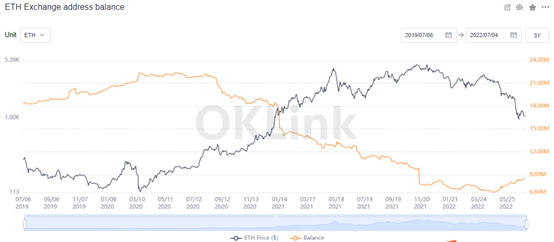
Recently, the number of eth in the exchange showed signs of growth, from a low of 6.69 million to 8.56 million eth on July 4, with an increase of 1.87 million eth, an increase of 27%. From June 26 to July 4, the growth of eth means that the release space of selling pressure is increasing. In terms of absolute number, the number of eth of the exchange is still running at a low level. From the end of 2020 to the end of 2021, the number of eth in the exchange fell from 2.2 million to 8.2 million, and its downward trend has always continued. Since 2022, the number of eth in the exchange has shown signs of a low rebound. In the recent three months, ETH fell from US $3000 to below US $1000, which was synchronized with the rebound of eth in the number of exchanges.

In the short term, the number of eth in the exchange remains stable, and then we can continue to pay attention to the impact of changes in the number on the market.
Пов'язані матеріали

NVIDIA CPU Advances, China's RISC-V Responds: Semiconductor Deep Dive - Part Four

NVIDIA is set to launch its new Vera AI data center CPU in China as early as August, with high pricing. While this move offers a new option, it highlights China's continued dependence on foreign-controlled Arm architecture. In response, the Chinese semiconductor industry is increasingly turning to RISC-V as a strategic alternative for achieving high-performance computing autonomy. The article explores the concept of the "impossible triangle" in CPU development—balancing prosperity, control, and autonomy—and posits that RISC-V's open-source, modular nature offers a unique path to achieving all three. While RISC-V is already dominant in embedded systems, the focus is now shifting to data centers and AI workloads. China has become a global hotspot for RISC-V development, driven by AI-driven compute demand, supply chain concerns from export controls, cost benefits of open-source, and strong policy support. Multiple Chinese companies have reportedly crossed the key performance threshold of 15 SPECint per GHz, a benchmark for entering the high-performance CPU club. Progress extends beyond single-core benchmarks. Companies are developing complete computing subsystems, including commercial-grade coherent network-on-chip (NoC) technology and server processors with up to 40 cores that strictly adhere to the RVA23 standard to ensure software compatibility. Real-world applications are emerging in areas like video transcoding and edge AI. However, significant challenges remain. The RISC-V ecosystem faces fragmentation, immature toolchains and verification processes, and gaps in single-core performance and energy efficiency compared to mature x86 and Arm architectures. The formidable software moat, epitomized by NVIDIA's CUDA, is a long-term hurdle. In conclusion, while RISC-V cannot immediately replace offerings like NVIDIA's Vera, it represents a viable long-term path for China to develop a self-sufficient, high-performance CPU ecosystem. The journey is acknowledged to be long and arduous, requiring sustained effort to overcome technical and ecosystem challenges.

marsbit3 год тому

NVIDIA CPU Advances, China's RISC-V Responds: Semiconductor Deep Dive - Part Four

marsbit3 год тому

My Coding Betting Dashboard is Profiting, but Polymarket is Truly Not a Good Place for 'Arbitrage'

The author built a custom monitoring dashboard for Polymarket, a prediction market platform, and tested it with $1,600, achieving over 30% returns. However, the core argument is that Polymarket is not a good venue for traditional arbitrage. The dashboard has two main sections: a "Portfolio Dashboard" for tracking active positions with key metrics like total capital, P&L, and a risk-control module using a tier system (T1, T2, T3), and an "Opportunity Watchlist" for monitoring markets. The article details a critical structural trap in binary markets: a bet with a high perceived probability of success still carries a 100% loss risk if wrong. The author's T1/T2/T3 system is designed to manage this by limiting position sizes based on conviction and time horizon, emphasizing that high confidence should not equal high concentration. A key insight is the danger of "pseudo-diversification"—betting on different markets driven by the same underlying variable. The author concludes that Polymarket offers few true low-risk, arbitrage opportunities. It is instead a high-risk environment where wins can create a false sense of mastery, leading to large losses. The platform is better viewed as a training ground for honing judgment through disciplined, framework-driven betting rather than a reliable income source. The tools help transform intuition into structured, rule-based decisions to mitigate the risk of catastrophic errors.

marsbit6 год тому

My Coding Betting Dashboard is Profiting, but Polymarket is Truly Not a Good Place for 'Arbitrage'

marsbit6 год тому

WeChat AI Card Hands-On Guide: Has the AI Shopping Era Arrived?

**"WeChat AI Card" Practical Test Guide: Has the Era of AI Shopping Arrived?** WeChat has officially launched the "AI Exclusive Card," a feature integrated into its Workbuddy AI assistant. This card is designed to handle payments for AI-initiated purchases. Our hands-on test reveals it's not yet a tool for fully autonomous AI shopping, but rather a controlled payment layer for AI agents. The AI Card functions as an isolated sub-wallet within WeChat Pay. Users must bind the card and transfer funds into it from their main wallet. Crucially, every transaction requires explicit user confirmation via smartphone scan; AI cannot spend autonomously. Currently accessible through the Workbuddy agent, the card targets specific digital consumption scenarios: purchasing paid content (reports, data), calling paid APIs/tools, and subscribing to services. Its design prioritizes security and control by separating funds and mandating approval for each payment. We tested a real-world scenario: ordering bubble tea via Workbuddy using a "Meituan Life Assistant" skill. The process encountered multiple hurdles: high "skill" usage costs (exceeding daily free credits), and most importantly, while a payment was successfully initiated, the AI purchased an incorrect product (a mismatched group-buy coupon instead of the desired drink). This highlights the current limitation: the **AI Card only solves the payment step**. The broader challenge lies in the **AI agent's execution chain**—accurately understanding intent, navigating third-party platforms, selecting the right product, and ensuring proper fulfillment. The payment succeeded, but the purchase failed to meet the user's need. In conclusion, the WeChat AI Exclusive Card is a cautious, early-step experiment in AI commerce. It provides a secure, user-controlled payment method for agent interactions but is not yet capable of reliable, end-to-end complex purchases. For now, it's best used for low-value, low-risk digital services with careful user verification at each step. The vision of AI handling complete shopping tasks remains a work in progress.

marsbit9 год тому

WeChat AI Card Hands-On Guide: Has the AI Shopping Era Arrived?

marsbit9 год тому

Торгівля

Спот
Ф'ючерси
活动图片