As Bitcoin [BTC] flashes green, is the worst finally behind it

AmbcryptoОпубліковано о 2022-07-05Востаннє оновлено о 2022-07-05

Анотація

On-chain data indicates that the worst might be over for Bitcoin as per acclaimed researchers. BTC has also seen a bullish uptick since 3 July, marking a good start to the month.

Bitcoin [BTC] investors have more reasons than one to be amused by the celebrations of 4 July. On-chain data indicates that the worst might be over for Bitcoin as per acclaimed researchers. BTC has also seen a bullish uptick since 3 July, marking a good start to the month.

A renewed optimism on the charts

Bitcoin supporters have good reasons to be optimistic after positive signs on the network. A recent Santiment tweet suggested a positive uptick in longs on exchanges in the early hours of 4 July. The tweet further claims that trader optimism is usually high on holidays. It also raises caution as whales may attempt to “punish the overly eager”.
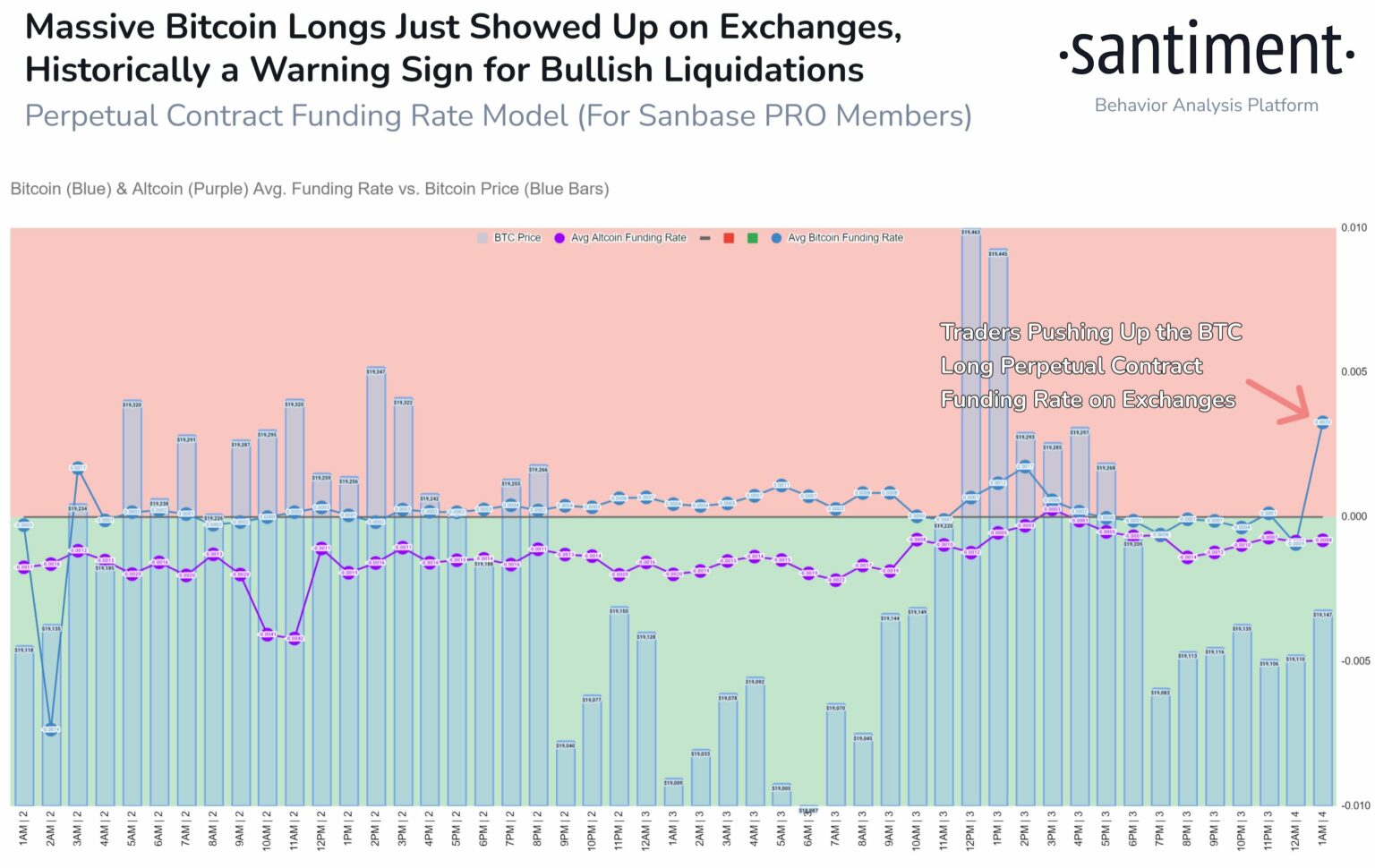
Source: Santiment

Crypto analyst Ali Martinez further posted his analysis suggesting the worst is probably over for Bitcoin. He used the Santiment MVRV (365d) metric which timed the previous market bottoms in two bearish cycles.
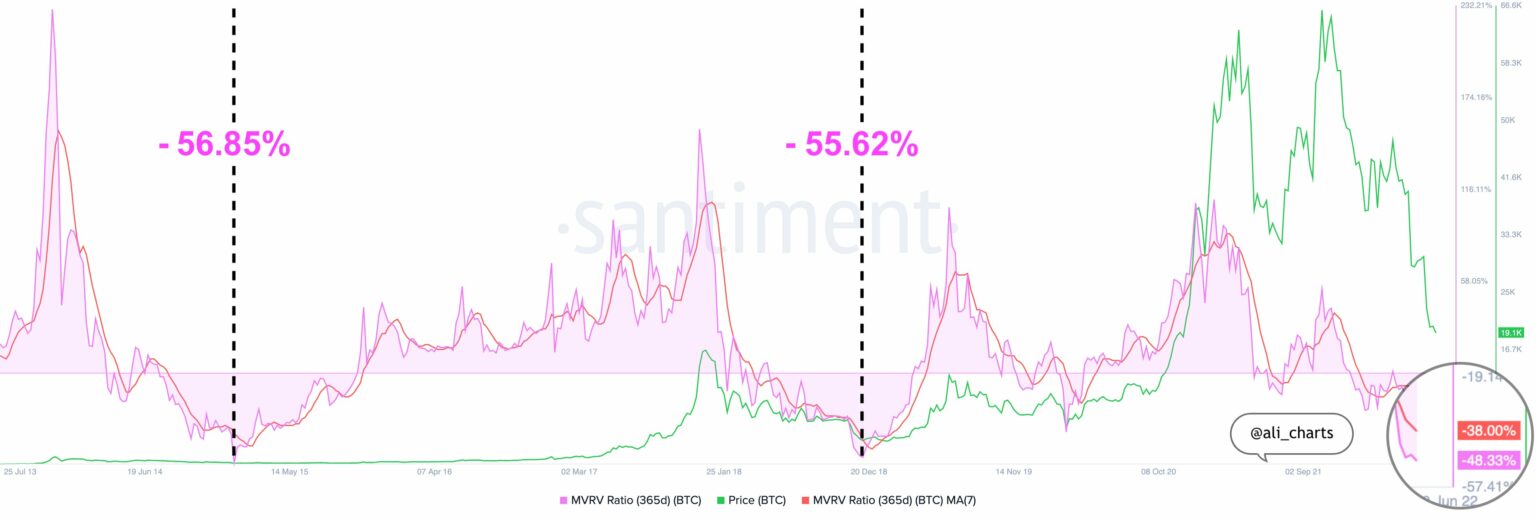
Source: Ali Martinez/ Santiment

During the January 2015 bear market, the MVRV metric hit -56.85% to mark the market bottom. And again in December 2018, it struck -55.62% flashing a bottom for the bear market. As of now, with the current bearish cycle in full swing, this value dropped to -50.09% in mid-June and currently sits at – 48.23%.

Can this ignite the bulls as we wrap the underwhelming Q2?

Let’s talk data!

Bitcoin is consolidating in the $18,000-$22,000 range as both bulls and bears are not sure of the trends of market volatility. Currently trading at $20,241, BTC was up by 5.7% in the last 24 hours. In its latest recovery attempt, Bitcoin is further aided by a near 50% hike in network volume. This is a healthy sign for Bitcoin as it battles on under difficult market conditions.

The MVRV ratio has also witnessed significant changes since mid-June. The value saw a gradual upturn during a late recovery in June. Despite a fall in prices of the king token and the volatility it has experienced, the MVRV ratio still stands in a good position.
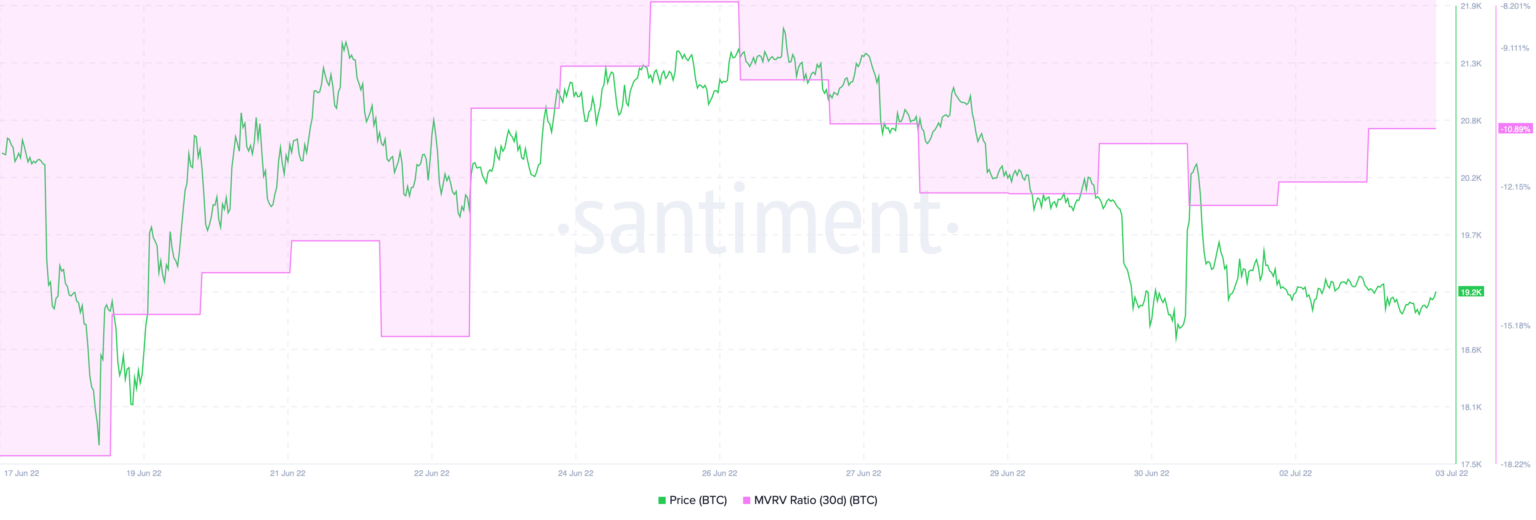
Source: Santiment

The Musk-BTC affair

Despite numbers showing some signs of recovery, Tesla wrapped up a disastrous Q2 on 30 June. With Elon Musk’s $1.5 billion Bitcoin investments, the CEO must have been reeling from his losses. Additionally, Musk’s move has so far not gone as per plan at least financially.

As the Telegraph reports, “Tesla is likely to record an impairment on its Bitcoin holdings of around $440m – equivalent to 9% of its annual profit last year – when it reports quarterly results later this month.”

Пов'язані матеріали

DAT Companies Take on Side Businesses

The article details the strategic shifts of Digital Asset Treasury (DAT) companies amid a prolonged market downturn. Initially popularized by firms like MicroStrategy, the DAT model—where companies hold cryptocurrencies on their balance sheets—has faced significant pressure as crypto ETFs eroded their investment thesis and bear markets strained finances. Key players are adapting in several ways. Some, like ETHzilla, have abandoned the model entirely. Others are pivoting towards becoming active, revenue-generating participants in the crypto ecosystem rather than passive holders. This evolution is taking two main paths: 1. **Transformation into Institutional Crypto Asset Managers:** Companies like SharpLink Gaming and GameSquare are leveraging their holdings to generate yield, moving beyond simple storage. They employ strategies like 100% ETH staking or using machine learning to optimize DeFi yields, positioning themselves as platforms offering institutional-grade crypto yield products. 2. **Becoming Blockchain Infrastructure Operators:** This is prominent in the Solana ecosystem. Firms like DeFi Development and SOL Strategies are acquiring validator businesses, issuing liquid staking tokens (e.g., dfdvSOL, fwdSOL), and integrating them into DeFi protocols. They generate fee-based revenue from these operations, building network effects. The article notes that successful转型 hinges on building operational expertise and defensible business models around crypto assets, such as technical advantages or deep ecosystem integration. However, these new paths carry risks like smart contract vulnerabilities or ecosystem dependence. Ultimately, this collective shift signals a maturation phase for the DAT movement. It highlights that in crypto, sustainable value is increasingly tied to active participation, cash flow generation, and providing real utility, rather than speculative capital allocation alone.

Foresight News1 хв тому

DAT Companies Take on Side Businesses

Foresight News1 хв тому

The Fate of Digital Banks: A Fancy App Can't Match a Banking License

**Title:** The Fate of Digital Banks: A Fancy App is No Match for a Banking License **Summary:** The article argues that digital-only "neobanks" have struggled to achieve profitability, with 76% still operating at a loss. Their core mistake was focusing on offering low-fee checking accounts, which generate minimal revenue from interchange fees. The fundamental profit engine of banking is **credit**—lending money and earning interest—a business largely restricted to licensed entities. Successful neobanks like **Nubank** and **Revolut** only became profitable by pivoting to become full-scale lenders, using their sleek apps as mere customer acquisition tools. Others, like **Chime**, suffered for years relying solely on transaction fees before embracing lending. The piece highlights the systemic risks of depending on third-party infrastructure, exemplified by the **Synapse** bankruptcy which froze millions in user funds. The only reliable safeguard is a **banking license**, which provides direct regulatory oversight and control over assets. This realization is now dawning in the cryptocurrency sector. Major firms like Paxos, Circle, and Crypto.com are actively seeking **national trust charters** from the OCC to legitimize their operations and escape dependency on traditional banking partners. Companies like **SoFi** have completed the evolution from fintech to licensed bank to stablecoin issuer. While DeFi has grown in secured lending, **unsecured lending** remains minuscule due to the lack of real-world identity and legal recourse for defaults on blockchain. Truly scaling credit likely requires a banking license. The conclusion is stark: despite promises of disruption, surviving digital banks have simply replicated the age-old banking model—profiting from interest on loans. A user-friendly interface changes the experience, but not the essential economics. In the end, a banking license is not an option but a necessity for sustainable operation.

marsbit11 хв тому

The Fate of Digital Banks: A Fancy App Can't Match a Banking License

marsbit11 хв тому

A Country That Has Been Mining Bitcoin for 8 Years Establishes Its Own Dedicated Crypto Bank

Bhutan, a small Himalayan nation known for prioritizing Gross National Happiness over GDP, has established a dedicated crypto bank after eight years of Bitcoin mining. The DK Bank, located in the Gelephu Mindfulness City (GMC) Special Administrative Region, aims to fill the persistent banking gap for the crypto industry. Unlike traditional banks that often reject crypto firms or only handle their fiat transactions, DK Bank offers integrated multi-currency accounts where users can manage both fiat currencies and stablecoins like USDT and USDC, alongside services such as Bitcoin-backed loans. The bank operates under a unique "one country, two systems" governance model in GMC, which is designed to become a financial hub for South Asia. Its regulatory framework is modeled on Singapore's common law and Abu Dhabi Global Market's (ADGM) rules, offering a fast-track licensing process for firms already licensed in those jurisdictions. DK Bank and GMC authorities emphasize stringent, real-time on-chain and off-chain transaction monitoring to mitigate risks associated with anonymity in crypto. This move is part of Bhutan's longer-term strategic pivot toward institutional crypto services—including mining, custody, and asset management—rather than retail-focused speculative tokens. Officials stress diversification within the blockchain ecosystem to hedge against volatility in assets like Bitcoin. The development of supporting infrastructure, including an international airport managed by Singapore's Changi operator, is ongoing, with completion targeted for 2029. The initiative represents Bhutan's attempt to position itself at the forefront of the shift of global financial services on-chain, leveraging its early experience and a stated ethos of orderly and mindful progress.

marsbit32 хв тому

A Country That Has Been Mining Bitcoin for 8 Years Establishes Its Own Dedicated Crypto Bank

marsbit32 хв тому

Market Trends in US Stocks (June 18): Walsh's Pivot Ignites Broad Sell-Off, SpaceX Suffers First Drop, Semiconductors Sole Safe Haven

**U.S. Market Trends (June 18): Wash Sparks Full-Scale Sell-off; SpaceX's First Drop, Semiconductors the Only Safe Haven** Markets plunged after the June FOMC meeting. The "dot plot" revealed a hawkish shift, with half the officials projecting at least one rate hike in 2024. New Fed Chair Wash, in his press conference, announced the abandonment of forward guidance, stating he "can't tell you what the next step will be." This policy uncertainty triggered a broad sell-off. All major indices fell over 1%, with the S&P 500 down 1.21%. The VIX volatility index jumped 12%. Treasury yields spiked, and the dollar surged to a two-month high, while gold erased its weekly gains. The sell-off was led by rate-sensitive sectors. Meta plunged over 5%, leading the Magnificent 7 lower. SpaceX closed down ~5%, marking its first decline since its IPO, as valuation pressure from higher rate expectations took hold. The sole market bright spot was semiconductors. The Philadelphia Semiconductor Index rose 1.38%, with Applied Materials, Lam Research, and Arm Holdings all posting significant gains. The narrative held that long-term AI computing demand remains intact, driving a rotation of funds from high-valuation software/internet stocks into infrastructure and equipment names. Retail sales data came in strong, and EIA crude inventories fell sharply, supporting the view of persistent inflation and limiting the Fed's scope for easing. Traders fully priced in a rate hike by October, with September seen as likely. In summary, Chair Wash's debut dismantled the market's traditional policy anchors, injecting new uncertainty. While the AI investment thesis provided pockets of resilience in semiconductors, the repricing of rate-sensitive, high-valuation technology stocks appears to have just begun under the new "hawkish reset" framework.

marsbit52 хв тому

Market Trends in US Stocks (June 18): Walsh's Pivot Ignites Broad Sell-Off, SpaceX Suffers First Drop, Semiconductors Sole Safe Haven

marsbit52 хв тому

Торгівля

Спот
Ф'ючерси
活动图片