Эксперт заявил о конце эры самостоятельного хранения биткоина

cryptonews.ruОпубліковано о 2025-10-13Востаннє оновлено о 2025-10-22

Времена самостоятельного хранения криптовалют близятся к завершению, поскольку крупные игроки все чаще отдают предпочтение ETF. Об этом заявил глава блокчейн-исследований в Uphold Мартин Хисбек.

The real reason for all the whale movements out of self-custody is simple: taxes.

We are witnessing the first decline in self-custodied Bitcoin in 15 years.

BlackRock's iShares spot Bitcoin ETF (IBIT) has facilitated over $3 billion worth of Bitcoin conversions from whales.… pic.twitter.com/yepXRbLozM

— Dr Martin Hiesboeck (@MHiesboeck) October 22, 2025

Обратному переходу в традиционные финансовые инструменты способствуют налоговые льготы и совершенствование институциональной инфраструктуры, а также возможность управлять капиталом через консультантов и получать доступ к более широкому спектру услуг, считает эксперт.

«Мы наблюдаем первое снижение объемов самостоятельного хранения биткоинов за 15 лет», — добавил он.

По подсчетам Хисбека, биржевой фонд IBIT от BlackRock обеспечил конвертацию первой криптовалюты «китами» на сумму более $3 млрд. В общей сложности американские эмитенты поглотили монеты стоимостью $151 млрд — около 6,8% эмиссии.
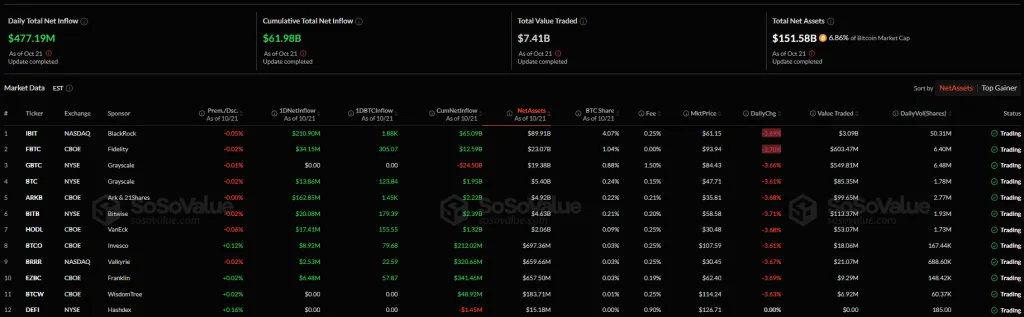
Источник: SoSoValue.

Недавнее изменение правил Комиссии по ценным бумагам и биржам США, разрешающее погашение криптовалютных ETF в натуральной форме, тоже ускорило переход.

Нововведение позволяет авторизованным участникам напрямую обменивать криптовалюту на акции фондов, что более эффективно и потенциально выгодно с точки зрения налогообложения, чем погашение наличными.

«Тенденция свидетельствует о более глубокой интеграции биткоина в традиционную финансовую систему и отходе от мантры самостоятельного хранения — “не ваши ключи, не ваши монеты”. Ещё один гвоздь в крышку гроба первоначальной криптовалютной идеи», — подчеркнул Хисбек.

Кроме того, ускоряется развитие криптовалютный торговых инструментов в других крупных юрисдикциях вроде ЕС, Великобритании и Австралии.

Напомним, в октябре Комиссия по ценным бумагам и фьючерсам Гонконга одобрила первый в регионе спотовый ETF на базе Solana.


Пов'язані матеріали

Tiger Research: Zuckerberg Begins Betting on Prediction Markets, While Asian Nations Still View Them as Gambling

This article examines the rise of prediction markets, contrasting their growing institutional acceptance in the West with their restrictive regulation in Asia. It details how prediction markets, which originated from informal political betting and academic experiments like the Iowa Electronic Market, aggregate crowd wisdom into probabilistic prices through binary contracts. Their growth accelerated around 2020, reaching over $14 billion in monthly volume. A key driver is the "skin in the game" principle, where users risk their own capital, leading to high accuracy in predicting events like Fed rate decisions and elections, as demonstrated by platforms like Polymarket. Meta's entry, with Mark Zuckerberg reportedly leading the development of the Arena app, signals the market's maturation. In the U.S., court rulings have distinguished prediction markets from gambling, facilitating entry by traditional financial institutions. However, most Asian jurisdictions still classify them as gambling, focusing on social control rather than financial innovation. The article argues this stance creates three problems for Asia: 1) regulatory arbitrage pushes users to riskier offshore platforms, 2) loss of sovereign information infrastructure as valuable social sentiment data accumulates abroad, and 3) abandonment of user protection. It concludes that Asia needs a policy shift from prohibition to constructive regulation, integrating these markets into the formal system to harness their data as a national asset, as initiatives like Limitless Research are beginning to do.

marsbit2 год тому

Tiger Research: Zuckerberg Begins Betting on Prediction Markets, While Asian Nations Still View Them as Gambling

marsbit2 год тому

Ethereum's Next Decade in the Eyes of Vitalik

"Lean Ethereum" Long-Term Roadmap Unveiled by Vitalik Buterin On July 5, 2026, Vitalik Buterin published the "Lean Ethereum" roadmap, positioning it as Ethereum's third major evolution following the Merge. This multi-year, multi-phase upgrade aims to fundamentally transform Ethereum's core protocol through staged network upgrades extending to 2029. Key goals include achieving 1 gigagas per second L1 throughput (a massive increase from the current ~32 TPS), near-instant finality, and quantum-resistant cryptography. The plan involves transitioning Ethereum's security model from full transaction re-execution by all nodes to native verification via recursive STARK proofs. A major proposed change is replacing the EVM with a proof-friendly architecture like RISC-V or leanISA, though this remains a point of contention, especially with L2s like Arbitrum favoring alternatives like WASM. Other planned upgrades include a restructured state model with a large, cheap "warehouse" storage layer to drastically reduce fees for migrated applications, multi-dimensional gas pricing, and a new focus on making privacy a first-class, native protocol feature. While the roadmap significantly raises Ethereum's long-term technical ceiling, analysts note it does not directly address ETH's mid-term token economics or value capture. The plan's multi-year timeline means near-term price impact will likely depend on observable progress milestones, such as the successful deployment of the upcoming Glamsterdam gas limit increase, growth in L2 activity and blob usage, and trends in L1 fee revenue and ETH burn.

链捕手3 год тому

Ethereum's Next Decade in the Eyes of Vitalik

链捕手3 год тому

In Just 11 Days, Claude Rewrote Millions of Lines of Code, an Epic AI Engineering Feat Sparks Fury

In just 11 days, Bun's founder Jarred Sumner used Anthropic's Claude AI models to rewrite its million lines of code from Zig to Rust. This move sparked significant controversy, particularly from Zig's creator, Andrew Kelley, who publicly criticized Sumner's engineering practices and the decision to use AI for such a massive rewrite. Bun, a high-performance JavaScript/TypeScript runtime and rival to Node.js, was originally written in Zig. After Anthropic acquired Bun, the team encountered persistent stability and memory safety bugs in the Zig codebase. These issues, combined with Zig's strict policy against LLM-generated code, led to the decision to rewrite in Rust. The rewrite was executed using Claude AI tools at an estimated API cost of $165,000, dramatically reducing the expected time and financial cost. Andrew Kelley's response was scathing. He blamed the original bugs on poor engineering habits, calling Bun's Zig code a collection of "hacks on top of hacks." He expressed relief that Bun was no longer associated with Zig, fearing it would misrepresent the language and attract low-quality, AI-generated contributions. The tech community is divided; some view Kelley's critique as unprofessional, while others see it as a defense of engineering integrity. A major concern about the AI-driven rewrite is the resulting code quality. The translation from Zig left approximately 27,000 lines of unsafe Rust code, raising fears about long-term maintainability and technical debt. The debate centers on whether this project is a milestone in AI-assisted development or a future maintenance nightmare.

marsbit4 год тому

In Just 11 Days, Claude Rewrote Millions of Lines of Code, an Epic AI Engineering Feat Sparks Fury

marsbit4 год тому

Торгівля

Спот
活动图片