3 разблокировки токенов, за которыми стоит следить на четвертой неделе октября 2025 года

cryptonews.ruОпубліковано о 2025-04-19Востаннє оновлено о 2025-10-20

Крипторынок готовится к разблокировкам токенов в четвертую неделю октября 2025 года. События выведут на рынок миллионы новых монет. Три крупных проекта — LayerZero (ZRO), Plasma (XPL) и Soon (SOON) — выпустят ранее заблокированные токены

Эти разблокировки могут привести к волатильности на рынке и повлиять на ценовые движения в краткосрочной перспективе. Рассказываем, чего еще стоит ждать от предстоящих разлоков.

Лучшие биржи для альткоинов: где торговать криптовалютой

1. LayerZero (ZRO)

  • Дата разблокировки: 20 октября
  • Количество токенов для разблокировки: 25,71 млн ZRO (2,57% от общего объема)
  • Текущий объем в обращении: 111,15 млн ZRO
  • Общий объем: 1 млрд ZRO

LayerZero — это омничейн-протокол, который обеспечивает бесшовное взаимодействие между различными блокчейнами. Он поддерживает цензуроустойчивую разработку с неизменяемыми смарт-контрактами.

20 октября LayerZero разблокирует 25,71 млн токенов ZRO, стоимостью примерно $42,68 млн. Разблокировка составит 7,86% от объема выпущенных токенов.
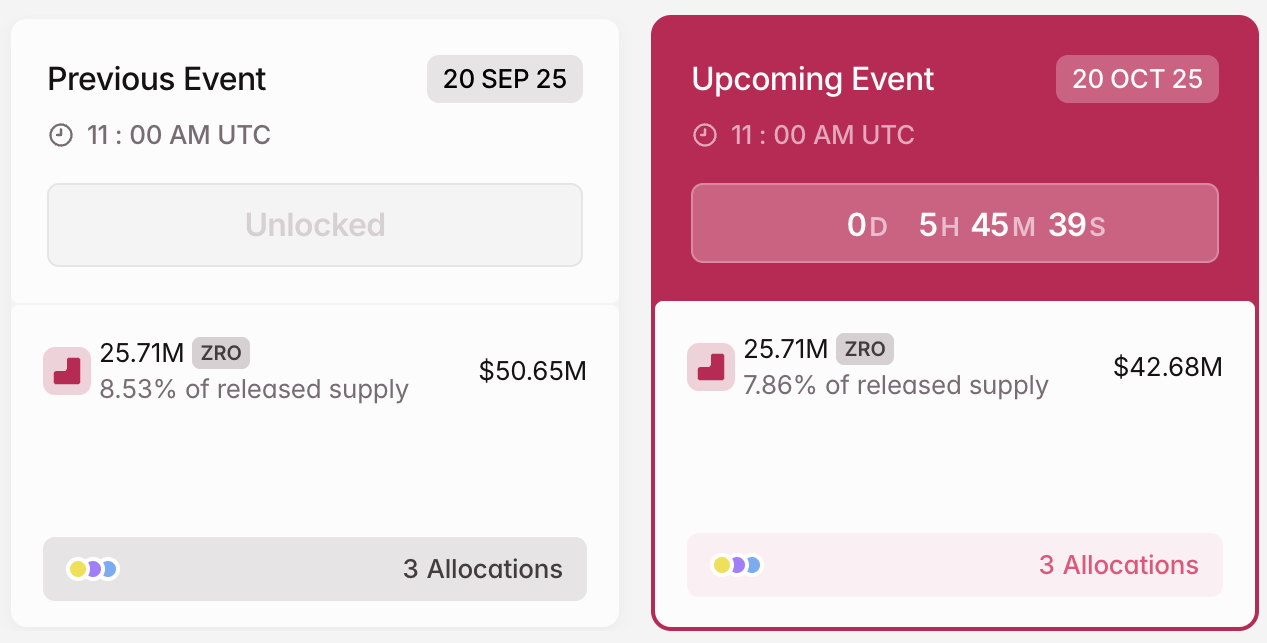
Разблокировка токенов ZRO в октябре.
Разблокировка токенов ZRO в октябре. Источник: Tokenomist

Стратегические партнеры получат 13,42 млн ZRO. В распределение также входят 10,63 млн токенов для ключевых участников и 1,67 млн ZRO для доли, выкупленной командой.

2. Plasma (XPL)

  • Дата разблокировки: 25 октября
  • Количество токенов для разблокировки: 88,89 млн XPL (0,89% от общего объема)
  • Текущий объем в обращении: 1,8 млрд XPL
  • Общий объем: 10 млрд XPL

Plasma — это блокчейн-платформа первого уровня, созданная для повышения эффективности и масштабируемости транзакций со стейблкоинами. Она обеспечивает переводы USDT без комиссий, позволяя задействовать собственные токены для газа. Платформа поддерживает конфиденциальные платежи и предлагает высокую пропускную способность.

Plasma выпустит 88,89 млн XPL в конце этой недели, 25 октября. Стоимость токенов — $36,27 млн. Они составляют 4,97% от текущего объема циркулирующих токенов.
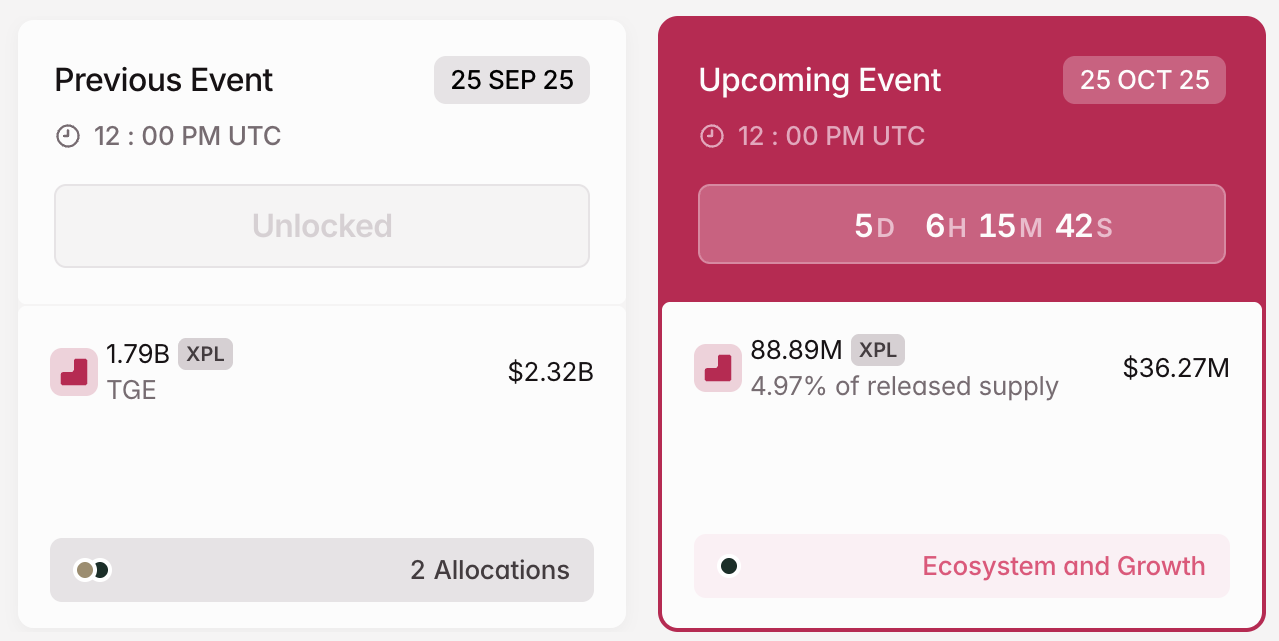
разблокировка токенов XPL
Разблокировка криптовалютных токенов XPL в октябре. Источник: Tokenomist

Команда направит все 88,89 млн XPL на развитие экосистемы и ее рост.

3. Soon (SOON)

  • Дата разблокировки: 23 октября
  • Количество токенов для разблокировки: 15,21 млн SOON (1,55% от общего объема)
  • Текущий объем циркулирующих токенов: 272,4 млн SOON
  • Общий объем: 981,8 млн SOON

SOON — это высокопроизводительный Rollup на базе Solana Virtual Machine (SVM), разработанный для реализации Super Adoption Stack. Он включает три основных компонента: SOON Mainnet, SOON Stack и InterSOON.

Сеть разблокирует 15,21 млн SOON 23 октября. Этот выпуск составляет 4,52% от объема и оценивается в $14,22 млн.
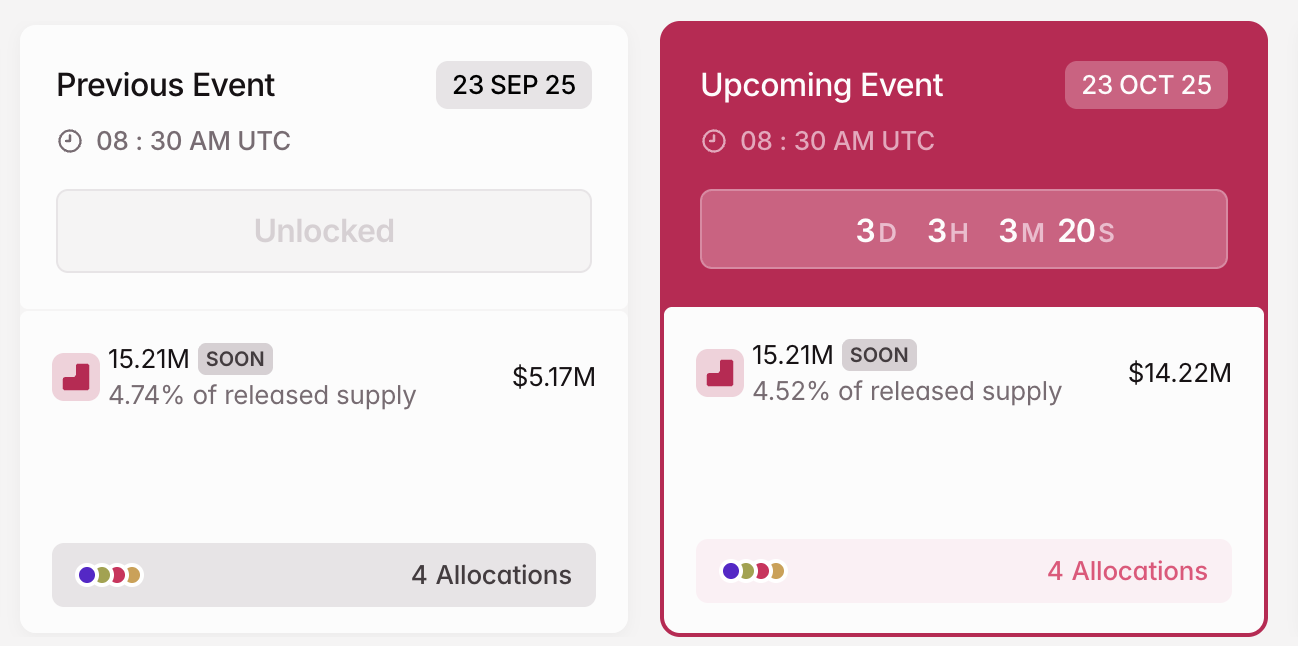
разблокировка токенов SOON
Разблокировка криптовалютных токенов SOON в октябре. Источник: Tokenomist

SOON оставит 8,30 млн токенов для аирдропа держателям невзаимозаменяемых токенов (NFT). Команда также выделит 4,17 млн SOON для экосистемы. Кроме того, будет распределено 2,22 млн токенов для стимулирования сообщества и 520 830 токенов для аирдропа и ликвидности.

Другие значительные разблокировки, на которые инвесторы могут обратить внимание в четвертую неделю октября, включают MBG от Multibank Group (MBG), Scroll (SCR), Undeads Games (UDS), KAITO (KAITO) и другие.

Пов'язані матеріали

After Missing the 20x, I've Found a 'Dumb' Method for AI Investing

**Missing the 20x Opportunity: A Simple 'Dumb' Approach to AI Investing** The AI boom, driving NVIDIA's revenue from $60B to $216B in two years, creates immense investment pressure. However, like the internet bubble of 2000, the largest AI opportunities likely lie ahead, perhaps after a correction. Instead of rushing in now or waiting paralyzed for a crash, the author proposes a third way: building a "knowledge warehouse" by systematically mapping the AI industry to be ready when opportunities arise. The core of the strategy is understanding AI's four-layer value chain: 1. **Compute Infrastructure (The "Engine"):** This foundational layer, where all money eventually flows, includes: a) **Chip Design:** NVIDIA's dominance via its CUDA ecosystem, b) **Chip Manufacturing/Packaging/Memory:** TSMC's near-monopoly in advanced manufacturing and SK Hynix's lead in High Bandwidth Memory (HBM), c) **Optical Interconnects:** Essential for large-scale AI clusters (e.g., Lumentum, Coherent), d) **Cooling & Power:** Critical for high-density AI data centers (e.g., Vertiv), e) **Servers/Data Centers & Cloud Platforms:** The physical and virtual wholesale providers. 2. **Models & Tools (The "OS"):** The competitive layer of foundation models (OpenAI, Anthropic, Google, Meta, xAI), now generating real revenue. A key shift is the center of gravity moving from **Training** models to **Inference** (running models), which demands different chip characteristics and could challenge NVIDIA's monopoly. 3. **Middleware & Platform ("The Glue"):** Connects models and applications (e.g., Scale AI, Hugging Face). This layer could explode if applications take off. 4. **Vertical Applications ("The Cash Register"):** Where AI meets end-users (e.g., enterprise AI, coding tools, medical AI, robotics). A critical cross-cutting constraint is **Energy**, as AI's massive power consumption drives investment in nuclear and other energy infrastructure. The author identifies four key questions for further research: 1) How will the shift from Training to Inference reshape the competitive landscape? 2) With tech giants spending over $600B on capex, where is the ROI from AI applications? 3) What are the under-the-radar opportunities in the "second" and "third" circles of the value chain (e.g., cooling, specialty foundries)? 4) How will geopolitics (e.g., U.S.-China chip restrictions) bifurcate the supply chain? The conclusion is that missed opportunities stem from insufficient research, not slow timing. By methodically studying each layer—its business models, competition, and valuations—investors can build the "killer intuition" needed to act decisively when the market presents its chance.

marsbit2 хв тому

After Missing the 20x, I've Found a 'Dumb' Method for AI Investing

marsbit2 хв тому

Rented Faith: How Much of the Bitcoin ETF Inflows Is Real Money?

"Rented Conviction: How Much of Bitcoin ETF Flows Is Real Money" The weekly inflows into Bitcoin ETFs are often interpreted as a gauge of institutional belief. However, a significant portion of this activity is driven by a hidden arbitrage trade, not directional conviction. The core mechanism is a cash-and-carry arbitrage: traders buy spot Bitcoin (often via ETFs) while simultaneously shorting CME futures to lock in the price difference, or "basis." This delta-neutral trade is essentially an interest rate play. In weekly data, about half the fluctuation in ETF flows can be explained by new short positions added by leveraged funds (hedge funds), with a correlation of 0.70. Bitcoin's price movement in a given week shows no statistical power in predicting these flows. While this arbitrage trade drives weekly *volatility*, it is not the main component of the cumulative *stock*. Of the total ~$55 billion in net ETF inflows, the current net arbitrage position is only about $1 billion. The remainder is steady, directional buying averaging ~$400 million per week, which constitutes the vast majority of the accumulated "mountain" over two years. Thus, ETF flow data overstates the *volatility* of conviction, not its *level*. This arbitrage trade has been unwinding for nearly two years. Leveraged fund short positions peaked at ~$14 billion in late 2024 and have since declined to ~$4.5 billion. When the basis compresses to unprofitable levels, ETF inflows and short positions retreat together. Recent outflows should not be mistaken for a loss of faith but rather the routine unwinding of this rate trade. For Ethereum ETFs, the pattern is weaker. Accounting for staking yield makes the basis often negative, so neither strong conviction buying nor robust arbitrage supports its flows. To interpret ETF flows correctly, monitor the CME basis versus T-bill rates and leveraged fund net shorts. They reveal how much of the next "demand" headline is real. The real, patient buy-and-hold demand is what constitutes the enduring bulk of ETF assets.

marsbit49 хв тому

Rented Faith: How Much of the Bitcoin ETF Inflows Is Real Money?

marsbit49 хв тому

Soaring Over Tenfold Within the Year: The Frenzy Over SK Hynix Leveraged Products

South China Morning Post The leveraged ETF tracking SK Hynix has surged over tenfold year-to-date, fueled by intense market speculation on the memory chip sector. By June 22, the value of the 'South Korea 2x Long SK Hynix ETF' listed in Hong Kong had skyrocketed by more than 1,061% since the start of the year, while its asset size exploded over twenty times from the end of last year. The rally is driven by AI-driven demand for high-bandwidth memory (HBM), with SK Hynix recently sampling its next-generation HBM4E product. However, industry professionals warn of significant risks. Leveraged ETFs magnify both gains and losses. During a recent market correction, while the underlying SK Hynix stock fell 19.1%, its double-leveraged ETF dropped nearly 38%. Korean regulators noted that such products could theoretically lose 60% in a single day. Additionally, these ETFs face risks like time decay in volatile markets, liquidity spirals during mass redemptions, and extreme price dislocations from market-making failures, as seen in early June when an ETF moved opposite to its underlying stock. The trading is predominantly driven by retail investors, with institutional capital largely absent due to the products' high volatility. Analysts caution that with the semiconductor sector at elevated valuations and facing geopolitical and supply chain uncertainties, leveraged ETFs pose a substantial threat of amplified losses for uninformed investors.

marsbit1 год тому

Soaring Over Tenfold Within the Year: The Frenzy Over SK Hynix Leveraged Products

marsbit1 год тому

Торгівля

Спот
Ф'ючерси
活动图片