Без паники: октябрьский обвал показал, как изменилось поведение инвесторов

cryptonews.ruОпубліковано о 2025-10-23Востаннє оновлено о 2025-10-23

Балансы на биржах остаются на минимумах, долгосрочные держатели фиксируют прибыль без паники, а розничные инвесторы активно накапливают биткоин — что это значит для рынка

Обвал рынка криптовалют в прошлую пятницу не спровоцировало массовых распродаж, характерных для предыдущих циклов. Наоборот, данные показывают, что инвесторы сохраняют уверенность, а рынок демонстрирует признаки зрелости.

Биржевые балансы на исторических минимумах

Аналитик платформы CryptoQuant отметил, что текущее поведение рынка заметно отличается от событий 2020 и 2021 годов.

«Биткоин вновь столкнулся с резким падением, однако структура рынка сейчас принципиально иная», — говорится в его обзоре.

Главное отличие — динамика биржевых резервов. В предыдущие годы во время обвалов балансы криптовалют на централизованных биржах (CEX) резко росли: инвесторы переводили активы для продажи.

Теперь же ситуация обратная — объем монет на биржах остаётся близким к историческим минимумам, несмотря на коррекцию.

Это говорит о том, что инвесторы не готовят активы к продаже, а значит, потенциал для глубокого и затяжного падения ограничен. По мнению аналитика, вероятность перехода в долгосрочный медвежий тренд остаётся низкой.
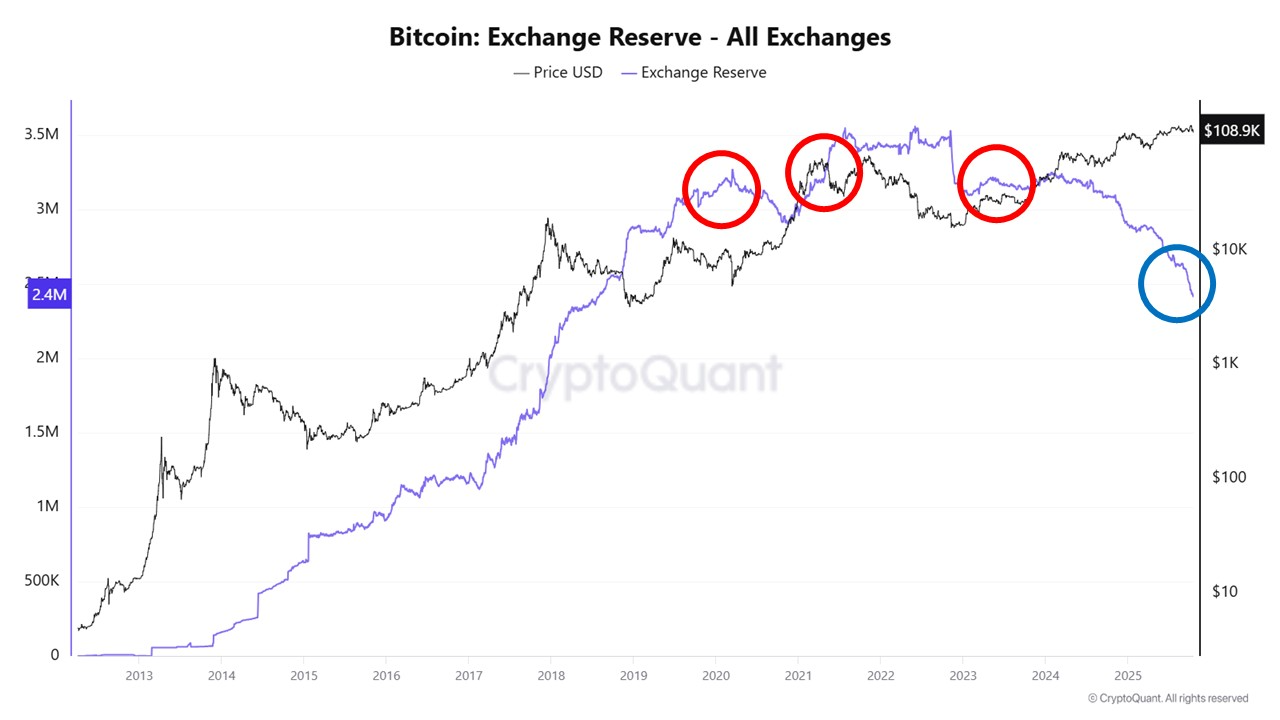
история обвала крипторынка
Биткоин: Резерв на биржах – Все биржи. Источник: CryptoQuant

Долгосрочные держатели не капитулируют

Поведение опытных инвесторов также подтверждает устойчивость рынка. Показатель LTH-SOPR, который отражает прибыльность долгосрочных держателей, в отличие от 2021 года, не опустился ниже отметки 1.

Это значит, что владельцы старых монет фиксируют прибыль, а не распродают активы в убыток.

Такое поведение указывает на рациональные действия инвесторов и отсутствие паники. Долгосрочные держатели продолжают удерживать позиции, укрепляя устойчивость сети и создавая фундамент для восстановления.

Аналитики CryptoQuant напоминают, что за последние годы V-образные отскоки часто следовали после ликвидации избыточного кредитного плеча. Так было, например, во время 30%-го падения в мае 2021 года (на фоне новостей о Tesla и китайских ограничениях):

крупные игроки тогда продали около 50 000 BTC, но выкупили 34 000 ближе к минимумам.

Похожая ситуация наблюдалась и в августе 2023 года — после коррекции на 15%, вызванной понижением кредитного рейтинга США, рынок быстро отыграл потери.

Розничные инвесторы усиливают накопление

Данные Glassnode подтверждают этот тренд. Метрика Bitcoin Accumulation Score by Cohort показывает, что активность мелких держателей заметно выросла: кошельки с балансом от 1 до 1 000 BTC накапливают активы, а не продают их.

«Мелкие держатели $BTC активизируются», — отметили аналитики Glassnode.

В то же время крупные инвесторы, владеющие более 1 000 BTC, сократили объёмы продаж и перешли в фазу ожидания.
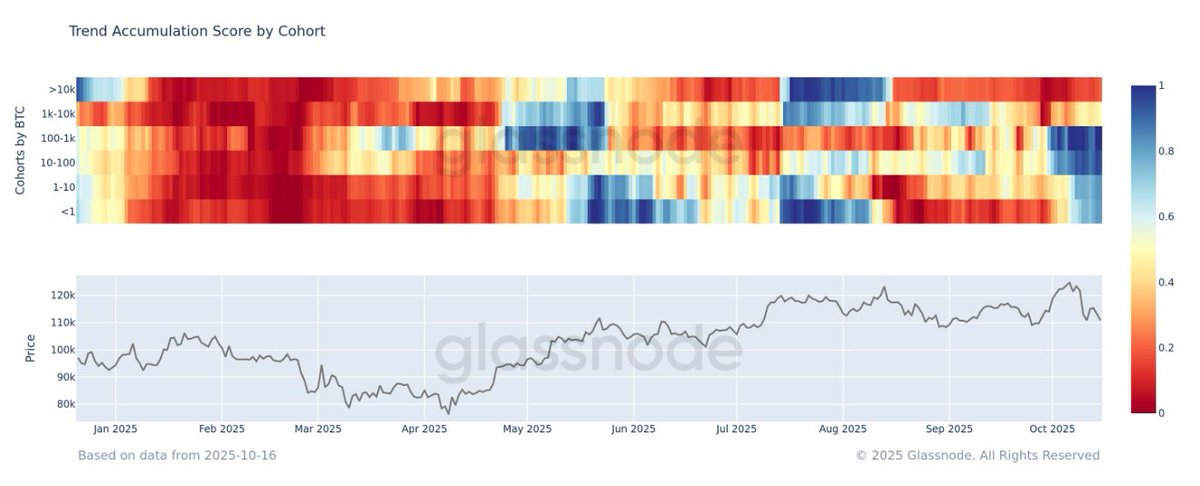
тепловая карта крипторынка
Данные “Скорость накопления биткоина по группам”. Источник: Glassnode

Таким образом, розничные участники рынка замещают краткосрочных спекулянтов, демонстрируя доверие к активу даже в условиях повышенной волатильности.

Подводим итог

Рынок криптовалют пережил серьёзную коррекцию, но структура осталась устойчивой. Долгосрочные держатели сохраняют уверенность, балансы на биржах остаются на минимуме, а розничные инвесторы продолжают покупать.

В совокупности эти сигналы показывают, что рынок вошел в стадию зрелости, где краткосрочные колебания уже не вызывают паники, а воспринимаются как возможность для накопления. Если тенденция сохранится, этот спад может стать не началом новой «криптозимы», а очередной фазой консолидации перед ростом.

Пов'язані матеріали

Goldman Sachs Bans It, Google Bans It Too: The Gray Zone of Prediction Markets Is Shrinking Fast

Goldman Sachs has updated its personal trading policy, prohibiting employees from trading event contracts on prediction markets involving specific companies (including whether Goldman itself might restructure or initiate acquisitions in a quarter), election outcomes, financial market performance (including Bitcoin prices), macroeconomic data, geopolitical events, and regulatory results for pending M&A deals. Sports and entertainment bets remain allowed. Violations can lead to dismissal or account closure, and the firm may reclaim profits over $200 or donate them to charity. This follows a CFTC case against a Google engineer who allegedly used non-public data to profit $1.2 million on Polymarket. Simultaneously, Google's Chrome Web Store updated its policy, banning extensions that facilitate real-money trading on prediction market outcomes, effective August 1, 2026. While not affecting platforms' websites or mobile apps directly, this restricts a key user access channel. These actions occur amid growing regulatory pressure on prediction markets. The CFTC is investigating Polymarket for alleged misconduct, and a consumer group has filed a lawsuit. Over 30 countries, including Argentina, have blocked access. Despite this, trading volume has hit record highs, and major investments continue, such as ICE's $2 billion stake in Polymarket. The core debate remains whether prediction markets are financial instruments or gambling. CFTC argues for federal oversight as derivatives, while some states seek to regulate them under gambling laws. Multiple fronts—federal probes, political pressure, internal corporate bans, and platform restrictions—are narrowing the operational space for these markets.

Foresight News7 хв тому

Goldman Sachs Bans It, Google Bans It Too: The Gray Zone of Prediction Markets Is Shrinking Fast

Foresight News7 хв тому

Tsinghua AI Mathematician Emerges: From Intuition to Theorem, Contributing to an 84-Page Quantum Algorithm Paper

Tsinghua University’s Intelligent Industry Research Institute (AIR) has developed an AI mathematician agent named AIM, designed not just to solve math problems but to actively participate in early-stage research. In a recent study, researchers collaborated with AIM to develop "Sign Embedding Quantum Algorithms," resulting in an 84-page paper on quantum algorithms for matrix equations and functions. The research began with a human researcher's intuition: can rational approximation serve as a design principle for quantum algorithms? AIM helped expand this idea into multiple candidate research directions. Human researchers then filtered and focused on the most promising path. AIM assisted in organizing theorems, generating proof drafts, and performing complexity analysis, while humans maintained oversight, auditing assumptions and refining derivations. This case illustrates a human-AI collaborative workflow: AI rapidly explores and expands research avenues, generates draft materials, and aids in checking derivations; human researchers provide critical judgment on direction, value, and validity. The process emphasizes "high-throughput candidate generation + human value gating + AI-assisted audit and repair + human final integration." The resulting quantum algorithm framework offers a unified approach to several matrix problems, advancing quantum linear algebra under more general conditions. This work suggests AI's role in theoretical research is evolving from task-specific assistance to supporting the entire research lifecycle—enhancing exploration and efficiency while keeping human expertise central to guiding inquiry and ensuring rigor. *Paper & System Links:* - AIM application report: https://arxiv.org/abs/2606.24899 - Quantum algorithm paper: https://arxiv.org/abs/2604.25333 - AIM repository: https://github.com/TheoryFoundry/AIMv2

marsbit58 хв тому

Tsinghua AI Mathematician Emerges: From Intuition to Theorem, Contributing to an 84-Page Quantum Algorithm Paper

marsbit58 хв тому

Short-Lived Meme Mania: Can It Be the Icebreaker for Robinhood's RWA Narrative?

Robinhood recently launched its own Layer 2 network, Robinhood Chain, built on Arbitrum and focusing on tokenized stocks, RWA, DeFi, and AI finance. Shortly after launch, a meme coin called CASHCAT, named after an early unused Robinhood brand, surged in popularity, achieving a market cap near $150 million and high daily trading volume. It gained traction through third-party DEXs and launchpads like Uniswap and Noxa.fun, bypassing Robinhood's official listing process. This highlights a key feature of the permissionless chain: even assets not officially approved can achieve significant liquidity and trading activity. While CASHCAT currently dominates the chain's meme coin sector, its high turnover indicates speculative trading. The rapid proliferation of new meme coins risks dispersing liquidity. Meanwhile, the chain's core RWA sector remains relatively small at $12.5 million. CEO Vlad Tenev has expressed that the chain is well-suited for both RWA and meme coins. In the optimistic scenario, meme-driven activity could bootstrap the chain's user base and liquidity for its long-term RWA vision. However, if the meme frenzy fades quickly, the RWA narrative may struggle to gain traction independently. The incident demonstrates that on a permissionless platform, the market itself can create major assets, offering Robinhood a potential new growth avenue beyond its core crypto business as it navigates the long-term development of the tokenized asset market.

Foresight News1 год тому

Short-Lived Meme Mania: Can It Be the Icebreaker for Robinhood's RWA Narrative?

Foresight News1 год тому

The Fall of Zapper: An Act of God or a Human Error?

The Fall of Zapper: A Post-Mortem of a DeFi Pioneer In July 2026, Zapper, a once-dominant DeFi portfolio tracker, announced its shutdown. Born in 2020 from a merger, Zapper capitalized on the DeFi Summer boom, reaching 2 million monthly users and processing over $13B in transactions, backed by $16.5M in funding from investors like Framework Ventures and Coinbase Ventures. Its core "Zap" feature simplified complex multi-step DeFi operations. Despite its early success, Zapper failed to build a sustainable business model. Revenue from DEX aggregation was minimal due to fierce competition, while maintaining its multi-chain data infrastructure was costly. Furthermore, the DeFi landscape shifted: capital consolidated around top protocols, reducing the need for complex portfolio tracking across numerous platforms. Zapper's user base and core demand eroded. The company attempted multiple pivots, including an NFT-based points system, a social app (Chainchat), and plans for a ZAP token protocol. However, these initiatives—often focused on creating new, speculative C端需求 rather than solving existing pain points—ultimately failed. Critics argue Zapper remained trapped in a "blockchain purist" mindset, prioritizing costly, non-revenue-generating features over its competitive DEX aggregator. Unlike competitor DeBank, which successfully pivoted to its Rabby Wallet, Zapper lacked a diversified revenue stream. Its closure highlights the peril for tooling projects that fail to adapt to market shifts and monetize effectively, serving as a cautionary tale for the industry.

Foresight News1 год тому

The Fall of Zapper: An Act of God or a Human Error?

Foresight News1 год тому

Торгівля

Спот
活动图片