BlackRock Plans Tokenization as IBIT Surpasses $100B in AUM and $HYPER’s Presale Reaches $23.9M

bitcoinistОпубліковано о 2025-10-17Востаннє оновлено о 2025-10-17

Анотація

Quick Facts: 1️⃣ BlackRock’s spot Bitcoin ETF IBIT surpassed $100B less than two years after its release on January 11,...

Trusted Editorial content, reviewed by leading industry experts and seasoned editors. Ad Disclosure

Quick Facts:

1️⃣ BlackRock’s spot Bitcoin ETF IBIT surpassed $100B less than two years after its release on January 11, 2024.
2️⃣ Larry Fink announced a long-term plan to tokenize all assets, from funds to stocks and cash.
3️⃣ Fink argues that bubbles don’t impact long-term investors and that time in the market outweighs opportunistic buy-ins.
4️⃣ Bitcoin’s Layer 2 project, Bitcoin Hyper ($HYPER) reaches $23.9M in presale and eyes a Q1 2026 release.

BlackRock’s spot Bitcoin ETF (IBIT) just surpassed $100B in assets under management (AUM), which prompted CEO Larry Fink to announce the company’s tokenization plans.

Fink made the comments during a CNBC interview, where he said:

I do believe we’re just at the beginning of tokenization of all assets, from real estate to equities to bonds, across the board.

Larry Fink, CNBC Interview

This comes over a year and a half after BlackRock launched its first tokenized fund, BUIDL, on the Ethereum network by partnering with Securitize.

In the official press release, Securitize’s co-founder and CEO, Carlos Domingo, said that BUIDL proves that tokenization is essentially unstoppable and that it will transform the capital market.
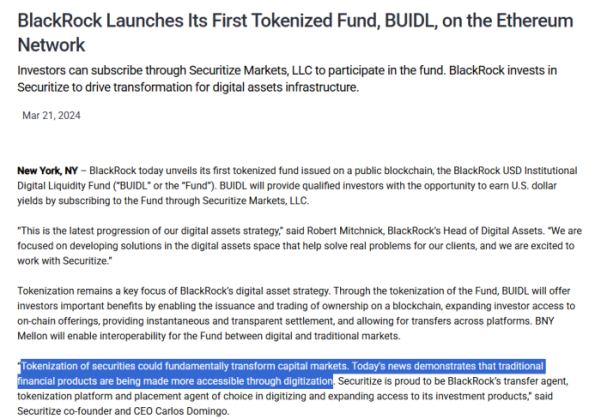
The official press release announcing BUIDL and showcasing Carlos Domingo’s comments.

With over $1T in AUM, BlackRock’s decision to invest in tokenization tech stems from Bitcoin’s and Ethereum’s success, especially amid 2025’s rampant adoption wave.

This spells good news for Bitcoin Hyper’s ($HYPER) $23.9M presale which feeds Bitcoin’s coming Layer 2 with a projected Q1 2026 public launch.

How BlackRock Could Transform the Capital Market

Fink believes that asset tokenization is imminent and the key step to attracting digital investors into the TradFi market, which pack more unpopular products like retirement funds.

The overarching goal is to allow investors to hold multiple assets together, including funds, cash, and cryptos, which would represent a turning point for the capital market as a whole.

To that end, Fink pushes for ‘time in the market,’ as opposed to opportunistic buy-ins, as an anti-bubble strategy. As he sees it, it’s only opportunistic buyers who push the notion of financial bubbles due to their short time in the market.

This doesn’t happen with long-term investors who ride the bubbles to follow the larger trend.

If you put money to work on January 1st, 2000, a year later you had the Dot Com crysis, six years later you had the financial crisis, you had the COVID crysis; you still would’ve made 8% compound interest over the entire 25 years.

It’s not about if our markets are going up or down […] it’s about being in the market for the entire cycle.

Larry Fink, CNBC interview

The same mindset applies to the digital market and Bitcoin is the living proof of that. While opportunistic snipers often find themselves in hot waters – last Friday’s market crash anyone? – long-term investors who bought $BTC in 2011 are now up 169,000,000%.
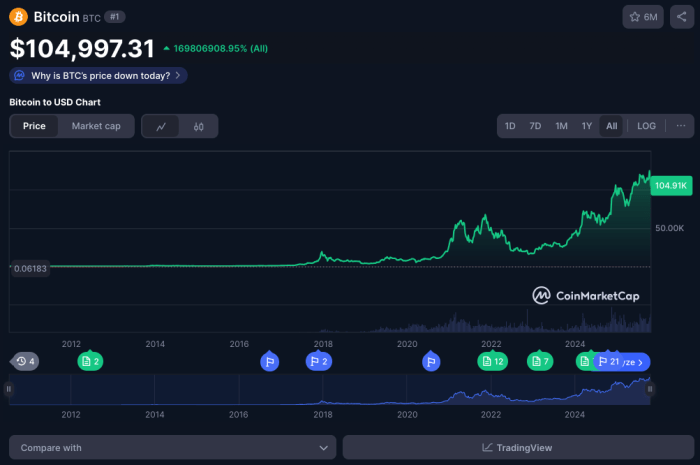
Bitcoin’s all-time performance on CoinMarketCap

Bitcoin’s recent performance only adds to that. $BTC now trades at just under $106K after a 13.7% drop over the last week, which is painful for leverage traders, but neutral for long-term investors, because Bitcoin will eventually bounce back.

Especially with Bitcoin Hyper just around the corner.

How Bitcoin Hyper Promises to Change the Bitcoin Ecosystem

Bitcoin Hyper ($HYPER) aims to address Bitcoin’s most pressing problem: its performance limitation.

With a hard cap of seven transactions per second (TPS), Bitcoin currently ranks 22nd on the list of the fastest blockchains by TPS. This translates to slow confirmation times, high fees, and lack of scalability.

Hyper relies on tools like the Solana Virtual Machine (SVM) and the Canonical Bridge to change that.

While SVM increases the network’s performance, unlocking the ultra-fast execution of DeFi apps and smart contracts, the Canonical Bridge addresses Bitcoin’s long confirmation times directly.

Once the Bitcoin Relay Program confirms incoming transactions in milliseconds, the Bridge then mints the bitcoins on the Hyper layer, allowing you to use the wrapped assets with near-instant finality within the Layer 2 ecosystem.
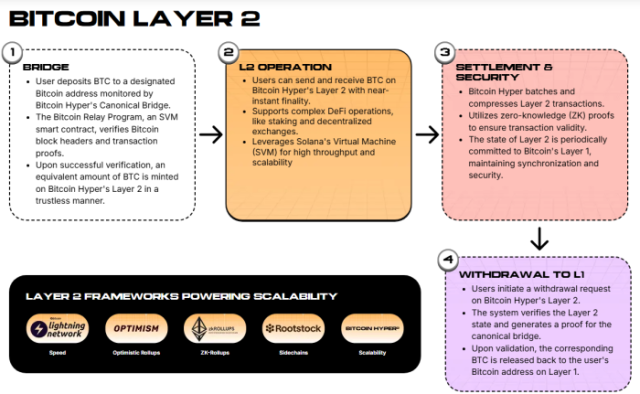
How Hyper’s Canonical Bridge works

Long-term, Hyper aims to turn Bitcoin into a more feasible option for institutional investors by making the network faster, cheaper, and more scalable.

The project is seeing outstanding investor support, managing to reach $23.9M since its beginning and it’s still growing fast.

$HYPER is available right now at the presale price of $0.013125, which could be the lowest you could ever buy the token at.

Based on the project’s utility, release window, and current investor support, our price prediction for $HYPER is $0.32 in 2025, with a Q4 release. Long-term, the token could push as high as $1.5 or higher by 2030, for a projected ROI of 11,328% if you invest today.

Long-term investments, remember?

If you want to get in while you still can, check our guide on how to buy $HYPER and visit the presale page today.

Join the $HYPER presale here.

This isn’t financial advice. Do your own research (DYOR) before investing.

Authored by Bogdan Patru, Bitcoinist: https://bitcoinist.com/blackrock-tokenization-bitcoin-etf-100b-hyper-surges

Editorial Process for bitcoinist is centered on delivering thoroughly researched, accurate, and unbiased content. We uphold strict sourcing standards, and each page undergoes diligent review by our team of top technology experts and seasoned editors. This process ensures the integrity, relevance, and value of our content for our readers.

As a crypto writer, Bogdan’s responsibilities are split between researching and writing articles and entertaining the team with his humor bordering on the politically incorrect, an aspiring Bill Burr, if you will. Thanks to his 12+ years of writing experience in just as many fields, including tech, cybersecurity, modelling, fitness, crypto, and other topics-that-shall-not-be-named, he's become a genuine asset to the team. While his position as a senior writer at PrivacyAffairs thought him valuable lessons about the power of self-management, his entire writing career was and is an exercise in self-improvement. Now, he's ready to sink his teeth into crypto and teach people how to take control of their own money on the blockchain. With fiat as an eternally devaluing currency, Bitcoin and altcoins seem like the best-fitting alternative for Bogdan. Bogdan’s biggest professional accomplishment, aside from securing a position as a main writer for Bitcoinist, was his 5-year run as a writing manager at Blackwood Productions, where he coordinated a team of four writers. During that time, he learned the value of teamwork and that of creating a working environment that breeds efficiency, positivity, and friendship.

Пов'язані матеріали

Base MCP, The Next Step for x402

Base has officially launched Base MCP, allowing users to connect their Base Account to AI Agents to perform actions like swaps, transfers, portfolio tracking, and transaction history queries through conversational commands. This move aligns with Base's strategic focus on AI, driven by the broader competition in the emerging Agent-to-Agent payment sector. The evolution of Agent payments has accelerated. In late 2024, the primary method involved insecure browser automation. By 2025, solutions like Coinbase's x402 (providing crypto wallets for Agents), Google's AP2, and Visa's token-based system emerged. x402 has since processed 176 million transactions totaling over $70 million, with a median value between $0.01 and $0.10. Stablecoins, particularly USDC, dominate these settlements due to their negligible transaction costs compared to traditional payment fees, which are prohibitive for micro-payments. Coinbase faces competition from Stripe, which has built a comparable infrastructure for Agent payments with its Tempo blockchain, Privy wallets, Bridge routing (acquired for $1.1B), and the recently launched MPP protocol. Both companies are now competing at the application layer. The core reason AI is central to Base's strategy is to expand the scenarios for Agent payments, ensuring more transactions occur on its network. By securing a dominant position and scale advantage in this nascent field, Coinbase aims to capture the future commercial potential of Agent-driven payments. The launch of Base MCP is thus a strategic step in this larger ambition.

marsbit5 хв тому

Base MCP, The Next Step for x402

marsbit5 хв тому

Reframing Ethereum's Valuation: Why the Fee Model is Wrong, and the 'Treasury Logic' is the Future?

"Rethinking Ethereum's Value: The 'Vault Logic' Framework" Traditional valuation models incorrectly treat Ethereum as a company, valuing ETH based on transaction fees ("revenue"). This is flawed. Fees are network friction; a successful network aims to reduce them to zero. Ethereum's average fee has dropped from over $50 in 2021 to around $0.20 today, while transaction volume has tripled. Instead, view Ethereum as a digital vault securing ~$250 billion in on-chain assets (stablecoins, RWAs, L2 bridged funds, wBTC, etc.). Post-merge, Ethereum's security is directly purchased with its own asset: ETH. To attack the network, an attacker must acquire and control staked ETH. Therefore, the vault's security level is intrinsically tied to ETH's market value. Currently, the value of all staked ETH is only ~$72B, protecting ~$250B in assets—a dangerous imbalance. For robust security, the staked ETH securing the network should be valued significantly *higher* than the total value it protects. Applying a conservative security multiplier suggests ETH's fair value should be closer to ~$6,900 (vs. ~$2,070 currently). As on-chain asset value grows into the trillions, ETH's price must rise proportionally to maintain this security budget. Comparisons to free infrastructure like Linux or low-margin utilities like the DTCC are misguided. Their security is provided externally (community, law, banks). Ethereum's security is internal and must be purchased in the open market using ETH. ETH is not the clearinghouse; it is the collateral backing it. The model is not a short-term price predictor but a structural framework. The economic force for ETH appreciation grows monotonically with the adoption of Ethereum for settling value. The narrative that high fees are good is backwards; low fees enable more activity, which increases the value needing protection, thus demanding a more valuable ETH.

marsbit12 хв тому

Reframing Ethereum's Valuation: Why the Fee Model is Wrong, and the 'Treasury Logic' is the Future?

marsbit12 хв тому

Justin Sun’s Interview with Hurun Report: A New Order and Certainty for Value Flow in the Era of Transformation

In an interview with *Hurun Report*, Justin Sun, founder of TRON, discussed the evolution of the Web3 industry as it moves from initial exploration to large-scale adoption. He emphasized that the core value of blockchain lies in building an open and inclusive internet of value, enabling anyone globally to transfer and use funds efficiently and at low cost, regardless of location or access to banking. Sun highlighted that projects with lasting impact are those built on genuine demand and real-world usage. He pointed to the stablecoin payment ecosystem as the most mature and scalable application currently, noting that TRON has rapidly become one of the world's largest stablecoin networks. The circulation of USDT on TRON has surpassed $86.3 billion, driven by actual use cases such as cross-border transfers and daily payments, demonstrating strong network effects. Regarding strategy, Sun outlined a methodology combining data-driven iteration, rapid execution, and user-centric focus. He cited the decision to partner with Tether to launch TRC-20 USDT as a key strategic move, based on an assessment of market trends and long-term potential, which has become a significant growth engine for the TRON ecosystem. On globalization, Sun stressed the importance of local compliance and cultural adaptation, noting that success in different markets depends on deep understanding and local partnerships. He also addressed the convergence of AI and blockchain, describing it as a transformative direction where blockchain provides decentralized infrastructure for AI, while AI enhances the intelligence and user experience of blockchain systems. For industry participants and young entrepreneurs, Sun advised continuous learning and adaptability in a fast-changing environment, focusing on building irreplaceable core strengths rather than spreading resources too thinly. Through infrastructure development, global strategy, and technological foresight, TRON aims to advance the practical implementation and evolution of the value internet.

marsbit44 хв тому

Justin Sun’s Interview with Hurun Report: A New Order and Certainty for Value Flow in the Era of Transformation

marsbit44 хв тому

Samsung Leverages Technology Cycles, SK Hynix Relies on HBM, What Enabled Micron to Win a Trillion-Dollar Market Cap?

Micron Technology, the Idaho-based memory chip maker, recently saw its market cap surpass $1 trillion, securing its position as one of the top three DRAM manufacturers alongside Samsung and SK Hynix. Its survival and growth story is marked by a unique combination of political maneuvering and hard-won manufacturing efficiency, but also strategic missteps that now challenge its future. Founded in 1978 in Boise without significant government or capital backing, Micron repeatedly turned to Washington for survival during critical junctures. In the 1980s, it filed anti-dumping complaints against Japanese firms, leading to the U.S.-Japan Semiconductor Agreement. Ironically, this created an opening for Samsung, which Micron had earlier licensed its 64K DRAM technology to. In 2002, Micron avoided heavy fines in a price-fixing investigation by acting as a whistleblower against its competitors, cementing its reputation as a "political opportunist." A major strategic error occurred in 2013 with its $2.5 billion acquisition of bankrupt Japanese firm Elpida. This deal burdened Micron with integrating incompatible manufacturing processes just as the industry was pivoting toward HBM (High Bandwidth Memory), a critical technology for AI. SK Hynix had launched its first HBM chip that same year. By the time AI demand exploded with ChatGPT in 2022, SK Hynix commanded about 85% of the HBM3 market, while Micron, playing catch-up, held only around 3%. In 2017, Micron employed similar tactics against a new competitor, Chinese startup Fujian Jinhua, by alleging intellectual property theft, which led to U.S. sanctions effectively crippling the firm. However, this strategy backfired in 2023 when China banned Micron's products from its critical infrastructure, causing its revenue share from China to plummet from 14% in FY2023 to just 7.1% by FY2025. Today, Micron faces a triple squeeze: it lags in the high-margin HBM race, faces pricing pressure in low-end DRAM from Chinese manufacturers like CXMT, and has lost crucial access to the booming Chinese AI server market. Despite its political strategies, Micron's core strength is its exceptional manufacturing cost control, achieved through decades of engineering. Its DRAM chips have a smaller cell area than its rivals, yielding more chips per wafer. This efficiency has been vital for weathering industry downturns. However, this advantage cannot compensate for the decade lost in HBM development. Micron is now racing to ramp up production of its HBM3E, certified by NVIDIA, and develop HBM4. Its future hinges on whether it can close this technological "time debt" through relentless R&D and execution, in a marathon where its competitors, having started earlier, are not slowing down.

marsbit1 год тому

Samsung Leverages Technology Cycles, SK Hynix Relies on HBM, What Enabled Micron to Win a Trillion-Dollar Market Cap?

marsbit1 год тому

Deconstructing Mysterious Researcher Serenity's Chokepoint Algorithm and the Global Revaluation of Equity Assets

Unmasking Serenity's "Chokepoint Theory": A Framework for AI-Era Investment This article deconstructs the investment methodology of the pseudonymous online researcher Serenity (formerly AleaBito on Reddit), who claims extraordinary returns by identifying critical bottlenecks in AI and robotics supply chains. Rejecting Wall Street's typical top-down analysis, Serenity employs a bottom-up, reverse-engineering approach. Starting with an end product like an Nvidia GPU cluster, he meticulously maps the global supply chain down to its most essential, irreplaceable physical components—the "choke points." These are low-profile, often monopolized sub-sectors where a disruption could paralyze entire downstream industries, analogous to a strategic strait controlling global oil flow. His primary focus is the physical evolution of AI data centers, specifically the shift from copper interconnects to silicon photonics and Co-Packaged Optics (CPO). He identifies five critical, monopolized technical barriers within CPO: high-precision fiber alignment components (e.g., FOCI), external light sources and high-power lasers (e.g., SIVE), molecular beam epitaxy equipment (ALRIB/Riber), ultra-high-purity red phosphorus raw materials, and Silicon-on-Insulator (SOI) wafers (Soitec). Serenity extends this framework to humanoid robotics, arguing that while the AI "brain" resides in the US, the physical "body" hardware (actuators, gears, motors) is dominated by Asian manufacturers. He highlights a looming "demand tsunami" for specific rare earth elements essential for robot motors, presenting a severe future supply chain and geopolitical challenge. The article cites several of his investment targets (RPI, SIVE, Soitec, VLN, NBIS) where identifying such choke points, coupled with correcting market mispricings (e.g., ticker code confusion for VLN), allegedly led to significant re-ratings. Ultimately, the article posits that Serenity's core value is not in providing stock picks, but in demonstrating a paradigm: using deep technical analysis to find the silent, indispensable "physical switches" within complex systems, thereby exploiting institutional research blind spots. However, it warns of major risks, including illiquidity in micro-cap stocks, potential "pump-and-dump" accusations, and the foundational gamble that his identified technological paths (like CPO) are the correct and inevitable ones.

marsbit1 год тому

Deconstructing Mysterious Researcher Serenity's Chokepoint Algorithm and the Global Revaluation of Equity Assets

marsbit1 год тому

Торгівля

Спот
Ф'ючерси
活动图片