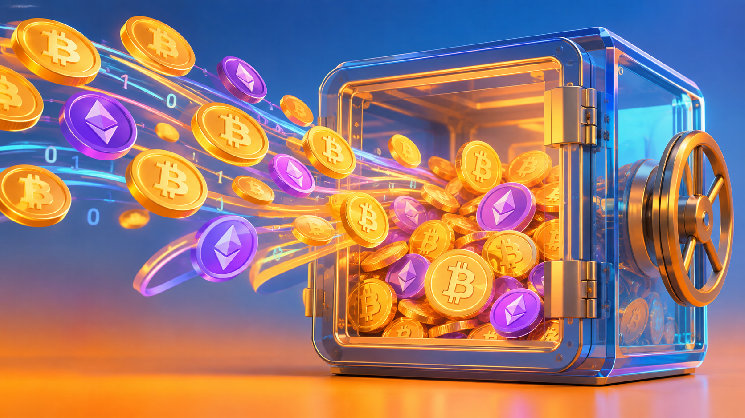
Люксембург инвестировал в биткоин для будущих поколений

cryptonews.ruОпубліковано о 2025-04-08Востаннє оновлено о 2025-10-09

Страна стала первой в еврозоне, вложившей средства в криптовалюту

Межпоколенческий суверенный фонд благосостояния Люксембурга (Fonds souverain intergénérationnel du Luxembourg, FSIL) инвестировал 1% своих активов в биткоин, передает Coindesk. Об этом сообщил министр финансов Люксембурга Жиль Рот во время презентации бюджета на 2026 год в Палате депутатов.

Отмечается, что таким образом, Люксембург стал первым государством в еврозоне, который вложил средства в биткоин. Финляндия также владеет биткоинами, но эти активы получены в результате конфискаций.

Чтобы избежать операционных рисков, инвестиции в биткоин осуществляются через ряд спотовых биржевых фондов (ETF), рассказал журналистам руководитель отдела по связям с общественностью Люксембургского финансового агентства Джонатан Уэстхед. По его словам, эти инвестиции — признание растущей зрелости класса криптовалютных активов.

rbc.group

«Кто-то может возразить, что мы слишком поздно ввязываемся в это дело; другие укажут на волатильность и спекулятивный характер инвестиций. Тем не менее, учитывая специфику и миссию FSIL, правление фонда пришло к выводу, что доля в 1% обеспечивает правильный баланс и в то же время дает ясный сигнал о долгосрочном потенциале биткоина. Очевидно, что то, что подходит FSIL, может не подойти другим инвесторам», — сказал Уэстхед.

FSIL был создан в 2014 году с целью формирования резерва, который может быть направлен на «содействие благополучию будущих поколений». В общей сложности активы фонда составляют, по информации журналистов, $730 млн. Большая часть из них вложена в облигации и акции, с 2025 года FSIL имеет право инвестировать 1% в криптовалюту.

Стратегические вложения в криптовалюты ряд стран делают уже несколько лет. Сальвадор покупает биткоины с 2021 года, Бутан копит намайненные. В США, Пакистане, Казахстане и Киргизии проводится создание резервов на государственном уровне.

Напротив, в Японии, Швейцарии и Австралии власти не поддерживают идею инвестировать в криптовалюты из-за их волатильности. В Минфине России в марте также заявили, что не рассматривают криптовалюту в качестве актива для Фонда национального благосостояния (ФНБ) из-за ее высокой волатильности.

9 октября, выступая форуме «Финополис-2025», зампред Банка России Владимир Чистюхин назвал создание государственного крипторезерва — «шагом в болото». Он подчеркнул, что сначала нужно посмотреть, как это будет работать в других странах.
Пов'язані матеріали

Jensen Huang's Daughter: From Chef to an $8 Million Annual Salary

Madison Huang, daughter of NVIDIA founder Jensen Huang, recently made a rare public appearance in Beijing during the 2026 World Robot Conference. As the Senior Director of Product and Technology Marketing for NVIDIA's Physical AI Platform, with an annual salary of approximately $1.2 million, her visit focused on evaluating leading Chinese robotics companies like UBTech, Unitree, and others. This highlights NVIDIA's strategic interest in the burgeoning Chinese robotics ecosystem, a key battleground for the development of Physical AI—technology that enables machines to understand and interact with the physical world. Huang's career path is unconventional. Initially pursuing her passion, she studied culinary arts, worked as a chef, and later held a marketing role at LVMH. She joined NVIDIA as an intern in 2020 after completing an MBA, quickly rising through the ranks. Her brother, Spencer Huang, followed a similar path, closing a cocktail bar he co-founded to also join NVIDIA, where he now works on robotics software. Jensen Huang has publicly addressed nepotism concerns, humorously noting that some "second-generation" employees outperform their parents. The conference itself underscored China's vibrant robotics sector, marked by Unitree's recent blockbuster IPO and a pipeline of companies preparing to go public. While hardware development and manufacturing are advancing rapidly, industry leaders like Wang Xingxing of Unitree point to the next critical challenge: developing the "brain" or AI that allows robots to perform diverse, unseen tasks based on simple instructions. With massive manufacturing scale and diverse real-world testing scenarios, China is positioned as a central player in the global race to define the future of robotics.

marsbit13 хв тому

Jensen Huang's Daughter: From Chef to an $8 Million Annual Salary

marsbit13 хв тому

He Gave Wang Xingxing the First 2 Million, Now Serves as Chairman for the Next 'Unitree'

On August 19, 2024, Unitree Robotics, China's "first humanoid robotics stock," went public. Its founder, Wang Xingxing, started a decade ago with his self-developed XDog. In 2016, at a critical funding juncture, he received his first angel investment of 2 million RMB from Yin Fangming. This bet has since yielded a return of over 140 times. Yin Fangming is more than just a key investor. He was a co-founder of the AI robotics company ROOBO, whose own venture ultimately struggled. This firsthand experience with the hardware challenges in robotics gave him unique insight when backing Unitree, a company renowned for its hardware R&D and cost control. While his own company faltered, Yin continued investing shrewdly. He partially cashed out some Unitree shares early, reinvesting the proceeds into sectors like energy (e.g., solid-state battery firm TaiLan) and commercial aerospace (e.g., small launch vehicle developer XianDeng Aerospace). However, his most significant move after Unitree is his deep involvement with Galaxy General, a leading embodied AI unicorn. In July 2024, Yin stepped from behind the scenes to officially become its Chairman, indicating a role far beyond a typical investor. This comes as Galaxy General is viewed as preparing for future capital moves. Yin's career has consistently been ahead of the curve—from mobile internet to AI and robotics. Known for his foresight and low profile, he declined an interview for this story, offering only a statement encouraging support for visionary entrepreneurs like Wang Xingxing.

marsbit28 хв тому

He Gave Wang Xingxing the First 2 Million, Now Serves as Chairman for the Next 'Unitree'

marsbit28 хв тому

Coldcard Theft Reflection: Source Code Visibility Does Not Equal Security

The article examines the open-source vs. closed-source debate in crypto, prompted by a theft of over $100M in Bitcoin from Coldcard hardware wallets. It clarifies key terminology: true "Free and Open Source Software" (FOSS) grants four essential freedoms (use, study, share, modify), while "source available" code, like Coldcard's firmware, may have usage restrictions. The piece argues that visible source code alone does not guarantee security; actual safety depends on the economic incentives for thorough, ongoing review by skilled individuals. Using Bitcoin Core as a model, the article describes a successful, transparent open-source development culture built on public review and consensus. It contrasts this with the Coldcard case, where a critical bug in a lightly-reviewed, source-available library went undetected for years, highlighting a "tragedy of the commons" scenario where assumed but absent scrutiny creates vulnerability. The economics of licensing are crucial: restrictive licenses can limit the pool of motivated commercial reviewers. Finally, the article explores AI's impact. It cites the Bitcoin Red Team's use of AI to rapidly audit codebases and find vulnerabilities at scale, demonstrating a powerful new tool for security. However, AI also floods projects with low-quality code, straining maintainers. The piece concludes that in high-stakes crypto, only well-audited projects—whether open or closed-source—can withstand evolving threats, with AI both challenging and aiding security practices.

marsbit38 хв тому

Coldcard Theft Reflection: Source Code Visibility Does Not Equal Security

marsbit38 хв тому

Торгівля

Спот
活动图片