Опрос: 73% криптоинвесторов поддерживают политику Трампа в отношении цифровых активов

cryptonews.ruОпубліковано о 2025-03-07Востаннє оновлено о 2025-10-08

  • По данным опроса, большинство криптоинвесторов (73%) одобряют действия Трампа в противовес лишь 39% американцев.
  • Кроме того, криптополитика будет ключевым электоральным фактором в США на выборах в Конгресс в следующем году.
  • Тем не менее, 37% опрошенных считаются с мнением республиканцев в вопросах криптополитики.

По результатам исследования McLaughlin & Associates, проведенного в июле 2025 года среди 800 криптоинвесторов по заказу лоббистской организации Digital Chamber, 73% респондентов поддерживают криптополитику президента США Дональда Трампа.

При этом его уровень одобрения среди криптоинвесторов составляет 54% — значительно выше, чем среди общего электората. Погрешность анализа составила 3,4%.
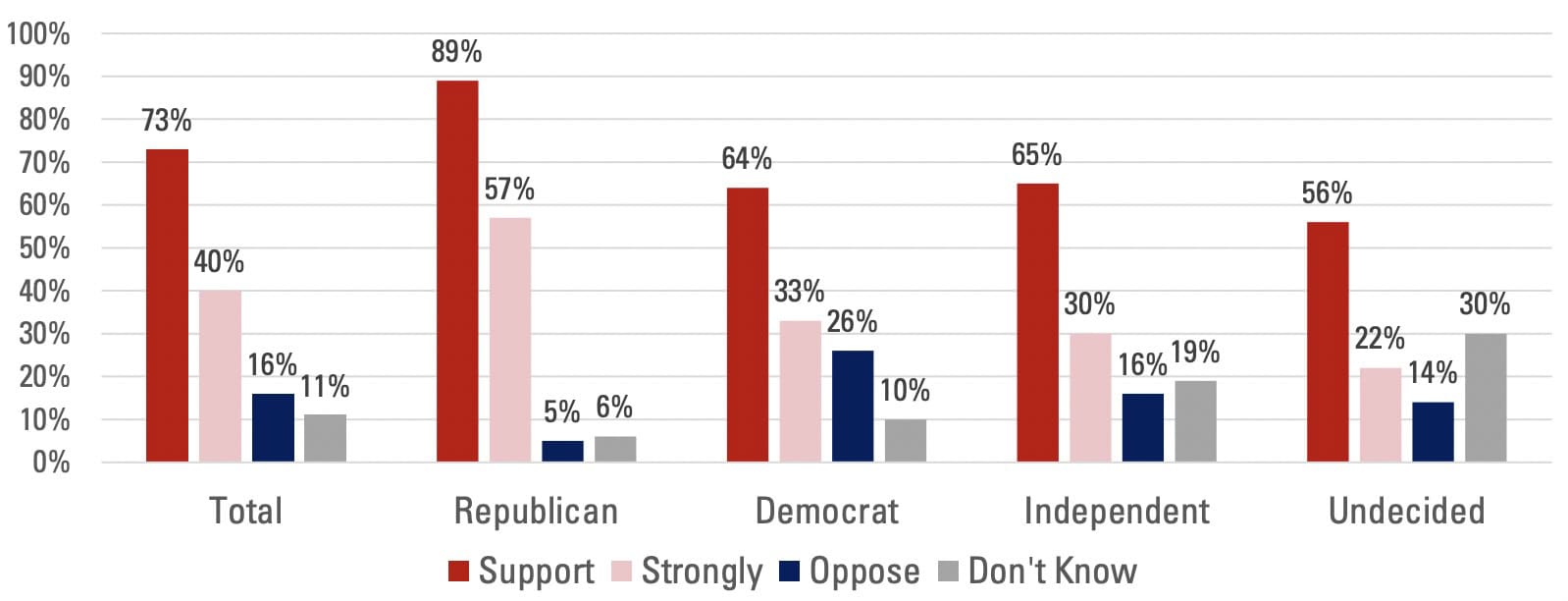
Результаты опроса McLaughlin & Associates. Источник: Digital Chamber.

Кроме того, 64% криптоинвесторов считают позицию кандидата в отношении цифровых активов важной при голосовании на промежуточных выборах в Конгресс 2026 года.

Эта тенденция, по словам аналитиков, начала формироваться еще в 2024 году, когда растущая доля избирателей начала называть криптополитику одним из главных вопросов на выборах.

Несмотря на то, что опрошенные в целом несколько склоняются к либеральным и демократическим взглядам, значительная часть из них поддерживает именно Трампа и Республиканскую партию.

Согласно исследованию:

  • 37% респондентов доверяют республиканцам в вопросах развития криптоиндустрии;
  • 24% — демократам;
  • 16% выбрали вариант «ни одна из сторон».

Как отмечается в отчете, «криптоинвесторы одобряют работу президента Трампа и больше доверяют ему и республиканцам, чем демократам, в продвижении криптоинициатив в США».

Несмотря на то, что политически эта группа имеет «профиль, более близкий к Демократической партии», большинство из них голосует за республиканцев на выборах в Конгресс.

Опрошенные криптоинвесторы, по данным исследования, чаще имеют высшее образование, более низкий уровень дохода, моложе, более разнообразны по этническому составу и, самое главное, чаще зарегистрированы как избиратели, чем средний американец.

Согласно The Economist, через 261 день после начала второго срока Трампа 39% американцев одобряют работу президента, 56% — не одобряют, а 4% не определились, свидетельствуют данные общенациональных опросов.

Несмотря на рост критики со стороны общества — из-за попыток Трампа «переформатировать правительство с помощью президентских указов, изменить торговую, иммиграционную и внешнюю политику» — криптоинвесторы оценивают его работу значительно выше среднего уровня.

Американцы в целом негативно относятся к тому, как он решает вопросы инфляции, экономики, иммиграции и преступности. Однако среди криптосообщества эти факторы преимущественно уступают важности его позиции по цифровым активам.

Напомним, что под руководством Трампа и республиканского Конгресса в этом году приняли первый масштабный закон о регулировании стейблкоинов.

Следующим шагом должно стать законодательство, которое урегулирует более широкий рынок криптоактивов в США, однако этот процесс затормозился из-за бюджетного кризиса и временного прекращения работы правительства.

Несмотря на то, что республиканцы в целом выступают более активными сторонниками криптополитики, значительная часть демократов также поддержала ключевые голосования для продвижения законопроектов. Также демократы разработали и представили свою версию инициативы о регулировании крипторынка в США.

Пов'язані матеріали

Just now, DeepSeek V4 updates with DSpark, improving inference speed by 80%

DeepSeek has updated its DeepSeek V4 model with the DSpark speculative decoding framework, achieving a significant 60-85% speedup in generation for Flash models and 57-78% for Pro models while maintaining the same overall throughput. This engineering-focused update, rather than a core architectural change, introduces DSpark to address latency and throughput bottlenecks in high-concurrency production environments. DSpark combines high-throughput parallel generation with adaptive load-aware verification. Its key innovations include a semi-autoregressive generation architecture to model dependencies within token blocks and a hardware-aware confidence-scheduled verification system. This system uses a confidence head to predict token acceptance probabilities, allowing it to dynamically optimize verification length per request and allocate compute only to tokens with the highest expected payoff. The asynchronous scheduler is designed for real-world deployment, ensuring zero-overhead scheduling and continuous CUDA graph replay while preserving the target model's output distribution. In tests across mathematical reasoning, code generation, and daily dialogue, DSpark outperformed state-of-the-art models like Eagle3 and DFlash, increasing average acceptance length by 26.7%-30.9% and 16.3%-18.4% respectively on Qwen3 target models. DeepSeek also open-sourced DeepSpec, a full-stack codebase for training and evaluating speculative decoding draft models, providing a standardized toolkit that includes data preparation tools, model implementations, training code, and evaluation scripts.

marsbit2 год тому

Just now, DeepSeek V4 updates with DSpark, improving inference speed by 80%

marsbit2 год тому

BIT Research: The 2028 Halving Is Not the End, the Real Shake-Up of the Bitcoin Mining Industry Is Just Beginning

The Bitcoin mining industry is undergoing its most complex structural adjustment since inception. Despite Bitcoin's price holding near $61,000 and the network hash rate approaching a record 1 ZH/s, miner profitability is deteriorating. The industry is operating close to its breakeven point, with the 2028 halving expected to accelerate consolidation. The challenges extend beyond the halving's subsidy reduction; the industry's revenue model has yet to successfully transition towards a fee-driven structure. Increasingly, mining companies are evolving from simple Bitcoin producers into infrastructure and energy operators, including providers of AI/HPC computing power. Competition is shifting from pure hash rate expansion to business model upgrades. Economic pressure is evident. The theoretical daily mining revenue at current prices is around $78 million, yet the actual figure is only about $33 million—a 136% gap. Transaction fees remain low at roughly $220k daily, far below historical implied levels. With a current estimated industry-wide breakeven price near $65,000, mining alone is struggling to generate ideal profits. The 2028 halving is projected to push the fundamental production cost floor to approximately $93,289. This will likely accelerate a shift towards consolidation among larger, well-capitalized miners with diversified revenue streams. Competitive advantage will belong to institutionalized players with access to low-cost energy, AI/HPC hosting operations, and stronger balance sheets. In essence, Bitcoin mining is transitioning from a "mining business" to an "infrastructure business." Future profitability and resilience will depend less on block rewards and more on diversified income sources like energy management and computational infrastructure services. For investors, the key question is not the halving itself, but which miners can successfully navigate this business model transformation.

marsbit4 год тому

BIT Research: The 2028 Halving Is Not the End, the Real Shake-Up of the Bitcoin Mining Industry Is Just Beginning

marsbit4 год тому

This is How God Karpathy Uses Claude?

Andrej Karpathy, a prominent figure in AI, has reportedly joined Anthropic, leading to a noticeable decrease in his open-source contributions and social media activity. A document claiming to be his personal "CLAUDE.md" file—a set of instructions for the Claude AI to follow within a specific codebase—has been circulating online. While its authenticity is unverified, the content aligns closely with Karpathy's publicly shared principles on effective AI-assisted programming. The document outlines key rules for AI coding assistants, emphasizing the importance of reading existing code thoroughly before writing new code to maintain consistency. It advises against over-engineering, advocating for simple, surgical modifications that match the project's existing style. Other guidelines include clarifying assumptions upfront, writing meaningful tests, thoughtful debugging, and carefully considering dependencies. The core message is that these principles help prevent common AI coding failures, such as introducing unnecessary abstractions, style drift, or making invisible architectural decisions. The community has noted that even experts like Karpathy require detailed instructions to guide AI effectively, akin to managing a junior developer. A related GitHub repository, "andrej-karpathy-skills," which encapsulates these ideas, is reported to significantly reduce Claude's code error rate. Ultimately, the advice stresses that the best CLAUDE.md is tailored to one's own tech stack and coding practices.

marsbit4 год тому

This is How God Karpathy Uses Claude?

marsbit4 год тому

Торгівля

Спот
活动图片