Bitcoin Price Pulls Back From $125K Record High: Analysts See Path Toward $170K in Q4

bitcoinistОпубліковано о 2025-10-06Востаннє оновлено о 2025-10-07

Анотація

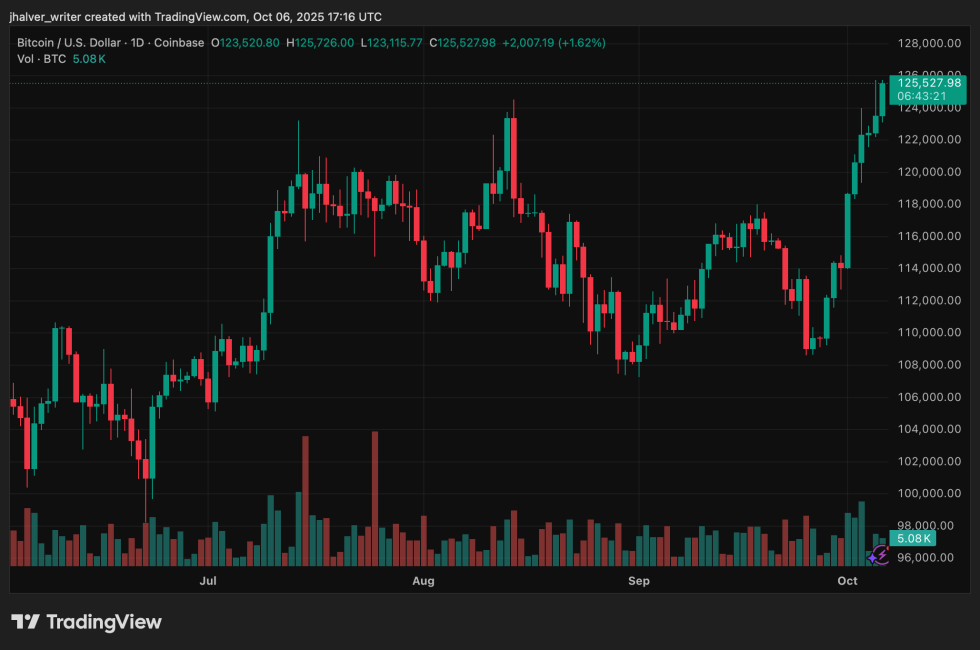
The Bitcoin price set a fresh all-time high near $125,700 before easing back as traders locked in gains and reassessed...

Trusted Editorial content, reviewed by leading industry experts and seasoned editors. Ad Disclosure

The Bitcoin price set a fresh all-time high near $125,700 before easing back as traders locked in gains and reassessed near-term risks. Despite the dip, market structure remains bullish. Spot ETF demand is accelerating, exchange balances are at multi-year lows, and macro tailwinds continue to favor “digital gold.”

With “Uptober” seasonality intact, several strategists now map a route toward $150K–$170K in Q4 if inflows persist.
Bitcoin price btc btucsd

BTC's price trends to the upside on the daily chart. Source: BTCUSD on Tradingview

Why Bitcoin Rallied to a Record

The latest breakout was supported by a perfect storm of demand and scarcity. U.S. spot Bitcoin ETFs drew $3Billion plus of net inflows in early October, led by heavyweight issuers, while on-chain data show exchange reserves sliding to 6–7-year lows (roughly 2.45–2.83M BTC).

That supply squeeze, Bitcoin moving to self-custody, treasuries, and ETF vaults, reduces sell pressure at the same time large buyers add exposure.

Macro helped too. A weaker dollar, government-shutdown uncertainty, and shifting rate-cut odds boosted safe-haven bids, with Bitcoin tracking alongside gold’s strength. Historically strong Q4 performance (the “Uptober” effect) layered on a behavioral tailwind as trend followers chased the breakout.

Key Levels to Watch in Q4

After hitting a fresh ATH, Bitcoin has entered a consolidation phase above its key support zones, setting the stage for Q4’s next major move. The $121,000–$118,000 range now acts as the primary demand pocket, with deeper support at $115,000 and $108,000, levels tied to the origin of the recent impulse rally.

On the upside, traders are watching $135,000 as the immediate resistance and potential price magnet, while a strong weekly close above the psychological $150,000 mark could open the path toward the $165,000–$170,000 corridor.

Overall market internals remain healthy: spot-driven accumulation is outpacing leveraged speculation, liquidations were minimal at the highs, and funding rates have stayed balanced.

These factors suggest a controlled advance rather than a blow-off top, meaning any dip into the $118,000–$121,000 zone accompanied by declining volume is likely to be seen as a re-accumulation opportunity by seasoned investors.

Will $170K Happen This Quarter?

The bullish case hinges on sustained ETF inflows and ongoing exchange supply shrinkage.

If net creations remain robust and long-term holders keep coins off-market, price discovery can extend toward $150K to $165K then $170K. Seasonality supports the view that Bitcoin has historically outperformed in Q4 when September closes green.

Risks to monitor include a sharp ETF outflow week, a US-dollar rebound, or regulatory shocks, all of which could force a retest of sub-$118K supports. However, as long as BTC holds $120K on a closing basis and the spot bid persists, analysts argue the path of least resistance remains higher.

Cover image from ChatGPT, BTCUSD chart from Tradingview

Editorial Process for bitcoinist is centered on delivering thoroughly researched, accurate, and unbiased content. We uphold strict sourcing standards, and each page undergoes diligent review by our team of top technology experts and seasoned editors. This process ensures the integrity, relevance, and value of our content for our readers.

Пов'язані матеріали

Fei-Fei Li's Team Clarifies the Concept of 'World Models', Sora Merely a Renderer

"World Models" has become a widely used yet confusing term in AI. To address this, a team led by Fei-Fei Li and World Labs proposed a functional taxonomy based on the Partially Observable Markov Decision Process framework. This taxonomy categorizes systems called "world models" into three distinct projections: Renderers, Simulators, and Planners. Renderers, like OpenAI's Sora and other video generation models, focus on producing photorealistic visual outputs for human perception. They prioritize visual fidelity over physical accuracy. Simulators, such as NVIDIA Omniverse, aim to compute precise future environmental states for computational tasks like engineering analysis or digital twins. Planners, like Vision-Language-Action models, take in observations and goals to output executable actions for robots or agents. The article clarifies that most current "world models," including Sora, are primarily Renderers. They generate convincing visuals but lack the core ability to simulate state transitions based on actions, a key requirement for a true world model in classic reinforcement learning definitions. This conceptual confusion has practical implications, leading to potential misalignment in technology selection, investment, and public understanding of AI capabilities. Clear categorization is crucial. It helps enterprises avoid costly mistakes (e.g., using a renderer for robot training), allows investors to accurately assess markets, and enables researchers to build comparable benchmarks. While future systems may integrate these functions, recognizing current boundaries is essential for honest assessment and progress.

marsbit45 хв тому

Fei-Fei Li's Team Clarifies the Concept of 'World Models', Sora Merely a Renderer

marsbit45 хв тому

Bloomberg Uncovered: How Do China's Wealthy Circumvent the Annual $50,000 Limit to Transfer Assets?

**Summary: How Wealthy Chinese Circumvent $50,000 Annual Foreign Exchange Limits** Despite China's strict capital controls, including an annual $50,000 per person foreign exchange quota, an estimated $150 billion in funds still leaves the country annually via various gray and underground channels. This report outlines the evolution of China's "capital wall" and the methods used to bypass it. **The Evolving Capital Controls:** * **Foundation (1994):** The system of "current account convertibility with strict capital account controls" was established. * **Quota Set (2007):** The $50,000 individual annual forex purchase limit was formalized. * **Crackdown Begins (2015-2017):** Following market volatility, enforcement tightened. Banks were required to scrutinize transactions, and channels like using UnionPay cards for Hong Kong insurance premiums or buying overseas property were blocked. * **Digital & Legal Upgrades (2024-2026):** Enhanced algorithms now flag suspicious patterns (e.g., "smurfing"). The Common Reporting Standard (CRS) provides Chinese tax authorities with data on citizens' offshore accounts. Unlicensed cross-border brokers have been targeted. **Five Primary Methods for Moving Capital:** 1. **Underground Banking / "Hawala" (Duiqiao):** The largest-scale method. No money crosses borders. Clients pay RMB to a domestic account; an overseas associate deposits equivalent foreign currency into the client's offshore account. Risks include high fees, account freezes, and legal penalties. 2. **"Smurfing" or "Ant Moving":** Using multiple individuals' $50,000 quotas to pool funds for one offshore recipient. Increasingly detected by anti-money laundering algorithms. 3. **Trade Invoice Manipulation:** Businesses over-invoice imports or under-invoice exports via offshore shell companies, creating a pretext to transfer excess funds abroad under the guise of trade. 4. **Channel Migration:** After a crackdown on internet brokers, funds flow toward more compliant but costly channels like major banks' cross-border wealth management services or Qualified Domestic Institutional Investor (QDII) quotas. 5. **Structural Arrangements:** High-net-worth individuals use complex, high-cost legal structures involving offshore trusts, insurance, and investment migration programs to transfer asset ownership. **Regulatory Response: Focusing on People, Not Just Money** The current strategy extends oversight from enterprises to **individual residents**. Tools like CRS allow retroactive visibility into offshore assets. Cryptocurrencies, once seen as a potential loophole, are now actively monitored and prosecuted as an illegal channel. The underlying driver remains: with significant wealth concentrated among millions of affluent households seeking diversification amid domestic economic shifts, the incentive to move assets offshore persists despite regulatory barriers.

marsbit1 год тому

Bloomberg Uncovered: How Do China's Wealthy Circumvent the Annual $50,000 Limit to Transfer Assets?

marsbit1 год тому

Торгівля

Спот
Ф'ючерси
活动图片