Bitcoin All-Time High At $125,700 Was A Trap, Warns Analyst

bitcoinistОпубліковано о 2025-10-06Востаннє оновлено о 2025-10-07

Анотація

Bitcoin’s dramatic weekend spike to a fresh all-time high of $125,700 lacked real spot demand and was largely the product...

Trusted Editorial content, reviewed by leading industry experts and seasoned editors. Ad Disclosure

Bitcoin’s dramatic weekend spike to a fresh all-time high of $125,700 lacked real spot demand and was largely the product of leveraged speculation in thin conditions, according to crypto analyst Maartun, who characterized the move as a classic fakeout rather than a durable breakout. “Bitcoin prints a brand new all-time high, $125,700… But hold on a second. The price almost immediately reversed,” he said, framing the question that followed: “Was that move for real?”

The Truth Behind Bitcoin’s Weekend Surge

Maartun argues the answer sits in the futures market. Open interest—capital tied up in outstanding derivatives positions—“didn’t just go up, it absolutely exploded,” rising by more than $2.1 billion during the rally. In his telling, that surge came “over a weekend, which is a time when there are way fewer buyers and sellers around,” amplifying the impact of leveraged positioning in a low-liquidity window. “This whole move was driven by futures, by bets,” he said, adding that the jump in open interest, roughly 5%, turned the market into “a house of cards ready to fall over at the slightest touch.”

Equally important, Maartun says, is what did not happen: an influx of committed spot buyers to underpin the advance. Earlier in the week, he notes, Coinbase showed aggressive spot demand, trading about $110 above other venues—evidence of “real buyers… snapping up Bitcoin.” During the weekend push, that premium vanished. “The gamblers were placing their bets,” Maartun said, “but the investors, the people actually buying Bitcoin, they were sitting this one out.”

With those two “clues”—a derivatives-led surge and the absence of spot confirmation—Maartun’s verdict is unambiguous. “You can call it a fake out, you can call it a swing failure pattern, or you can even call it the head of a head and shoulders pattern… It was a trap. A move that was designed to look like the real deal, but had absolutely no substance behind it.” After the brief print at $125,700, price swiftly retraced “right back down to where the whole move started,” he added.

From here, Maartun identifies a single inflection point: $123,000. “This is the level… that is going to tell us whether the bulls or the bears take control from here,” he said. On confirmation criteria, he is explicit: “What we need to see is a strong, confident close above that $123K mark. That would signal acceptance… and a true breakout is probably coming.”

Failure to reclaim and hold that area, in his view, likely hands momentum back to sellers with an initial drawdown target around $117,500. He also cautions against expecting a repeat head-fake at the same level: “Fakeouts don’t usually happen twice in a row. The second attempt to break a level like this is very often the real deal one way or the other.”

The broader context to Maartun’s assessment is the unusual timing and texture of the move. Weekends in crypto “are normally kind of sleepy,” he said, yet this one delivered “the best weekend performance we’ve seen in four whole months”—a signal, in his analysis, not of rekindled spot enthusiasm but of how quickly leverage can dominate price in quiet order books. Without renewed spot leadership—such as a return of the Coinbase premium or other evidence of net spot accumulation—he sees the market “on a knife’s edge” at the $123,000 line in the sand: “Break out or pull back?”

At press time, Bitcoin held above $124,216.
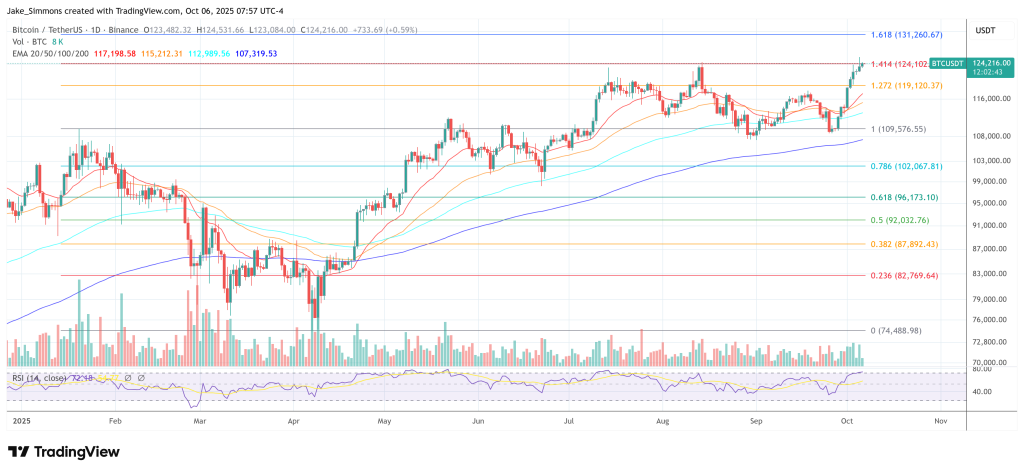
Bitcoin price
BTC remains above $124,000, 1-day chart | Source: BTCUSDT on TradingView.com
Featured image created with DALL.E, chart from TradingView.com
Editorial Process for bitcoinist is centered on delivering thoroughly researched, accurate, and unbiased content. We uphold strict sourcing standards, and each page undergoes diligent review by our team of top technology experts and seasoned editors. This process ensures the integrity, relevance, and value of our content for our readers.

Jake Simmons has been a Bitcoin enthusiast since 2016. Ever since he heard about Bitcoin, he has been studying the topic every day and trying to share his knowledge with others. His goal is to contribute to Bitcoin's financial revolution, which will replace the fiat money system. Besides BTC and crypto, Jake studied Business Informatics at a university. After graduation in 2017, he has been working in the blockchain and crypto sector. You can follow Jake on Twitter at @realJakeSimmons.

Пов'язані матеріали

STRC Breaks Below $95: Why Does It Continue to Depeg? Is There Default Risk?

"STRC Falls Below $95: Why the Persistent Depegging and Is There Default Risk?" The article discusses the recent decline in the price of STRC, a perpetual preferred stock issued by Strategy (MSTR) designed to trade around a $100 par value. As of publication, STRC traded at $94.65, raising market concerns. STRC is described as a high-yield cash flow product, offering an 11.50% annual dividend paid monthly. Its "preferred" status grants it priority over common stock for dividends and in liquidation. Key reasons cited for the price depegging include: 1. **Bitcoin's Price Drop:** MSTR's assets are heavily tied to Bitcoin (BTC), which fell over 21% from its recent high, pressuring all Strategy-related products. 2. **Competitive Pressure:** Rival Strive Asset Management's similar product, SATA, offers daily dividends and has maintained its $100 par value with a ~13% yield. In response, Strategy has proposed changing STRC's dividend frequency from monthly to bi-weekly, pending shareholder vote. 3. **Technical Selling:** A break below $100 may have triggered algorithmic selling and stop-losses, exacerbating the decline. Regarding default risk, the analysis suggests it is currently low. Strategy founder Michael Saylor confirmed the June 2026 dividend rate remains at 11.50% with no cuts or suspensions. The company's massive reserve of 843,706 BTC provides a significant backstop for its obligations. Industry opinions are mixed. Some analysts view the BTC holdings as reliable support for dividends, while critics like Peter Schiff warn of potential dividend cuts leading to price crashes and lawsuits. Others highlight inflation risk and the company's ability to reduce dividends without a formal default. In summary, STRC's drop is attributed to BTC volatility, competition, and technical factors. While immediate default risk appears contained, the product faces challenges from market conditions and competitive dynamics.

marsbit7 хв тому

STRC Breaks Below $95: Why Does It Continue to Depeg? Is There Default Risk?

marsbit7 хв тому

AI Trading Cools, South Korean Stocks Plunge 1.8%, Spot Gold Rises 1%, Bitcoin Dives

A sell-off in AI-related stocks, triggered by Broadcom's disappointing earnings forecast, sent shockwaves through global markets. South Korea's KOSPI led Asia's decline, plunging 1.8% as the risks from concentrated chip stock gains and surging leveraged investments came to the fore. The tech-heavy Nasdaq 100 futures fell 0.5% following Broadcom's 14% after-hours plunge, which signaled a slower-than-expected transition to AI clients. This pullback extended Wall Street's weakness, halting the S&P 500's nine-day rally amid hawkish Fed signals and renewed Middle East tensions. South Korean authorities convened an emergency meeting, pledging "immediate measures" against market volatility and warning of record-high stock margin debt. The adjustment rippled across assets: Bitcoin fell to around $64,000, its lowest since February, while safe-haven gold rose 1% on bargain hunting. Oil prices dipped on Middle East ceasefire news. Market analysts noted the sell-off was driven by profit-taking after massive gains, particularly in chip stocks like Samsung and SK Hynix, which now dominate the KOSPI. Wall Street banks are divided on Korea's outlook, with Goldman Sachs raising its target while Citigroup and others warn of overvaluation and a potential bubble. Bridgewater's Ray Dalio noted that great technological shifts often create bubbles. Meanwhile, Fed officials' hints at potential future rate hikes added to the cautious mood ahead of key U.S. jobs data.

华尔街日报33 хв тому

AI Trading Cools, South Korean Stocks Plunge 1.8%, Spot Gold Rises 1%, Bitcoin Dives

华尔街日报33 хв тому

Seeking Alpha's Hot Article: Why Might the U.S. Stock Market Crash in June?

In a recent Seeking Alpha article, financial professor and analyst Damir Tokic argues that the US stock market may be poised for a significant crash in June 2026. The core thesis centers on a "mega-bubble" in equities, particularly within the technology sector, which has driven the S&P 500 to near-record valuations, with a Shiller P/E ratio exceeding 40—a level comparable to the 2000 dot-com bubble. Tokic identifies two primary catalysts for a potential collapse. First, he points to unsustainable market exuberance fueled by what he terms the "Trump Stimulus"—massive AI capital expenditure by tech giants, which he believes is politically driven and cannot last. Second, and more urgently, he highlights the escalating Iran war as a critical threat. The ongoing closure of the Strait of Hormuz has created a severe global energy supply crunch. Strategic petroleum reserves are projected to hit critically low operational levels by June, potentially causing oil prices to spike above $200 per barrel and triggering a severe, supply-driven inflationary shock. This scenario, Tokic warns, would force the Federal Reserve's hand. Despite currently maintaining a dovish bias, the Fed would likely be compelled to officially pivot to a hawkish stance at its June FOMC meeting to combat soaring inflation and bond yields. He contends that such a shift—or even a failure to act, which would destroy Fed credibility—could be the trigger that punctures the market bubble. The resulting downturn, he concludes, could rival the bear markets of 2000 and 2008, advising investors to prepare for a major correction.

marsbit56 хв тому

Seeking Alpha's Hot Article: Why Might the U.S. Stock Market Crash in June?

marsbit56 хв тому

Торгівля

Спот
Ф'ючерси
活动图片





