За три месяца предложение стейблкоинов выросло на рекордные $45 млрд

cryptonews.ruОпубліковано о 2025-10-13Востаннє оновлено о 2025-10-13

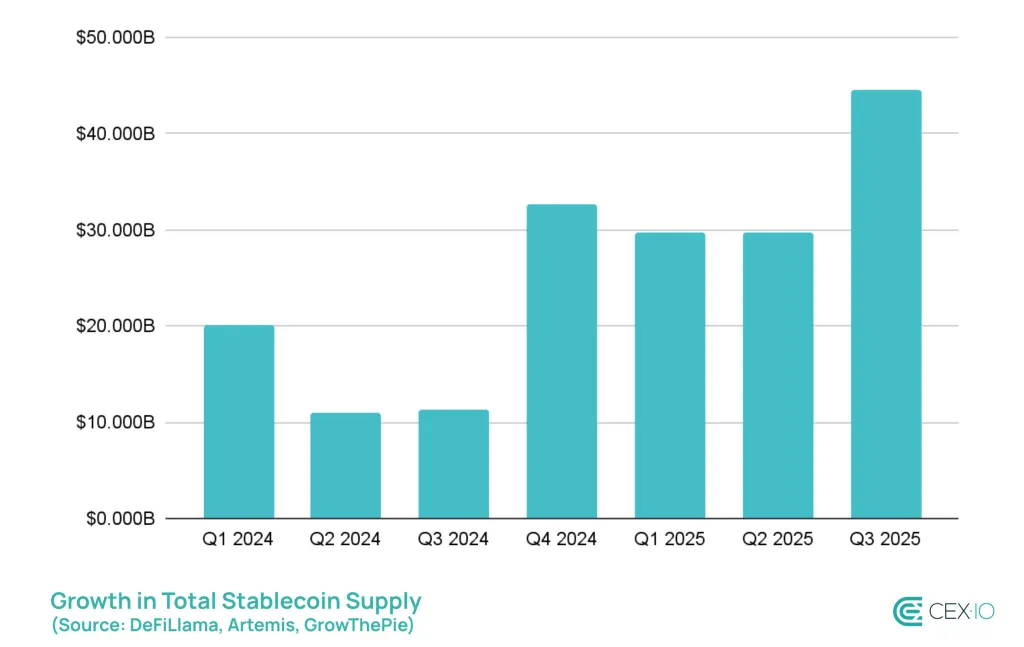
В III квартале общее предложение «стабильных монет» выросло более чем на $45 млрд — самый большой показатель за всю историю. Об этом говорится в отчете CEX.io.
Источник: CEX.io.

Совокупный показатель превысил $300 млрд.

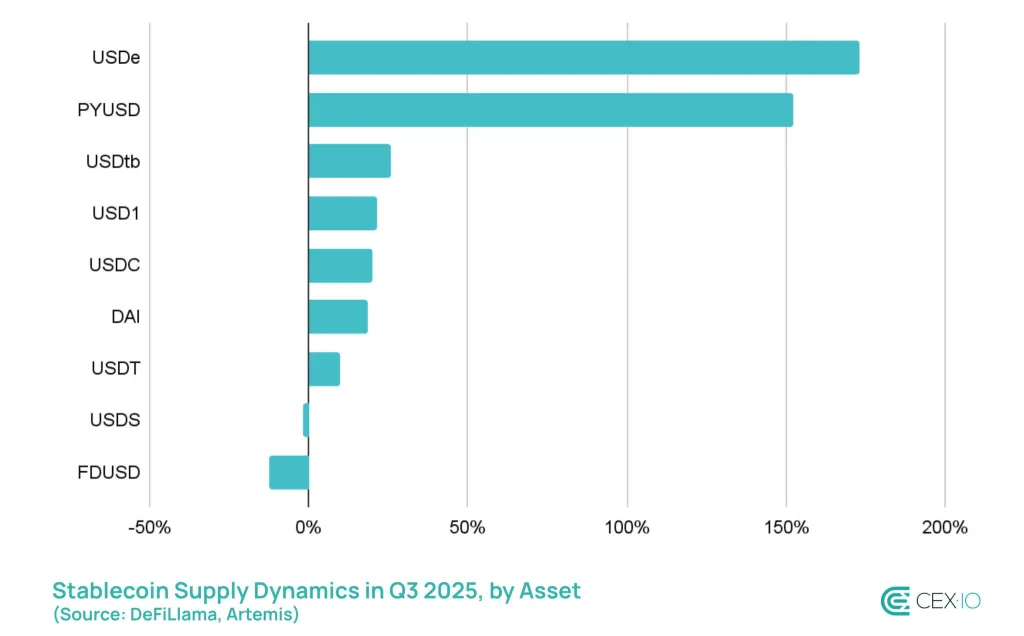
84% новой эмиссии за июль-сентябрь пришлось на USDT, USDC и USDe. При этом 69% от «напечатанного» объема выпущено в основной сети Ethereum.

По приросту предложения лидируют USDe и PYUSD (+173% и +152% соответственно), несмотря на закон GENIUS Act, запрещающий доходные стейблкоины в США.
Источник: CEX.io.

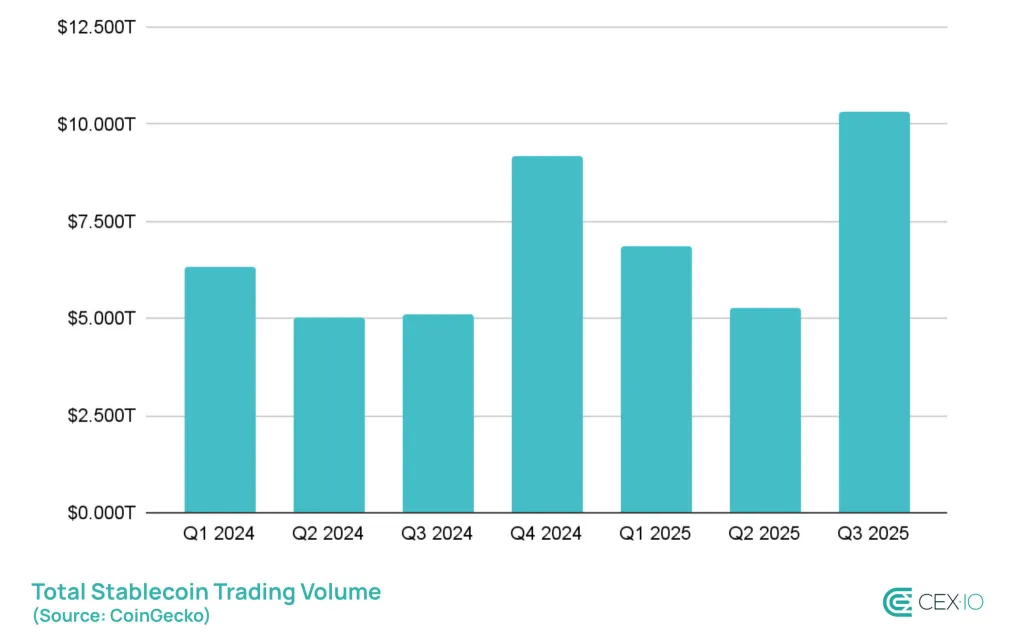
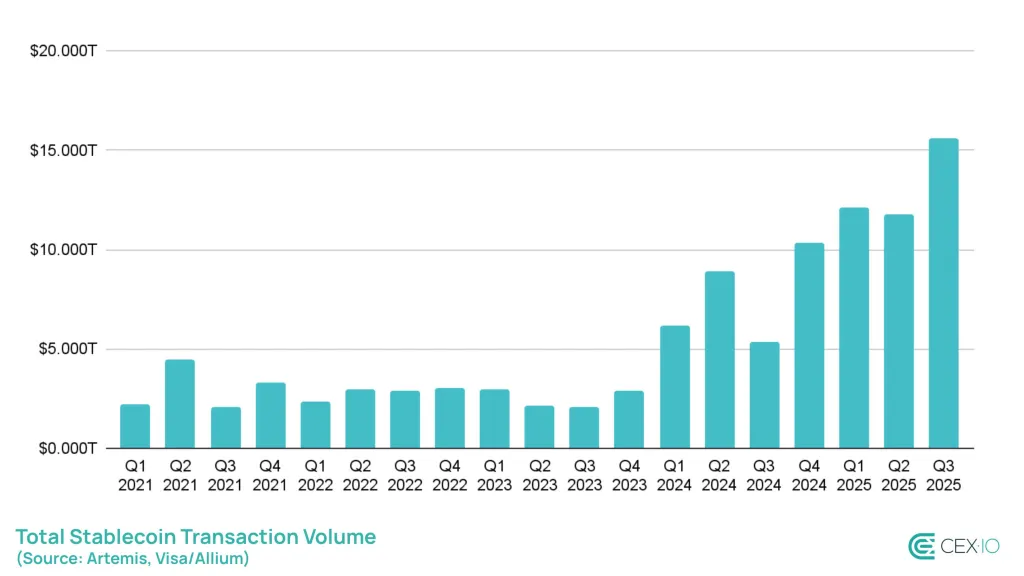
Общий объем торгов «стабильными монетами» в III квартале достиг $10,3 трлн, что сделало его самым активным с первой половины 2021 года. Среднесуточный показатель вырос до $124 млрд — он более чем вдвое превышает значения августа-июня.
Источник: CEX.io.

«Первоначально отскок был обусловлен возросшей активностью на более широких рынках криптовалют, но позднее в том же квартале стейблкоины также стали ключевым инструментом оборота капитала, поскольку осторожность начала расти», — объяснили авторы отчета.

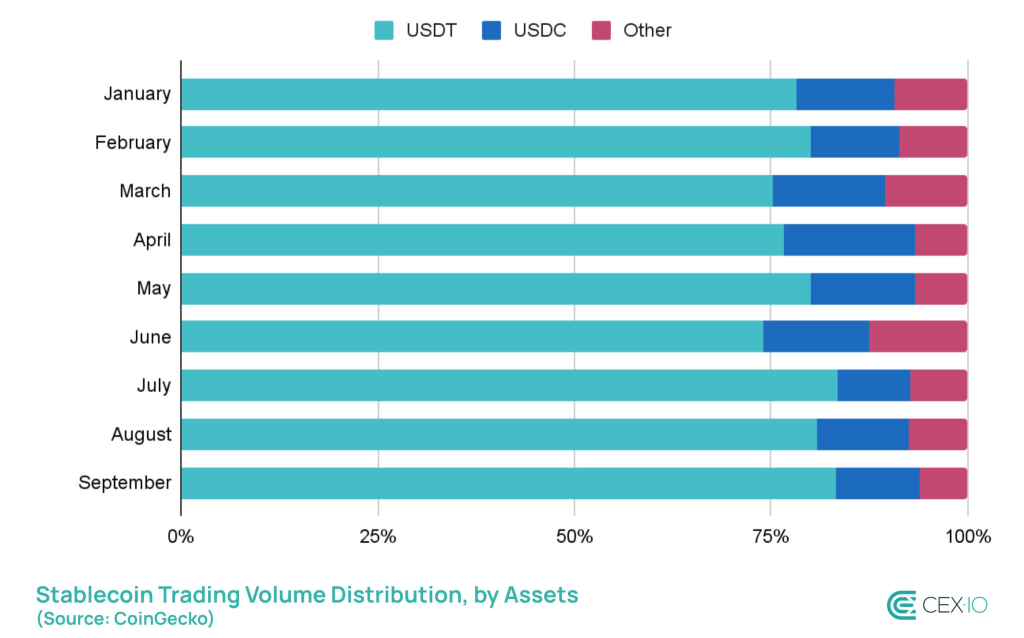
USDT удалось укрепить доминирование по объему торгов. Его доля в квартальном выражении выросла с 77,2% до 82,5%, в то время как у USDC снизилась с 14,5% до 10,5% . Другие монеты тоже потеряли позиции.
Источник: CEX.io.

Стейблкоин Tether обогнал монету от Circle по обороту на DEX, впервые превысив месячный показатель в $100 млрд. Это свидетельствует о том, что доминирование USDT все больше распространяется на децентрализованные биржи, потенциально подрывая позиции USDC в DeFi, отметили в CEX.io.

Рекордный оборот и боты

За прошедшие три месяца совокупный объем транзакций со «стабильными монетами» вырос до исторического максимума в $15,6 трлн. Доля органических переводов выросла более чем на 30%, достигнув нового рекорда в $2,9 млрд.
Источник: CEX.io.

Однако боты продолжают доминировать, составляя 71% всех ончейн-транзакций со стейблкоинами.

«Рост количества автоматизированных переводов был наиболее заметен в августе и оставался высоким до сентября, несмотря на некоторое охлаждение рынка. Всплеск активности ботов и немаркированных высокочастотных транзакции может вызвать вопросы о возможном распространении фиктивной торговли и не имеющих экономической ценности операций», — отметили исследователи.

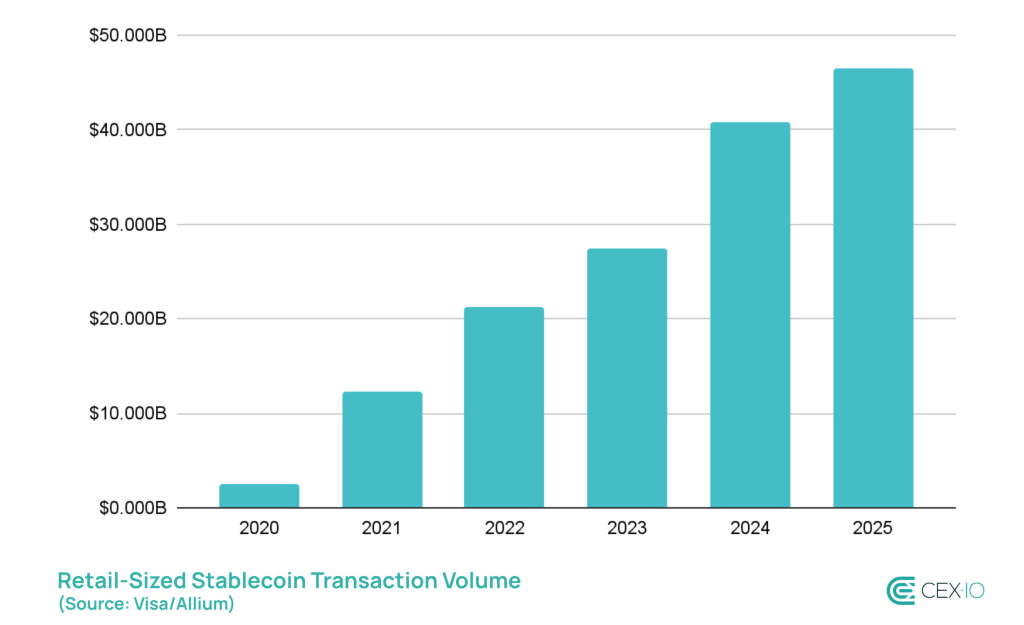
Среди органический переводов наиболее сильно выделился ритейл (транзакции на сумму менее $250). Показатель достиг нового исторического максимума, что помогло 2025 году стать «самым активным годом в истории розничного использования стейблкоинов».
Источник: CEX.io.

«III квартал подтвердил, что стейблкоины больше не являются просто вспомогательным инструментом для криптовалютных рынков — они становятся ядром расчетов и даже шлюзом для розничного внедрения. Заглядывая в IV квартал, можно сказать, что эта динамика, вероятно, сохранится», — заключили эксперты.

Напомним, в сентябре аналитики Moody’s указали на риски бума «стабильных монет» для денежного суверенитета и финансовой стабильности.


Пов'язані матеріали

Pantera Capital: As Perpetual Contracts Move Towards the Financial Center, Hyperliquid Aims to Be All-Encompassing

Perpetual futures ("perps"), once a crypto-native phenomenon, are becoming a dominant global financial instrument, evolving into a fundamental market structure shift that traditional finance can no longer ignore. This article outlines the advantages of perpetual contracts over traditional futures, highlighting their simplicity (no expiry/rollover), easier risk management, and native 24/7 operation. While the concept is not new, digital assets provided the ideal environment for its explosive growth. Initially dominated by centralized exchanges (CEX), perps have recently migrated significantly to decentralized exchanges (DEX), with Hyperliquid emerging as the leading DEX for perps, capturing ~40% of the on-chain volume. Hyperliquid, built on its own purpose-built L1 blockchain, has successfully expanded beyond crypto into traditional assets like stocks, commodities, and indices, driven by its permissionless listing framework (HIP-3) and 24/7 availability. It has become a crucial price discovery venue during off-hours and for pre-IPO companies, attracting attention from traditional hedge funds and major exchanges like ICE, which now views it as serious competition. The investment thesis for Hyperliquid's token, HYPE, rests on its large and growing total addressable market (TAM) across all finance, strong execution, superior user experience, and direct value accrual via aggressive token buybacks using 99% of protocol revenue. Key risks remain, primarily regulatory uncertainty in the U.S., though recent CFTC actions approving certain regulated crypto perp contracts signal a potential shift toward broader acceptance. The core question is no longer if perpetuals matter beyond crypto, but whether blockchain-based infrastructure like Hyperliquid can become the primary venue for pricing, trading, and discovering risk across all financial domains.

marsbit1 год тому

Pantera Capital: As Perpetual Contracts Move Towards the Financial Center, Hyperliquid Aims to Be All-Encompassing

marsbit1 год тому

Tiger Research: Zuckerberg Begins Betting on Prediction Markets, While Asian Nations Still View Them as Gambling

This article examines the rise of prediction markets, contrasting their growing institutional acceptance in the West with their restrictive regulation in Asia. It details how prediction markets, which originated from informal political betting and academic experiments like the Iowa Electronic Market, aggregate crowd wisdom into probabilistic prices through binary contracts. Their growth accelerated around 2020, reaching over $14 billion in monthly volume. A key driver is the "skin in the game" principle, where users risk their own capital, leading to high accuracy in predicting events like Fed rate decisions and elections, as demonstrated by platforms like Polymarket. Meta's entry, with Mark Zuckerberg reportedly leading the development of the Arena app, signals the market's maturation. In the U.S., court rulings have distinguished prediction markets from gambling, facilitating entry by traditional financial institutions. However, most Asian jurisdictions still classify them as gambling, focusing on social control rather than financial innovation. The article argues this stance creates three problems for Asia: 1) regulatory arbitrage pushes users to riskier offshore platforms, 2) loss of sovereign information infrastructure as valuable social sentiment data accumulates abroad, and 3) abandonment of user protection. It concludes that Asia needs a policy shift from prohibition to constructive regulation, integrating these markets into the formal system to harness their data as a national asset, as initiatives like Limitless Research are beginning to do.

marsbit4 год тому

Tiger Research: Zuckerberg Begins Betting on Prediction Markets, While Asian Nations Still View Them as Gambling

marsbit4 год тому

Торгівля

Спот
活动图片