DeepSeek Predicts SOL to Break $450 – $750 by Year-End, Snorter Token Stands to Benefit

bitcoinistОпубліковано о 2025-10-01Востаннє оновлено о 2025-10-01

Анотація

Chinese AI tool DeepSeek has high hopes for Solana’s next growth spurt, citing several bullish catalysts: technological upgrades, a favorable...

Trusted Editorial content, reviewed by leading industry experts and seasoned editors. Ad Disclosure

Chinese AI tool DeepSeek has high hopes for Solana’s next growth spurt, citing several bullish catalysts: technological upgrades, a favorable macro environment, and ETF approvals.

Suppose these factors work as planned, the chatbot believes that $SOL could exceed $450 by this year’s end – a 108%+ increase compared to its current $220 price tag.

It even goes as far as to suggest that a $750 price point might not be out of the equation.

And when $SOL rises, it’s not just a win for the asset itself. Solana-based projects often experience increased user activity and deeper liquidity – especially those pushing boundaries, like Snorter Token’s upcoming trading bot.

Solana’s Growth to Explode Under Compute Limit Upgrade

DeepSeek scouts the web in real time, ingesting and analyzing vast amounts of publicly available data – its findings aren’t to be sneezed at.

The chatbot found that a key driver of Solana’s future will likely be its expanding ecosystem. As applications like DeFi protocols and NFT marketplaces scale, demand for $SOL – which is required for transaction fees and staking – is expected to surge.

Another major catalyst includes technological advancements on the Solana network. Under Jump Crypto, Firedancer developers are working on SIMD-0370 to eliminate Solana’s fixed compute limit.

In turn, it should slash transaction finality from roughly 12.8 seconds to just 150 milliseconds. This would significantly boost Solana’s efficiency as a leading blockchain for real-time apps.
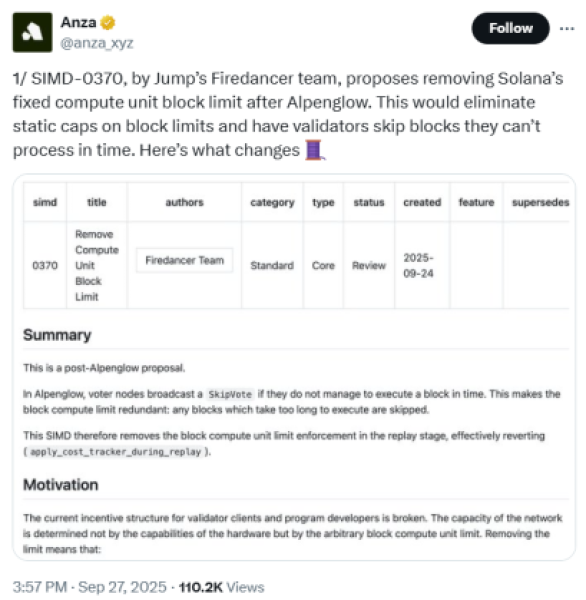
Anza announced Jump Crypto SIMD-0370 upgrade on X.
Source: X (Anza)

Macroeconomic conditions could also play a major role in $SOL’s success.

If 2025 brings lower interest rates and increased market liquidity, risk-on sentiment could return to financial markets. In such an environment, capital often flows into riskier assets like crypto, and which are better ones to invest in than the leaders: $BTC, $ETH, and $SOL?
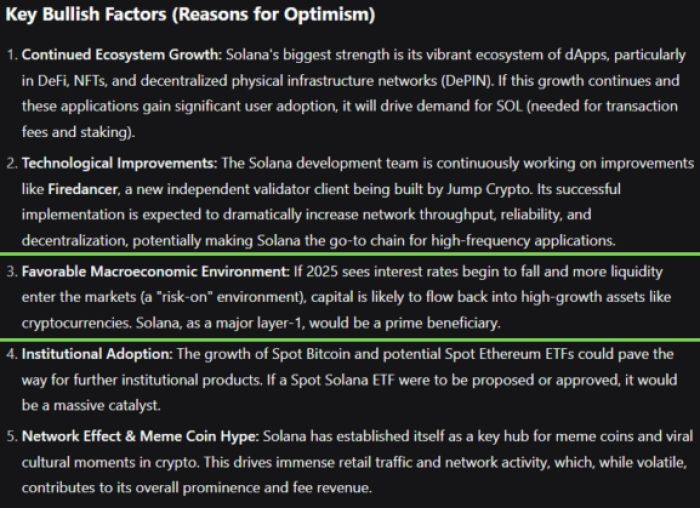
SOL bullish factors on DeepSeek.
Source: DeepSeek

Another area to watch? Solana ETFs, of course. The reason is that they’d unlock institutional capital, increase market liquidity, and cement $SOL’s status alongside $BTC and $ETH as a cornerstone asset in the digital economy.

Bloomberg analyst James Seyffart recently announced that significant movement is already underway on this front. Multiple issuers – Franklin, Fidelity, CoinShares, Direction, and Bitwise – have all submitted updated filings for $SOL ETFs.

With progress being made by the Securities and Exchange Commission (SEC), approvals may be just around the corner.
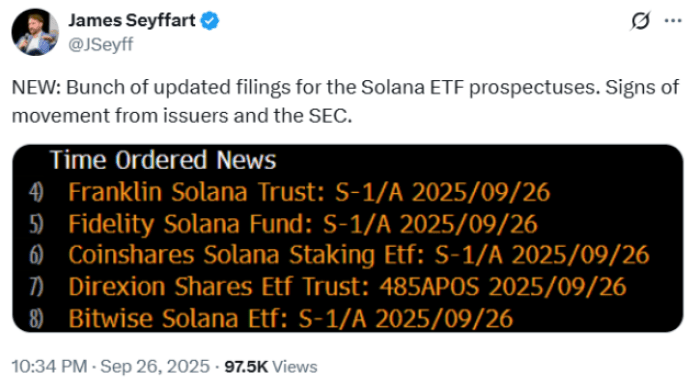
Bloomberg analyst announced SOL ETF filings on X.
Source: X (James Seyffart)

Finally, the network, driven by the best Solana meme coins and viral cultural moments like high-profile NFT mints (check out Mad Lads and Tensorians), continues to be a significant growth engine.

Together, these developments could propel not only $SOL but Solana-based projects like Snorter Token ($SNORT) to even rosier pursuits.

Snorter Bot to Go Live on Solana This Quarter

$SNORT would significantly benefit from a $SOL price rise as its flagship product – Snorter Bot – is set to go live on Solana this quarter.

The Telegram trading bot is designed to give traders a potent edge in the ultra-fast crypto market. By leveraging Solana’s high throughput, it promises to offer the lowest trading fees (at just 0.85%) and the fastest execution speeds.

When also taking into account Solana’s upcoming SIMD-0370 upgrade, its transaction fees might become even lower.

While it strategically picks Solana as its first network of choice, the bot’s also set to expand across Ethereum, BNB Chain, and other EVM-compatible chains. Doing so means that it’ll open the door to broader trading opportunities.

Whichever chain you favour, the bot will offer many ways to help you hunt down the next crypto to explode.

Take its copy trading tool, for instance. By copying the strategies of top-performing traders, you’ll be able to capitalize on market opportunities without deep crypto know-how.

To top it off, it promises to roll out automated sniping so that you can enter new token launches as soon as they go live.

Another boon is its upcoming set limit tool. You’ll be able to automatically buy and sell tokens at your preferred price tag, whether online or offline.
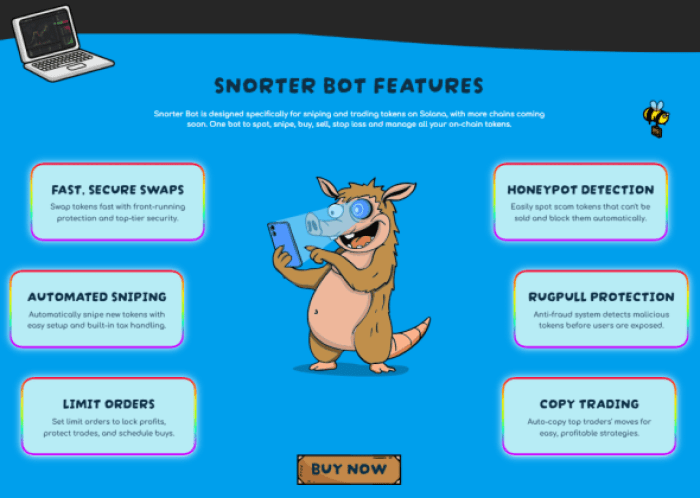
Top Snorter Token bot benefits.
Source: Snorter Token

And all will be achieved without compromising security. Snorter Bot will be MEV-protected and include built-in rug pull and honeypot detection alerts, so you don’t fall victim to scams.

Join the Snorter Token Presale for Possible 782% Returns

Behind it all is $SNORT, the ecosystem’s native token. It sets aside a substantial 25% of its total token supply for development, ensuring continuous innovation and growth.

By purchasing $SNORT, you not only contribute to its future trajectory, but are also granted perks. Think leaderboard rewards, staking yields up to 113% APY (if you join now), and DAO rights.

You can get involved by purchasing $SNORT on presale for as little as $0.1065, using either $SOL, $ETH, $USDT, $USDC, $BNB, or fiat.

Our Snorter Token price prediction anticipates it to close at around $0.94 this year. There might not be any better time to join the presale for potential returns exceeding 782%.

Join Snorter Token for possible 8x gains.

Disclaimer: This isn’t investment advice. DYOR and never invest more than you’re willing to lose. 

Authored by Leah Waters, Bitcoinist – https://bitcoinist.com/deepseek-sol-prediction-boosts-snorter-token

Editorial Process for bitcoinist is centered on delivering thoroughly researched, accurate, and unbiased content. We uphold strict sourcing standards, and each page undergoes diligent review by our team of top technology experts and seasoned editors. This process ensures the integrity, relevance, and value of our content for our readers.

Leah is a British journalist with a BA in Journalism, Media, and Communications and nearly a decade of content writing experience. Over the last four years, her focus has primarily been on Web3 technologies, driven by her genuine enthusiasm for decentralization and the latest technological advancements. She has contributed to leading crypto and NFT publications – Cointelegraph, Coinbound, Crypto News, NFT Plazas, Bitcolumnist, Techreport, and NFT Lately – which has elevated her to a senior role in crypto journalism. Whether crafting breaking news or in-depth reviews, she strives to engage her readers with the latest insights and information. Her articles often span the hottest cryptos, exchanges, and evolving regulations. As part of her ploy to attract crypto newbies into Web3, she explains even the most complex topics in an easily understandable and engaging way. Further underscoring her dynamic journalism background, she has written for various sectors, including software testing (TEST Magazine), travel (Travel Off Path), and music (Mixmag). When she's not deep into a crypto rabbit hole, she's probably island-hopping (with the Galapagos and Hainan being her go-to's). Or perhaps sketching chalk pencil drawings while listening to the Pixies, her all-time favorite band.

Пов'язані матеріали

Anthropic's IPO Launch: Commercial Miracle or Valuation Bubble?

Anthropic has confidentially filed for an IPO, led by Morgan Stanley and Goldman Sachs, potentially going public by October. Following its latest $650 billion funding round, its pre-IPO valuation stands at $965 billion, with projections reaching up to $2 trillion at listing, which would make it the highest-valued private company ever. The article, written by Fu Sheng, addresses skepticism that this represents an AI bubble akin to the 2000 dot-com crash. It argues the current situation differs fundamentally. Unlike the internet bubble era, which relied on speculative narratives with little revenue, Anthropic's valuation is backed by unprecedented, measurable financial performance. Key data points include: * **Revenue Growth:** ARR skyrocketed from $10 billion in early 2025 to $470 billion by May 2026, targeting $100 billion by year-end—a growth curve unmatched in business history. * **Profitability:** It achieved operating profitability in Q2 2026 with an estimated $5.6 billion profit. * **Efficiency:** With ~3,000 employees and ~$470 billion ARR, its revenue per employee exceeds $10 million. Products like Claude Code, launched less than a year ago, already generate $25 billion in annualized revenue. * **Enterprise Adoption:** It boasts a strong enterprise client base, with 8 of the Fortune 10 and over 1,000 large firms spending over $1 million annually on Claude. The valuation is framed using a traditional SaaS model (e.g., a 10x Price-to-Sales multiple on $100 billion revenue). The author contends the core question for analysts has shifted from "How big could this be?" to "How much is it earning and will earn next quarter?" The discussion extends beyond Anthropic to a broader paradigm shift: the transition from a "carbon-based" to a "silicon-based" economy. Companies are increasingly prioritizing investment in compute and AI capabilities over human resources, as these directly scale productivity and competitive advantage. Anthropic's IPO is thus positioned not just as a corporate milestone, but as a price anchor for this new economic era.

链捕手1 год тому

Anthropic's IPO Launch: Commercial Miracle or Valuation Bubble?

链捕手1 год тому

Near Returns to the AI Stage: Transformation into a Public Chain Due to 'Payroll Difficulties,' Agent and Privacy Emerge as New Growth Narratives

NEAR Returns to AI Origins: From Payroll Struggles to Blockchain, Now Focusing on AI Agents and Privacy NEAR Protocol's journey began not with grand blockchain ambitions, but from a practical hurdle: its AI startup founders, including Transformer paper co-author Illia Polosukhin, couldn't efficiently pay international developers in 2017. This led them to pivot and build a high-performance, scalable blockchain. After years navigating various crypto narratives like sharding and cross-chain interoperability, NEAR is now leveraging its AI roots to re-enter the AI arena. A key driver is its "NEAR Intents" layer, which abstracts complex cross-chain transactions. Users simply state their goal (e.g., swap BTC for ETH), and a solver network finds the optimal route. This system has processed over $20B in cross-chain volume, generating significant fee revenue. A major growth area is private transactions via "Confidential Intents/Swaps," which hide trade details until settlement to protect against MEV and front-running. Remarkably, private swaps recently accounted for over 40% of NEAR's transaction volume, highlighting strong demand but also potential regulatory scrutiny. With its AI-founder pedigree, NEAR is positioning itself at the intersection of blockchain, AI agents, and privacy, aiming to become infrastructure for the emerging agent economy while navigating the challenges of its rapid adoption.

marsbit3 год тому

Near Returns to the AI Stage: Transformation into a Public Chain Due to 'Payroll Difficulties,' Agent and Privacy Emerge as New Growth Narratives

marsbit3 год тому

From Ethereum to AI's 'CROPS': What Exactly is This Set of 'Slow Variables' That Vitalik Repeatedly Emphasizes?

In recent discussions, Vitalik Buterin has frequently emphasized the concept of "CROPS," a framework defining core values for Ethereum's development. CROPS stands for Censorship Resistance, Capture Resistance, Open Source, Privacy, and Security. Initially outlined in the Ethereum Foundation's "EF Mandate," it represents a commitment to user sovereignty, ensuring that the network resists external control, remains open, protects privacy, and prioritizes security. The relevance of CROPS extends beyond Ethereum's foundational principles, becoming crucial in the context of AI integration. As AI agents begin handling wallet operations and automated transactions, the risk increases that users may cede control over their digital assets, privacy, and intentions to centralized AI service providers. A "CROPS AI" would therefore emphasize local execution where possible, privacy-preserving remote model calls (e.g., using zero-knowledge proofs), and transparent, verifiable processes to maintain user agency. Vitalik highlights a significant convergence between "CROPS Ethereum access layer" and "CROPS AI." Both address the same fundamental challenge: how users can access powerful services—be it blockchain data via RPCs or AI models—without exposing sensitive information or relinquishing ultimate control. This intersection points toward a future digital entry point that is more private, secure, and user-controlled. Ultimately, CROPS is not merely an abstract ideal but a practical guidepost. It steers development—from protocol resilience and wallet design to AI agent safety—towards a future where users retain self-sovereignty even as digital systems grow more complex and powerful. In an era of accelerating AI adoption, these "slow variables" of censorship resistance, openness, privacy, and security may define Ethereum's enduring value.

marsbit4 год тому

From Ethereum to AI's 'CROPS': What Exactly is This Set of 'Slow Variables' That Vitalik Repeatedly Emphasizes?

marsbit4 год тому

Торгівля

Спот
Ф'ючерси
活动图片