‘Make XRP Great Again’: CoreNest Capital GP Calls Out Ripple

bitcoinistОпубліковано о 2025-09-30Востаннє оновлено о 2025-09-30

Анотація

Swift’s decision to embed a blockchain-based, shared ledger into its core infrastructure has triggered a new round of soul-searching around...

Trusted Editorial content, reviewed by leading industry experts and seasoned editors. Ad Disclosure

Swift’s decision to embed a blockchain-based, shared ledger into its core infrastructure has triggered a new round of soul-searching around Ripple’s strategy and the XRP Ledger’s utility. Announced at Sibos 2025 in Frankfurt on September 29, Swift framed the move as a “pivotal step” toward instant, always-on cross-border settlement at global scale—positioning its new ledger as an extension of two years of tokenization trials rather than a wholesale system replacement.

“Make XRP Great Again”

Against that backdrop, CoreNest Capital GP Bob Ras urged Ripple to rethink its roadmap. “So Ripple has been trying to replace SWIFT for years. SWIFT just added blockchain instead. The plot twist writes itself. What’s the next move? Maybe it’s the right time to pivot?” he wrote on X.

In a follow-up post he sharpened his critique: “Ripple has been all over the map: cross-border payments, then NFTs, then tokenization, now stablecoins. The core issue is XRPL itself. Without smart contracts it’s just not a friendly chain for developers, which is why you don’t see much serious building happening on it. Even the attempts to add smart contracts, like the grant to Axelar, haven’t really materialized.”

In anticipation of the expected pushback from the XRP army, he added: “Hate me or love me, the reality is, right now XRP doesn’t offer real utility beyond simple value transfers from one wallet to another. Any tokens can do that. For a project that once aimed to flip SWIFT, that’s not enough. Ripple needs a pivot toward true utility if it wants to stay relevant. MAKE XRP GREAT AGAIN!”

Ras’s remarks landed as Chainlink publicly congratulated Swift and underscored a multi-year collaboration that includes 2023 interoperability experiments using Chainlink’s Cross-Chain Interoperability Protocol (CCIP) and Swift’s messaging rails. Chainlink called the Sibos announcement “a landmark moment,” reiterating that oracles and messaging standards can bridge banks to public and private chains without ripping out existing infrastructure.

XRP Vs. Chainlink And SWIFT

That framing spurred a valuation and token-economics debate. “Can someone from the XRP army explain how XRP is more than TEN times LINK’s value, when LINK has a REAL partnership with SWIFT, AND a clear path to revenue to be shared with token holders…,” wrote Dave Weisberger, co-founder and former chairman of CoinRoutes, who later clarified that he holds both assets but sees “delusional” price calls.

Community replies ranged from market-cap arithmetic to claims about on-chain volume, with critics countering that high transactional throughput does not, on its own, translate into accrual of value to a token. The exchange captured a persistent fault line: does institutional adoption of bank-friendly rails and oracle networks favor neutral middleware like Chainlink more than L1 tokens whose payment-network ambitions overlap with Swift’s upgrade path?

Ras’s central technical claim—that XRPL’s base layer is inhospitable to developers because it lacks general-purpose smart contracts—has historical grounding but requires nuance in late-2025. Ripple has long prioritized deterministic, built-in primitives for payments, a native DEX, and, more recently, NFTs (XLS-20), rather than a Turing-complete VM.

Community proposals such as “Hooks” seek to add lightweight, on-ledger programmability; in parallel, Ripple and ecosystem teams shipped an XRPL EVM Sidechain, live on mainnet since June 30, 2025, to provide Ethereum-compatible smart contracts connected to XRPL via the Axelar bridge. That sidechain—and Ripple/Axelar interoperability work—directly addresses developer surface area, even if it does so off the L1.

Strategically, Ripple has broadened beyond cross-border messaging into tokenization and dollar settlement. Its US dollar-denominated stablecoin, RLUSD, was announced in 2024 with distribution partners across exchanges and payments platforms; Ripple has also pursued institutional infrastructure, including a 2025 agreement to acquire prime broker Hidden Road.

These moves suggest a pivot toward providing liquidity and balance-sheet utilities around tokenized assets—an area Swift’s new ledger explicitly targets at the messaging layer. Whether that ends up complementary or competitive for XRP’s investment case depends on how much value accrues to the ledger (or its EVM sidechain) versus to bank-operated ledgers linked by oracles and standards.

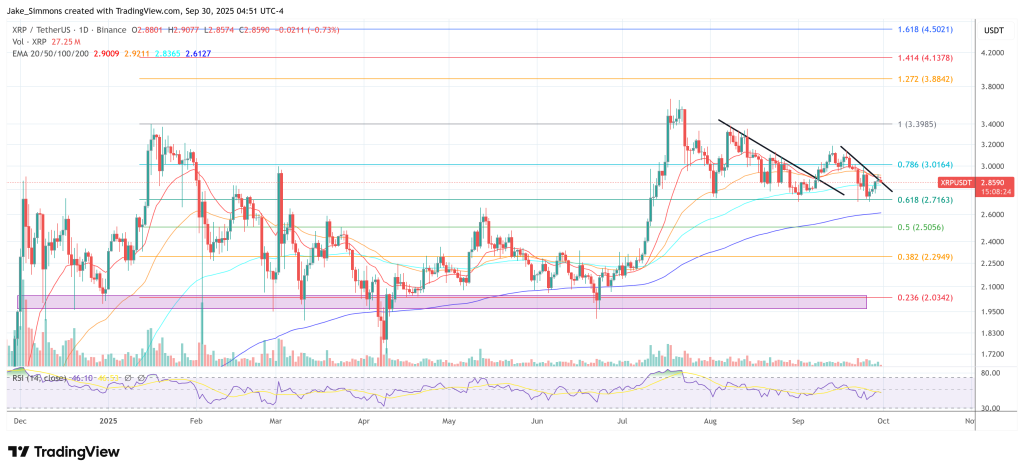
At press time, XRP traded at $2.86.
XRP price
XRP bulls eyes trendline breakout, 1-day chart | Source: XRPUSDT on TradingView.com
Featured image created with DALL.E, chart from TradingView.com
Editorial Process for bitcoinist is centered on delivering thoroughly researched, accurate, and unbiased content. We uphold strict sourcing standards, and each page undergoes diligent review by our team of top technology experts and seasoned editors. This process ensures the integrity, relevance, and value of our content for our readers.

Jake Simmons has been a Bitcoin enthusiast since 2016. Ever since he heard about Bitcoin, he has been studying the topic every day and trying to share his knowledge with others. His goal is to contribute to Bitcoin's financial revolution, which will replace the fiat money system. Besides BTC and crypto, Jake studied Business Informatics at a university. After graduation in 2017, he has been working in the blockchain and crypto sector. You can follow Jake on Twitter at @realJakeSimmons.

Пов'язані матеріали

On-Chain Figures on the Eve of Kickoff: 1.6 Billion Traded Before the World Cup Even Begins

"On-Chain Numbers on the Eve of the World Cup: $1.6 Billion Traded Before Kick-off" Analysis of on-chain markets before the 2026 FIFA World Cup reveals significant crypto integration into football. The most striking figure is the approximately **$1.6 billion** in total trading volume on the single "World Cup Winner" contract on the Polymarket prediction market platform, accumulated before a single match was played. This represents explosive growth for a sector whose annual volume surged from ~$16B in 2024 to ~$64B in 2025. The ecosystem is maturing beyond speculation. Key developments include: 1) **Infrastructure upgrades** like Polymarket's migration to native, regulated USDC stablecoin for settlements; 2) **Reliable data oracles**, such as Chainlink, being used to resolve real-world match outcomes on-chain; and 3) **Official recognition**, with FIFA appointing its first-ever "Prediction Markets" partner. Over 100 contracts now cover everything from the outright winner to individual match results and even non-sporting risks like venue relocation. This evolution marks a fundamental shift. While crypto firms are absent from FIFA's top-tier sponsor list, the technology has deeply penetrated the tournament's financial and predictive infrastructure through regulated stablecoin settlements, decentralized oracles, and new official partnership categories. The regulatory landscape remains complex and varies by jurisdiction, but on-chain markets for the World Cup are already a multi-billion-dollar reality.

marsbit3 хв тому

On-Chain Figures on the Eve of Kickoff: 1.6 Billion Traded Before the World Cup Even Begins

marsbit3 хв тому

From SpaceX's IPO to the Future of Crypto: Which Crypto Sectors Will Host the Trillion-Dollar Narrative?

From the SpaceX IPO, which targets a $750 billion raise at a $1.77 trillion valuation, we can extrapolate capital flow trends relevant to crypto. The focus shifts from speculative narratives to foundational infrastructure and real-world asset (RWA) integration. Key crypto sectors poised to benefit include: 1. **AI Infrastructure**: The narrative is moving from consumer-facing AI applications to underlying, scarce resources like compute power and decentralized GPU networks (e.g., TAO, RENDER, AKT, IO). These protocols are positioning as the essential "picks and shovels" providers for the AI economy. 2. **Real-World Assets (RWA)**: Beyond tokenized treasury bonds, RWA's future lies in on-chain equity and pre-IPO assets like SpaceX. This could democratize access to high-growth assets and reshape global capital flows, benefiting infrastructure projects like ONDO, LINK, and Plume that facilitate issuance, data, and liquidity. 3. **Core Financial Infrastructure**: Stablecoins, payment networks, and DePIN (Decentralized Physical Infrastructure Networks) are critical for settling the future on-chain economy. Their role expands from internal trading tools to foundational layers for global finance, AI systems, and real-world asset networks, leading to potential value reassessment. In summary, the next cycle may prioritize long-term infrastructure value—AI compute, asset tokenization networks, and settlement layers—over short-lived application hype, mirroring the broader market's shift towards funding the foundational systems of the future.

marsbit24 хв тому

From SpaceX's IPO to the Future of Crypto: Which Crypto Sectors Will Host the Trillion-Dollar Narrative?

marsbit24 хв тому

Tech Stocks Plunge and Bitcoin Slumps, Retail Investors Face Ultimate Test Ahead of SpaceX IPO

Technology stocks suffered their biggest drop in months, and Bitcoin fell below the $60,000 mark, coinciding with the eve of SpaceX's massive IPO plans. The sell-off was triggered by strong U.S. jobs data, dashing hopes for Fed rate cuts and reviving fears of further hikes. High-valuation sectors like AI and semiconductors led the declines, with the Nasdaq plunging over 4%. Cryptocurrencies, sensitive to higher interest rates and a strong dollar, also tumbled sharply. This market stress test raises critical questions about the limits of retail investor capital and its next destination. SpaceX's upcoming IPO, which plans to allocate an unusually high 30% of shares to retail investors, now faces a more uncertain landscape. Analysts warn that to buy SpaceX,散户 may need to sell existing holdings, with Tesla seen as a potential source of funds. The market is saturated with speculative options—from crypto and meme stocks to zero-day options and AI-themed ETFs—all competing for the same pool of retail attention and capital. While SpaceX's listing could inject fresh excitement, it also enters a fiercely competitive environment where investor loyalty is fleeting. The ease of zero-commission trading and lower barriers to margin trading accelerate capital rotation between narratives, making it difficult for any single story, even a historic IPO like SpaceX's, to dominate for long.

华尔街日报1 год тому

Tech Stocks Plunge and Bitcoin Slumps, Retail Investors Face Ultimate Test Ahead of SpaceX IPO

华尔街日报1 год тому

Торгівля

Спот
Ф'ючерси
活动图片