No License, No Problem? Wisconsin Bill Aims To Ease Crypto Rules

bitcoinistОпубліковано о 2025-09-30Востаннє оновлено о 2025-09-30

Анотація

Wisconsin lawmakers have introduced a proposal that could reshape how cryptocurrency businesses are treated under state law. The measure, Assembly...

Trusted Editorial content, reviewed by leading industry experts and seasoned editors. Ad Disclosure

Wisconsin lawmakers have introduced a proposal that could reshape how cryptocurrency businesses are treated under state law. The measure, Assembly Bill 471, aims to exempt a wide range of digital asset activities from money transmitter licensing requirements.

The proposal has been referred to the Committee on Financial Institutions and is backed by several Republican legislators.

Bill Targets Mining, Staking And Wallet Use

Based on reports, the Wisconsin Legislative Reference Bureau outlines clear exemptions for crypto-related work that usually falls into regulatory gray zones.

Mining, staking, and operating blockchain nodes are among the activities that would not require a money transmitter license. Developers creating blockchain software or tools are also included in the exemptions.

The bill goes further by stating that individuals can keep custody of their own coins, whether through hardware wallets or self-hosted digital wallets, without state interference.
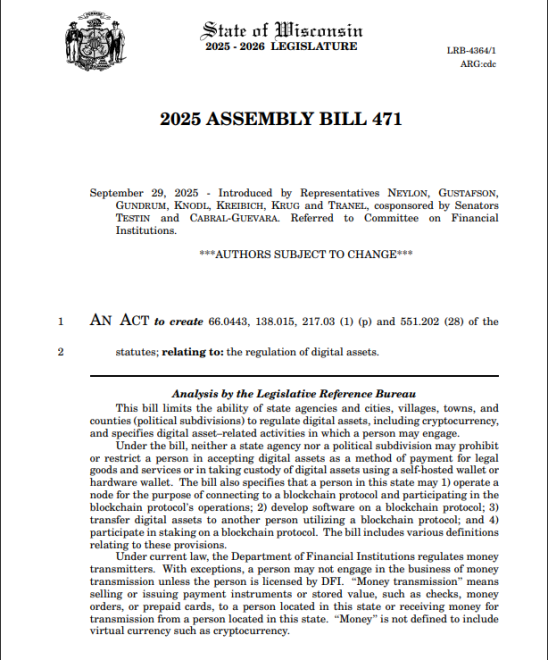
It also seeks to prevent local governments from banning the use of digital assets in payments for lawful goods or services, as long as the transaction doesn’t involve conversion to US dollars or bank deposits.

This distinction matters. While businesses may be free to accept tokens directly, the bill does not cover cases where cryptocurrency is exchanged into legal tender.

That boundary keeps traditional regulatory requirements intact for fiat conversions and custodial services tied to banks.
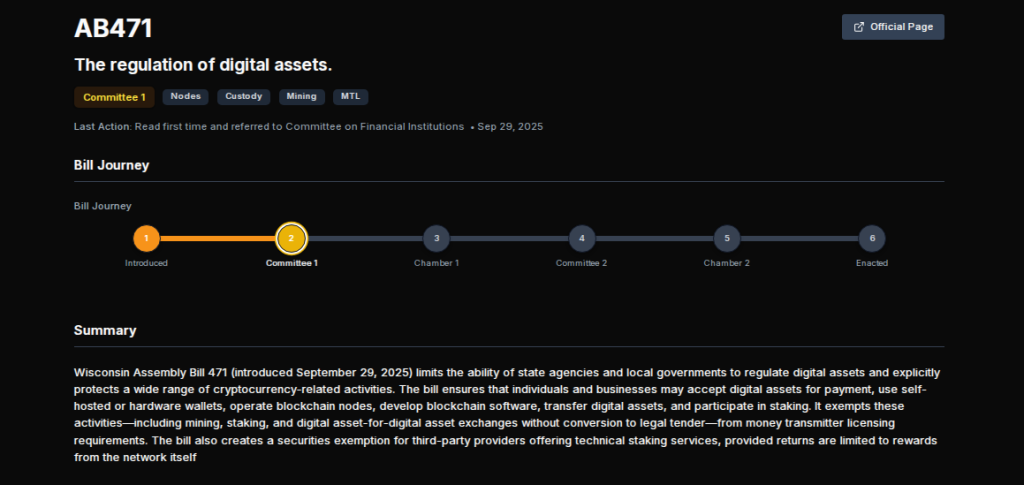
The status of AB471 Bill. Source: Bitcoin Laws

Another Bill Targets Crypto Kiosks

While Assembly Bill 471 attempts to carve out freedom for certain digital asset activities, another measure, Senate Bill 386, pushes in a different direction.

SB 386 would require anyone operating a virtual currency kiosk in Wisconsin to obtain a license. These kiosks, often compared to ATMs, allow users to swap cash for cryptocurrency and vice versa.

Thus, in a nutshell, two separate paths are being pursued in the state legislature: one expanding exemptions for miners, developers, and users, and the other providing more regulation to business involved in providing direct fiat-to-crypto services.

This distinction shows what a route policymakers are taking with supporting innovation while still having consumer protections. There are still questions of who would be covered and the actual effect of the changes.

BTCUSD trading at $113,725 on the 24-hour chart: TradingView

Bill Advocates Upbeat

The proponents of the exemption bill are optimistic it will secure Wisconsin’s advantage as a center for blockchain developers and firms that are exploring careers in blockchain development, smart contracts, research, etc., and who want fewer burdensome regulations to work with.

By protecting users who merely operate nodes, stake coins, or have tokens stored in private wallets, the state would be more friendly to mainstream users too.

But there are open questions. Federal regulators such as the Securities and Exchange Commission and the Financial Crimes Enforcement Network may still claim oversight in areas the state bill does not touch.

Ambiguities in the language, such as how “conversion to legal tender” is defined, could spark disputes later.

Featured image from Northwest Wisconsin, chart from TradingView

Editorial Process for bitcoinist is centered on delivering thoroughly researched, accurate, and unbiased content. We uphold strict sourcing standards, and each page undergoes diligent review by our team of top technology experts and seasoned editors. This process ensures the integrity, relevance, and value of our content for our readers.

Christian, a journalist and editor with leadership roles in Philippine and Canadian media, is fueled by his love for writing and cryptocurrency. Off-screen, he's a cook and cinephile who's constantly intrigued by the size of the universe.

Пов'язані матеріали

Goldman Sachs' Summary After Silicon Valley Investigation: Agents Enter the Execution Era, AI Competition Shifts to Workflows, World Models Rise

Based on a recent field research in Silicon Valley, Goldman Sachs highlights a key shift in the AI industry: moving from systems that "answer questions" to autonomous AI agents that "execute tasks." Commercial models are transitioning from per-seat subscriptions to usage- and outcome-based pricing. The competition is shifting from raw model capability to mastery over specific business workflows, with value accruing to proprietary data, domain context, and operational expertise. A major hurdle for enterprise Agent deployment is not technical ability but "controllability"—issues of accountability, auditability, and error correction, especially in regulated fields. Workflows with clear rules, verifiable outcomes, and reversible actions (e.g., invoice processing) are being automated first. The model landscape is evolving toward a division of labor. Frontier models (like GPT-4) are expected to handle high-value, high-reliability core tasks, while improving open-source models will likely capture the majority (~90%) of inference tokens for standardized, high-volume tasks due to cost advantages. Finally, attention is moving from Large Language Models (LLMs) to "World Models," which understand physical environments, causality, and dynamic interactions. This shift elevates the importance of proprietary, real-world data (from industrial, scientific, and robotic systems) and could drive a second wave of compute demand. Goldman Sachs projects compute needs could grow ~24x over five years, benefiting cloud and infrastructure providers.

marsbit4 хв тому

Goldman Sachs' Summary After Silicon Valley Investigation: Agents Enter the Execution Era, AI Competition Shifts to Workflows, World Models Rise

marsbit4 хв тому

Fidelity Warns: The Boom in AI Agents May Not Be a Feast for Public Blockchains

Fidelity Digital Assets cautions that the anticipated boom in AI agents does not automatically guarantee a corresponding surge in public blockchain adoption or token value. While AI agents that can autonomously perform tasks like payments and data calls could theoretically utilize blockchain for settlement, a significant gap exists between "can use" and "must use." The analysis highlights six key risks. First, many AI agents, especially in corporate settings, may prefer closed, permissioned systems over public blockchains due to needs for speed, cost, compliance, and control. Second, increased on-chain transactions from AI-driven micropayments may not benefit native tokens if fees remain low or if value is captured by stablecoins and payment service providers instead. Third, while AI lowers development costs and increases the number of projects, more code does not equal more economic value and can lead to market oversaturation. Fourth, AI commoditizes coding, making pure technological advantage less of a sustainable moat; competition may shift to brand, liquidity, and user networks. Fifth, AI can also lower the cost of attacks by making vulnerability discovery easier, potentially outpacing security auditing and increasing ecosystem risk. Sixth, institutions may require "controlled blockchain" systems with robust identity, permissioning, and audit trails, conflicting with the permissionless nature of public chains. Ultimately, Fidelity argues against simply equating AI growth with blockchain prosperity. The narrative requires moving from speculation to a concrete analysis of which infrastructures can convert real AI agent needs into sustainable economic value, critically examining each step of the assumed value chain.

marsbit5 хв тому

Fidelity Warns: The Boom in AI Agents May Not Be a Feast for Public Blockchains

marsbit5 хв тому

Telegram Introduces WEB-Proxy Technology: Masks Traffic as Regular Website Visits

Telegram has introduced a new experimental WEB-Proxy technology designed to circumvent blocking by disguising messenger traffic as regular, secure website visits. Announced on August 21, 2026, the technology routes MTProxy data through an in-app WebView using HTTPS or WebSocket transport, making the data stream indistinguishable from legitimate web surfing. The core innovation is a multiplexed stream sent through a single WebView session. It uses special frame formats to pack multiple logical Telegram connections into one encrypted channel that externally resembles loading a web page. A server-side relay receives this stream, separates it into individual connections for the standard MTProxy, without decrypting content or knowing final destinations, thus preserving privacy. The WEB-Proxy operates on a standard HTTPS domain that also hosts a public website. The proxy bridge page is only activated by a specific URL parameter derived via HMAC-SHA256 from the proxy configuration; all other requests receive the normal site homepage. This provides reliable cover against automated detection systems. Currently a proof-of-concept, the system includes a desktop implementation, an experimental Android client, and plans for iOS support. The technology represents a shift towards more sophisticated integration with legitimate web infrastructure, complicating filtering systems that must choose between blocking HTTPS traffic entirely or allowing service access. Its long-term value will depend on resilience to adaptive traffic analysis and scalability without performance loss.

cryptonews.ru20 хв тому

Telegram Introduces WEB-Proxy Technology: Masks Traffic as Regular Website Visits

cryptonews.ru20 хв тому

MiCA is coming for DeFi vaults, but regulation will be difficult

The European Commission is exploring whether to extend the Markets in Crypto-Assets (MiCA) regulation to cover decentralized finance (DeFi) lending and borrowing, including lending vaults. These vaults, which channel billions into on-chain credit markets, present significant regulatory challenges because their decentralized structure doesn't map neatly onto existing financial frameworks. Their legal status is currently based on non-binding interpretations that they fall outside MiCA and EU fund rules. The article uses Morpho's decentralized lending protocol as an example, illustrating how responsibilities are divided among various participants (owner, curator, allocator, sentinel), making it difficult to identify a single "provider" to regulate. Experts warn that broadly categorizing "DeFi lending" could inadvertently capture vastly different structures. They argue that any regulatory approach should focus on the specific structure and control mechanisms of a vault, rather than using decentralization as a simple dividing line, and that DeFi lending may require a dedicated, carefully crafted framework distinct from traditional finance. The Commission's consultation closes on September 30, 2026. The core challenge for regulators is not just whether to regulate DeFi lending, but how to design rules that distinguish between different forms of on-chain lending and the entities that control them.

cointelegraph2 год тому

MiCA is coming for DeFi vaults, but regulation will be difficult

cointelegraph2 год тому

Торгівля

Спот
活动图片