Are Ethereum Treasuries’ Reserves Slowing Down? Here’s How Much Has Been Acquired In September

bitcoinistОпубліковано о 2025-09-29Востаннє оновлено о 2025-09-29

Анотація

Cryptocurrency-based treasury reserves have become a highly adopted initiative in the sector, with Ethereum and Bitcoin leading the charge. Even...

Trusted Editorial content, reviewed by leading industry experts and seasoned editors. Ad Disclosure

Cryptocurrency-based treasury reserves have become a highly adopted initiative in the sector, with Ethereum and Bitcoin leading the charge. Even though the initiative kicked off with Bitcoin, Ethereum treasury reserves have witnessed exponential growth as accumulation grows among large companies in the past few months.

Institutional Ethereum Adoption Still Growing

Amid the new wave of crypto adoption in the financial landscape, Ethereum’s role as a premier institutional asset is gaining traction, with treasury reserves holding ETH expanding at a rapid pace. In recent months, corporate and cryptocurrency-native treasuries have both increased their holdings, indicating a growing conviction in Ethereum’s long-term value and utility.

However, Ted Pillows, a crypto enthusiast and investor, has reported a cooling down in ETH accumulation among treasury companies in September. Such a development hints at a potential pause in the accumulation trend.

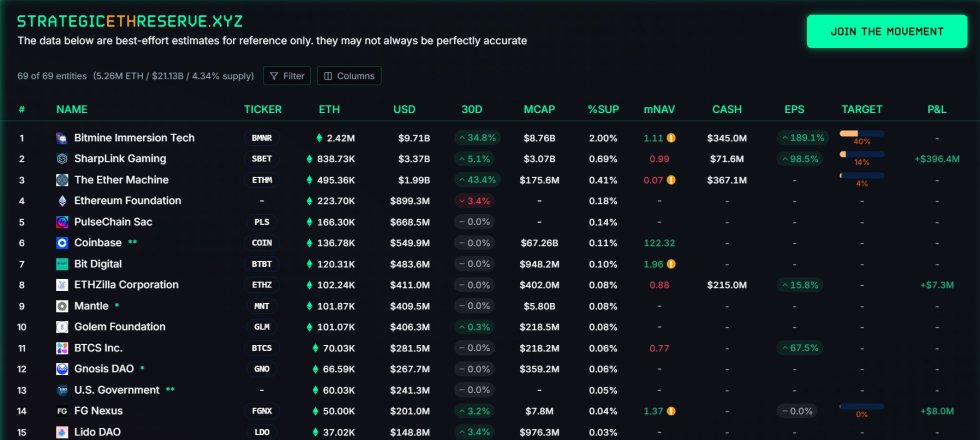
Following months of aggressive ETH allocations, this cooling trend raises the question of whether treasuries are taking a break or waiting for the market to reevaluate. Data shared by Ted shows that companies have acquired over 816,000 ETH in the month alone. While it may seem like a large quantity, this is a 50% decline when compared to August’s accumulation.
Ethereum
ETH holdings held by treasury companies | Source: Chart from Ted Pillows on X

This drop in half marks one of the steepest month-to-month pullbacks of this year. Despite the pullback in institutional accumulation, Ethereum treasury reserves remain elevated, with over 5 million ETH held in total by companies.

According to the expert, there are now 5,255,246 ETH held by treasury reserve corporations, signaling growing confidence in Ethereum’s long-term value and utility. With these enormous holdings, ETH is positioned as a key component of treasury diversification strategies across the globe, highlighting not only its growing reputation as a store of value but also its pivotal role in decentralized finance and staking economies.

ETH Being Hailed As The Asset To Drive The Next Business Strategy

Forbes has proclaimed that the ETH treasuries could be the next big business strategy in the financial sector. What was once seen as a high-risk experiment is now being reconsidered as a forward-looking business strategy, with business and investors exploring ETH holdings as a hedge and a growth engine.

The firm’s bold statement is driven by its belief that ETH treasuries are yield-bearing assets, unlike Bitcoin, which typically sits idle on corporate balance sheets. Furthermore, Forbes stated that the statement is not from a speculative view because ETH is balance sheet engineering. By staking or lending ETH, treasury funds can lower circulating liquidity and generate new revenue streams.

At the time of writing, ETH’s price was trading back above $4,100, demonstrating a nearly 3% increase in the last 24 hours. Bullish sentiment is gradually returning to the market, as evidenced by an increase in its trading volume. Data from CoinMarketCap shows that the trading volume has spiked by more than 50% in the last day.

Ethereum
ETH trading at $4,110 on the 1D chart | Source: ETHUSDT on Tradingview.com
Featured image from iStock, chart from Tradingview.com
Editorial Process for bitcoinist is centered on delivering thoroughly researched, accurate, and unbiased content. We uphold strict sourcing standards, and each page undergoes diligent review by our team of top technology experts and seasoned editors. This process ensures the integrity, relevance, and value of our content for our readers.

Godspower Owie is my name, and I work for the news platforms NewsBTC and Bitcoinist. I sometimes like to think of myself as an explorer since I enjoy exploring new places, learning new things, especially valuable ones, and meeting new people who have an impact on my life, no matter how small. I value my family, friends, career, and time. Really, those are most likely the most significant aspects of every person's existence. Not illusions, but dreams are what I pursue.

Пов'язані матеріали

Report Interpretation: J.P. Morgan Details Micron's Pre-Earnings Sentiment, Current Hardware Sector Dynamics

Morgan Stanley analyst Joshua Meyers' report (June 21, 2026) highlights key trends in the hardware and semiconductor sector ahead of Micron's earnings. The core takeaways are: 1. **Micron & Memory:** Memory remains a high-conviction long theme, driven by strong AI demand and rising ASPs. However, investor focus is shifting to the sustainability of Micron's >80% gross margins and the specifics of potential new long-term supply agreements (SCAs). 2. **Hardware Supply Chain:** AI-related demand for servers, networking, and storage remains robust, but company performance is diverging. Celestica (CLS) shows improved margin confidence, Western Digital and Seagate benefit from pricing, Fabrinet (FN) sees predictable AI optics growth, and Teradyne (TER) anticipates a new Google customer. 3. **AI Capex & WFE Forecasts:** JPMorgan increased its Wafer Fab Equipment (WFE) market growth forecasts to 28% in 2026 and 29% in 2027. AI infrastructure financing is evolving, with higher project-level debt reducing constraints on capex expansion. The report signals that while the AI-driven hardware cycle is strong, the market is entering a phase focused on execution verification (e.g., Micron's SCA details, Fabrinet's ramp with Amazon) and valuation sustainability. Key near-term signals include Micron's guidance, Arista Networks' outlook, and the pace of demand normalization post potential tariff-related pull-ins.

marsbit6 год тому

Report Interpretation: J.P. Morgan Details Micron's Pre-Earnings Sentiment, Current Hardware Sector Dynamics

marsbit6 год тому

Research Report Analysis: The Fed's New Chair's Debut – New Leader, But Same Script?

Report Analysis: Federal Reserve's New Chair Debut – A New Captain, But the Same Script? Morgan Stanley's chief global economist Seth B. Carpenter analyzes the first FOMC meeting under new Fed Chair Kevin Warsh in a June 21 report. Warsh deliberately avoided providing forward guidance on interest rates, aligning with his philosophy. However, market expectations for a rate hike this year were reinforced. Key signals lie elsewhere: inflation may fall more than expected, and quantitative tightening (QT) could be more aggressive than anticipated. The FOMC's "dot plot" suggests only one rate hike in 2026. Carpenter argues that if inflation undershoots forecasts, the logic for even a single hike weakens, especially as projections indicate potential rate cuts in 2027. On QT, Warsh's stance is clear. Carpenter notes that measures like halving the Treasury's account balance could shrink the Fed's balance sheet by around $500 billion with minimal market impact. Combined with adjustments to reserve interest and liquidity rules, the ultimate QT scale may exceed expectations, though its market effect might be less disruptive unless the Fed actively sells Mortgage-Backed Securities (MBS). While Warsh initiated a review of the Fed's policy framework, the 2% inflation target remains intact for now. The report concludes that the market may be overestimating the significance of reduced forward guidance and the near-term rate hike risk, while potentially underestimating the scope and manageable nature of the coming balance sheet reduction. The key debates will hinge on upcoming core PCE data, the specifics of the QT path, and the framework review's findings.

marsbit6 год тому

Research Report Analysis: The Fed's New Chair's Debut – New Leader, But Same Script?

marsbit6 год тому

Critical Game Week: BTC Retracement Confirmation vs. HYPE Support Battle | Guest Analysis

This weekly analysis outlines a critical juncture for BTC and HYPE markets, focusing on key price level confirmations. **BTC Analysis:** BTC is at a pivotal point after a five-wave rally from the June 5th low of $59,100. The price has broken below a short-term rising channel's lower boundary, with the current move seen as a pullback to test this breakdown. Failure to reclaim this level could lead to a retest of the $59,000-$60,000 support zone. The core scenario hinges on this channel retest outcome. * **Key Levels:** Resistance at $64,500-$65,000 (channel boundary) and $69,500-$70,500. Support at $59,000-$60,000 and $55,000. * **Strategy:** A core bearish stance is maintained (20% short from last week), with short-term plans for tactical trades. Three detailed contingency plans (A/B/C) are provided for short positions on resistance tests or breakdowns, emphasizing strict stop-loss discipline. **HYPE Analysis:** HYPE shows strong momentum but is currently in a corrective phase after hitting a new high of $76.94. The price is retesting the crucial $64-$66 support area. * **Key Levels:** Resistance near $77 and $80-$82. Support at $64-$66 and $52-$54. * **Strategy:** The short-term approach is "buy on dips, avoid chasing rallies." A long position is considered only if clear stabilization signals appear at the $64-$66 or deeper $52-$54 support zones, with tight risk controls. **General Risk Management:** A standardized trailing stop-loss protocol is emphasized: set initial stop, breakeven at +1% profit, then trail stops upward to lock in gains. *Disclaimer: All analysis is presented as a personal trading framework, not investment advice. Market conditions are complex and require dynamic adjustment.*

marsbit6 год тому

Critical Game Week: BTC Retracement Confirmation vs. HYPE Support Battle | Guest Analysis

marsbit6 год тому

Торгівля

Спот
Ф'ючерси
活动图片