Октябрь станет «месяцем ETF» — 16 криптовалютных фондов ожидают решения SEC

cryptonews.ruОпубліковано о 2025-02-27Востаннє оновлено о 2025-09-29

В октябре Комиссия по ценным бумагам и биржам (SEC) примет решения по 16 заявкам на криптовалютные биржевые фонды. Нейт Герачи (Nate Geraci), президент NovaDius Wealth Management, заявил в соцсети X, что впереди «насыщенные несколько недель для спотовых крипто-ETF».

Фонды связаны с несколькими крупными альткоинами: Solana, XRP, Litecoin и мемкоином Dogecoin. Финальные сроки рассмотрения заявок распределены по всему октябрю.

График решений регулятора

Первым на утверждение выходит Litecoin-ETF децентрализованной биржи Canary — крайний срок 2 октября. Затем, 10 октября, SEC должна рассмотреть конвертацию трастов Solana и Litecoin от управляющей компании Grayscale. Завершает марафон фонд XRP от WisdomTree с дедлайном 24 октября. Эти данные приводит аналитик Bloomberg Джеймс Сейфферт (James Seyffart).
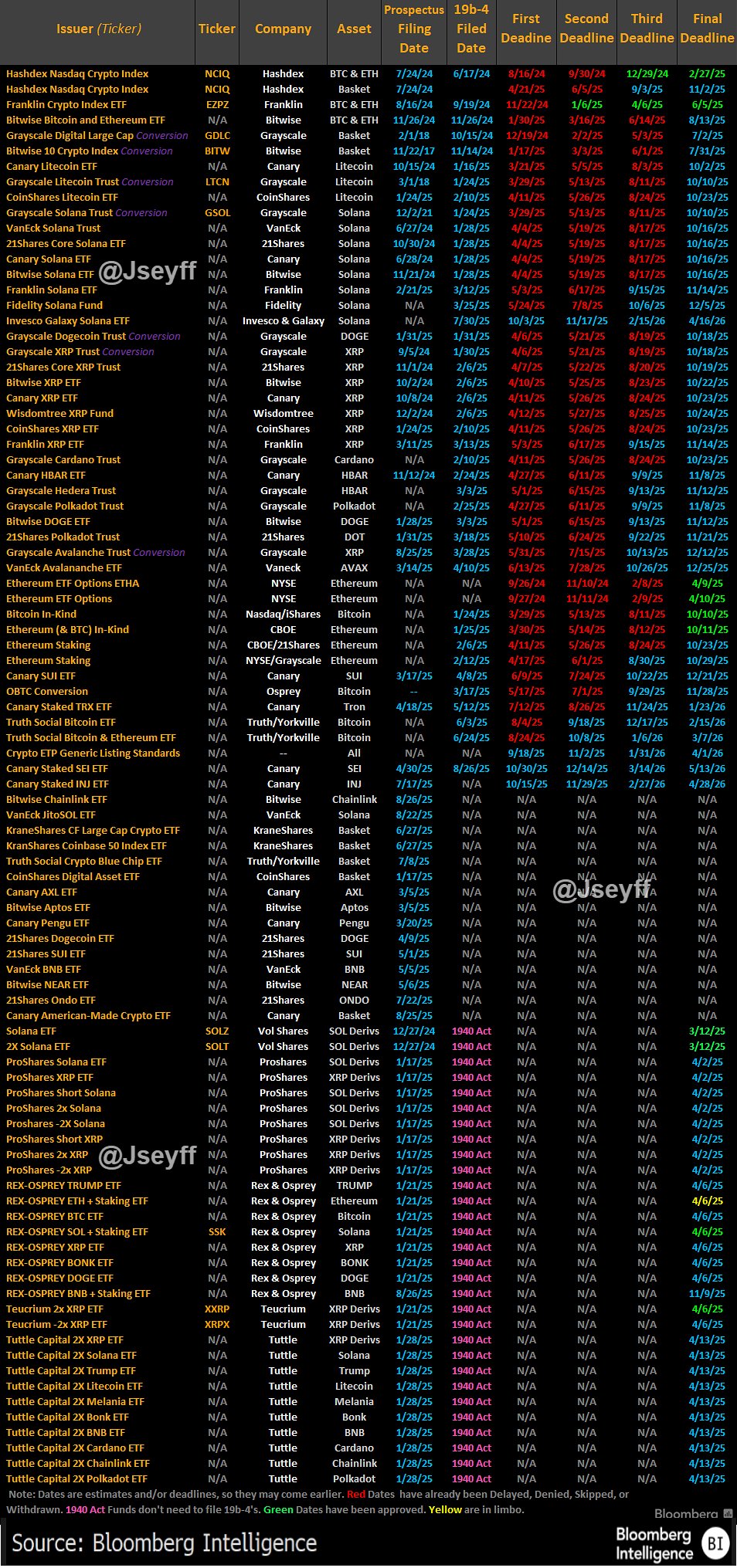
График утверждения криптовалютных ETF. Источник: Джеймс Сейфферт

Регулятор может принять решение в любой момент до финального дедлайна. Аналитики криптобиржи Bitfinex прогнозировали в августе, что одобрение крипто-ETF способно спровоцировать новый сезон альткоинов. Инвесторы получат доступ к монетам с меньшим риском, что может подстегнуть ралли.

Октябрь как месяц ETF

Герачи отметил, что решения начнутся уже на этой неделе с Litecoin-фонда Canary. «За этим последуют решения по SOL, DOGE, XRP, ADA и HBAR-ETF, хотя SEC может одобрить любой из них или все сразу в любое время», — добавил он.

Криптотрейдер Daan Crypto Trades назвал октябрь «месяцем ETF», но обратил внимание на отсутствие в списке двух крупнейших игроков — Fidelity и BlackRock. «Ни один из фондов с октябрьскими дедлайнами не выпущен Fidelity или BlackRock, которые являются главными участниками рынка крипто-ETF. Тем не менее это стоит отслеживать в ближайшие недели», — заявил трейдер.

SEC упрощает путь к запуску

На протяжении 2025 года регулятор неоднократно откладывал решения по нескольким крипто-ETF, устанавливая новые сроки. Однако комиссия также предприняла шаги к сокращению временных рамок на фоне более дружественного подхода к криптовалютам.

17 сентября SEC утвердила новый стандарт листинга для акций трастов на основе товаров, что может ускорить запуск будущих спотовых крипто-ETF. Сейфферт заявил тогда, что это изменение политики станет позитивным шагом в сторону «волны запусков спотовых крипто-ETP».

Его коллега, аналитик Эрик Балчунас (Eric Balchunas), предположил, что вскоре может появиться намного больше фондов. Он указал на 22 монеты с фьючерсами на Coinbase, которые «подходят для создания спотовых ETF».
Пов'язані матеріали

A Group of Suzhou Engineers Unexpectedly Attain Financial Freedom

In Suzhou, a group of engineers from Lianxun Instruments, a leader in optical communication testing equipment, have achieved remarkable wealth after the company's IPO. Listed just two months ago on the STAR Market, the company's stock price surged approximately 30 times, making it the only A-share stock priced above 2,000 yuan. This surge created substantial fortunes for nearly 100 technical employees who held a collective 15.91% stake through employee stock ownership platforms, valued at over 36 billion yuan at the current market cap. Among them, nearly 40 became billionaires, while even the smallest holdings exceeded 5 million yuan in value. Founded in 2017 by Hu Haiyang, Yang Jian, and Huang Jianjun, Lianxun Instruments was established to address China's reliance on foreign high-end testing instruments. The company grew rapidly with a strong focus on R&D, where technical staff make up nearly 80% of its workforce. Early implementation of employee stock plans helped retain this core talent. The company's explosive growth is fueled by booming AI computing demand, with clients including major global optical module leaders. Its revenue skyrocketed from 276 million yuan in 2023 to 1.194 billion yuan in 2025, turning a profit in 2024. The IPO has also generated massive returns for early investors, including Suzhou's state-owned capital, which saw a hundredfold return. This story reflects a broader trend in China's markets, where technology firms in AI, semiconductors, and optics are creating new wealth, rewarding engineers and technical teams who are now central to modern capital-driven success stories, marking a shift from previous eras dominated by internet and real estate tycoons.

marsbit1 год тому

A Group of Suzhou Engineers Unexpectedly Attain Financial Freedom

marsbit1 год тому

NVIDIA's Annual 'Most Dangerous' Paper: AI Self-Replicating Code, Unlimited Leveling and Evolution

NVIDIA's "Red Queen Gödel Machine" (RQGM) paper proposes a potentially groundbreaking AI self-evolution framework. It breaks from the long-stalled concept of the "Gödel Machine," which required mathematically proven beneficial self-modifications, by adopting an evolutionary approach. The core, and most striking, innovation is that the AI does not just evolve its own code in a static environment. Instead, it co-evolves both the "student" (the task-performing agent) and the "examiner" (the evaluation system that judges it). This creates a dynamic, recursive self-improvement loop inspired by the biological "Red Queen Hypothesis"—where continuous adaptation is needed just to maintain relative fitness. The mechanism operates in epochs. Within an epoch, a fixed examiner evaluates all candidate code variants. At epoch boundaries, a new, potentially more rigorous examiner can replace the old one, but only if it proves statistically superior on a held-out "ground truth" dataset. This "controlled utility evolution" aims to ensure progress is measurable and grounded. The paper demonstrates RQGM's effectiveness across three domains: 1. **Code Generation:** It achieved a 71.7% test-set pass rate (improving over a 69.9% SOTA) while using 1.35-1.72x fewer computational tokens. 2. **Paper Writing:** In a subjective task, the co-evolved writer and reviewer achieved a 40.5% acceptance rate by a fixed human panel, up from 21.8%. 3. **Math Proofs:** It evolved more accurate graders (at 3x lower cost) and higher-scoring provers. Notably, RQGM also mitigated a known LLM bias where AI reviewers favor AI-generated content. By specifically rewarding reviewers that correctly rejected AI-written papers from a historical pool, the evolved system achieved impartiality while maintaining 80% accuracy. The research has sparked significant discussion about the acceleration of Recursive Self-Improvement (RSI). Some, like Anthropic's Jack Clark, have predicted a high probability of highly autonomous, self-evolving AI emerging by 2028. The paper suggests that when an AI begins to design its own evaluators and push itself toward ever-higher standards in a recursive loop, it may be taking a fundamental step toward redefining intelligence and autonomy.

marsbit1 год тому

NVIDIA's Annual 'Most Dangerous' Paper: AI Self-Replicating Code, Unlimited Leveling and Evolution

marsbit1 год тому

Apple and the Power Rebalancing with 'The Microns': Dissecting the Profit Ledger Behind the iPhone

The article analyzes the shifting profit dynamics and power balance between Apple and memory suppliers like Micron within the iPhone supply chain. It highlights a social media post criticizing Apple for raising iPhone prices while blaming memory chip cost increases, despite historically paying suppliers like Micron very little. An estimated iPhone 18 cost breakdown is referenced. Historically, memory was a minor cost component. In 2017's iPhone X, memory accounted for only about 1.6-2.3% of the price, with Apple capturing nearly 50% net profit. Over time, memory's share of the Bill-of-Materials (BOM) cost has grown significantly, reaching an estimated 12-15% for the iPhone 17 series. The core driver of this change is soaring demand for memory from the AI industry, particularly for High Bandwidth Memory (HBM) and AI servers, which is diverting production capacity and squeezing supply for consumer electronics. Memory manufacturers, after enduring periods of low profits, now hold greater pricing power. This is reflected in their recent strong financials, like Micron's 84.6% gross margin. Apple CEO Tim Cook initially described the memory price pressure as unprecedented in his 40-year career, later calling it a "once-in-a-century flood," before Apple announced price hikes across several product lines, causing a significant stock drop. Elon Musk echoed Cook's sentiment about the dramatic cost surge. The article concludes that the era of memory suppliers being at the mercy of Apple's pricing power has temporarily reversed, thanks to AI-driven demand. It notes Apple is reportedly seeking to diversify its supply chain, including exploring chips from China's CXMT.

Odaily星球日报3 год тому

Apple and the Power Rebalancing with 'The Microns': Dissecting the Profit Ledger Behind the iPhone

Odaily星球日报3 год тому

Conversation with the Founder of 42 Macro: The Fed's 'Boiling the Frog Slowly' and the K-Shaped Economy

In a conversation with Anthony Pompliano, Darius Dale, founder of 42 Macro, discusses the Federal Reserve's monetary policy and the K-shaped U.S. economy. Dale characterizes new Fed Chair Kevin Warsh as a "dove in hawk's clothing," expecting the Fed to signal or enact policy tightening in the coming quarters to create room for later easing. He argues current economic signals, including high deficit spending, debt monetization, and credit growth, strongly indicate inflation is not on a credible path back to 2%, forcing the Fed to act. The discussion highlights the stark "K-shaped" economic reality. While top earners, buoyed by massive cash savings (up ~$8 trillion since pre-pandemic), continue robust spending, those at the bottom face severe financial strain, with delinquency rates on consumer loans reaching crisis-era highs. Dale attributes much of the current social and political anxiety to this divergence, driven by the "Cantillon effects" of monetary expansion, which disproportionately benefits asset owners. He emphasizes that in this environment of "financial repression," individuals must participate in asset markets to avoid being left behind. On equities, Dale notes a rotation from the "Magnificent Seven" tech giants into broader AI-exposed companies, while warning that the tech giants' massive capital expenditure cycles could eventually puncture over-optimistic cash flow projections. Dale concludes by stressing that the core desire across all economic strata is simply the dignity to provide for one's family, a goal currently undermined by systemic policies that act as a "wealth siphon" from the bottom to the top.

marsbit3 год тому

Conversation with the Founder of 42 Macro: The Fed's 'Boiling the Frog Slowly' and the K-Shaped Economy

marsbit3 год тому

Торгівля

Спот
活动图片