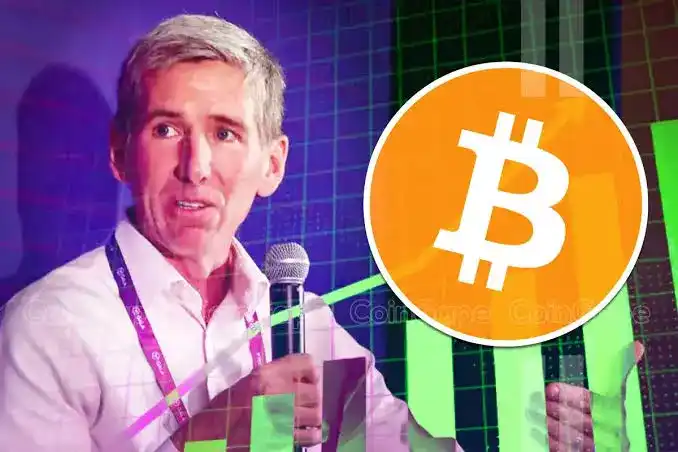
SEC Release Agenda for September 29 Roundtable with CTFC

TheCryptoTimesОпубліковано о 2025-09-24Востаннє оновлено о 2025-09-24

The Securities and Exchange Commission (SEC) has shared the full agenda for its joint meeting with Commodity Futures Trading Commission (CFTC) which is secluded for Sept. 29. 

The joint roundtable will be broadcast live on the SEC website and will focus on answering the questions about where the line between securities and commodities falls. This would help the two agencies clarify their rules and decide how to manage shared responsibilities.

What’s on the Agenda

According to the press release, the program will begin at 1.p.m with opening remarks from SEC Chair Paul Atkins, CFTC Acting Chair Caroline Pham, and SEC Commissioner Caroline Crenshaw. 

The first panel, “How We Got Here,” will explore the history of both agencies working together. Former CFTC Chairman J. Christopher Giancarlo will moderate, with panelists including Kenneth Bentsen Jr. of SIFMA, Craig Lewis of Vanderbilt University, Scott Litvinoff of Interactive Brokers, Walt Lukken of FIA, Scott O’Malia of ISDA, and Jim Overdahl of Delta Strategy Group.

At 2:10 p.m., this second panel will begin. This session will discuss trading platforms, and better rules for them that can help them grow while keeping investors safe.

Moderators Jill Sommers, a former CFTC Commissioner, and Jamie Selway, SEC Director of Trading and Markets, will lead the session with with Shayne Coplan of Polymarket, Craig Donohue of Cboe Global Markets, Terrence Duffy of CME Group, Adena Friedman of Nasdaq, Tarek Mansour of Kalshi, Arjun Sethi of Kraken, Jeffrey Sprecher of Intercontinental Exchange, and Don Wilson of DRW Holdings. SEC Commissioner Mark Uyeda will follow with remarks at 3:25 p.m.

After a short break, the third panel, “Participants,” will begin at 4 p.m and will look at how some common rules give investors more choices and lower their costs. For this part, Moderators Giancarlo and former SEC Commissioner Troy Paredes will guide a discussion on it.

Panelists include Stephen Berger of Citadel, Ryan Louvar of WisdomTree, Nick Lundgren of Crypto.com, JB Mackenzie of Robinhood Markets, Dave Olsen of Jump Trading Group, Sonali Theisen of Bank of America, and Brad Tulley of J.P. Morgan. Closing remarks at 5:20 p.m. will come from SEC Commissioner Hester Peirce.

Atkins Clears the Air

Meanwhile, in another report. SEC Chair Paul Atkins has denied reports that he could step in as CFTC chair. “Thanks but no thanks,” Atkins said in an interview. He said he wants to focus on cooperation between the two agencies, rather than taking on another role. 

“The Howey test is very vague,” he added. He also criticized the decades-old method of determining what counts as a security. “It’s a ‘you know it when you see it’ problem. Guidance from Congress would be very helpful.” He also said the SEC should not become the “Securities and Everything Commission.”

Also Read: SEC Clears Grayscale’s ETH ETFs Under New Generic Rules


Mobile Only Image

Пов'язані матеріали

Chip Stocks Lead U.S. Market Decline: Is AI Trading Being Hit by Both Interest Rates and Returns?

Chip stocks led a broad decline in US markets, with the Nasdaq dropping 2.2% and the S&P 500 falling 1.4%. This selloff reflects a dual challenge for the once-high-flying AI hardware trade: rising interest rate expectations and growing investor impatience for clear returns from massive AI capital expenditures. The pressure was most acute on hardware leaders. Nvidia fell about 4%, dipping below a $5 trillion market cap, while Micron plunged 13.2% ahead of its earnings report. Declines across memory, storage, AI, and mobile chips indicated a sector-wide retreat. The selloff spread globally, with South Korea's KOSPI index dropping nearly 10% as key suppliers SK Hynix and Samsung recorded double-digit losses. Investors appeared to be taking profits from the most crowded trades first. Macro headwinds intensified as market expectations shifted toward a more aggressive Federal Reserve. Forecasts for multiple rate hikes in 2026 pressured high-valuation tech stocks, which rely on long-term growth projections that become less attractive as discount rates rise. Concurrently, investors are scrutinizing the profit potential of the immense AI spending by cloud giants like Alphabet, Amazon, and Meta. While these expenditures drive demand for chips and hardware, the market is now questioning whether AI services will generate sufficient returns to justify the ongoing costs. This adjustment is not necessarily a bubble burst but a recalibration. AI demand fundamentals remain, but the narrative of endless growth can no longer fully offset concerns over higher interest rates and a longer path to profitability. Near-term direction may hinge on Micron's upcoming earnings guidance and incoming inflation data, which will influence both the AI demand outlook and the Fed's policy path. The market is transitioning from blindly buying growth to demanding clearer visibility on returns.

marsbit15 хв тому

Chip Stocks Lead U.S. Market Decline: Is AI Trading Being Hit by Both Interest Rates and Returns?

marsbit15 хв тому

OpenAI's New Paper: How to Train an AI that "Doesn't Deteriorate Under Pressure"?

OpenAI's new paper "Reinforcement Learning Towards Broadly and Persistently Beneficial Models" explores training AI to maintain safe, helpful, and honest behavior even under pressure, in unseen scenarios, or after being fine-tuned for harmful purposes. Moving beyond simple rule-based "don'ts," the research focuses on cultivating "beneficial traits" like honesty, risk-awareness, corrigibility, and transparency. It investigates if reinforcement learning (RL), often prone to "reward hacking" where models exploit loopholes, can instead be used to instill robust, generalized positive behaviors. Researchers created a multi-domain synthetic dialogue dataset covering areas like healthcare and law. They trained a model by replacing 5% of standard RL data with "beneficial trait" data. This model outperformed the baseline in 83% of 53 evaluations, showing average gains of 9.1% in alignment, safety, and helpfulness. Crucially, improvements generalized: a model trained only on healthcare "good behavior" data also performed better in 17 out of 19 non-healthcare alignment tests. The paper also tests "alignment persistence." When subjected to adversarial prompts or harmful fine-tuning, the beneficial trait model showed greater resilience, with smaller performance drops and less "spillover" of bad behavior to unrelated tasks. While not a complete solution, this work suggests a shift from post-hoc correction to proactively shaping robust, principled AI behavior, a critical step for deploying models in high-stakes, complex decision-making scenarios.

marsbit18 хв тому

OpenAI's New Paper: How to Train an AI that "Doesn't Deteriorate Under Pressure"?

marsbit18 хв тому

Semiconductor Stock Rebound: Is the Technical Correction Over or a Trend Reversal?

The core of recent semiconductor stock volatility is not about daily price swings, but rather the market questioning whether AI-driven semiconductor pricing has entered a new phase. Following a sharp sell-off in Korean stocks on June 23rd, led by Samsung and SK Hynix, a subsequent rebound is seen more as a technical positioning adjustment rather than a confirmed trend reversal. The key variable is HBM (High Bandwidth Memory), essential for AI chips. Its supply-demand imbalance granted memory makers significant pricing power. The current market focus is on whether this dynamic remains strong enough to justify elevated valuations. All eyes are on Micron's upcoming earnings report. The critical factor is not whether results meet already high expectations, but whether the company's guidance confirms that AI memory pricing power, order visibility, and future margins are still expanding. Micron's outlook will serve as a crucial test for the broader AI semiconductor chain, including Samsung, SK Hynix, and other infrastructure players. The recent bounce appears to be a pre-earnings positioning repair. For it to evolve into a sustained uptrend, concrete evidence is needed that the AI infrastructure expansion cycle's fundamentals—particularly for high-end memory—remain robust and can continue to surpass elevated market expectations. The risk is that strong demand alone may not be sufficient if future guidance hints at peaking momentum or increasing supply-side pressures.

marsbit55 хв тому

Semiconductor Stock Rebound: Is the Technical Correction Over or a Trend Reversal?

marsbit55 хв тому

Торгівля

Спот
Ф'ючерси
活动图片