As blockchain technology matures, the burgeoning growth of decentralized applications (dApps) has created an urgent demand for off-chain, real-world data. Oracles, which act as bridges connecting blockchains to the outside world, are of undeniable importance. However, traditional oracles still face numerous challenges in terms of latency, decentralization, and customizability. It is against this backdrop that Switchboard (SWTCH) has emerged, dedicated to building a highly customizable, decentralized, permissionless, and efficient oracle network to provide reliable, verifiable, and real-time data services for the Web3 world.
1. Switchboard: The "Oracle of Everything" Connecting On-Chain and Off-Chain Worlds
1.1 Project Overview: What is Switchboard?
Switchboard is the only permissionless oracle protocol at scale, designed to provide secure, reliable, and verifiable access to off-chain data for Web3 applications. It is more than just a simple data bridge; it is an "oracle of everything," capable of bringing almost any data that exists online onto the blockchain. This includes cryptocurrency prices, stock prices, commodity prices, sports scores, weather forecasts, election results, blockchain gas fees, DeFi lending rates, NFT floor prices, and even verifiable random numbers for gaming or lotteries.
At the core of Switchboard is its innovative "On-Demand Oracle" model, a permissionless design that allows anyone to define custom data sources and configure how the oracle network processes these workloads. Data is fetched only when requested by a user, which saves resources and ensures maximum data freshness. Switchboard's governance token is SWTCH, which plays a central role in the network's security, incentives, and governance.
1.2 Core Mission and Vision: What Problems Does It Solve?
The demand for off-chain data in current blockchain applications is growing, but traditional oracle solutions often have the following limitations:
High Latency: Data updates are not timely enough, which can lead to significant risks and losses, especially in high-frequency trading and real-time application scenarios.
Permissioned Bottlenecks & Centralization Risks: Some oracles rely on centralized entities or require permission from the project to add new data feeds. This not only creates single points of failure and risks of data tampering but also limits the speed and breadth of innovation.
Poor Customizability: Developers find it difficult to customize data sources and data aggregation logic according to their specific needs, which restricts dApp innovation.
Switchboard's mission is to overcome these challenges. Its core vision is to create a truly permissionless data infrastructure that allows any dApp to access the data it needs, anytime and anywhere, with verifiable accuracy and lightning-fast speed. As the only permissionless oracle protocol at scale, Switchboard is committed to breaking down the barriers of traditional oracles, empowering Web3 developers to build more powerful and innovative applications, thereby pushing the boundaries of the decentralized world.
1.3 Technical Highlights and Advantages: Why Choose Switchboard?
Switchboard demonstrates significant advantages through its unique technical architecture and innovative mechanisms:
Permissionless Architecture and High Customizability: Switchboard's permissionless nature is its key differentiator. Developers can freely define and publish their own data feeds without waiting for or seeking approval. This is achieved through an open registration system where anyone can submit a data source on-chain to be fulfilled by a decentralized network of verifiers. This flexibility allows Switchboard to support a wide range of use cases beyond traditional price oracles.
Switchboard Surge: As Switchboard's flagship product, Switchboard Surge delivers unprecedented performance for latency-sensitive applications. It achieves sub-10 millisecond data updates, which is 300x faster than other oracles. Furthermore, on Solana, each oracle update consumes only 42 compute units, making it 1000x more efficient than other oracles. This extreme speed and efficiency provide a powerful competitive advantage for DeFi applications like high-frequency trading and derivatives.
True Decentralization and Resilient Network: Switchboard is built on a robust network of independent node operators, ensuring maximum uptime and data security for its feeds. Through a unique combination of economic incentives and Trusted Execution Environments (TEEs), Switchboard enables secure, verifiable, and on-demand data collection and propagation.
Verifiable and Transparent Data Delivery: On-chain verification ensures the trust and auditability of any data feed. By compiling signed data updates and atomically updating prices directly within a user's transaction, Switchboard minimizes the latency between a data update and a user's action.
Superior Cross-Chain Capabilities: Switchboard is a leading cross-chain data protocol integrated by over 50 projects and across 10+ chains. Its on-demand model facilitates seamless cross-chain data access through an oracle registry and cross-chain bridges (initially leveraging LayerZero). This allows users to verify data feeds on any supported blockchain, ensuring data reliability and trustworthiness.
Economic Security Model: The economic security model of the Switchboard protocol relies on its native SWTCH token, staking rewards, and slashing mechanisms to incentivize network participants and ensure data reliability. Node operators are required to stake SWTCH tokens (in the form of svSWTCH) to join the network, which incentivizes long-term participation and good performance.
2. Ecosystem Development and Future Outlook
2.1 Existing Products and Ecosystem
As a leading oracle network, Switchboard has already built a suite of products and a growing ecosystem:
Data Feeds: This is Switchboard's core product, providing secure and reliable real-time data to smart contracts. Currently, Switchboard serves over 50 projects, helping to secure over $5 billion in Total Value Locked (TVL), and supports seamless integration across 10+ chains.
Switchboard Surge: As Switchboard's marquee product, Switchboard Surge offers sub-10 millisecond data updates, 300x faster than other oracles. On Solana, each oracle update consumes only 42 compute units, making it 1000x more efficient than other oracles, significantly enhancing data efficiency and speed.
Verifiable Randomness: Switchboard's confidential runtimes provide a provably fair and fast mechanism for generating random numbers. This is crucial for applications requiring fair randomness, such as GameFi, lotteries, and NFT minting.
Oracle Aggregator: Switchboard can aggregate data from multiple top-tier oracles, providing a unified, real-time information stream, thereby enhancing data accuracy and resilience.
Switchboard On-Demand: This is Switchboard's unique on-demand data model, which allows users to request data only when needed, greatly improving efficiency and data freshness. It eliminates the need for an intermediate data layer, ensuring high-fidelity and up-to-date information through just-in-time data fetching.
Switchboard Push: To ensure compatibility with protocols that rely on the traditional push model, Switchboard also offers a "pusher" feature that periodically fetches price updates for specified data sources and submits them on-chain, ensuring seamless integration with the existing ecosystem.
Switchboard's ecosystem is rapidly expanding, with its services being widely used in various fields such as DeFi, GameFi, and NFTs, providing a solid data infrastructure for these applications.
2.2 Roadmap and Business Development
Switchboard's future development blueprint is clear and ambitious. According to its official information and market dynamics, the project is continuously advancing its technology and business expansion:
Continuous Technical Iteration: Switchboard will continue to optimize its oracle protocol, especially on core products like Switchboard Surge, to enhance data transmission speed, security, and customizability. Its economic security model will be further refined to ensure the long-term stable operation and data integrity of the network.
Expansion of Cross-Chain Capabilities: As a protocol already possessing strong cross-chain capabilities, Switchboard plans to integrate more bridging solutions through its on-chain governance mechanism, further expanding its influence in the multi-chain ecosystem.
Ecosystem Growth: Switchboard will continue to attract more dApps and blockchain projects to integrate its oracle services. The recent listing of the SWTCH token on several major exchanges has significantly increased the project's market exposure and liquidity, signaling an acceleration in its business development.
Deepening of Community Governance: With the launch of the SWTCH token, community governance will become a key driver of Switchboard's development. Token holders will be able to participate in key decisions such as setting network parameters and protocol upgrades, ensuring the project develops in a decentralized and community-led direction.
Potential for Innovative Applications: Switchboard's flexible architecture provides the potential to support more innovative applications in the future, such as more complex off-chain computations and privacy-preserving data processing, which will will further solidify its leading position in the oracle space.
3. SWTCH Tokenomics Analysis
3.1 The Core Role of the SWTCH Token
SWTCH is the native governance and utility token of the Switchboard protocol and is the core element driving the operation and security of the entire network. Its main roles include:
Network Governance: SWTCH token holders have the right to participate in the governance of the Switchboard protocol, allowing them to vote on key decisions such as network parameters, protocol upgrades, and fee structures.
Incentive Mechanism: The SWTCH token is used to incentivize oracle node operators to provide reliable data services. Node operators are required to stake SWTCH tokens (in the form of svSWTCH) to join the network and participate in data feeds.
Economic Security: The staking mechanism provides economic security for the Switchboard network. If an oracle node fails to perform its duties or provides incorrect data, its staked svSWTCH is at risk of being slashed, which effectively punishes bad actors and maintains data integrity.
Fee Payments: In the future, the SWTCH token may be used to pay for data services on the Switchboard network, creating a complete economic loop.
3.2 Token Distribution and Economic Model
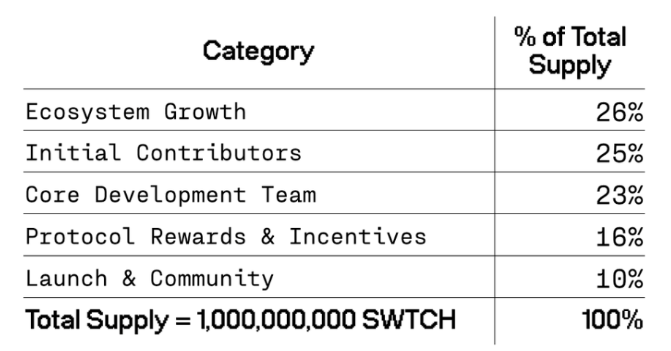
The economic model of the SWTCH token is designed to balance the incentives of network participants, ensuring the long-term sustainability and decentralization of the network.
Supply: The maximum supply of SWTCH is 1 billion tokens. According to information provided by the project team, the current circulating supply is 171,606,373 SWTCH.
Ecosystem Growth: A portion of SWTCH tokens is allocated for ecosystem growth to support the long-term development of the project and community building.
Staking Rewards: Switchboard allocates rewards to active oracle nodes through a SWTCH token subsidy program, similar to Bitcoin's block subsidy. Rewards are distributed based on node performance and other parameters determined by on-chain governance, aiming to encourage more node participation and promote network decentralization.
Deflationary Mechanism: Although a burning mechanism is not explicitly mentioned in the whitepaper, token burning resulting from staking penalties can be considered a deflationary mechanism, helping to reduce the circulating supply and potentially increasing token value.
4. Conclusion
As an innovative, permissionless oracle network, Switchboard is redefining the connection between blockchain and real-world data through its highly customizable, fast, secure, and decentralized data services. Its unique "On-Demand Oracle" model, combined with the superior performance of flagship products like Switchboard Surge, effectively addresses the pain points of traditional oracles in terms of latency, centralization, and customizability.
Currently, Switchboard helps secure over $5 billion in TVL, serving over 50 projects and 10+ chains, demonstrating its strong market appeal and technical prowess. The SWTCH token, as the core of the ecosystem, is not only the cornerstone of network governance but also key to ensuring the network's economic security.
For developers and investors looking to connect the real world with the blockchain, Switchboard, with its forward-thinking permissionless architecture, clear development roadmap, and growing ecosystem, is undoubtedly a project worthy of deep attention and research.
Related Links
Contract Address: SW1TCHLmRGTfW5xZknqQdpdarB8PD95sJYWpNp9TbFx
Website: https://switchboard.xyz/
Twitter: https://x.com/switchboardxyz
Trading Link: https://www.htx.com/trade/swtch_usdt?type=isolated