代币化股票现状观察:特斯拉成交易王者,周末流动性断崖式下跌

深潮Опубліковано о 2025-09-16Востаннє оновлено о 2025-09-17

韩国股民迎新机会?

作者:Heechang

编译:深潮TechFlow

xStocks 提供代币化股票服务,让投资者能够实时交易热门美股(如特斯拉)的代币化版本。尽管仍处于早期阶段,但已经展现出一些有趣的现象。

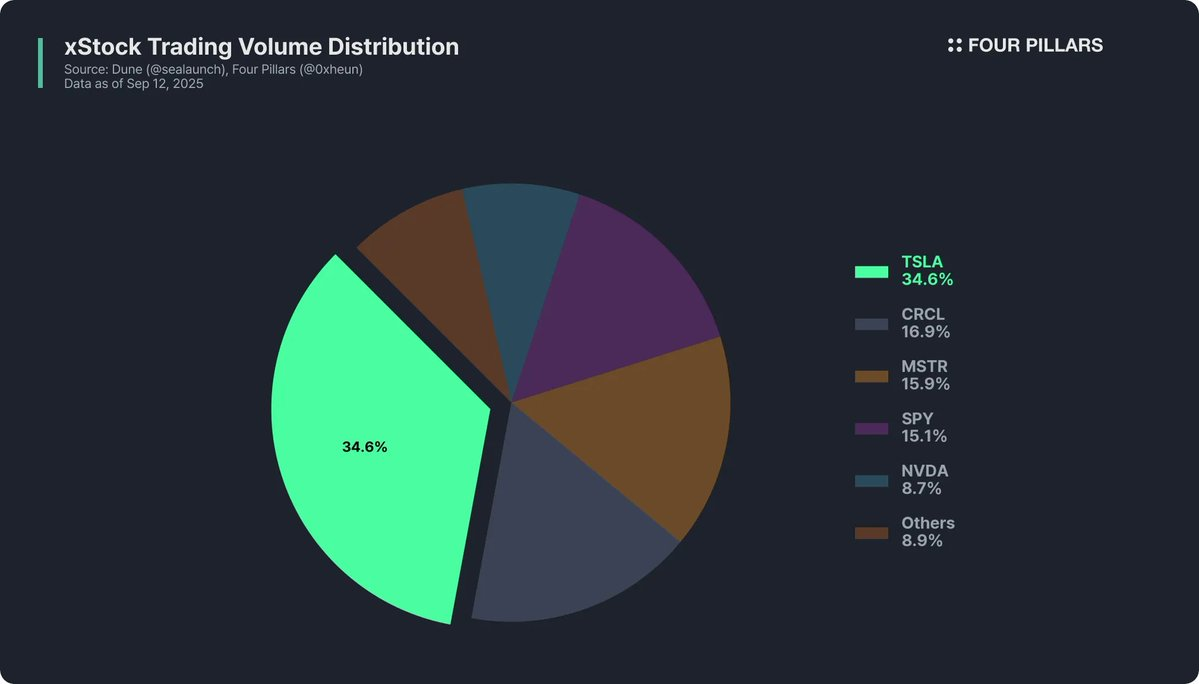
观察1:交易集中于特斯拉(TSLA)

与许多新兴市场类似,交易活动迅速聚集于少数几只股票。数据显示,交易量高度集中在最知名且波动性较大的股票上,特斯拉成为最突出的例子。

这种集中并不令人意外:流动性往往会累积到散户已经看好的资产上,而早期参与者通常会使用熟悉的高 beta 值股票来测试新的基础设施。

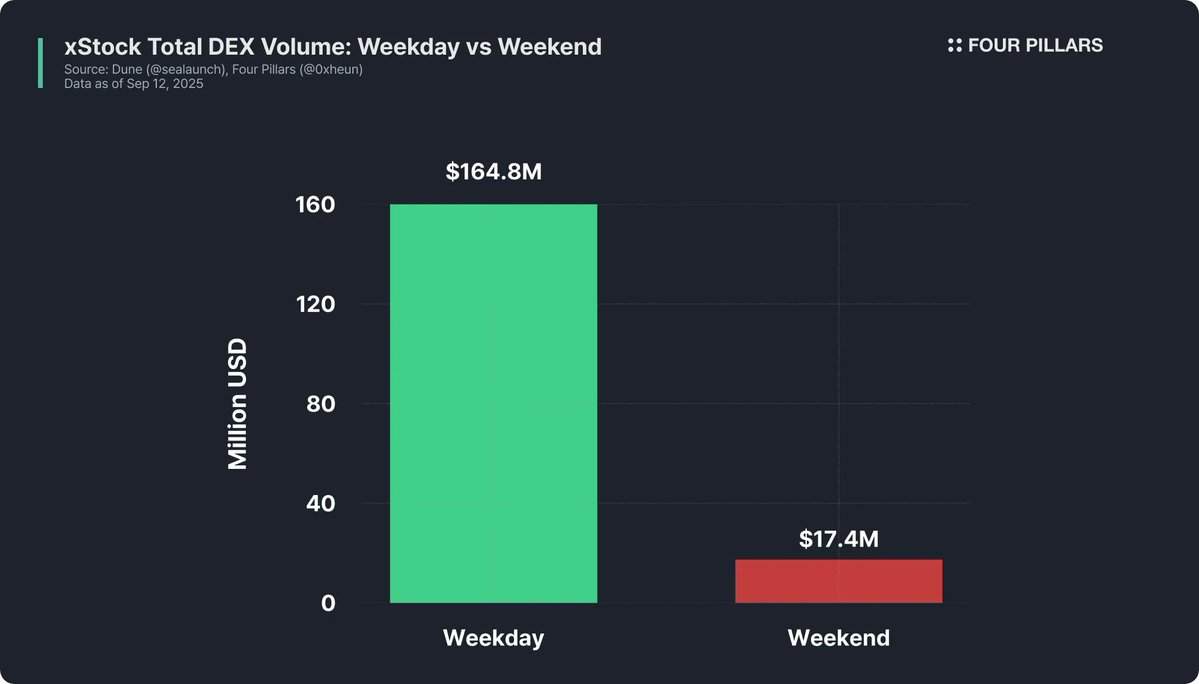
观察2:周末流动性下降

数据显示,周末链上股票交易量降至工作日水平的30%或更低。与全天候无缝交易的加密原生资产不同,代币化股票仍然继承了传统市场交易时间的行为惯性。当参考市场(如纳斯达克、纽约证券交易所)休市时,交易者似乎不太愿意进行交易,这可能是由于套利、价格缺口以及无法在链下对冲头寸的担忧。

观察3:价格与纳斯达克保持一致

另一个关键信号来自上线初期的定价行为。最初,xStocks 代币的交易价格明显高于其纳斯达克对应股票,反映了市场的热度以及桥接法币流动性的潜在摩擦。然而,随着时间推移,这些溢价逐渐减少。

当前交易模式显示,代币价格处于特斯拉日内价格区间的上限,与纳斯达克参考价格高度一致。

套利者似乎在维持这种价格纪律,但在盘中高点仍存在小幅偏差,表市场存在一些低效因素可能为活跃交易者带来机会和风险。

韩国股民的新机会?

韩国投资者目前持有超过 1000 亿美元的美股,自 2020 年 1 月以来,交易量增长了 17 倍。现有的韩国投资者交易美股的基础设施存在费用高昂、结算时间长以及套现流程缓慢等诸多限制,这为代币化或链上镜像股票创造了机会。随着支持链上美股市场的基础设施和平台不断完善,新的韩国交易者群体将进入加密市场,这无疑是一个巨大的机会。

Пов'язані матеріали

Farewell to Crash-Style Plunges: An In-Depth Review of the Crypto Lending and Futures Markets in Q2 2026

This report analyzes the Q2 2026 crypto lending and derivatives market, highlighting a continuation of controlled deleveraging. Unlike the 2022 crash, where loan volumes plummeted 55% in a single quarter, the current downturn is characterized by a gradual, stepwise decline across CeFi, DeFi, and crypto-collateralized CDP stablecoins, with Q2 seeing a total reduction of $113.3 billion (-16.78%) to $561.6 billion. DeFi lending saw the sharpest quarterly drop (-27.61%), while CeFi borrowing declined more moderately (-9.62%). For the first time since Q3 2023, CeFi outstanding loans surpassed DeFi. Corporate digital asset treasury (DAT) debt also decreased by $15 billion, largely due to a debt buyback by Strategy Inc. Futures open interest (OI) saw a modest 3.08% quarterly decline to $1032 billion, with notable divergence: Bitcoin OI fell 6.24%, while Ethereum OI dropped 26.31%. Both rebounded in July. A deep dive into Aave V3 revealed high leverage, particularly within "e-mode" loans, which are heavily concentrated on Ethereum staking/restaking tokens, with debt-weighted health factors near liquidation thresholds. The report concludes that the market is undergoing a healthier, managed deleveraging cycle driven by voluntary risk reduction rather than forced liquidations or counterparty failures, suggesting increased resilience against a repeat of the 2022 cascade. Early Q3 2026 data indicates potential stabilization in futures OI and DeFi lending volumes.

marsbit5 хв тому

Farewell to Crash-Style Plunges: An In-Depth Review of the Crypto Lending and Futures Markets in Q2 2026

marsbit5 хв тому

Crypto Funding Halves in Q1, Why Is Stablecoin Payment Still Attracting Money Against the Trend?

Crypto venture capital funding fell roughly 50% quarter-over-quarter in Q1 2026, yet the stablecoin payments sector was a notable exception, continuing to secure significant funding rounds. This shift signals that capital is moving away from speculative "token narratives" toward companies generating real revenue, as stablecoins evolve from a trading tool into payment infrastructure. Despite the overall funding slowdown, companies like Rain, OpenFX, and RedotPay completed major raises, focusing on areas such as card issuance, cross-border payments, and banking connectivity. Investors are attracted to the sector's potential to address long-standing inefficiencies in traditional cross-border payments through 24/7 settlement and clearer revenue models like transaction fees and FX spreads. However, the momentum may be overstated. On-chain stablecoin transaction volume does not equate to real-world payments for goods and services, and funding is concentrated in a few leading firms with reported volumes and customers. Key challenges remain, including compliance, fiat on/off-ramps, local banking relationships, and the risk of core services becoming commoditized. Looking ahead, capital is likely to flow into areas like cross-border B2B payments, bank-to-stablecoin connectivity, stablecoin-linked cards, multi-chain payment orchestration, and payments for AI agents. Ultimately, the investor interest reflects a bet on the necessary infrastructure to integrate stablecoins into the traditional financial system, with future valuations hinging on demonstrable payment volume, real revenue, and profitable market expansion.

marsbit40 хв тому
Crypto Funding Halves in Q1, Why Is Stablecoin Payment Still Attracting Money Against the Trend?

marsbit40 хв тому

South Korean Retail Investors 'Move from Seoul to Wall Street': Buying SK Hynix ADR, Betting on Triple-Leverage ETF

A surge of Korean retail investors is shifting funds from the volatile Seoul market to Wall Street, intensifying their bets on the AI theme through unconventional and high-risk instruments. Data shows Korean investors were net buyers of about $4.5 billion in US stocks in July, nearing a yearly peak. A notable trend is their purchase of approximately $840 million worth of SK Hynix American Depositary Receipts (ADRs), despite a significant 10% premium over the company's domestic shares, leading analysts to label the move as speculative and irrational. Simultaneously, Korean traders are heavily favoring leveraged ETFs. The triple-leveraged semiconductor ETF SOXL was the most-bought US product in July, with leveraged products occupying four of the top ten spots. Experts note that this shift in geography does not represent a diversification of risk; instead, investors are merely expressing the same concentrated bet on AI hardware through different, often riskier, US-listed vehicles. Analysts warn that while this capital inflow is unlikely to systemically impact the vast US institutional market, it risks creating localized distortions and amplifying volatility, particularly in the targeted sectors and instruments. The move follows a sharp correction in the Korean market, where high leverage in semiconductor stocks and related ETFs had previously led to significant losses, prompting this search for alternative avenues to chase the AI narrative.

marsbit1 год тому

South Korean Retail Investors 'Move from Seoul to Wall Street': Buying SK Hynix ADR, Betting on Triple-Leverage ETF

marsbit1 год тому

Bithumb's First Half Report: Net Loss Exceeds $76 Million, Where Did the Profits Go?

**Title: Bithumb H1 2026 Report: Net Loss Exceeds $76M – Where Did the Profits Go?** Despite a headline net loss of approximately 108.7 billion KRW (~$76.44 million) for the first half of 2026, a detailed breakdown reveals Bithumb's core exchange business remained profitable. The significant loss was primarily driven by two major non-operating items: substantial losses on the disposal and valuation of the company's own cryptocurrency holdings (net loss ~$48.21 million) and a sharp increase in litigation provisions (~$25.93 million), largely linked to a regulatory fine. Operating revenue fell 48.7% year-on-year to ~$119 million, almost entirely from transaction fees, as market activity cooled. While the company drastically cut marketing and subsidy expenses by ~70% to protect margins, more rigid costs like payment processing and salaries declined only modestly. This highlights the vulnerability of its highly fee-dependent revenue model in a down market. Total assets decreased by ~$584 million, but this was largely attributable to an ~86% drop in client KRW deposits. The market value of client crypto assets under custody also fell (~32.7%), partly influenced by declining cryptocurrency prices rather than solely client withdrawals. In summary, the report indicates underlying exchange profitability was eroded by significant crypto asset losses and mounting regulatory/legal costs, against a backdrop of declining trading revenue. Future focus should be on revenue recovery, managing crypto-related损益, and the ongoing impact of regulatory challenges.

marsbit1 год тому

Bithumb's First Half Report: Net Loss Exceeds $76 Million, Where Did the Profits Go?

marsbit1 год тому

Торгівля

Спот
活动图片