QMMM Stock Jumps 1,737% After $100M Crypto Treasury Announcement

TheCryptoTimesОпубліковано о 2025-09-10Востаннє оновлено о 2025-09-10

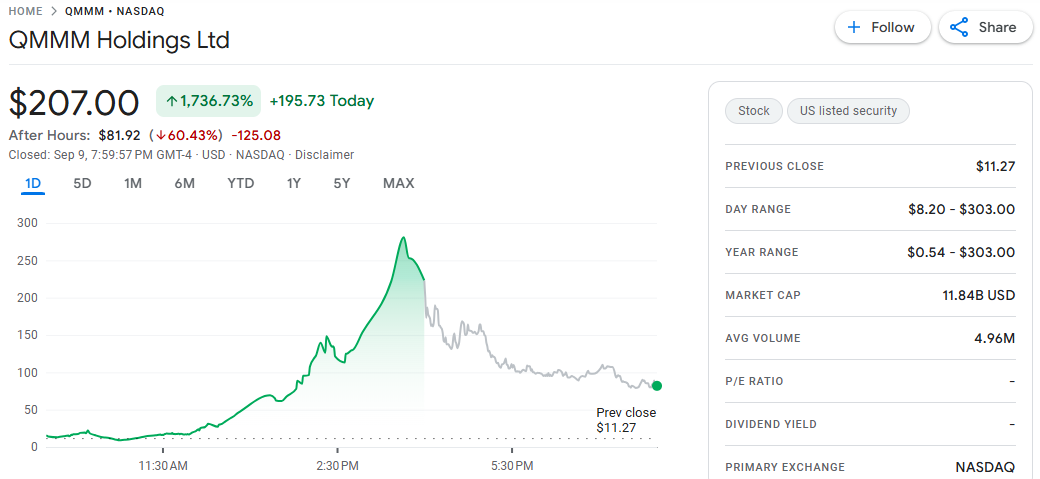
Shares of crypto-linked companies moved in opposite directions on Tuesday, with Hong Kong’s QMMM Holdings making headlines after announcing a $100 million digital treasury anchored by Bitcoin (BTC), Ethereum (ETH), and Solana (SOL). QMMM’s stock surged over 2,100% during the day, closing up 1,737% on Nasdaq.

The investment holding company revealed plans to integrate artificial intelligence (AI) with blockchain to create a platform combining crypto analytics and a Web3 autonomous ecosystem. Alongside, QMMM will build a “diversified cryptocurrency treasury” focusing on BTC, ETH, and SOL.

Sol Strategies Shares Drop

The announcement captured investor attention and sparked the massive rally in the company’s shares. Meanwhile, not all crypto-linked stocks fared well. Canadian company Sol Strategies, a newly listed Solana treasury and staking firm, saw its Nasdaq shares plunge 42% on Tuesday. Even on the Canadian Securities Exchange, its shares fell 16%. 

CEO Leah Wald emphasized the company’s long-term vision, saying their DAT++ model focuses on building sustained value through disciplined execution, despite short-term price swings.

Sol Strategies reported a $3.5 million net loss in Q2 but boosted its staking and validator revenue while converting a significant portion of its Bitcoin holdings into SOL and Sui tokens.

Crypto Companies Show Mixed Result

The trend indicates a two-sided month in crypto-related public firms. Solana-focused Upexi dropped 2.1% over the last month, while DeFi Development Corp., another Solana treasury, gained 13.2%. 

Japan’s Bitcoin treasury firm Metaplanet fell 37% despite ongoing Bitcoin accumulation and shareholder approval for a crypto-focused strategy. The first company to adopt a public crypto strategy was Strategy, whose share price fell 18% over the same period.

The volatile market shows how investors react sharply to crypto innovation news. While QMMM rode the hype of AI and blockchain integration, other firms experienced pressure from financial performance and market sentiment.

Also Read: Metaplanet raises $1.4B to fuel major Bitcoin buy


Mobile Only ImageMobile Only Image

Пов'язані матеріали

Why Is No One Buying DeFi Insurance?

"Why DeFi Insurance Remains Unpurchased" explores the paradox of decentralized finance insurance. While DeFi insurance promises automatic, unbiased payouts via smart contracts—eliminating traditional insurers' denial practices—it struggles to attract users. The core issue is economic viability. Premiums are prohibitively high relative to the yields from DeFi protocols. For example, insuring a deposit on Aave or Maple Finance can consume most or even all of the annual yield, leaving returns comparable to or worse than traditional savings. Only the safest protocols, like MakerDAO, offer affordable premiums. Furthermore, the DeFi insurance model is structurally fragile. Unlike traditional insurance where risks are uncorrelated, DeFi risks are highly interconnected (e.g., oracle failures, bridge hacks). A single major exploit can simultaneously threaten multiple protocols, potentially bankrupting the entire insurance pool, which holds only millions against billions in total value locked. The governance model also creates a conflict of interest. In platforms like Nexus Mutual, token holders who vote on claims risk their own capital if payouts are approved, incentivizing denials. Consequently, the market is tiny and shrinking. Nexus Mutual dominates with $81.56 million in assets, but the industry lacks the capacity to cover a catastrophic event like the $292M Kelp DAO hack. Other providers have dwindled or shut down. The article concludes that DeFi insurance faces a "tragedy of the commons": its stability requires widespread adoption, but individual users have no incentive to pay for it, as premiums destroy their yields. Current solutions involve preventative measures like bug bounties and seeking external capital from traditional reinsurance, acknowledging that on-chain capital alone is insufficient to cover on-chain risks.

marsbit2 год тому

Why Is No One Buying DeFi Insurance?

marsbit2 год тому

Торгівля

Спот
活动图片